Henry Golden Dearth

American, 1864 - 1918

Henry Golden Dearth was born in Bristol, Rhode Island, on April 22, 1864. He took his earliest art lessons with the portraitist Horace Chauncey Johnson, and traveled to Paris in 1883 to study at the École des Beaux-Arts with Ernest Hébert and privately with Aimé Morot. His work was first shown in 1888 at the National Academy of Design, and the following year in the Society of American Artists exhibition. For most of his life, Dearth kept a studio at Montreuil-sur-Mer in Pas-de-Calais on the English Channel, where he spent his summers. In 1896 Dearth married Cornelia van Rensselaer Vail, and they had a daughter, Nina van Rensselaer Dearth. He won a number of prestigious awards during his career, including the Webb prize from the Society of American Artists in 1893, a bronze medal at the 1900 Paris Exposition Universelle, and silver medals at the 1901 Pan-American Exposition in Buffalo, New York, and the 1910 Buenos Aires Exposition.

Dearth was a prolific landscapist who specialized in painting poetic twilight and moonlit coastal scenes of Long Island, New York, and Normandy and Brittany in France. His early work was tonalist in style. In 1905 Samuel Isham classified Dearth as first among a group of American artists who “all paint the decorative landscape, rather low in key, rich in color, and with the paint laid on solidly and with a pleasant, though varied, surface.”[1] Around 1912 the artist began to paint figurative works and still-life subjects but specialized in producing representations of rock pools in Brittany. In these later works Dearth achieved richly textured, decorative surfaces by applying paint to his canvases directly from the tube. At the end of his career he painted compositions of objects from his collection of Asian and medieval art. Dearth died suddenly of a heart attack in New York City on March 27, 1918.


[1] Samuel Isham, History of American Painting (New York, 1905), 447.

Explore selected works

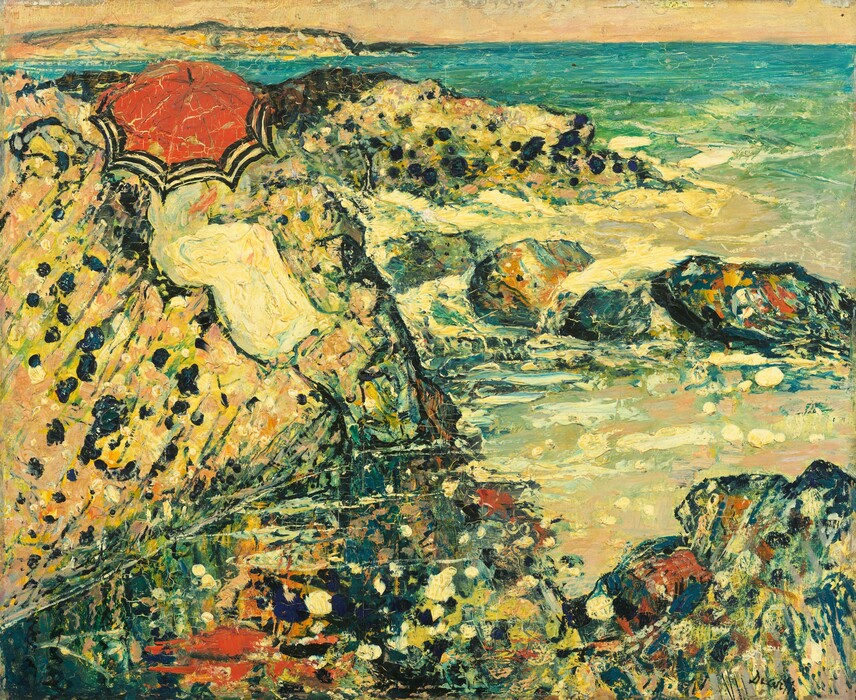
The painting depicts a rocky coastline dotted with color. The horizon is high in the scene, and a strip of pale-yellow sky is visible at the very top of the painting. Along the rocky coast in the distance, the colorful land meets vivid turquoise and green ocean waters, with white lines indicating small waves. A red-striped umbrella in the top left corner appears to shelter a person in a long white dress; the umbrella obscures their face. The rocks have been painted with thick dots of black, white, yellow, orange, red, and green. The brushstrokes are expressive and the paint has been thickly applied in dots and dashes.
Henry Golden Dearth, Flecks of Foam, c. 1911/1912, oil on wood, Chester Dale Collection, 1963.10.120

Flecks of Foam

Henry Golden Dearth · c. 1911/1912 · oil on wood ·  Accession ID  1963.10.120
The image depicts a scene from an elevated point of view facing a body of water. The horizon is positioned at the top third of the composition. A crescent moon is visible in the sky, reflecting on the water. A row of trees lines the horizon. The brushstrokes are fine and detailed, creating a stippled texture. The color palette is dominated by sepia tones. In the foreground, a woman stands on a path among tall grasses, looking towards the water where wooden boats are moored. The landscape extends into a mix of trees and a hillside.
Henry Golden Dearth, Untitled (Moonlight Stroll), 1889, etching, Reba and Dave Williams Collection, Gift of Reba and Dave Williams, 2008.115.1444

Untitled (Moonlight Stroll)

Henry Golden Dearth · 1889 · etching ·  Accession ID  2008.115.1444

Bibliography

1918

  • "Obituary: Henry Golden Dearth." American Art News 16, no. 25 (30 March 1918): 4.

  • Buchanan, Charles L. "Henry Golden Dearth." International Studio 64, no. 256 (June 1918): cxvi-cxvii.

  • "Henry G. Dearth, Painter, Dies at 53." The New York Times (28 March 1918).

  • Levy, Florence N., ed. American Art Annual 15. New York, 1918: 279.