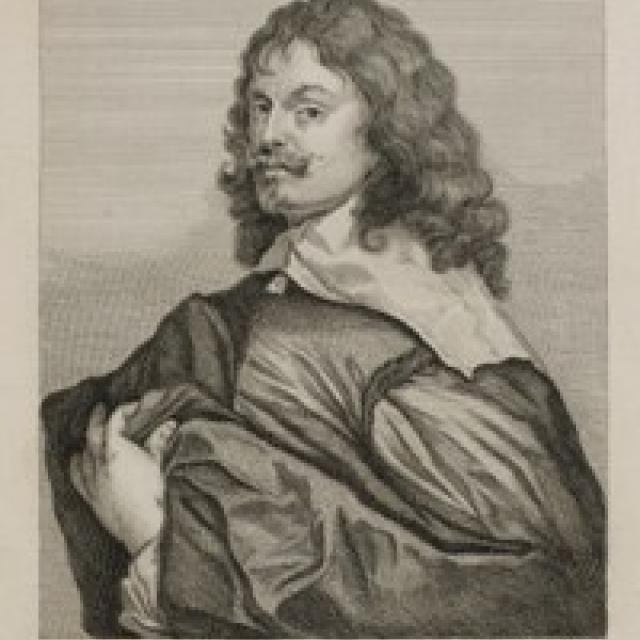
Adriaen Hanneman

Dutch, c. 1603/1604 - 1671

Adriaen Hanneman was born in The Hague in 1603 or 1604. In 1619 he became a pupil of the portrait painter Anthony van Ravesteyn the Younger (c. 1580–1669) and from this point on worked exclusively as a portraitist.

In 1626 Hanneman went to England, where he lived and worked until 1638. In 1630 he married an Englishwoman named Elizabeth Wilson, the first of three marriages, none of which seems to have produced any children. The arrival of Dyck, Anthony van, Sir in London in 1632 marked a crucial event in Hanneman’s career. The Flemish master’s work would have a lasting effect on Hanneman, to the point that in 1661 Cornelis de Bie described him as a counterfeiter of Van Dyck’s style. Although such a pejorative assessment is perhaps misplaced, it is certainly true that some of Hanneman’s better works, including the Gallery’s Henry, Duke of Gloucester, are so strikingly Van Dyckian that their correct attribution has in the past occasionally gone undetected.

In 1640, shortly after his return to The Hague, Hanneman was married for the second time, to Maria, daughter of Jan Anthonisz van Ravesteyn (1570–c. 1657), the elder brother of his teacher. Hanneman entered the city’s Guild of Saint Luke in the same year and soon assumed leadership positions. In 1643 he was elected hoofdman, and two years later he was named deken, the highest position in the guild. In 1656 Hanneman played an important part in setting up a rival guild for painters, engravers, and sculptors—the Confrerie—serving as deken and hoofdman several times during the 1660s.

Hanneman continued to paint portraits in an aristocratic, Anglo-Flemish manner in The Hague, where a great demand existed for portraits made in the style of Van Dyck. Hanneman’s patrons included the exiled members of the English court, a number of whom visited Maria Stuart, the daughter of Charles I and the wife of Willem II, the Prince of Orange.

Hanneman’s work was favorably received. By 1641 he was wealthy enough to buy a house in The Hague’s fashionable Nobelstraat and to purchase the adjoining property in 1657. After 1668, however, he appears to have had serious financial problems, and it is possible that an illness from which he is known to have suffered in that year left him unable to paint. He was married again in 1669, to Alida Besemer, but died not long after, in July 1671.

Explore selected works
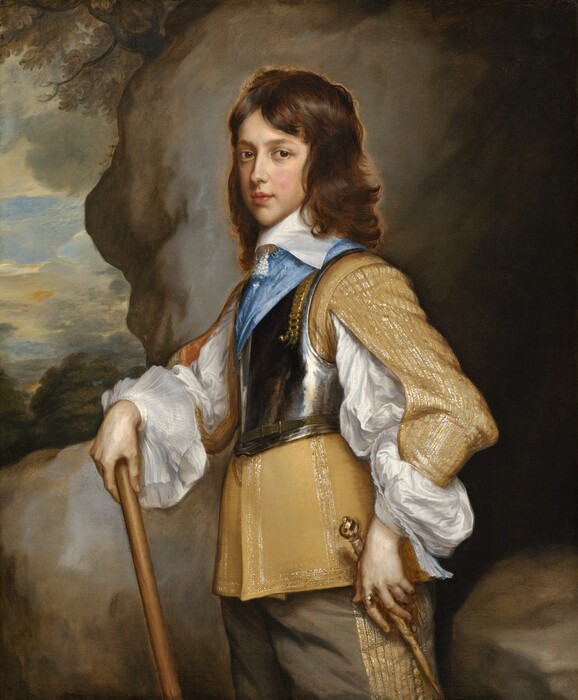
Shown from the hips up, a boy with pale, peachy skin and copper-brown hair stands in front of a rocky outcropping with a narrow view into a distant landscape to our left in this vertical portrait painting. His body faces our left almost in profile, and he turns his face to look at us with dark brown eyes under faint brows. He has a long, straight nose, a pointed chin, flushed cheeks, and his full, rose-pink lips are slightly parted. His dark hair falls in waves to the wide, flat, white collar at his neck. He wears a golden yellow doublet brocaded with shimmering threads, possibly silver and gold. The sleeves split along the inner arm to reveal a white shirt with voluminous, puffy sleeves that end with wide, transparent cuffs like floppy saucers around each wrist. Over the jacket, he wears a gleaming, pewter-colored breastplate with a topaz-blue sash crossing his chest. His peanut-brown pants are also sewn or woven with metallic thread in stripes down the side of the leg. The boy rests his right hand, farther from us, on a staff or walking stick propped in front of him. His other hand rests around the gold hilt of a rapier, a thin sword at his left hip, closer to us. Behind the boy, the view is almost entirely taken up with a slate-gray boulder, or it could be the entrance of a cave. A view onto the landscape along the left edge of the composition has a few treetops beneath pale yellow clouds against an ice-blue sky.
Adriaen Hanneman, Henry, Duke of Gloucester, c. 1653, oil on canvas, Andrew W. Mellon Collection, 1937.1.51

Henry, Duke of Gloucester

Adriaen Hanneman · c. 1653 · oil on canvas ·  Accession ID  1937.1.51
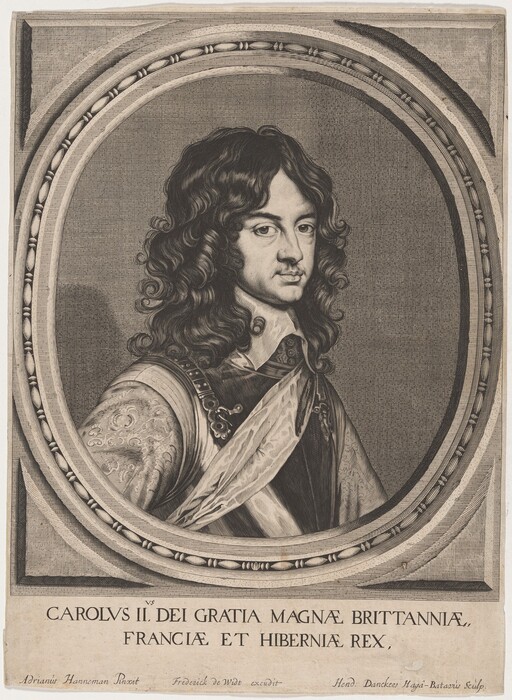
The image shows a man in a half-length view. He is posed slightly turned with his head facing forward, revealing long, wavy dark hair, a prominent nose, and a slight mustache. He wears ornate attire, including a detailed garment with patterns and a sash. The man is set in an oval frame with decorative borders and the background is also intricately designed. The caption below labels him as Carolus II, or Charles II of Britain.
Hendrik Danckerts, Charles II, engraving, Rosenwald Collection, 1950.14.283

Charles II

Hendrik Danckerts · engraving ·  Accession ID  1950.14.283

Bibliography

1896

  • Bredius, Abraham and Ernest W. Moes. "Adriaen Hanneman." Oud Holland 14 (1896): 203-218.

1931

  • Glück, Gustav. Van Dyck: des Meisters Gemälde. Klassiker der Kunst in Gesamtausgaben 13. Revised 2nd ed. New York, 1931.

1950

  • Toynbee, Margaret R. "Adriaen Hanneman and the English Court in Exile." The Burlington Magazine 92 (1950): 73-80.

1958

  • Toynbee, Margaret R. "Adriaen Hanneman and the English Court in Exile: A Further Note." The Burlington Magazine 100 (1958): 249-250.

1971

  • Bie, Cornelis de. Het gulden cabinet van de edel vry schilderconst. Edited by Gerard Lemmens. Reprint of Antwerp, 1661/1662. Soest, 1971: 412.

1976

  • Kuile, Onno ter. Adriaen Hanneman: 1604-1671, een Haags portretschilder = Adriaen Hanneman, 1604-1671, a portraitpainter in The Hague. Ph. D. dissertation, Rijksuniversiteit Utrecht, 1976.

1980

  • Larsen, Erik. Anton van Dyck: Werkverzeichnis. 2 vols. Translated by Wolfgang Bensch. Die großen Meister der Malerei. Frankfurt, 1980.

  • Larsen, Erik. L’opera completa di Van Dyck. 2 vols. Classici dell'arte 102-103. Milan, 1980.

1995

  • Wheelock, Arthur K., Jr. Dutch Paintings of the Seventeenth Century. The Collections of the National Gallery of Art Systematic Catalogue. Washington, D.C., 1995: 91-92.