Willem Kalf

Dutch, 1619 - 1693

Willem Kalf, baptized in Rotterdam on November 3, 1619, was one of the foremost still-life painters of the seventeenth century. His father, Jan Jansz Calff (Kalf), was a well-to-do textile merchant and town council member who died in 1625. Shortly after the death of his mother, Machtelt Gerrits, in 1638, Kalf settled in Paris, where he was active as a painter until his return to Rotterdam in 1646. Five years later his name appears in the marriage book for the city of Hoorn: “Willem Jansz Kalf, bachelor of Rotterdam, and Cornelia Pluvier, girl of Vollenhoven, both living at Hoorn, on October 22, 1651.” Not long after his marriage he is mentioned as a member of the Saint Luke’s Guild in Amsterdam. Unlike many of his contemporaries, Kalf lived in comfortable circumstances. He seems to have stopped painting around 1680 to concentrate his energies on being an art dealer. He died in Amsterdam on July 31, 1693, and was buried on August 3 in the Zuiderkerk.

Houbraken stated that Pot, Hendrik Gerritsz was Kalf’s teacher, but there is little in Kalf’s early work to suggest such a relationship. Because of the stylistic and coloristic resemblances between the work of Frans Rijckhals (c. 1600–1647) and Kalf’s early peasant kitchen interiors and his later elaborate (pronk) still lifes, it seems that this Rotterdam artist was an important influence on the young artist.

Kalf’s mature work developed during the 1650s, after his move to Amsterdam. He focused on a few objects, which he organized with great restraint against a dark background, and delighted in depicting the sheen of silver, the translucency of glass, and the rich textures of intricately patterned Oriental rugs. His luminous manner of painting highlights has often been compared to that of Vermeer, Johannes, and it is entirely possible that Kalf’s work influenced the Delft master.

Although Kalf probably had pupils who made replicas of his work, none are documented. His most successful follower was Jurriaen van Streek (1632–1687).

Explore selected works
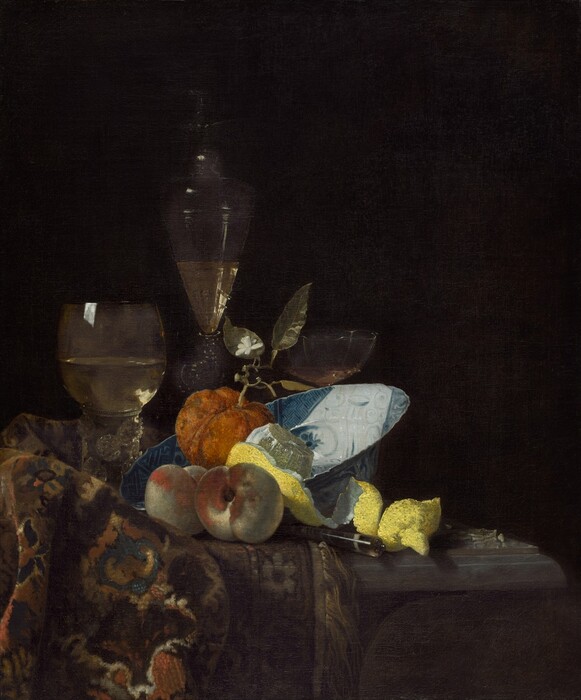
A blue and white porcelain bowl, fruit, wine glasses, and a woven rug are gathered on a tabletop in front of a black background in this vertical still life painting. Light strongly illuminates the objects, creating a stark contrast to the dark background. At the center of the composition, the porcelain bowl is tipped so its wide brim rests on the rug bunched on the tabletop to our left. The rug is painted with a pattern in earthy beige and chocolate brown, denim blue, bronze, and cream white. A piece of roughly textured orange fruit resembling a tiny pumpkin has a stem with a small white blossom growing from its top. The fruit sits in the bowl alongside a vivid yellow lemon that has been partially peeled. The top has been cut from the lemon to form a long strip that curls onto the table, and the pulp glistens in the light. Two peaches sitting in front of the bowl are painted with tones of silvery ivory and burnt orange. The handle of a utensil juts out from between the peaches and lemon peel. Two glasses and a slender carafe are arranged in a row behind the fruit and bowl. The glass to the left has a round bowl over a thick, columnar stem, and the tall, gently flaring glass carafe behind the orange fruit are both half-filled with pale gold liquid. A drinking glass with a wide, shallow, scalloped-edged cup is mostly hidden behind the porcelain bowl, to our right.
Willem Kalf, Still Life, c. 1660, oil on canvas, Chester Dale Collection, 1943.7.8

Still Life

Willem Kalf · c. 1660 · oil on canvas ·  Accession ID  1943.7.8
A tall goblet made with a spiraling nautilus shell on a gold and silver stem, a blue and white lidded, porcelain bowl, an orange, a cut lemon, and a bunched up, woven rug are gathered on a tabletop in front of a black background in this vertical still life painting. Light falling on the objects from our left contrasts sharply with the deep shadow beyond, which makes some details difficult to make out. The objects might be gathered on a silver tray. At the center of the composition, the flagon is made with a shimmering, ivory-colored nautilus shell with its wide opening facing up. The stem is made of gold bands coiling around a silver figurine, which is nearly lost in shadow. To our right, a white porcelain bowl has a rounded bottom and tall sides. It is painted with blue designs around a raised relief showing two people in crimson-red and harvest-gold garments. A utensil sits in the bowl to our right, and the lid, which has a finial in the shape of an animal, rests angled upward, partially in the bowl and partially on the stem of that utensil. A translucent, cylindrical knife handle protrudes toward us, angled to our right, in front of the bowl. A rug with a geometric pattern of rust red, tan, and pine green is bunched next to the bowl, along the right side of the painting. To our left of the nautilus cup, an orange with a stem and green leaves sits next to a bright, glistening lemon at the foot of the cup. Between the two pieces of fruit, the vivid yellow lemon rind has been peeled into a long, curling strip that curves off the front edge of the table.
Anonymous Artist, Still Life with Nautilus Cup, 1665/1670, oil on canvas, Gift of Robert H. and Clarice Smith, 1974.109.1

Still Life with Nautilus Cup

Anonymous Artist · 1665/1670 · oil on canvas ·  Accession ID  1974.109.1

Bibliography

1753

  • Houbraken, Arnold. De Groote Schouburgh der Nederlantsche Konstschilders en Schilderessen. 3 vols. in 1. The Hague, 1753 (Reprint: Amsterdam, 1976): 2:218-219.

1941

  • Gelder, Henrik Enno van. W. C. Heda, A. van Beyeren, W. Kalf. Palet Series. Amsterdam, n.d. [1941].

1942

  • Gelder, Henrik Enno van. "Aanteekeningen over Willem Kalf en Cornelia Pluvier." Oud Holland 59 (1942): 37-46.

1956

  • Bergström, Ingvar. Dutch Still-Life Painting in the Seventeenth Century. Translated by Christina Hedström and Gerald Taylor. London, 1956: 260-290.

1969

  • Lairesse, Gérard de. Groot schilderboek. 2 vols. in 1. Reprint of Haarlem 1740. Soest, 1969: 266-268.

1974

  • Grisebach, Lucius. Willem Kalf 1619-1693. Berlin, 1974.

1988

  • Segal, Sam. A Prosperous Past: The Sumptuous Still Life in the Netherlands, 1600–1700. Edited by William B. Jordan. Translated by P.M. van Tongeren. Exh. cat. Stedelijk Museum Het Prinsenhof, Delft; Fogg Art Museum, Cambridge, MA; Kimbell Art Museum, Fort Worth. The Hague, 1988: 180-196.

1991

  • MacLaren, Neil. The Dutch School, 1600-1900. Revised and expanded by Christopher Brown. 2 vols. National Gallery Catalogues. London, 1991: 1:213.

1995

  • Wheelock, Arthur K., Jr. Dutch Paintings of the Seventeenth Century. The Collections of the National Gallery of Art Systematic Catalogue. Washington, D.C., 1995: 145-146.

2007

  • Lammertse, Friso, and Michael Szanto. "Willem Kalf, eine Biographie." In Gemaltes Licht: die Stilleben von Willem Kalf 1619-1693. Edited by Sylvia Böhmer. Exh. cat. Suermondt-Ludwig-Museum, Aachen; Museum Boijmans Van Beuningen, Rotterdam. Munich, 2007: 9-23.