George Ropes

American, 1788 - 1819

George Ropes was born in Salem, Massachusetts, on May 15, 1788. Ropes, who was deaf and used a form of sign language to communicate, was one of nine children of a sea captain, George Ropes Sr., and Seethe (Millet) Ropes. The artist lived in Salem almost his entire life, except for the years 1798 to 1801, when his father decided to try his hand at farming in Orford, New Hampshire. He was apparently not successful and brought the family back to Salem.

The first reference to George Jr. as a painter was in 1802, when he was only 14 years old. Salem pastor William Bentley’s diary, an indispensable record of the town’s early history, states that Ropes “is very successful at painting. He is instructed by Mr. Cornè.” Michele Felice Cornè (1752–1845) was born on the island of Elba, in Italy, and came to the United States in 1799. He settled in Salem until 1806, when he moved to Boston. Cornè is known for his paintings, murals, and fireplace screens that feature portraits, landscapes, depictions of naval engagements, and ship portraits. Like his instructor, Ropes preferred landscape, nautical, and marine subjects, but he is not known to have painted portraits. The young painter followed his teacher’s example closely, copying Cornè’s works directly on at least two occasions. Although he never quite attained Cornè’s proficiency, his works at their best have sometimes been mistaken for his mentor’s.

In mid-1807 Captain Ropes died at sea, leaving George Jr. to support the family. To supplement his income, he took up sign and carriage painting, yet he continued to produce seascapes and landscapes as well as paintings documenting events in Salem’s history. George Ropes’s career was cut short by consumption, which took his life on January 24, 1819, at the age of 30.

Many of Ropes’s paintings have remained in Salem, where he is represented in the collection of the Peabody Essex Museum. His most successful works are treasured for their historical accuracy and wealth of minute detail.

[This biography is adapted from Julie Aronson, “George Ropes,” in Deborah Chotner et al., American Naive Paintings, The Collections of the National Gallery of Art Systematic Catalogue (Washington, DC, 1992), 324.]

Explore selected works

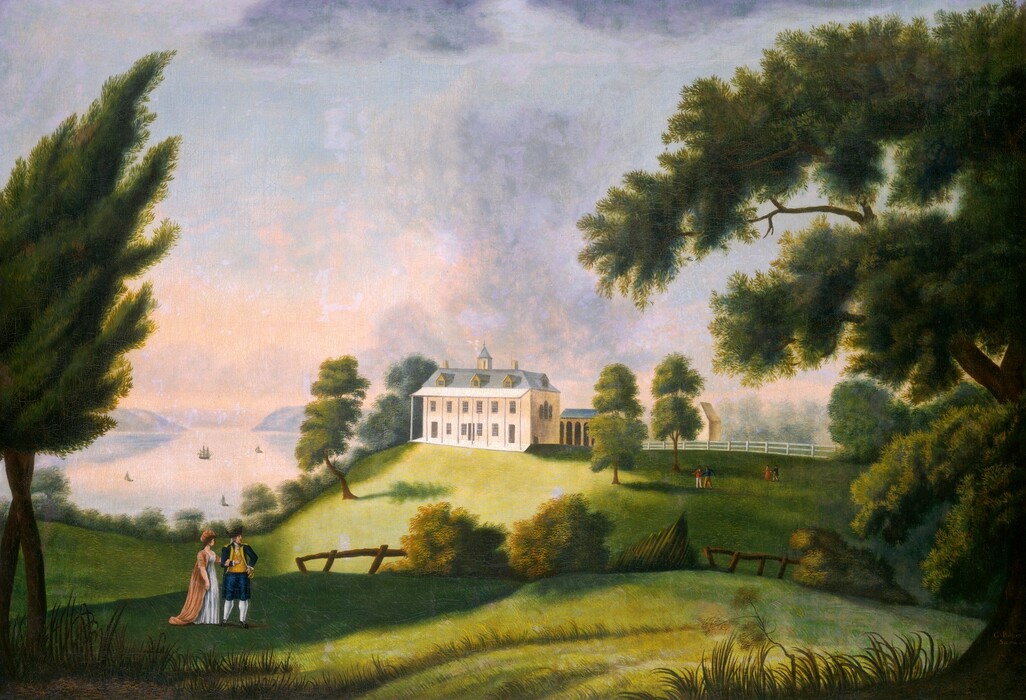
This painting shows a grassy, hilly landscape with trees around the edge and a wide river in the distance, dotted with small sailing ships. In the center of the painting is a stately white mansion on top of a green hill. To the right of the mansion, two couples walk along the grass by a white fence. Closer to us, in the bottom left corner, another couple walks arm in arm. The woman wears a long pink jacket over a white dress with a pink hat, and the man wears a dark blue coat over a yellow vest, with blue shorts over white stockings and a black hat on his head. Behind them, the wide river below stretches to the horizon. The sky above the scene is light blue and light pink, with purple clouds. The water of the river reflects these colors, and is mostly a soft, light pink.
George Ropes, Mount Vernon, 1806, oil on canvas, Gift of Edgar William and Bernice Chrysler Garbisch, 1956.13.6

Mount Vernon

George Ropes · 1806 · oil on canvas ·  Accession ID  1956.13.6

Bibliography

1905

  • Bentley, William. The Diary of William Bentley (1784-1819). Salem, Massachusetts, 1905-1914.

1940

  • Swan, Mabel M., and Louise Karr. "Early Marine Painters of Salem." Antiques 37-38 (August 1940): 63-65.

1967

  • Hill, Ruth Henderson. "George Ropes: 1788-1819." Paper presented to the Beverly Historical Society, Beverly, Massachusetts, 1967.

1972

  • Smith, Philip Chadwick Foster, and Nina Fletcher Little. Michele Felice Corne (1752-1845): Versatile Neapolitan Painter. Exh. cat. Peabody Museum of Salem, Massachusetts, 1972.

1992

  • Chotner, Deborah, with contributions by Julie Aronson, Sarah D. Cash, and Laurie Weitzenkorn. American Naive Paintings. The Collections of the National Gallery of Art Systematic Catalogue. Washington, D.C., 1992: 324.