Adriaen Coorte

Coorte, Adrian
Dutch, active c. 1683 - 1707

Very little is known about the still-life painter Adriaen Coorte. He belonged to the Coorte family of IJzendijke, a small town near the Dutch city of Middelburg. The Coortes were a relatively well-off family who, according to land registers from the period, owned many of the dikes and polders surrounding the town. Although Adriaen’s birth date is not precisely documented, records of his siblings’ births and deaths suggest he was born between 1659 and 1664.[1] Information concerning his artistic training is similarly elusive. His earliest known painting dates to 1683, by which time he would have been between 20 and 24 years old.[2] Coorte may well have continued to live in his home town, as he eventually inherited two IJzendijke polders from his parents. Based on the fact that many of his paintings appeared in sale catalogues and inventories in Middleburg in the eighteenth century, it seems probable that he worked in proximity to that city. In 1695–1696, the Middelburg Guild of Saint Luke fined Coorte one Flemish pound for selling paintings as an unregistered master, suggesting he was active within the city, even if he did not keep a permanent residence there.[3] In any event, he must not have been well known within the guild, as guild records misspell his last name and entirely omit his first name. Coorte continued to be associated with the area after his death. An estate inventory from 1783 makes note of “a flower piece by Coorde of Vlissingen,” a community located just to the south of Middelburg.[4]

Coorte’s paintings, which number about one hundred, consist primarily of high-quality, small-scale still lifes depicting fruit, vegetables, flowers, shells, wild game, and vanitas subjects on a ledge or in a niche, arranged against a dark background. His latest known work dates to 1707. Descriptions of his work that survive from the early eighteenth century suggest that he was held in high esteem at the time.[5] In spite of this, Coorte’s name was virtually forgotten until the 1950s, when his artistic qualities were newly recognized by the Dutch art historian Lawrence Bol.[6]


[1] Ton de Jong and Huib J. Plankeel, “Adriaen Coorte of IJzendijke,” Oud Holland 128, no. 1 (2015), 58.

[2] Quentin Buvelot, The Still Lifes of Adriaen Coorte (Active c. 1683–1707): With Oeuvre Catalogue (The Hague, 2008), 18.

[3] Abraham Bredius, “De Gildeboeken van St. Lucas te Middelburg,” in Fr. D. O. Obreen, Archief voor Nederlandsche kunstgeschiedenis, 7 vols. (Rotterdam, 1884–1887), 6:229.

[4] de Jong and Plankeel, 57.

[5] Buvelot, 120–127.

[6] Laurens J. Bol, “Adriaen Coorte, stillevenschilder,” Nederlands Kunsthistorisch Jaarboek 4 (1952–1953): 193–232; Dordrechts Museum and Laurens J. Bol, Adriaen Coorte: Stillevenschilder Dordrechts Museum, 2 Augustus–28 September 1958 (Dordrecht, 1958).


Explore selected works
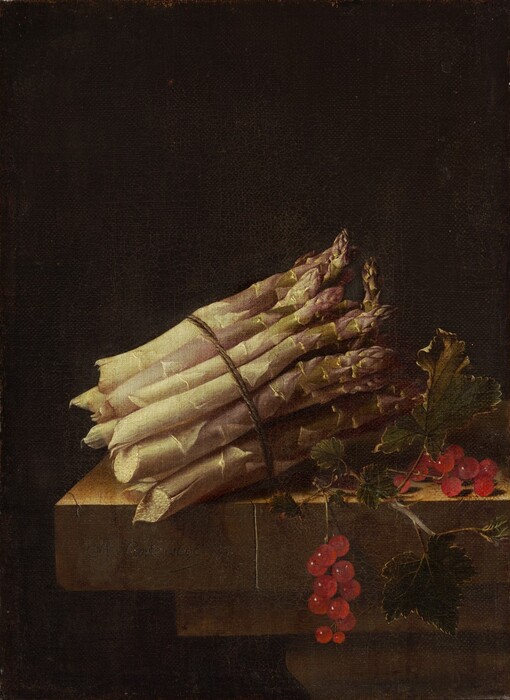
A bundle of pale green, thick asparagus stalks bound by twine and a bunch of glistening ruby-red currants sit on the edge of a stone table or ledge against a deeply shadowed background in this vertical still life painting. The asparagus is situated with the jagged, broken edges facing our left and the pointed tips angled away from us to our right. The base of the stalks are nearly cream-white, and the tips are faint green and muted purple. To our right, one the two stems of the red currant berries and leaves dangles off the front edge of the table. Light spills onto the scene from our upper left giving the currants a glassy sheen. The stone ledge or table is cracked in a couple of places. The artist signed this work as if he had inscribed his name and the date on the front surface of the table: “A. Coorte. 1696.”
Adriaen Coorte, Still Life with Asparagus and Red Currants, 1696, oil on canvas, The Lee and Juliet Folger Fund, 2002.122.1

Still Life with Asparagus and Red Currants

Adriaen Coorte · 1696 · oil on canvas ·  Accession ID  2002.122.1
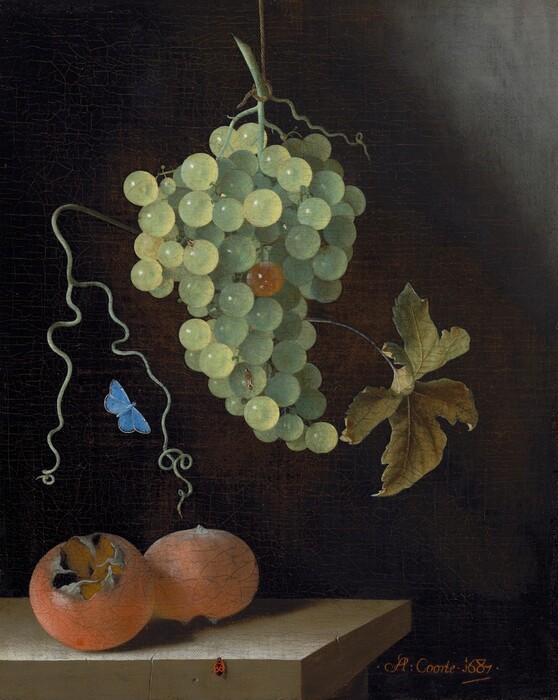
A large cluster of green grapes hangs prominently in the upper center of this painting, accompanied by an intertwined vine and a single olive-green leaf. One of the grapes at the center of the bunch is a golden color, while the others are light green. Below the grapes, two round red fruits rest on the surface of a table, one with an opening that reveals a light orange interior. A delicate blue butterfly flutters to the left of the grapes, and a small red ladybug sits at the edge of the table at the bottom of the painting. The table is light brown, and the background behind the fruit and bugs is black.
Adriaen Coorte, Still Life with a Hanging Bunch of Grapes, Two Medlars, and a Butterfly, 1687, oil on canvas, The Lee and Juliet Folger Fund, 2020.16.1

Bibliography

1877

  • Bredius, Abraham. "De Gildeboeken van St. Lucas te Middelburg." In Archief voor Nederlandsche Kunstgeschiedenis. 7 vols. Edited by Frederik D.O. Obreen. Rotterdam, 1877-1890: 6(1884):229.

1953

  • Bol, Laurens J. "Adriaen S. Coorte: Stillevenschilder." Nederlands Kunsthistorisch Jaarboek 4 (1952-1953): 193-232.

1958

  • Adrian Coorte: Stillevenschilder. Exh. cat. Dordrechts Museum, 1958.

  • Bol, Laurens J. Adriaen Coorte, Stillevenschilder. Exh. cat. Dordrechts Museum, Dordrecht, 1958.

1969

  • Bol, L.J. Holländische Maler des 17. Jahrhunderts neben den grossen Meistern. Landscaft und Stilleben. Brunswick, 1969: 359-364.

1975

  • Müllenmeister, K.J. "Adrian Coorte." Die Weltkunst xlv (1975): 1603.

1977

  • Bol, Laurens J. Adriaen Coorte: a unique late seventeenth century Dutch still-life painter. Assen, 1977.

1989

  • Schneider, N. Stilleben: Realität und Symbolik der Dinge. Cologne, 1989.

2003

  • Wheelock, Arthur K., Jr. Small Wonders: Dutch still lifes by Adriaen Coorte. Exh. brochure, National Gallery of Art. Washington, 2003.

2008

  • Buvelot, Quentin. The Still Lifes of Adriaen Coorte (active c.1683-1707): with oeuvre catalogue. Exh. cat. Royal Picture Gallery Mauritshuis, The Hague. Zwolle, 2008.

2015

  • Ton de Jong and Huib J. Plankeel, “Adriaen Coorte of IJzendijke,” Oud Holland 128, no. 1 (2015), 58