Jan Miense Molenaer

Dutch, c. 1610 - 1668

Jan Miense Molenaer was the oldest son of the tailor Jan Mientsen Molenaer and his second wife, Grietgen Adriaensdr. Molenaer was born in Haarlem around 1610.[1] He may have trained with Frans Hals (c. 1582/1583–1666) or his brother Dirck Hals (1591–1656), as his earliest known works, which date to 1629, favor the same palette and subjects as these two masters, notably energetic scenes of merrymaking.[2] In 1634, Molenaer is mentioned in the register of the Haarlem Guild of Saint Luke.[3]

During the 1630s, Molenaer depicted a wide range of subjects, from merry company scenes to tavern groups, biblical scenes, theatrical subjects, and portraits. His style of painting was quite varied, ranging from precise and refined to loose and free. Above all, Molenaer was able to impart individuality to his figures and convey their relationships with one another. In 1636, Molenaer married his fellow Haarlem artist, Judith Leyster (1609–1660). In 1637, the two moved to Amsterdam, where they resided for the next 12 years. Attracted like so many others to the city’s bustling art market, Molenaer found professional and personal success in Amsterdam. He continued to paint a variety of subjects, from theatrical scenes and images of the five senses to religious narratives, but he also produced genre scenes of peasant villages and tavern scenes. While in Amsterdam, the couple had four children, all baptized in the Nieuwe Kerk.[4]

Molenaer and Leyster relocated to Heemstede, south of Haarlem, around 1648. Molenaer’s output during this last phase of his career is large, though not particularly inspired. During this time he was also contending with mounting debts, difficulties with his forays into real estate investments, and illness.[5] On November 6, 1659, Molenaer and Leyster, both in poor health, drew up their wills. Although Molenaer recovered, Leyster died three months later at the age of 50. Molenaer soon moved back to Haarlem, and spent the last five years of his life in a rented house on the Burgwal, where he died in 1668. He was buried in the Grote Kerk four days later.

Notes

[1] Molenaer testified on behalf of the Amsterdam art dealer Joannes de Renialme on November 21, 1637, calling himself “about 27 years old.” See Irene van Thiel-Stroman, “Jan Miense Molenaer,” in Painting in Haarlem 1500–1850: The Collection of the Frans Hals Museum, ed. Neeltje Köhler (Haarlem, 2006), 243, n. 1.

[2] Dennis P. Weller, “Jan Miense Molenaer: Painter of the Dutch Golden Age,” in Jan Miense Molenaer: Painter of the Dutch Golden Age, ed. Dennis P. Weller (Raleigh, 2002), 10.

[3] Hessel Miedema, ed., De archiefbescheiden van het St. Lukasgilde te Haarlem 1497–1798, 2 vols. (Alphen aan den Rijn, 1980), 420, 933.

[4] Irene van Thiel-Stroman, “Jan Miense Molenaer,” in Painting in Haarlem 1500–1850: The Collection of the Frans Hals Museum, ed. Neeltje Köhler (Haarlem, 2006), 241.

[5] Dennis P. Weller, “Jan Miense Molenaer: Painter of the Dutch Golden Age,” in Jan Miense Molenaer: Painter of the Dutch Golden Age, ed. Dennis P. Weller (Raleigh, 2002), 22.

Explore selected works
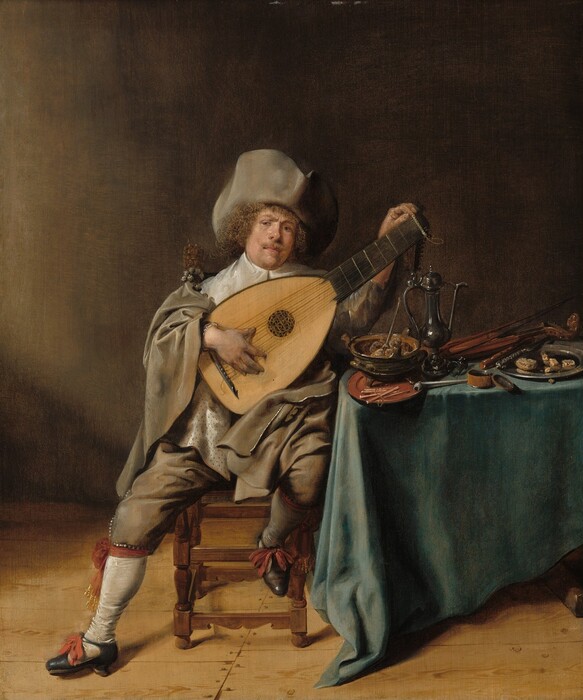
A man with pale, peachy skin sits holding and tuning a lute next to a heavily laden table in this vertical portrait painting. The man’s body faces us, and he looks at us with light brown eyes under slightly furrowed brows. His round face is tipped slightly to our right, toward the neck of his instrument, so he looks out from the corners of his eyes. He has a round face, a snub nose, and his pale pink lips are closed. His dark blond mustache curls up at the ends, and he has a faint goatee. Nestled on chin-length, curly, light brown hair, his gray hat has a wide, soft brim pushed up around the crown. Much of his torso is covered by the lute but he wears a wide, white collar under a billowing, fawn-brown cloak. A cloth on his shirt or pinned under the instrument has small black dots on a white background. His knickerboxers match his cloak, and are tied with a brick-red ribbons just below his knees, over white stockings. More red ribbons are tied to the front of his black leather shoes, which have low heels. One foot rests splayed on the bare, hardwood floor. His other foot is propped up on the rail of the chair to support the instrument. One hand is braced over the strings, and he tunes the pegs with the other. He sits next to a table covered with an aquamarine-blue cloth and overflowing with kitchen utensils, smoking instruments, and food. Closest to the man, a pipe rests in an earthenware bowl filled with burning embers, which sits on a terracotta-orange plate. Near that are a silver-colored, covered ewer, a short drinking glass, a covered box with its lid open, and, to our right, a pewter plate with a roll and a knife. A wooden instrument like a small violin sits at the back of the table. The scene is lit from our left. The back wall of the room deepens from clay brown near the light to coffee brown in the upper right corner.
Jan Miense Molenaer, Self-Portrait as a Lute Player, c. 1637/1638, oil on panel, The Lee and Juliet Folger Fund, 2015.20.1

Self-Portrait as a Lute Player

Jan Miense Molenaer · c. 1637/1638 · oil on panel ·  Accession ID  2015.20.1

Bibliography

1992

  • Weller, Dennis P. “Jan Miense Molenaer (ca. 1609/10–1668): The Life and Art of a Seventeenth-Century Dutch Painter.” Ph.D. dissertation, University of Maryland, 1992.

1993

  • Welu, James A., and Pieter Biesboer. Judith Leyster: A Dutch Master and Her World. Exh. cat. Frans Halsmuseum, Haarlem; Worcester Art Museum. Haarlem, 1993.

2002

  • Weller, Dennis P. “Jan Miense Molenaer: Painter of the Dutch Golden Age.” In Jan Miense Molenaer: Painter of the Dutch Golden Age. Edited by Dennis P. Weller. Exh. cat. North Carolina Museum of Art, Raleigh; Indianapolis Museum of Art; Currier Museum of Art, Manchester. Raleigh, 2002: 9–25.

2006

  • Van Thiel-Stroman, Irene. “Jan Miense Molenaer.” In Painting in Haarlem 1500–1850: The Collection of the Frans Hals Museum. Edited by Neeltje Köhler. Haarlem, 2006: 241–245.