Abraham de Verwer

Verwer van Burghstrate, Abraham de
Dutch, 1585 - 1650

Abraham de Verwer was probably born in Haarlem, which was where he was living with his wife, Barbara Sillevorts, in 1607. Her will, which a Haarlem notary drew up for her in that very year, identifies her husband as a cabinet maker.[1] When Abraham de Verwer appeared before an Amsterdam notary on January 9, 1617, however, he was identified as a painter.[2] Thus, De Verwer must have learned the art of painting between 1607 and 1617, probably by studying with the famous Haarlem marine painter Hendrick Vroom (1563–1640) before moving to Amsterdam. De Verwer’s early marine paintings of the 1620s reflect the large, brightly colored, and highly detailed depictions of marine battles that characterize Vroom’s work of the 1610s.[3] De Verwer’s son, Justus de Verwer (c. 1625–c. 1685), who was also a marine painter, presumably trained with his father.

De Verwer was extremely successful as an artist, and his large battle scenes soon graced the collections of the Amsterdam Admiralty, the Burgerweeshuis (Amsterdam’s civic orphanage), and the collection of the House of Orange. In the late 1630s he traveled to France, where he made a number of paintings and drawings of French ports and at least four paintings of the Louvre in Paris. In 1638, with the assistance of Constantijn Huygens, secretary to the Prince of Orange, De Verwer sent a number of drawings of French ports to Prince Frederik Hendrik, and in the following year sold him four paintings of French subjects, including two views of the Louvre. In 1642, identifying himself as “Seigneur Abraham de Verwer van Burghstrate,” he acquired a house called “De vergulde Fonteyn” on the Prinsengracht in Amsterdam for 6,500 guilders. He later moved to a house on the Warmoesstraat. He was buried on August 19, 1650.


[1] “Barbara Sillevort, huysvrouwe van Abraham de Verwer, schrijnwercker, wonende te deser stede” (Barbara Sillevort, wife of Abraham de Verwer, cabinet maker, living in this city). This reference, taken from Jeroen Giltaij and Jan Kelch, Praise of Ships and the Sea: The Dutch Marine Painters of the 17th Century (Rotterdam, 1996), 133, is based on information obtained from the A. Bredius Archive, Netherlands Institute for Art History (RKD), The Hague.

[2] “Abraham de Verwer, schilder, als man en voocht van Barbara Silvers” (Abraham de Verwer, painter, as husband and guardian of Barbara Silvers). See Jeroen Giltaij and Jan Kelch, Praise of Ships and the Sea: The Dutch Marine Painters of the 17th Century (Rotterdam, 1996), 133, which is based on information obtained from the A. Bredius Archive, Netherlands Institute for Art History (RKD), The Hague.

[3] Laurens Johannes Bol, Die hollä̈ndische Marinemalerei des 17. Jahrhunderts (Braunschweig, 1973), 84–88.

Explore selected works

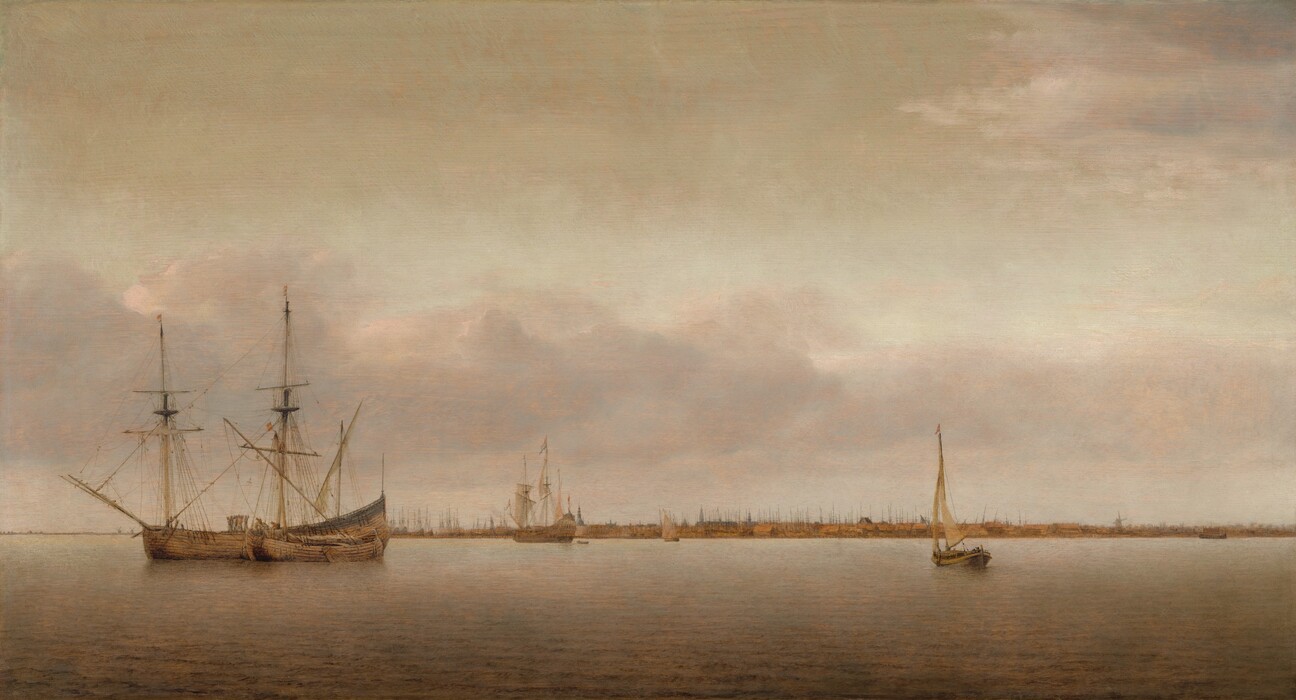
Painted in tones of beige, cream white, and pecan brown with hints of shell pink and faint blue, a few sailboats float in a calm body of water with a harbor and a town deep in the distance along the horizon, which comes about a quarter of the way up this painting. Rippling gently across the foreground, the water reflects the pale blue sky and blush pink of clouds above. To our left, two masted ships with sails furled have pulled up alongside each other. A smaller boat sails to our right and a few more are spaced sparsely along the waterway leading to the town. Painted as a dense forest of spiky masts, the harbor in the far distance is full of boats along a town that stretches nearly the width of the panel. Tiny in scale, there are a few windmills and slate-gray towers for churches, town halls, and other buildings.
Abraham de Verwer, View of Hoorn, c. 1650, oil on panel, Fund given in honor of Derald Ruttenberg’s Grandchildren, 2008.32.1

View of Hoorn

Abraham de Verwer · c. 1650 · oil on panel ·  Accession ID  2008.32.1

Bibliography

1996

  • Giltaij, Jeroen, and Jan Kelch. Praise of Ships and the Sea: The Dutch Marine Painters of the 17th Century. Exh. cat. Museum Boijmans Van Beuningen, Rotterdam; Staatliche Museum zu Berlin, Gemäldegalerie im Bodemuseum. Rotterdam, 1996: 133.