Johannes Cornelisz Verspronck

Sprong, Gerard
Dutch, 1606/1609 - 1662

The scarcity of documents relating to the life of the portraitist Johannes Cornelisz Verspronck has made securing his date of birth difficult. Though it was long believed that he was born in Haarlem in 1597, recent archival research suggests a date of about a decade later, between 1606 and 1609.[1] Theodorus Schrevelius, the only contemporary author to mention Verspronck, referred to him as Gerard Sprong, thereby contributing to the confusion surrounding the artist’s biography.[2] Nonetheless, some facts about Verspronck’s life remain clear. He was the son of the Haarlem-born painter Cornelis Engelsz (c. 1575–1650), who had trained with Cornelisz van Haarlem, Cornelis and Mander I, Karel van. Verspronck probably received his first training from his father, though he may have spent a brief period of time in the studio of Hals, Frans. He became a member of the Saint Luke’s Guild in Haarlem in 1632, and shortly thereafter, in 1634, produced his first dated painting.

Verspronck never married and lived with his parents for most of his life until he bought a house on the Jansstraat in 1656, where he lived with his brother and sister. Verspronck became quite wealthy as a successful portraitist for Haarlem’s patrician families. He also painted group portraits for civic organizations.[3] Even though Verspronck was a Catholic, he obtained commissions from Calvinist, as well as Catholic, patrons.[4] The only portrait for which the price is known is that of the Catholic priest Augustijn Alsthenius Bloemert, Verspronck’s last known work, dated 1658, for which he received a payment of 60 guilders.[5] Verspronck died in June 1662 and was buried on June 30 in Haarlem’s Saint Bavo Church. 


[1] Rudolf E. O. Ekkart, Johannes Cornelisz. Verspronck: leven en werken van een Haarlems portretschilder uit de 17de eeuw (Haarlem, 1979), 14–15.

[2] Theodorus Schrevelius, Harlemias, of, Eerste stichting der stad Haarlem (Haarlem, 1648), 382.

[3] Among Verspronck’s prominent patrons in Haarlem were the Colterman family, Johan van Schoterbosch, Pieter Jacobsz Schoudt, and Cornelis Montigny de Glarges. See Seymour Slive, ed., Frans Hals (London, 1989), 33.

[4] Seymour Slive, ed., Frans Hals (London, 1989), 32–33.

[5] Rudolf E. O. Ekkart, Johannes Cornelisz. Verspronck: leven en werken van een Haarlems portretschilder uit de 17de eeuw (Haarlem, 1979), 19, 121, no. 98. The portrait is in the Frans Hals Museum, on loan from the Haarlem Broodkantoor.


Explore selected works
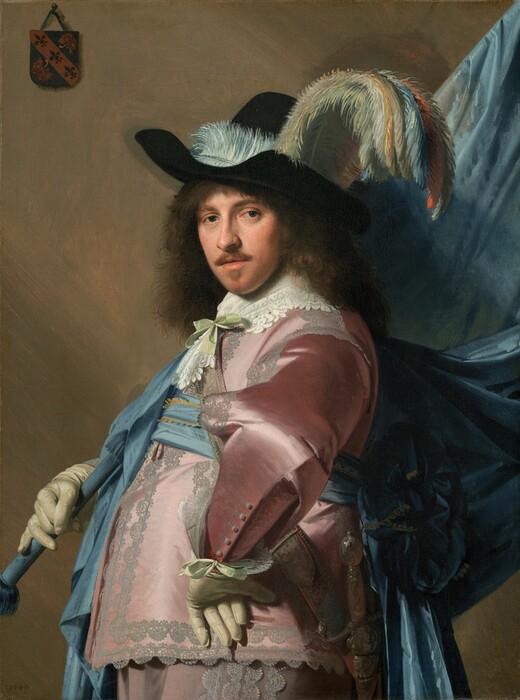
Shown from the hips up, a man with pale skin and shoulder-length brown hair, wearing a long-sleeved, rose-pink satin jacket and pants, props a flagpole with a voluminous blue flag against one shoulder in this vertical portrait painting. He stands with his body facing our left in profile with his left hand on his hip, elbow jutting out at us. He turns his face to look directly at us with dark eyes. He has a straight nose, rosy cheeks, and a mustache and narrow goatee below his lips, which are slightly parted. He wears a wide-brimmed black hat generously adorned with pale blue, turquoise, pale yellow, and orange plumes. The fabric of his pink clothing reflects the light in wide patches of white, creating the impression of a satin sheen. Wide, pale gray lace lines the front opening of the jacket, the shoulders, the arms, and the sides of the trousers. His white lace collar is tied with a pale celery-green bow and a bow of the same color ties the lace cuff of the wrist we can see. A baby-blue sash wraps around his waist and is tied in a large rosette at the back. Both hands are covered with ivory-white gloves. His left wrist rests against his hip so the underside of those fingers dangle down, while the other hand supports the flag pole, which is wrapped in blue fabric. A sword hangs from his front hip. The topaz-blue fabric of the flag, or standard, drapes down from the flag pole, which extends off the top right corner of the canvas. A coat of arms, about the size of a person’s palm, hangs from a nail with a string in the upper left corner on the taupe-colored wall behind the man. The coat of arms is made up of three fleur-de-lis lined up in a diagonal band and the remaining two corners are filled with stylized lions, long tongues curling out. The artist dated the work “1640” in the lower left corner.
Johannes Cornelisz Verspronck, Andries Stilte as a Standard Bearer, 1640, oil on canvas, Patrons' Permanent Fund, 1998.13.1

Andries Stilte as a Standard Bearer

Johannes Cornelisz Verspronck · 1640 · oil on canvas ·  Accession ID  1998.13.1
The image shows a man from the waist up, seated and looking to his right. He appears stern, with a strong jaw, pronounced cheekbones, deep-set eyes, and a furrowed brow. He has short, thin hair, a receding hairline, and sideburns. The man wears a dark robe with a white collar and holds a long pipe in his right hand. On the table next to him are three large books, some bound with leather straps. A crucifix stands to the left of the books. The background is a neutral, textured surface.
Jonas Suyderhoff, Augustyn Bloemaert, engraving, Rosenwald Collection, 1943.3.8093

Augustyn Bloemaert

Jonas Suyderhoff · engraving ·  Accession ID  1943.3.8093

Bibliography

1648

  • Schrevelius, Theodorus. Harlemias, ofte, De eerst stichtinghe der stad Haarlem. Reprinted in 1754. Haarlem, 1648: 382.

1870

  • Willigen, Adriaan van der. Les Artistes de Harlem: Notices historiques avec un précis sur la Gilde de St. Luc. Revised and enlarged ed. Haarlem and The Hague, 1870: 370.

1979

  • Ekkart, Rudolf E. O. Johannes Cornelisz. Verspronck: leven en werken van een Haarlems portretschilder uit de 17de eeuw. Exh. cat. Frans Halsmuseum. Haarlem, 1979.

2006

  • Biesboer, Pieter, and Neeltje Köhler, eds. Painting in Haarlem 1500-1850: the collection of the Frans Hals Museum. Translated by Jennifer Kilian and Katy Kist. Ghent, 2006: 323-324.

2007

  • Ekkart, Rudolf E.O., and Quentin Buvelot. Dutch portraits: the age of Rembrandt and Frans Hals. Translated by Beverly Jackson. Exh. cat. National Gallery, London; Royal Picture Gallery Mauritshuis, The Hague. London, 2007: 36, 56.