
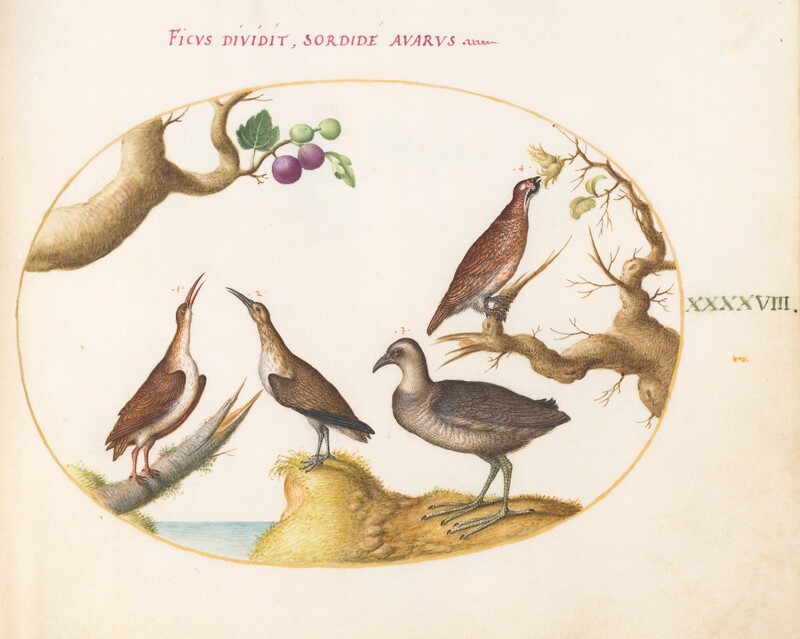
Plate 48: Wood Grouse, Rail, and Curlew with Hazelnuts and Figs
c.1575/1590s
Joris Hoefnagel
Artist, Flemish, 1542 - 1600

Artwork overview
-
Medium
watercolor and gold paint on parchment
-
Credit Line
-
Dimensions
page size (approximate): 14.3 x 18.4 cm (5 5/8 x 7 1/4 in.)
-
Accession Number
1987.20.8.49
-
Series Title
Animalia Volatilia et Amphibia (Aier)
Associated Artworks
See all 72 artworks
Animalia Volatilia et Amphibia (Aier)
Joris Hoefnagel
1575
Title Page
Joris Hoefnagel
1570
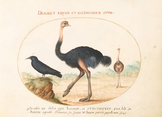
Plate 1: Two Ostriches and a Starling
Joris Hoefnagel
1570
Artwork history & notes
Provenance
Emperor Rudolf II of Austria?[1]; Secretarius Heinrich Hagen, Vienna, 1611.[2] Count Emanuel Maria Joseph von Arco, Munich, 1751.[3] Graf von Seinsheim, canon of Salzburg and Speyer, 1753. Master stonemason Rüpfel, Munich, c. 1830. Joseph Anton Niggl [1792 - 1842], Markt Tölz. Karl August von Brentano [1817 - 1896], Augsburg. (sale, Rudolph Weigel, 28 October 1861, no. 2220-a-d]; (Frederick Startridge Ellis [active 1860 - 1885], London; formerly identified as F. S. Eliot)[3]; Henry Huth [1815 - 1878], London; by descent to his son, Alfred Henry Huth [1850 - 1910], London; (sale, Sotheby's' London, 12 June 1913, no. 3722); (William Wesley & Son, London); Charles Francis George Richard Schwerdt, Old Alresford House, Hampshire (his sale, Sotheby's' London, 15 July 1946, no. 2216); (The Rosenbach Company, Philadelphia); Lessing J. Rosenwald, Jenkintown; given to Edith Goodkind Rosenwald, Jenkintown; gift to NGA, 1987.
[1] Although Van Mander claims the series was commissioned and purchased by Rudolf, this is impossible as dates scattered throughout volumes pre-date Hoefnagel's' contact with Rudolf. The series does not appear in Rudolf's' inventory, though he is likely to have owned it at one time as many copies from the volumes appear in his natural history collections, now in Vienna (see Bass 2020, 12).
[2] Vignau-Wilberg 2017, 98 without documentation.
[3]Wolfgang Wegner, Kurfurst Carl Theodor von der Pfalz als Kunstsammler, Mannheim, 1960: 13.
[4] Ellis was a book dealer who frequently sold to Huth and wrote the catalogue of Huth's' collection. He started his own business just a year before The Four Elements appeared at Weigel. Ellis is correctly identified by M. Bartels, "Ueber abnorme Behaarung beim Menschen," Zeitschrift fu¨r Ethnologie 11 (1879): 155, note 1.
Associated Names
Bibliography
1984
Hendrix, Lee. Joris Hoefnagel and the Four Elements: a Study in Sixteenth-Century Nature Painting. Ph.D. Hendrix, Lee. Joris Hoefnagel and the Four Elements: a Study in Sixteenth-Century Nature Painting. Ph.D. dissertation, Princeton University, 1984 (series).dissertation, Princeton University, 1984 (series).
2017
Vignau-Wilberg, Thea. Joris and Jacob Hoefnagel: Art and Science around 1600. Berlin, 2017: no. A6 (for series).
2019
Bass, Marisa Ann. Insect Artifice: Nature and Art in the Dutch Revolt. Princeton, 2019 (for series).
Inscriptions
Upper center in red/violet ink: FICVS DIVIDIT, SORDIDE AVARVS; center right in (gold?): XXXXVIII; birds in image numbered .1., .2., .3., and .4., in red ink
Facing page: Upper center in black ink: Verbo Domini Coeli firmati sunt: Et Spiritu / oris ejus, omnis virtus eius. ps: 32: (“By the word of the Lord were the heavens made; and all the power of them by the spirit of his mouth.” Psalms 32:6) (Latin Vulgate Bible); lower center in (gold?): Qui das escam omni carni: Quoniam / In aeternum misericordia eius ps: 135. (“Who gives food to all flesh: for his mercy endures forever.” Psalms 135:25) (Latin Vulgate Bible)
Wikidata ID
Q64591009