Teaching Packet

Uncovering America: Activism and Protest

Part of Uncovering America

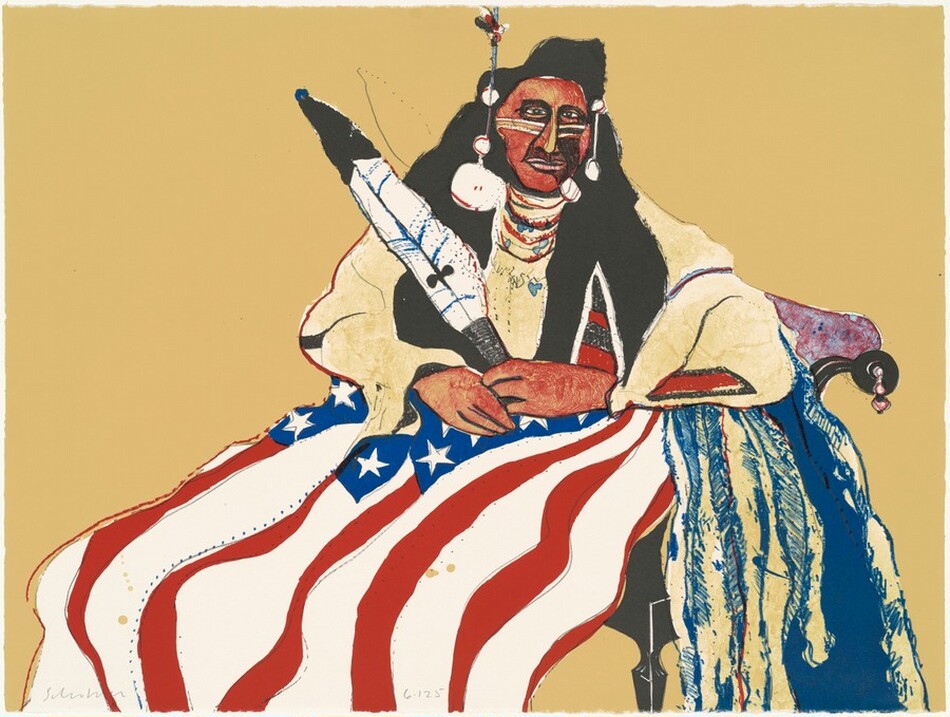
This print shows a person seated on a chair with a stylized representation of the American flag draped across their lap. The individual has long, dark hair with white beaded ornaments hanging in it, and light, reddish-tan skin. Horizontal white lines are painted on both of their cheeks, right below their eyes. They wear a cream-colored, robe-like garment over their torso under layered blue and red necklaces. Their hands are placed in their lap, holding a large white feather with black and blue details. The large flag is draped across their legs. On the right, a blue and white object hangs down from the purple-and-black chair they sit on, similar to a thick blanket or animal hide. The background is plain, pale yellow.
Fritz Scholder, Tamarind Institute, Lorillard, A Division of Loews Theatres, Inc., Bicentennial Indian, 1975, color lithograph on wove paper, Corcoran Collection (Gift of Lorillard Tobacco Company, 1975), 2015.19.2595

Grade Level

Subject

Language

Download Image Set

On this page:

  1. Overview
  2. Selected Works
  3. Activity: Taking Creative Action
  4. Additional Resources
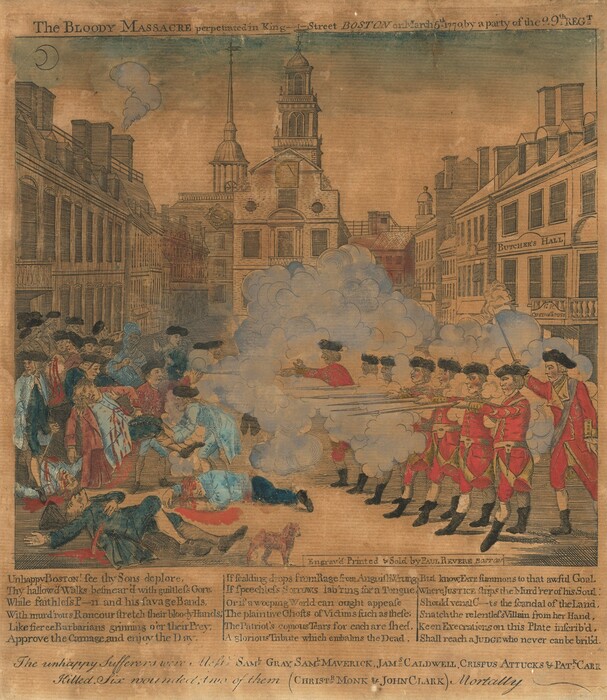
Printed with black lines and shading and then painted, a row of seven red-uniformed soldiers to the right fire rifles into a crowd of dozens in a town square in this vertical engraving. The soldiers are led by an eighth behind the line, who raises a sword. Blood gushes from wounded people to the left, who wear clothing in shades of marine and sky blue and brick red. A small brown dog stands near one dead person along the bottom of the composition, and two- and three-story buildings enclose the rectangular square behind the action. The sky is tinted blue along the top of the print, and a crescent moon is in the top left corner. An inscription near the dog in the image reads, “Engrav’d Printed & Sold by Paul Revere Boston.” Printed text over the image reads, “The Bloody Massacre perpetuated in King Street Boston on March 5th 1770 by a party of the 29th Regt.” Three columns of text below read, “Unhappy Boston! See thy Sons deplore, They hallowed Walks besmear’d with guiltless Gore. While faithless P—n and his savage Bands, With murd’rous Rancour stretch their bloody Hands; Like fierce Barbarainas grinning o’er their Prey, Approve the Carnage and enjoy the Day. If sealding drops from Rage from Anguish Wrung, If speeches Sorrows lab’ring for a Tongue, Or if a weeping World can ought appease, The plaintive Ghosts of Victims such as these; The Patriot’s copious Tears for each are shed, A glorious Tribute which embalms the Dead. But know, Fat summons to that awful Goal, Where Justice strips the Murd’rer of his Soul: Should venal C—ts the scandal of the Land, Snatch the relentless Villain from her Hand, Keen Execrations on this Plate inscribed, Shall reach a Judge who never can be brib’d.” Cursive printed script below reads, “The unhappy Sufferers were Sam’l Gray, Sam’l Maverick, Jam’s Caldwell, Crispus Attacuks & Pat’k Carr Killed. Six wounded, two of them (Christ’r Monk and John Clark) Mortally.”
Paul Revere, The Boston Massacre, 1770, engraving with hand coloring on laid paper, Rosenwald Collection, 1943.3.9042

Overview

Why and how do people protest?

How might works of art show support or advocate for a cause?

How are people, communities, and events affected by works of art?

Artists in the United States are protected under the First Amendment, which guarantees freedoms of speech and press. This module features works created by artists with a range of perspectives and motivations. Some artists hoped to create widespread, systemic change, while others desired to make visible the vulnerable. Still others used their chosen medium to call attention to an issue, event, or system. Broadly, these artists hoped to improve conditions for themselves, others, or the world.

Paul Revere was one of these artists. His engraving depicting the Boston Massacre, published in 1770 in the Boston Gazette, is one of the most effective examples of war propaganda in US history. The image of British soldiers firing upon a crowd of Bostonians inflamed anti-British sentiments and bolstered residents who were increasingly frustrated by levies imposed by the Crown. Without the distribution of Revere’s engraving, the Boston Massacre may have remained an isolated incident instead of becoming a key event that helped trigger the Revolutionary War.

What made the Boston Massacre engraving so powerful?

To answer this question, consider these other questions:

  • Who was Paul Revere? Why did he make this engraving and write the accompanying text?
  • How might the image both represent or deviate from actual events?
  • What artistic choices might Revere have made in order to promote his point of view?
  • Who do you think Revere hoped to persuade and influence with his engraving?
  • How do you imagine 18th-century viewers encountered and perceived the engraving?
  • How might this work of art still influence or inform people today?

Revere’s engraving is widely recognized as an exaggerated depiction of actual events, but less widely known is that he did not conceive of the image. Artist Henry Pelham loaned his work in progress, titled The Fruits of Arbitrary Power, to Revere, who copied it and distributed his version before Pelham published his own. Why might this matter?

Every artist has a point of view. Today, artists make use of new platforms, tools, and means of communication to advocate for a cause or inspire action. What similarities do you see between the issues in the works of art in this module and contemporary issues today? How might you take action about an issue or cause? How do the works of art collected here provoke, reveal, move, or make change in some way?

Selected Works
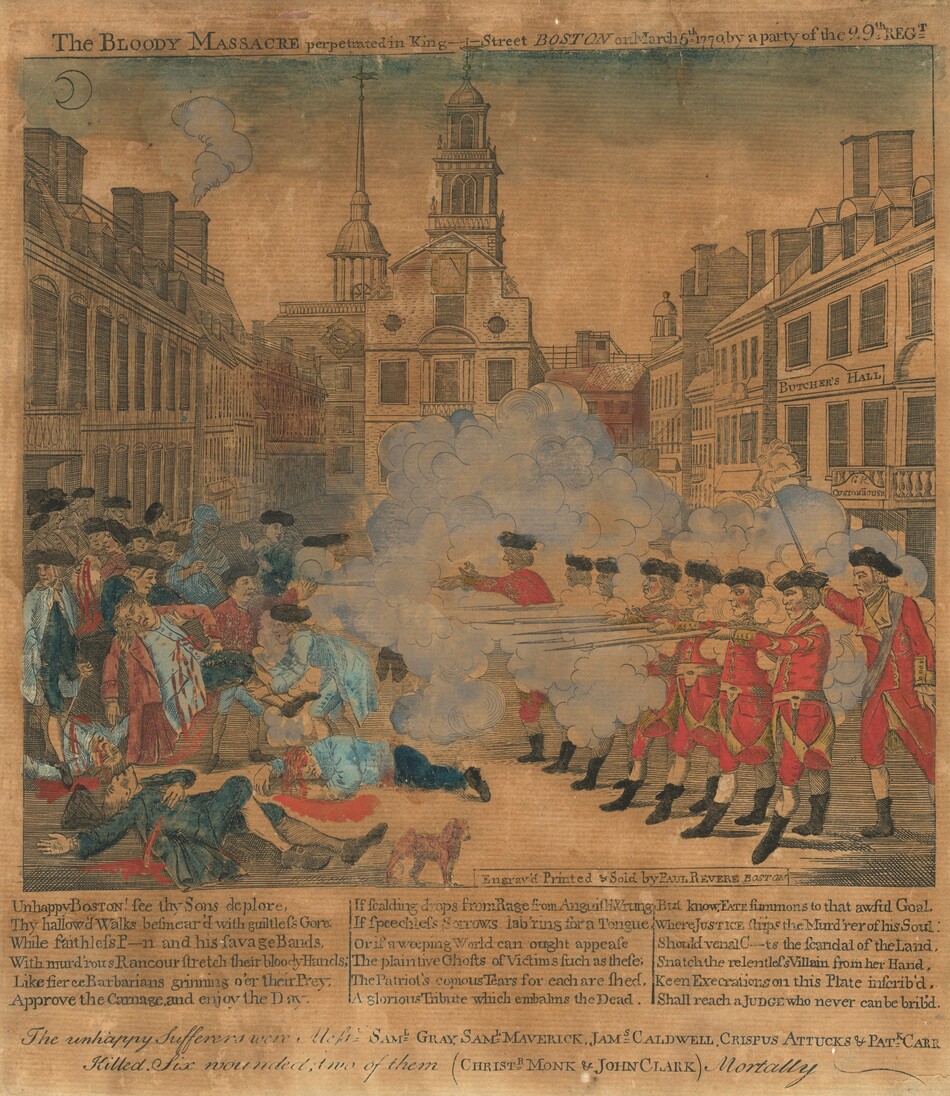
  • Printed with black lines and shading and then painted, a row of seven red-uniformed soldiers to the right fire rifles into a crowd of dozens in a town square in this vertical engraving. The soldiers are led by an eighth behind the line, who raises a sword. Blood gushes from wounded people to the left, who wear clothing in shades of marine and sky blue and brick red. A small brown dog stands near one dead person along the bottom of the composition, and two- and three-story buildings enclose the rectangular square behind the action. The sky is tinted blue along the top of the print, and a crescent moon is in the top left corner. An inscription near the dog in the image reads, “Engrav’d Printed & Sold by Paul Revere Boston.” Printed text over the image reads, “The Bloody Massacre perpetuated in King Street Boston on March 5th 1770 by a party of the 29th Regt.” Three columns of text below read, “Unhappy Boston! See thy Sons deplore, They hallowed Walks besmear’d with guiltless Gore. While faithless P—n and his savage Bands, With murd’rous Rancour stretch their bloody Hands; Like fierce Barbarainas grinning o’er their Prey, Approve the Carnage and enjoy the Day. If sealding drops from Rage from Anguish Wrung, If speeches Sorrows lab’ring for a Tongue, Or if a weeping World can ought appease, The plaintive Ghosts of Victims such as these; The Patriot’s copious Tears for each are shed, A glorious Tribute which embalms the Dead. But know, Fat summons to that awful Goal, Where Justice strips the Murd’rer of his Soul: Should venal C—ts the scandal of the Land, Snatch the relentless Villain from her Hand, Keen Execrations on this Plate inscribed, Shall reach a Judge who never can be brib’d.” Cursive printed script below reads, “The unhappy Sufferers were Sam’l Gray, Sam’l Maverick, Jam’s Caldwell, Crispus Attacuks & Pat’k Carr Killed. Six wounded, two of them (Christ’r Monk and John Clark) Mortally.”
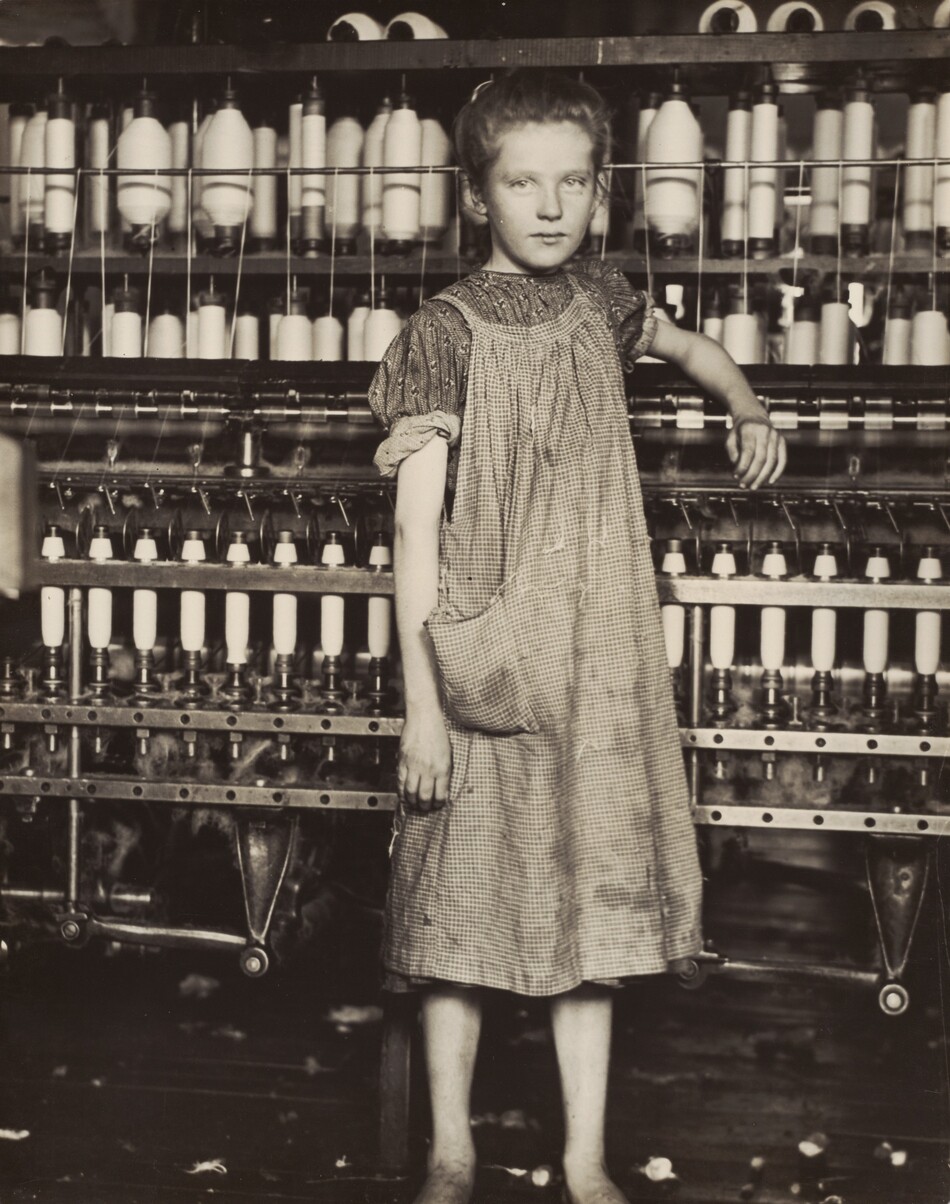
  • This sepia-toned photograph depicts a young girl standing next to a piece of machinery in an industrial setting. The girl has pale skin and dark hair that is tied up behind her head, and she looks out at us with large eyes and a neutral expression. She is wearing a plaid apron over a patterned dress with rolled-up sleeves, and her feet are bare and dirty. She has one of her arms bent behind her, resting casually on the large machine, which is full of spindles and spools loaded with white thread. Debris is scattered on the dark wooden floor.
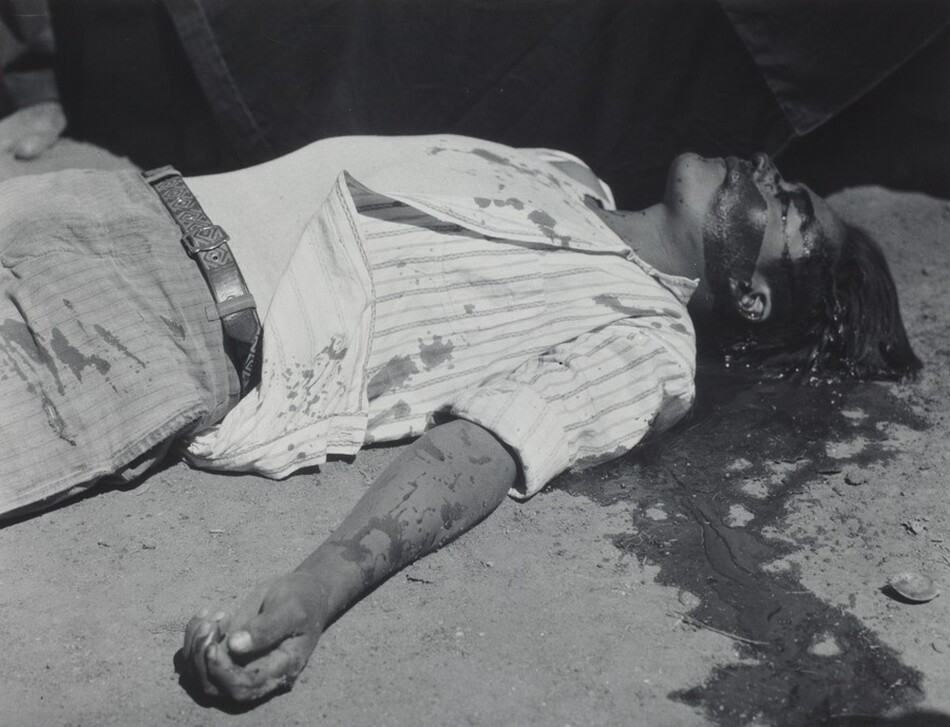
  • The image shows a man lying on the ground, facing up, with one arm stretched out to the side. He has a mustache and beard, dark slicked-back hair, and is wearing a light-colored striped shirt and pants with a patterned belt. There is dark liquid around his head and shirt. The background shows a plain ground surface with a dark draped cloth partially visible.
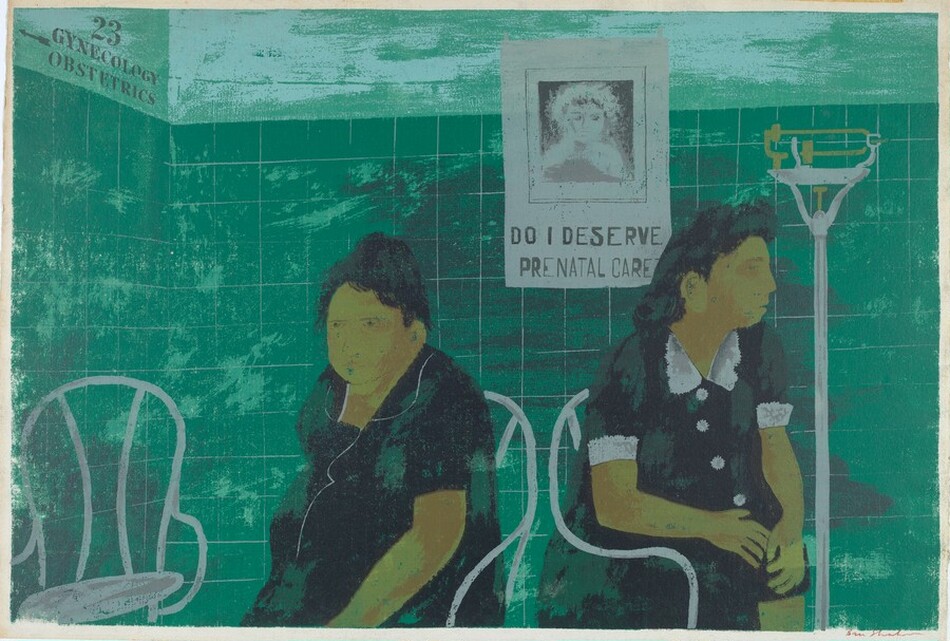
  • This print shows two women seated side by side, facing away from each other. The woman on the left has a round face with short, dark hair, and is wearing a dark garment with a thin collar outlined in white. The woman on the right has medium-length dark hair styled away from her face and is dressed in a dark dress with a white collar and buttons. Both women have tan skin and minimal facial features. They are seated on white metal chairs in a room with green tiled walls. A black-and-white image with the text "DO I DESERVE PRENATAL CARE" is displayed on the wall behind them, while the words "23 GYNECOLOGY OBSTETRICS" are painted in a corner of the room above their heads in the top left corner of the painting. There is also an old-fashioned medical scale visible to their right and an empty white chair on the left. The whole print has a green tint, and some areas appear slightly discolored. The tint, discoloration, and tiled walls almost give the impression that the women are underwater in a swimming pool.
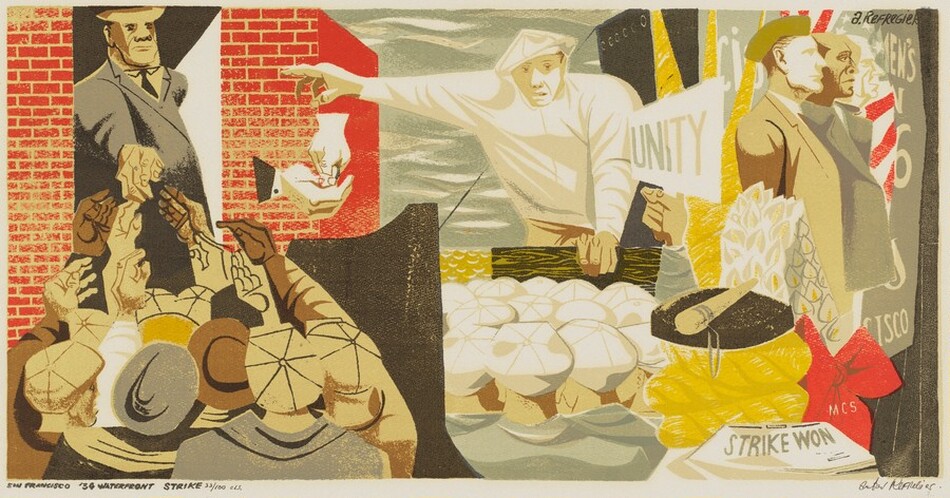
  • This is a painting of a waterfront strike. The image depicts a dynamic scene with various workers and symbolic elements that convey a sense of protest and unity. In the foreground, several hands, some raised with gestures, are reaching upwards. To the left, a figure in a suit stands in front of a brick wall, facing the crowd. To the right, a man in work clothes and a cap appears to be engaged with the workers. Surrounding these figures are signs with bold letters, such as "UNITY" and "STRIKE WON." The background showcases more industrial elements with stacks of goods and a waterfront setting. The color palette includes earthy tones with pops of red and yellow.
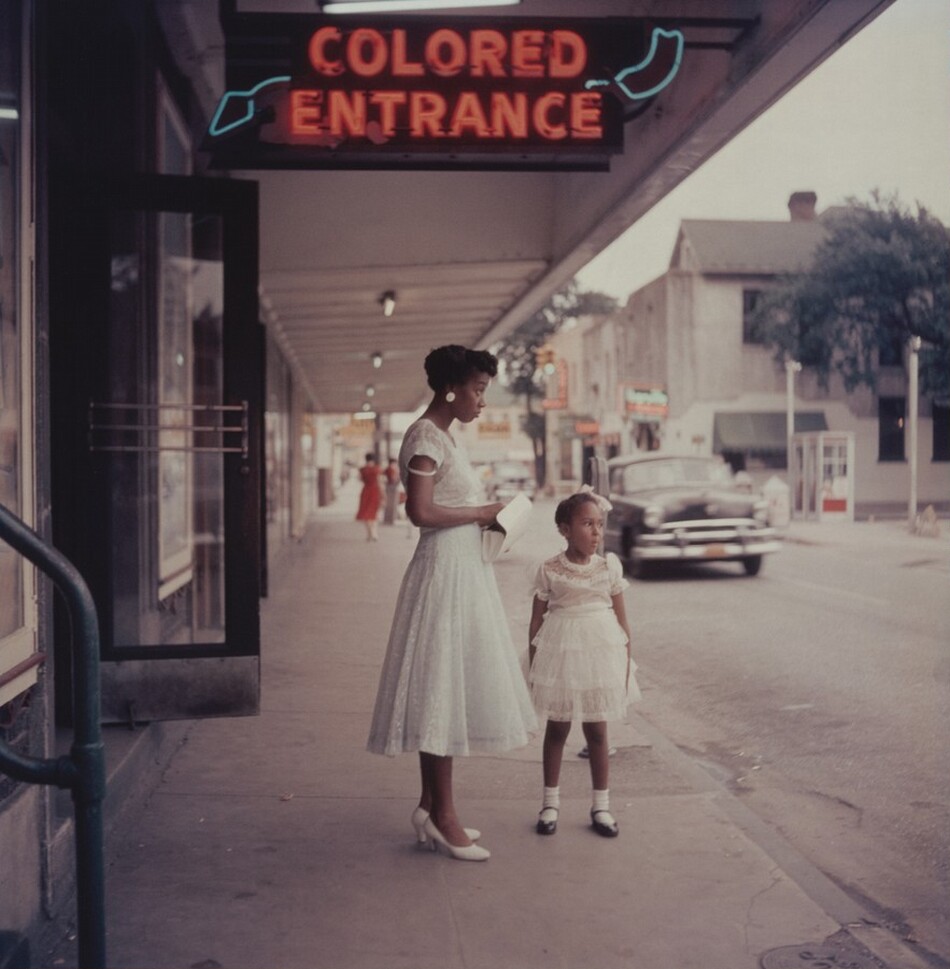
  • The photograph shows two people standing on a sidewalk. One of them is an adult woman and the other is a young girl. They both have dark skin and black hair, and they are dressed in formal attire. The woman is facing the right, and we see her in profile. She has short, dark, wavy hair and is wearing a long white dress with short sleeves and white shoes with low heels, and she is holding a white purse. She has a round white earring in her ear, and she looks upward with her eyebrows raised. The girl has her hair tied back with a white bow, and she is wearing a white dress with sheer puffed sleeves, a ruffled skirt, white socks, and black shoes. Her body is turned to us, but she looks off to the right. The two people are outside the entrance to a building on the left of the photo. Above an open door is a neon sign that reads "COLORED ENTRANCE" which hangs above the two people. The woman has her back to the door. On the right is a street lined with other gray buildings with neon signs and a phone booth. A black car is driving by, and a few other people are visible in the background.
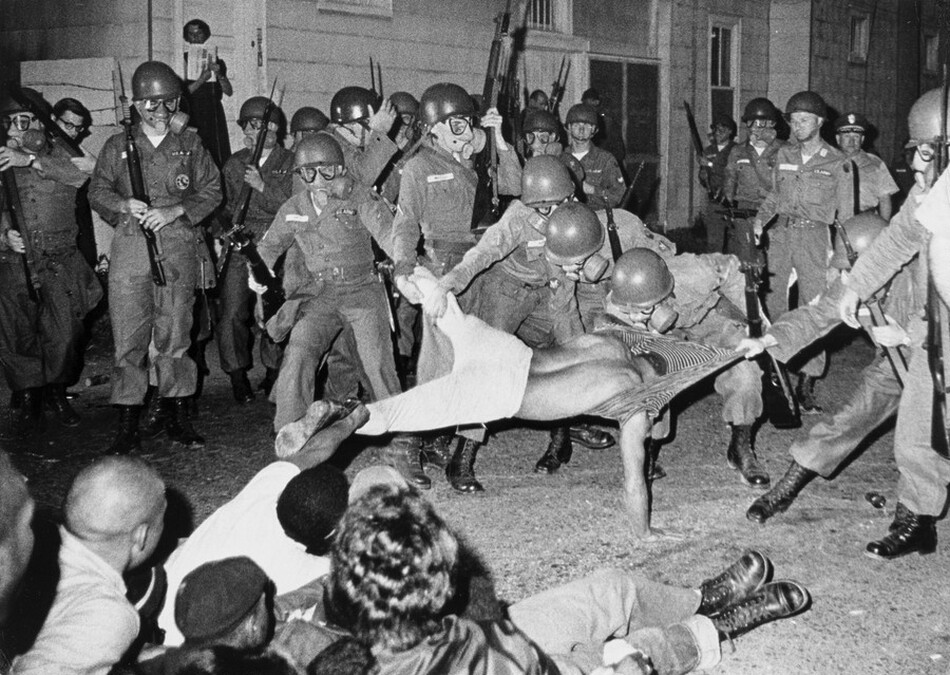
  • This is a photograph of a group of armed soldiers in helmets and uniforms interacting with people on the ground. The image depicts soldiers in military gear, including helmets and gas masks, holding rifles as they move towards a seated group blocking their path. The central focus is on the soldiers pulling at the legs and clothing of the individuals on the ground. The scene appears to convey tension and physical confrontation, taking place in an outdoor setting with a building in the background. The photograph is in black and white.
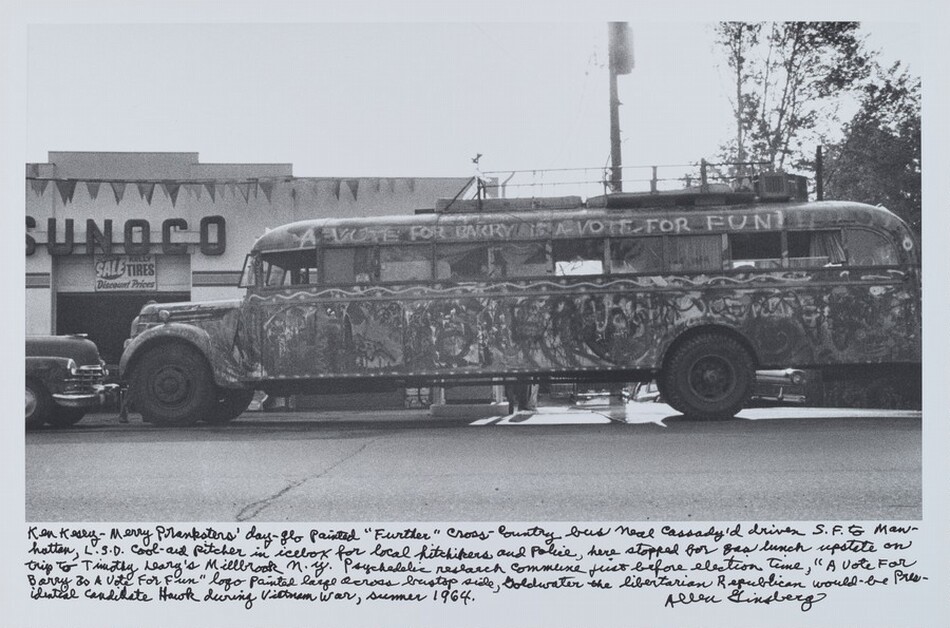
  • This is a grayscale photograph of a bus painted in swirling designs parked in front of a Sunoco gas station. The bus has the slogan "A VOTE FOR BARRY IS A VOTE FOR FUN!" painted on top. In the background, there is a Sunoco gas station with flags and signage on the left advertising "SALE TIRES" and "Discount Prices." To the left and right of the bus are trees, a lamp post, and a partially visible car. The bus is shaped similarly to a school bus, with the front facing the left. Below the photograph are several lines of handwritten text.
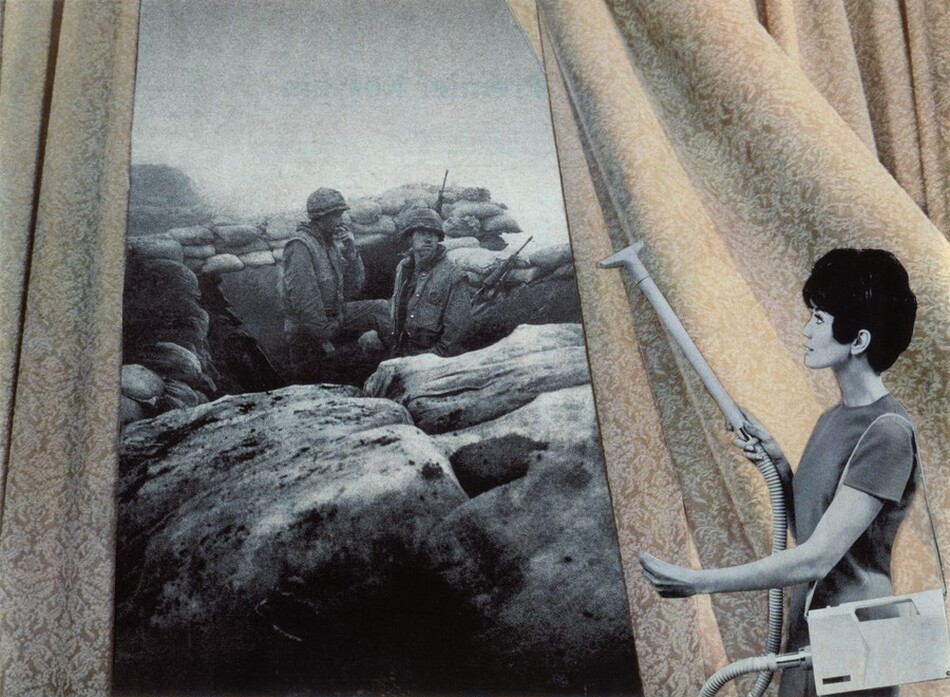
  • To the left of center in this print is black-and-white scene showing two soldiers standing in a rocky trench, both wearing jackets and helmets, with two long guns behind them. Overlaying this central image are long pale yellow drapes or curtains hanging down on either side in thick folds, covered in small white decorative patterns. On the right, a black-and-white woman with pale skin and short, dark hair stands facing the left, vacuuming the curtains with a vacuum that hangs over her shoulder. She is wearing a gray, short-sleeved dress and is looking up towards the soldiers in the central scene.
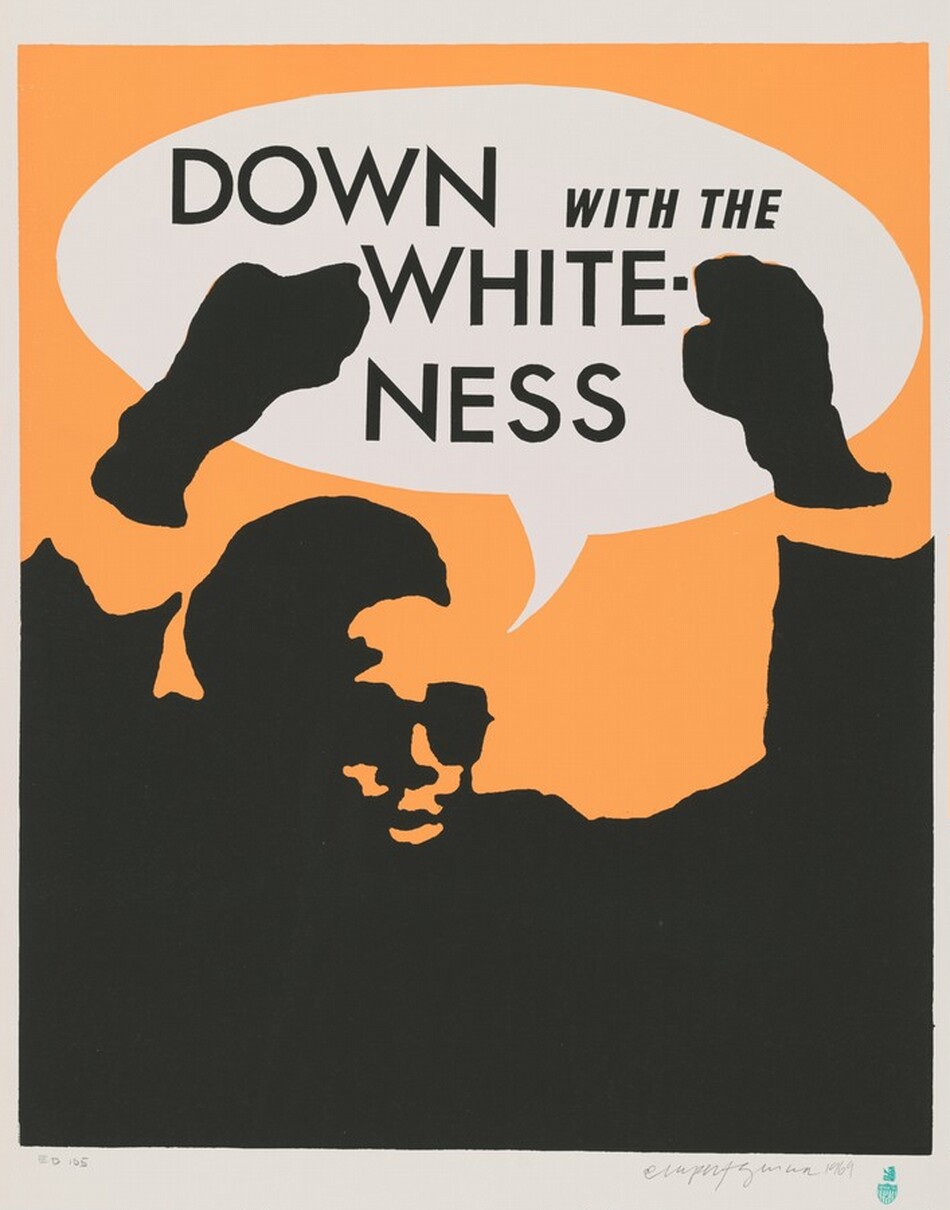
  • The black, stencil-like silhouette of a man with arms raised is printed against a pale orange background with a white speech bubble overhead. Shown from the chest up, the bearded man wears sunglasses and stands with both fists raised, his chest and arms along the bottom edge of the composition. The all-capital, black text in the speech bubble reads, “DOWN WITH THE WHITENESS.” The paper has a white margin all around. The artist signed and dated the work with graphite in the lower right corner: “Rupert García 1969.” And in the lower left, also in graphite: “ED 105.” Near the signature is a turqoise-colored stamp with a frog, sitting, pointing to our left, and smiling over a vertically striped shield, which reads, "MADE IN USA."
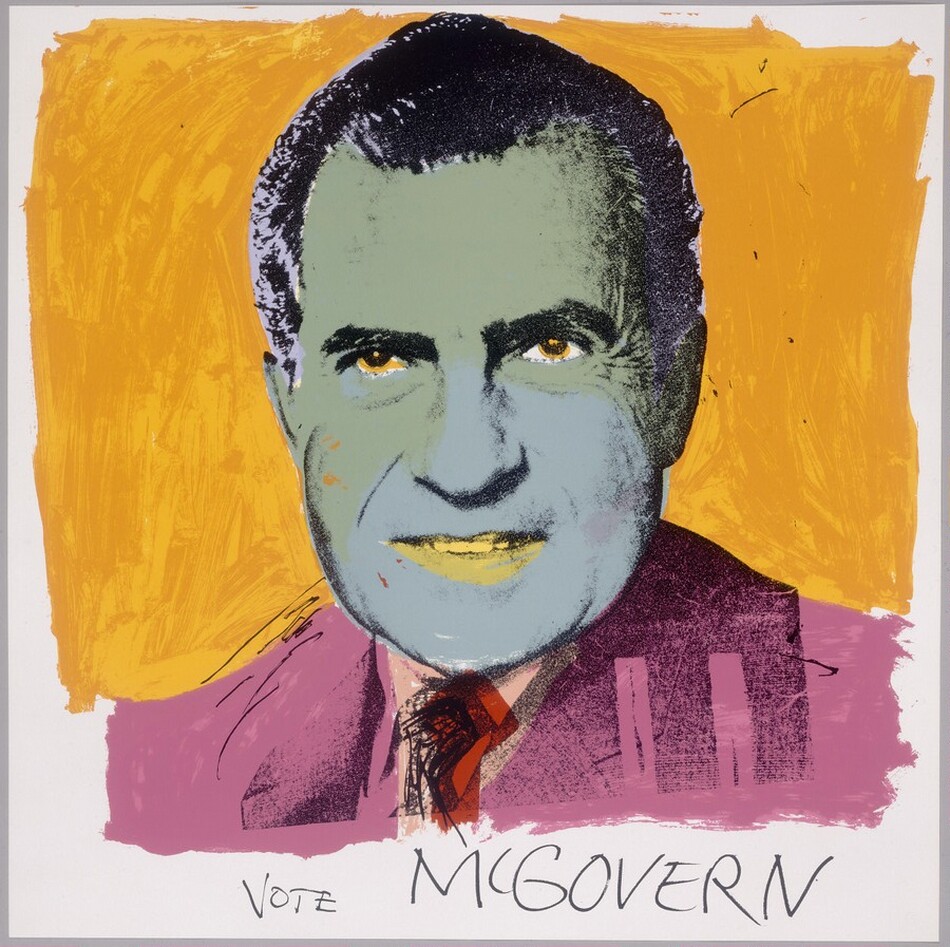
  • This print depicts a man, showing only his head and shoulders, in bright, vibrant colors. The man is looking slightly upward, facing us, and his mouth is open in a smile. The lower part of his face is light blue, while the upper half is light blue-green. The irises of his eyes and his entire mouth, including his teeth, have been colored in light yellow. His hair is mostly black, but the highlights have been colored in lilac purple. The suit he wears is bright pink, with hints of a peach shirt at his collar and a red tie. The background behind him is a bright orange-yellow color. Below the portrait, "VOTE McGOVERN" is handwritten in bold, uneven handwriting. The color has been applied unevenly, leaving streaks and areas where it bleeds outside the lines of the print.
  • This print shows a person seated on a chair with a stylized representation of the American flag draped across their lap. The individual has long, dark hair with white beaded ornaments hanging in it, and light, reddish-tan skin. Horizontal white lines are painted on both of their cheeks, right below their eyes. They wear a cream-colored, robe-like garment over their torso under layered blue and red necklaces. Their hands are placed in their lap, holding a large white feather with black and blue details. The large flag is draped across their legs. On the right, a blue and white object hangs down from the purple-and-black chair they sit on, similar to a thick blanket or animal hide. The background is plain, pale yellow.
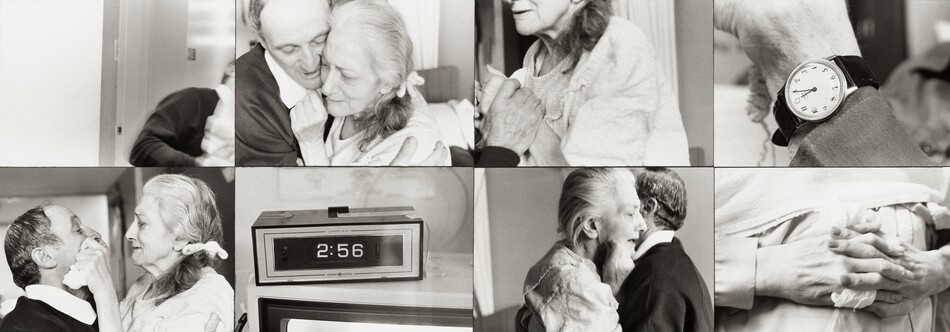
  • The image is a black and white collage showing multiple scenes featuring an elderly couple. The scenes include the couple hugging closely, focusing on their upper bodies and a close-up of their intertwined hands. There is also a photograph of a digital clock showing the time as 2:56 on a television console in a living space.
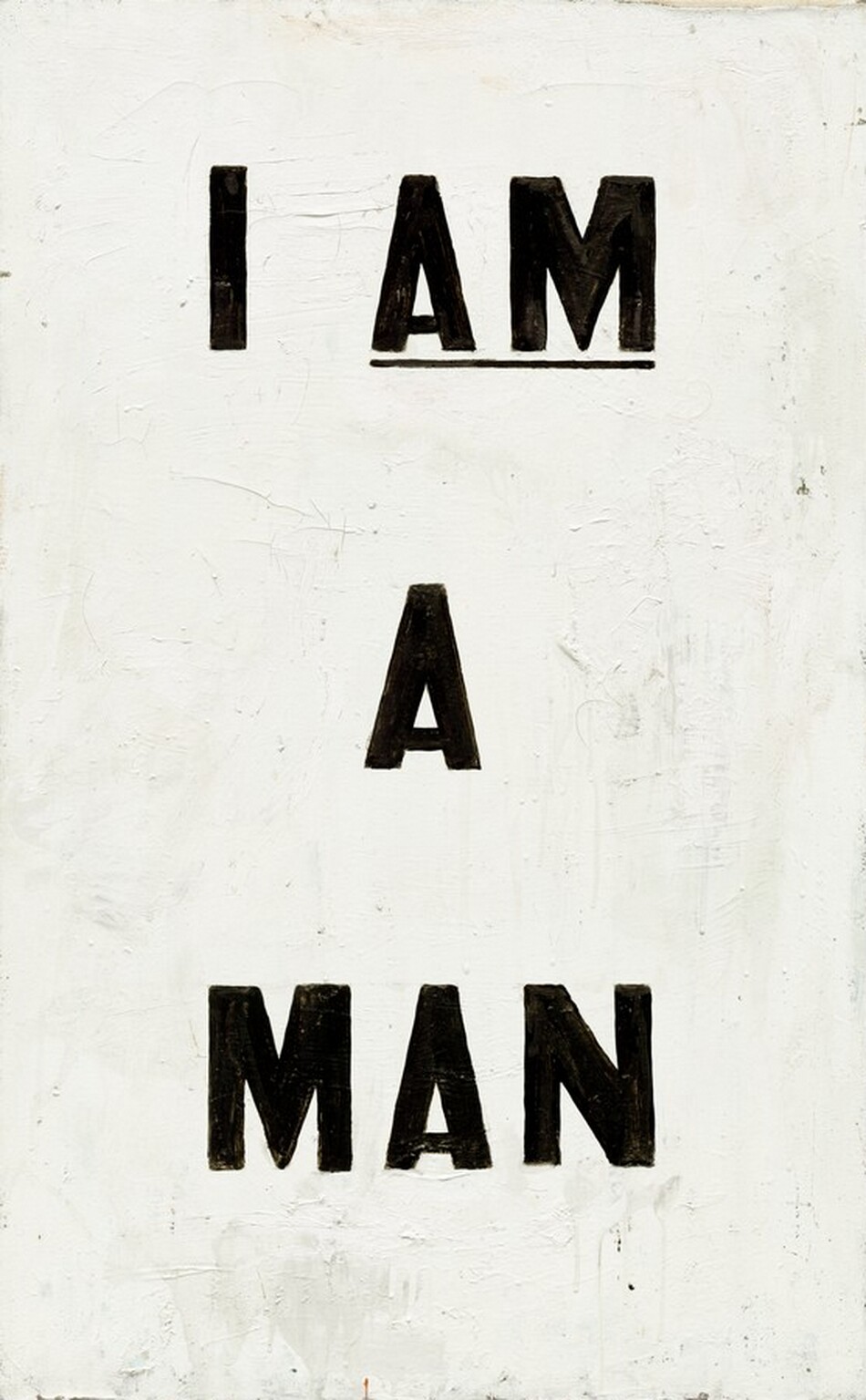
  • The words “I AM A MAN” are painted in all capital, bold black letters against a white ground in this vertical painting. The words are spaced so they take up most of the composition, with “I AM” on the top line, “A” at the center of the composition, and “A MAN” at the bottom. “AM” is underlined. The white paint is thickly applied and brushstrokes, drips, and cracks are visible on the surface. A sliver of raw, off-white canvas is visible at the top right corner.
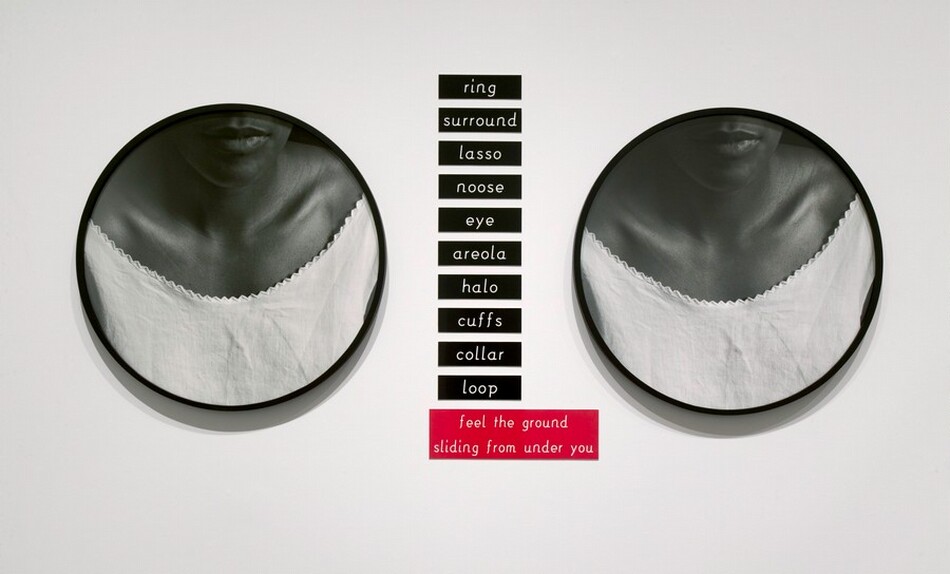
  • Ten black, horizontal, rectangular panels are hung evenly spaced in a vertical stack above a larger red rectangle, and those eleven pieces are flanked by two identical, round, black and white photographs that are almost as tall as the stacked panels. Each of the ten black panels bear a single word in lowercase, white letters. From top to bottom, they read, “ring,” “surround,” “lasso,” “noose,” “eye,” “areola,” “halo,” “cuffs,” “collar,” and “loop.” The red panel is inscribed, also with white, lowercase letters, “feel the ground sliding from under you.” Each of the two round photographs is framed with a narrow black band and shows the full lips, narrow chin, collarbone, and chest of a Black person. The person wears a white scooped neck top that creates a crescent moon shape at the bottom of the image.
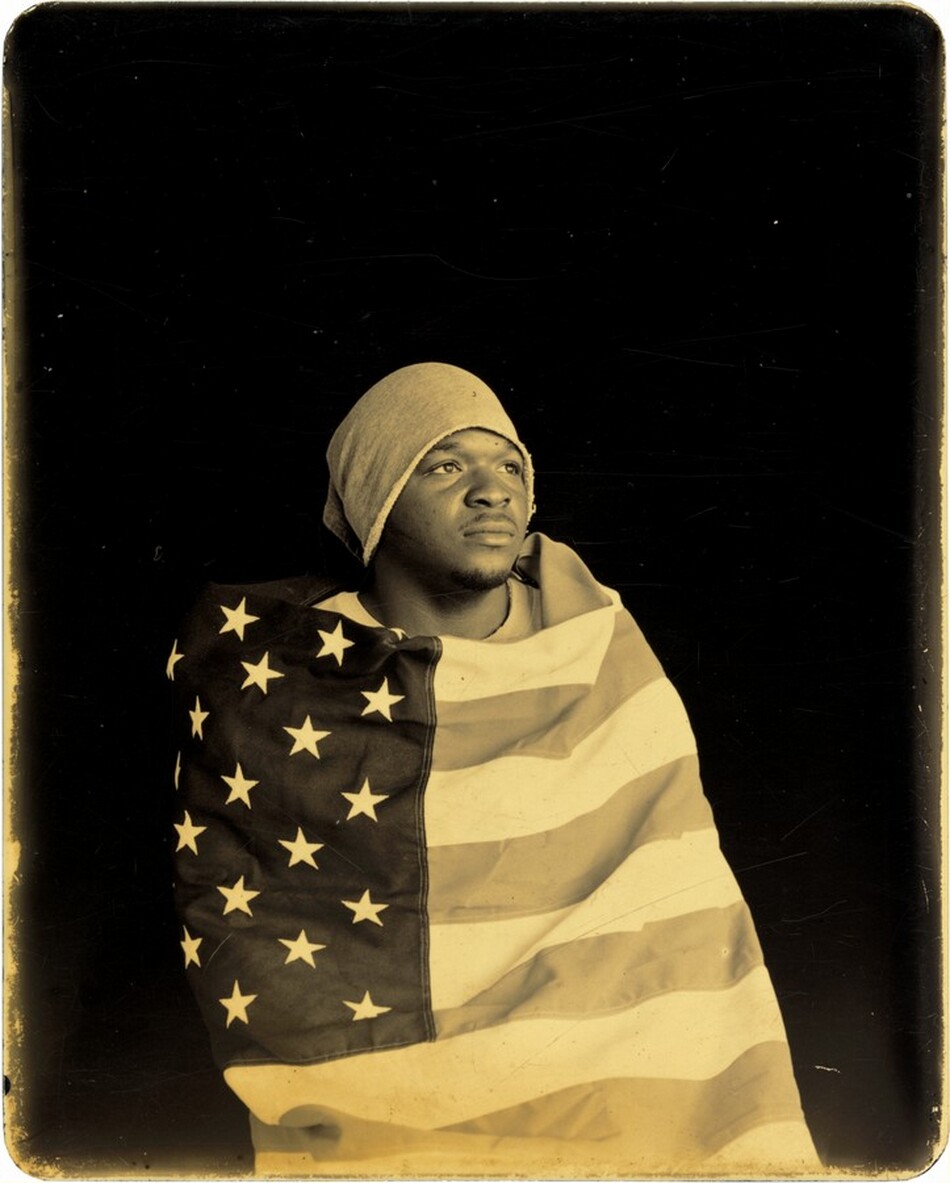
  • This sepia-toned photograph shows a man from the waist up, his body and face turned slightly to the right. He has dark skin, a thin black mustache, a sparse black beard, a broad nose, and lips set in a neutral expression. He wears a light-colored cap or head wrap covering his hair, and has the United States flag draped around his shoulders and torso. The collar of a white shirt is visible above the top of the flag. The background is black, and the edges of the photo have some hints of pale yellow.
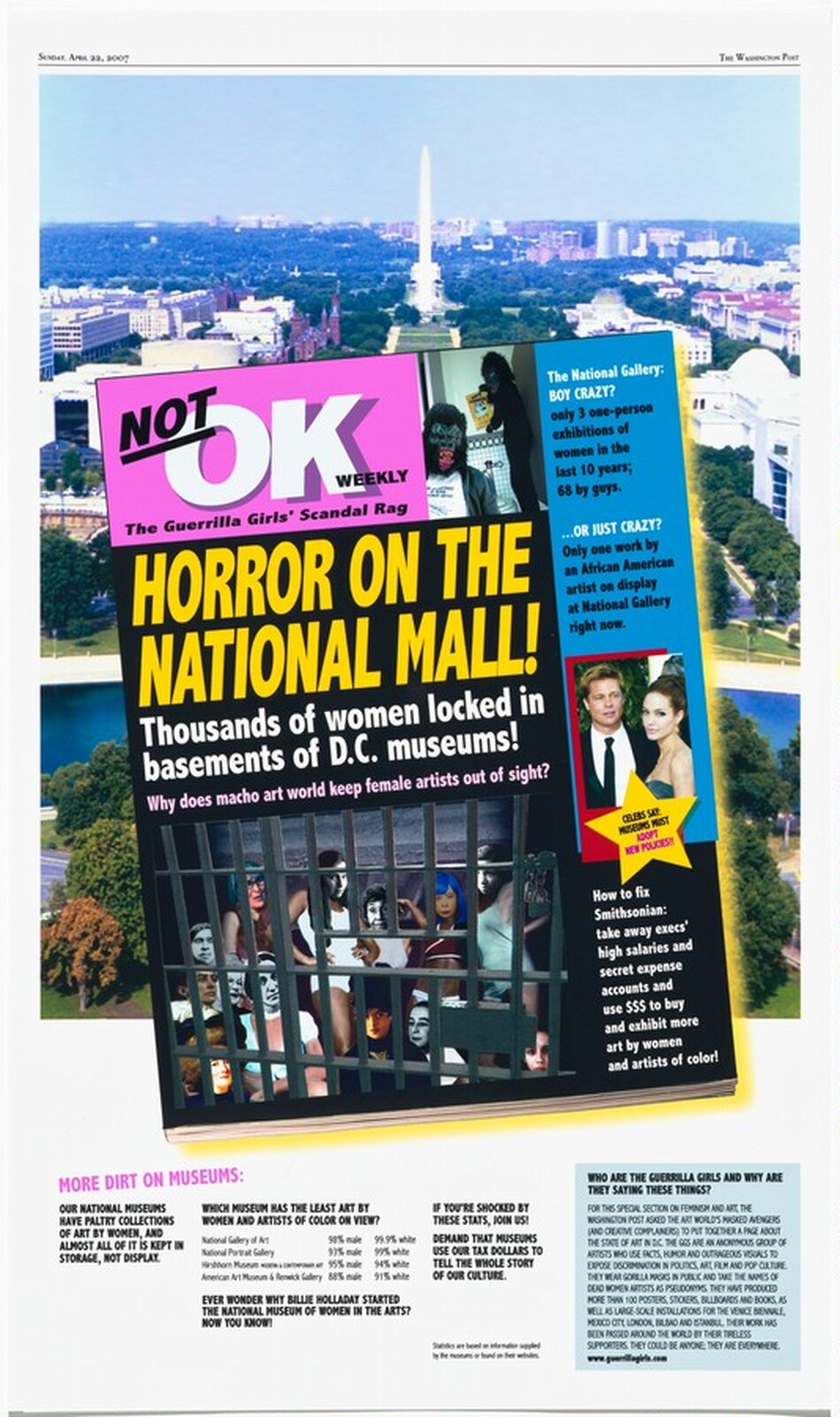
  • This is a photograph of a stylized magazine cover with feminist themes. The magazine is titled "NOT OK WEEKLY, The Guerrilla Girls’ Scandal Rag," featuring a headline "HORROR ON THE NATIONAL MALL!" Accusations are made against museums in Washington D.C. for neglecting female artists. The image includes a grid with various images of women behind it, suggesting entrapment. Accompanying text provides statistics on the underrepresentation of women and artists of color in galleries, along with satirical commentary and celebrity imagery. The design resembles a sensational tabloid with a political message urging museums to reflect broader cultural narratives.
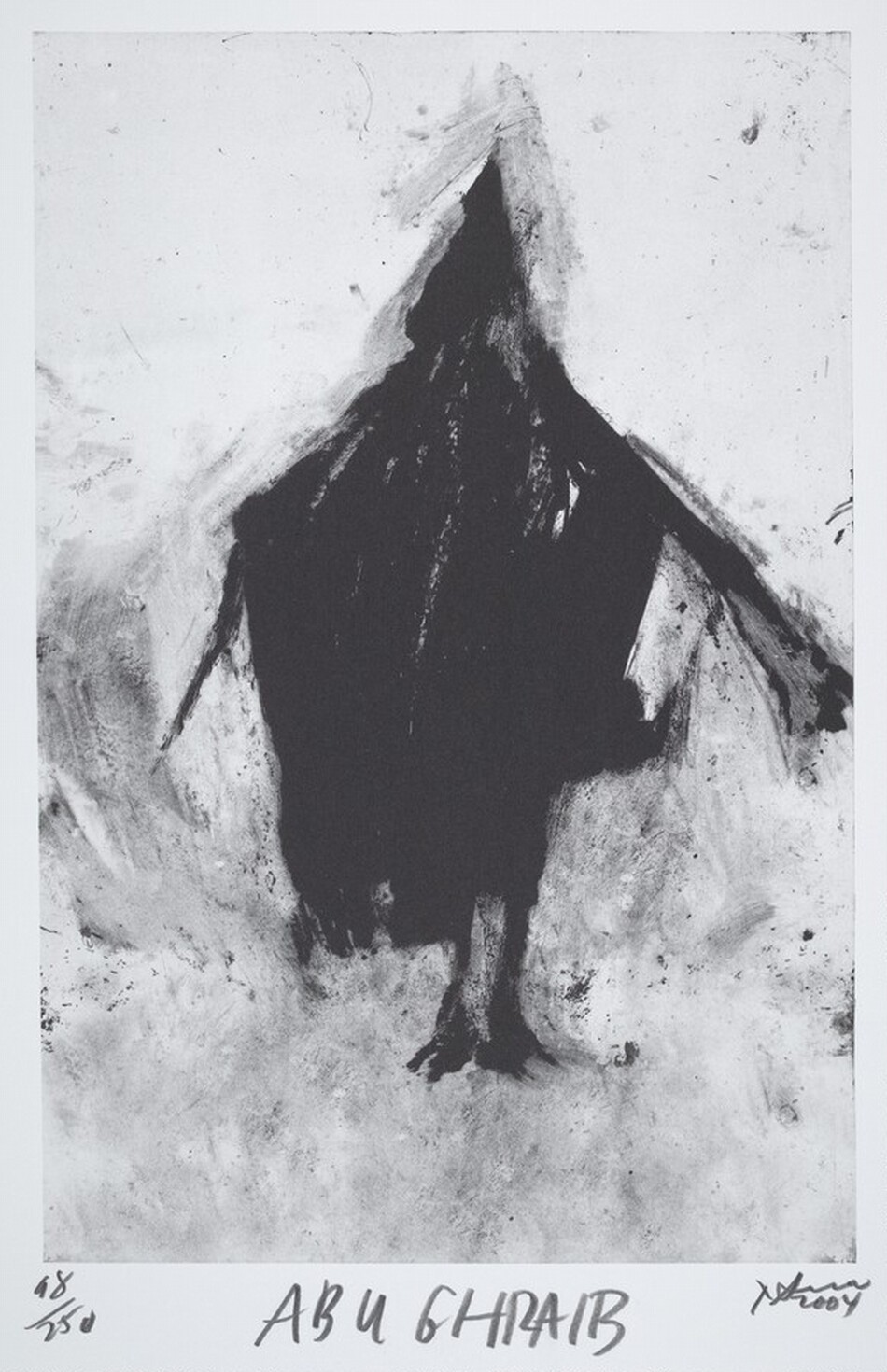
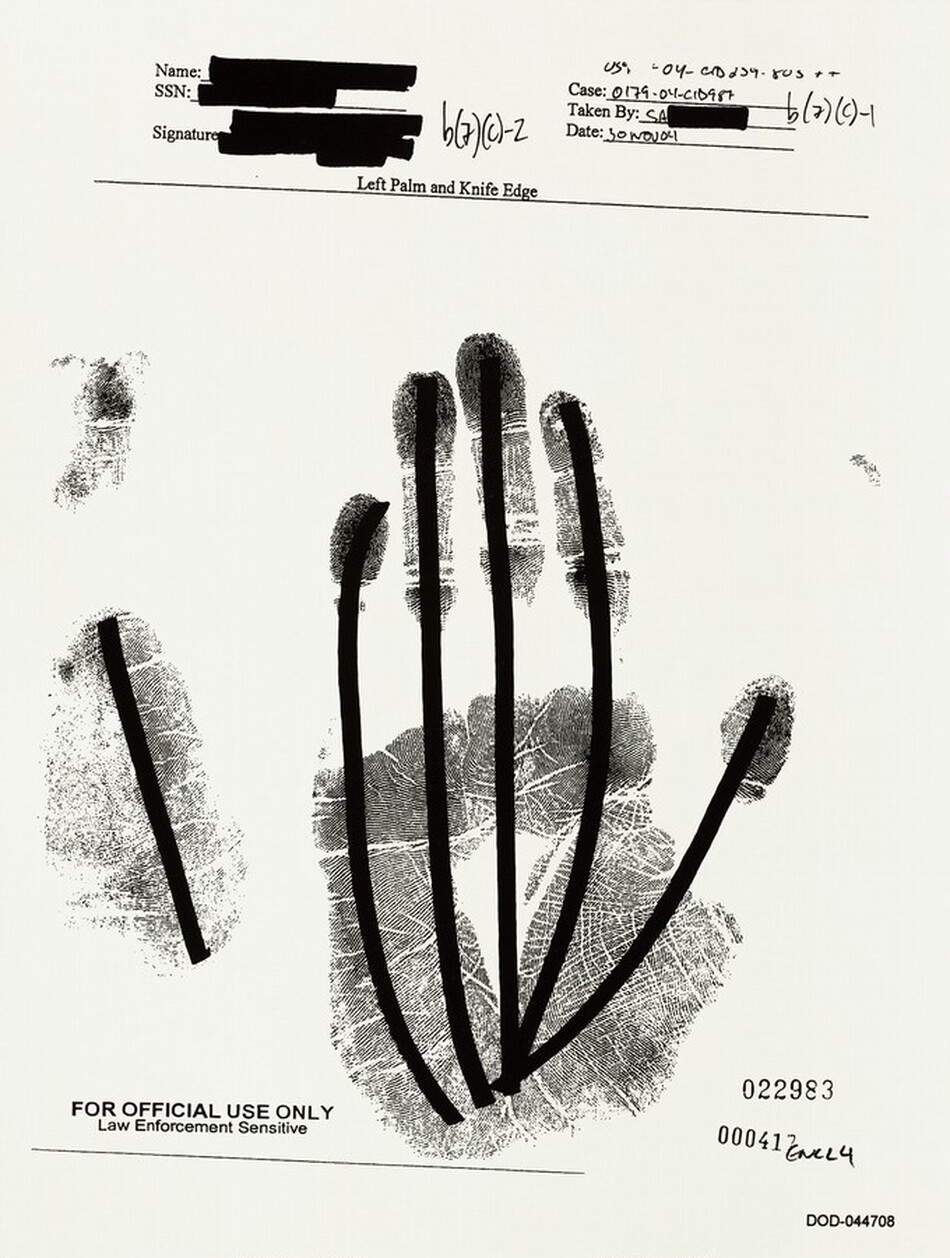
  • A full handprint and the edge of a palm have been partially blacked out under a heading in which information has been written and redacted, all against a white background, in this vertical painting. The print is of a left hand, and black lines sweep from the base of the palm up to the end of each finger. The blade of the hand is to the left, and it has also been marked with a black line. Text that appears to be printed below the hands reads “FOR OFFICIAL USE ONLY, Law Enforcement Sensitive” to the left and “DOD-044708” to the lower right. Two numbers appear to have been stamped in the lower right, “022983” and “00041” with a faint 2 or 7 following. A handwritten note here reads, “ENLL4.” The field with the handprint is titled “Left Palm and Knife Edge.” Above are fields for Name, SSN, Signature, Case#, Taken By, and Date. The name, SSN, and Signature have been entirely redacted. The case number is written in, “0179-04-CID987.” The “Taken by” field begins “SA” before a black line, and the date has been filled in, “30NOV04.” More writing above this area reads “US 04-CID289-803” and “b(7)(c)-1.” To the left is the note, “b(7)(c)-2.”

Activity: Taking Creative Action

Like many artists and activists, Rupert García and Andy Warhol created posters to provoke audiences and show support for a particular cause. In this activity, students will think critically about protest, study poster design (especially the work of García and Warhol), identify an issue they care about, consider the pros and cons, and then create and publicly exhibit a poster.
How might art be a vehicle to express support for an issue or advocate for a cause?

  1. What does protest mean to you? Distribute large sheets of paper with the word protest circled in the middle to small groups of students. Ask students to work together to write down words or phrases that come to mind when they think about protest. Ask each group to share the results of their “protest map.”
  2. Share digital or physical reproductions of García’s Down with the Whiteness and Andy Warhol’s Vote McGovern with small groups of students (only one work per group). Ask students to identify the parts of the image (its pieces and components; be specific), the purpose of the work of art (what it is for, why it might have been made), and what they wonder about the work (any questions they have). Then have groups with different images share their thoughts with each other. (Adapted from a Project Zero thinking routine.)
  3. Bring together the students and provide more information and context about how and why Rupert García and Andy Warhol created these works. Deepen the discussion by inviting students to conduct research about the Black Panther Party, the 1972 presidential election, and why García and Warhol took the positions they did. Discuss whether the students think these works of art were successful forms of protest.
  4. As a large group, generate a list of current events in the news. These issues might be of local, regional, or national significance, but they should be complex issues that the students care about. Examples might include universal health care, transgender rights, or immigration. Use a democratic method (e.g., sticker voter) to identify an issue that students care about most.
  5. Return students to small groups to identify opposing sides of the issue and generate a pros and cons list for each side using news articles and research. Students will then individually compose a position statement: where do they stand on the issue? They must use evidence from trusted news sources and studies to bolster their position, but they should also talk about why this issue matters to them, why it might matter to the people around them (e.g., family, friends, classmates, and neighbors), and why it might matter to the world. (Adapted from a Project Zero thinking routine.)
  6. Next, students will brainstorm memorable phrases, sayings, symbols, and imagery related to their issue that can be simply and clearly represented in a poster. How will they distill their position into a visual statement? Who will the audience for their poster be, and how will the poster be persuasive and memorable? Avoid clichés, such as smiley faces and peace signs. Incorporate time for feedback and improvement.
  7. Create posters using whatever mediums you have at hand, and then as a class determine how and when you would like to share them publicly. Could they be exhibited in your school, or is there an opportunity to use them in a public space outside your school to advocate for your cause? How might you use your posters to spark discussion or dialogue with others?
  8. Reflect: How successful was your public display of your posters? Do you think marches and protests make a difference? What would you do differently next time?

Additional Resources

Created Equal: The Abolitionists, Slavery By Another Name, Freedom Riders, Freedom Summer, and The Loving Story films and lesson unit, National Endowment for the Humanities

Boycotting Baubles of Britain lesson unit, National Endowment for the Humanities

Competing Voices of the Civil Rights Movement lesson unit, National Endowment for the Humanities

You may also like

Educational Resource:  Faces of America: Portraits

The basic fascination with capturing and studying images of ourselves and of others—for what they say about us, as individuals and as a people—is what makes portraiture so compelling.

Educational Resource:  Gordon Parks Photography

There is perhaps no individual who embodies the power of photography more than Gordon Parks.