Collecting Areas

Decorative Arts

Renowned for its masterpieces of painting and sculpture, the National Gallery of Art also possesses exceptional examples of decorative art.
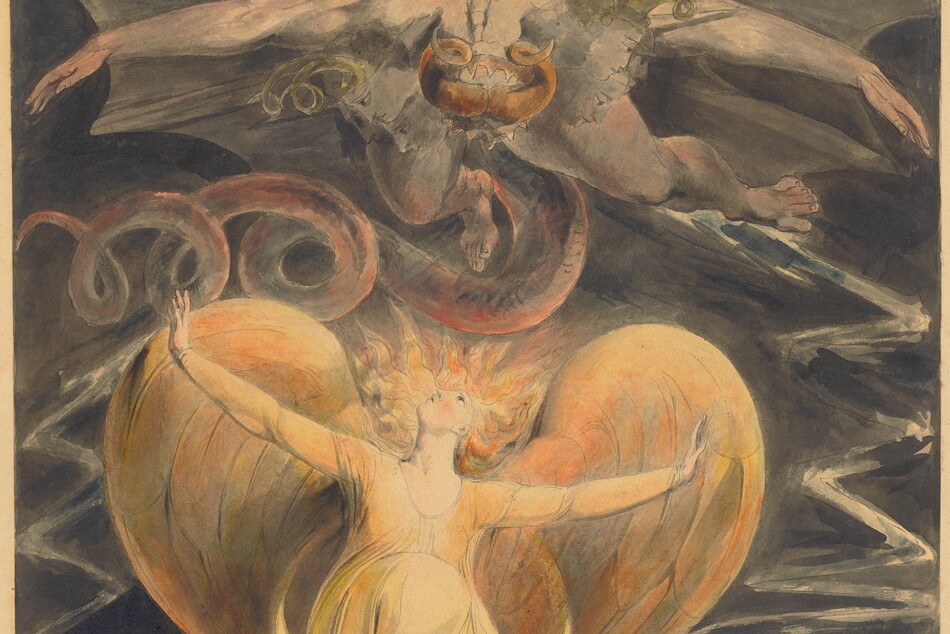
A winged woman, painted with tones of pale and butter yellow, kneels on a rock and looks up at a winged, horned creature with steel-gray skin and a curling tail flying above her in this vertical, graphite and watercolor work on paper. The woman, her body facing us, takes up most of the bottom half of the composition, and the winged creature the top half. The woman’s long blond hair flies up around her upturned face like stylized rays of sunlight. Her arms are spread wide, wrists flexed so her palms face out, and her pale, apricot-colored wings curve up over her shoulders and tuck behind her in a heart shape. She rests on a crescent moon with the tips pointing upward, which, in turn, rests on a gray, squared rock. Mirroring her pose but flying so his body faces downward as his feet point away from us, the creature above the woman has a muscular, humanoid physique. His long tail curls to our left in three loops, and is shaded with pale maroon red. Ram’s horns curve up from inside a golden crown encircling the top of his head, which faces us. Upon closer inspection, several faces, drawn with graphite and filled with nickel-gray watercolor, are connected around the creature's neck and also look down in profile onto the woman. The profiles overlap and some of the heads have moss-green, curling horns. The tips of the flying creature's outstretched fingers and arms nearly touch the sides of the paper and his light, rose-colored bat-like wings extend off both sides and the top of the composition. The background behind the pair is dark gray with white zigzagging lines to the left and right of the woman. Faces also emerge from the ground, looking up from the lower right corner. The artist signed his initials in black paint near the lower left: “WB.”

Drawings

The National Gallery’s 31,000 drawings, watercolors, and pastels date from the eleventh century to the present, including some of the finest Italian, German, and French works in this country, as well as important works by Winslow Homer and Georgia O’Keeffe and sizeable holdings of post-war American works on paper.
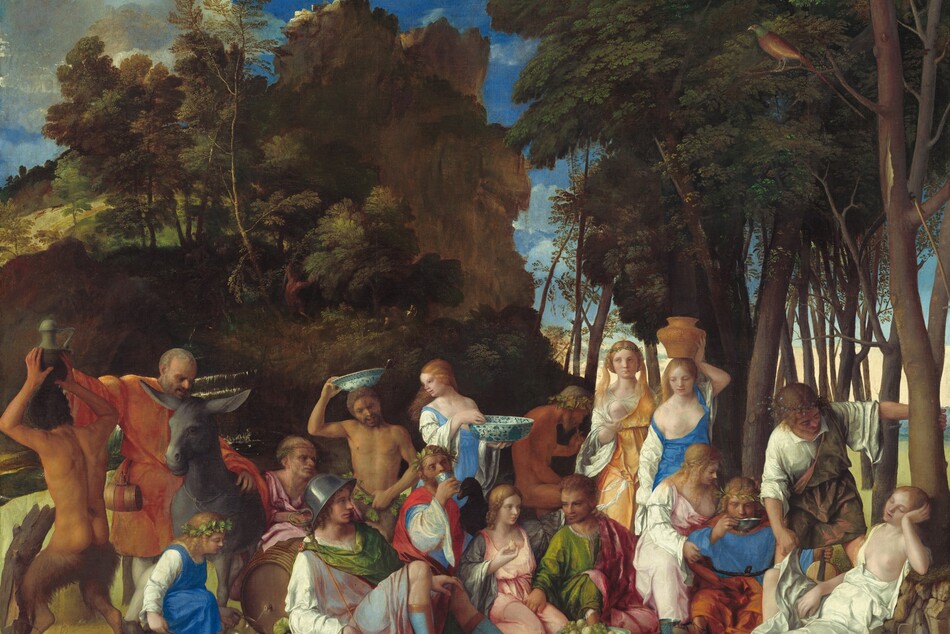
Six women, eight men, two satyrs, and one child gather in pairs and trios in a loose row that spans the width of this nearly square painting. They are set within a landscape with craggy rocks, cliffs, and trees. Most of the people face us, and the men, women, and child have pale skin. The two satyrs have men’s torsos and furry goat’s legs, and they have darker, olive complexions. Most of the men wear voluminous, knee-length togas wrapped in short robes in shades of white, topaz blue, grass green, coral orange, or rose pink. Most of the women wear long, dress-like garments in tones of shell pink, apricot orange, or lapis blue over white sleeves. For all but one woman, their garments have fallen off one shoulder to reveal a round, firm breast. Several objects are strewn on the rocky, dirt ground in front of the group, including a wide, wooden bucket with a piece of paper affixed to its front to our right, a glass goblet, a pitchfork, a large blue and white ceramic dish filled with grapes and small yellow fruits, and an overturned cup near the center. Cliff-like, craggy rocks rise steeply behind the group to our left, filling much of the sky opposite a tall grove of leafy, dark green trees to our right. A few puffy white clouds float across the vivid blue sky. The slip of paper on the barrel has been inscribed, “joannes bellinus venetus p MDXIIII.”

Paintings

The National Gallery of Art’s painting collection, like the museum itself, began with Andrew W. Mellon (1855–1937). When the National Gallery opened to the public in 1941, the 121 old master paintings that Mellon had given to the nation were on view.
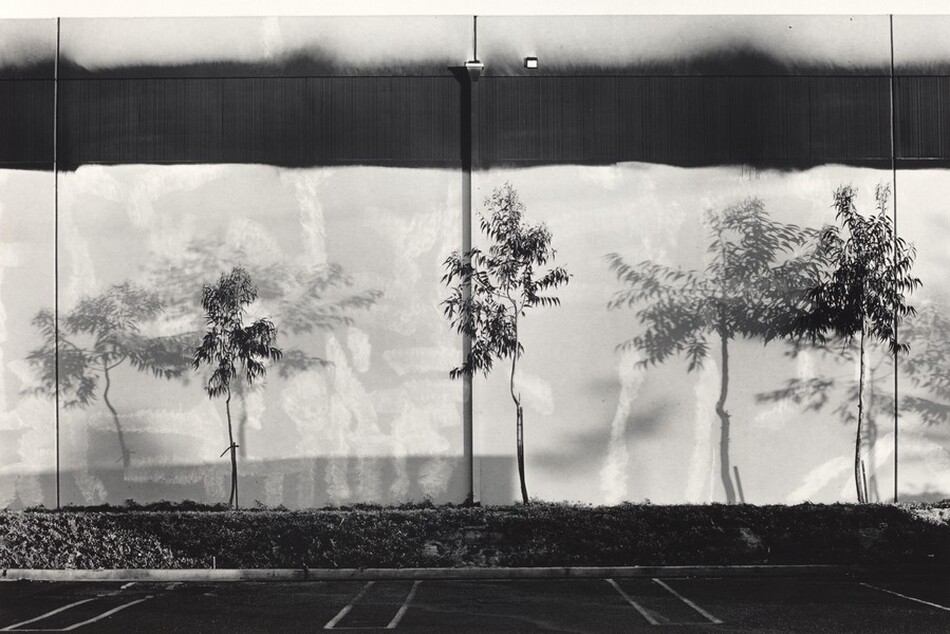
The image shows a view from just above ground level looking at a tall wall. The horizon is formed by the division between the ground and the wall, with a parking lot and greenery at the bottom third of the frame. Small trees are planted along the base of the wall, casting shadows that dominate the upper parts of the image. The wall has a dark band across its top section, contrasting with the lighter textured surface below the shadows. The image is in black and white, emphasizing strong contrasts, sharp lines, and dramatic light and shadow interplay.

Photographs

In 1990 the National Gallery launched an initiative to acquire the finest examples of the art of photography and to mount photography exhibitions of the highest quality, accompanied by scholarly publications and programs.
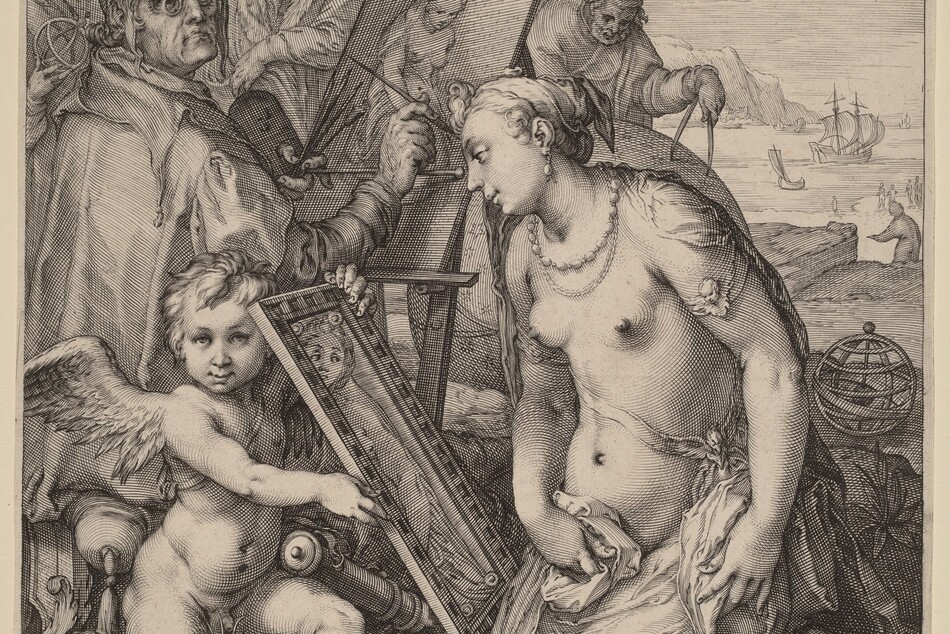
This is a print of an allegorical scene featuring various symbols of arts and sciences. Closest to us, there is a winged cherub holding a rectangular mirror up to a kneeling, semi-nude woman on the right who is draped in fabric. The woman seems to look down at her reflection in the mirror. Behind the cherub, an old man appears to paint the woman, looking towards her as he holds his brush up to the canvas. Three more men are partially visible behind him, all seeming to use tools related to measurement. More tools and objects are scattered on the ground. There is a cat sitting near the bottom-left corner, and a bird flying in the sky near the upper-right corner. In the sky above is a radiant sun, casting light over the background of mountains and a calm sea with ships.

Prints

The National Gallery’s 75,000 prints and rare illustrated books provide the broadest survey of the history of American and European art, with comprehensive collections of works by Albrecht Dürer, Rembrandt, Giovanni Battista Piranesi, William Blake, Mary Cassatt, Edvard Munch, Jasper Johns, and Robert Rauschenberg.
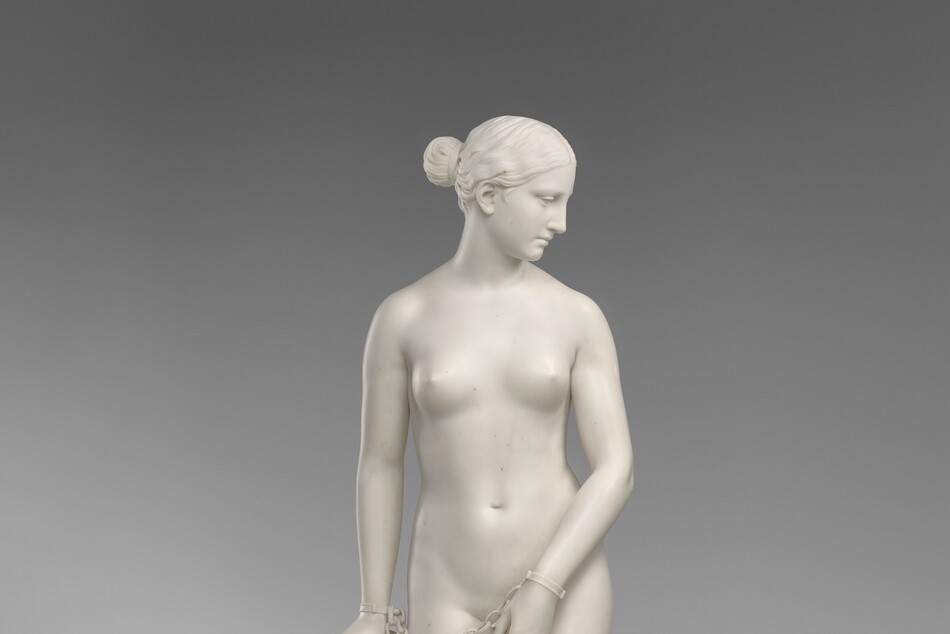
Carved from creamy white marble, a nude woman stands next to a hip-high support, perhaps a low post. In this photograph, her body faces us, and she looks down to our right in profile. Her wavy hair is tucked behind her ear and drawn back in a bun at the nape of her neck. Her weight rests on her left leg, on our right, and her other knee is bent. Her left arm is angled in front of her body so her hand covers her groin. Her other hand, on our left, rests on the post. Chains hang from shackles encircling her wrists. The post is covered with a cloth that gathers around the top and spirals to the ground beneath her feet, the edge trimmed with tassels. A cross and medallion peek out from under the cloth near her hand. She stands on a circular base.

Sculpture

The Gallery opened in 1941 with only about 30 sculptures. Yet the names of three great Renaissance artists appeared among them: Mino da Fiesole, Desiderio da Settignano, and Verrocchio. These were the seeds of what grew to become one of the finest collections of Italian Renaissance sculpture in the United States.
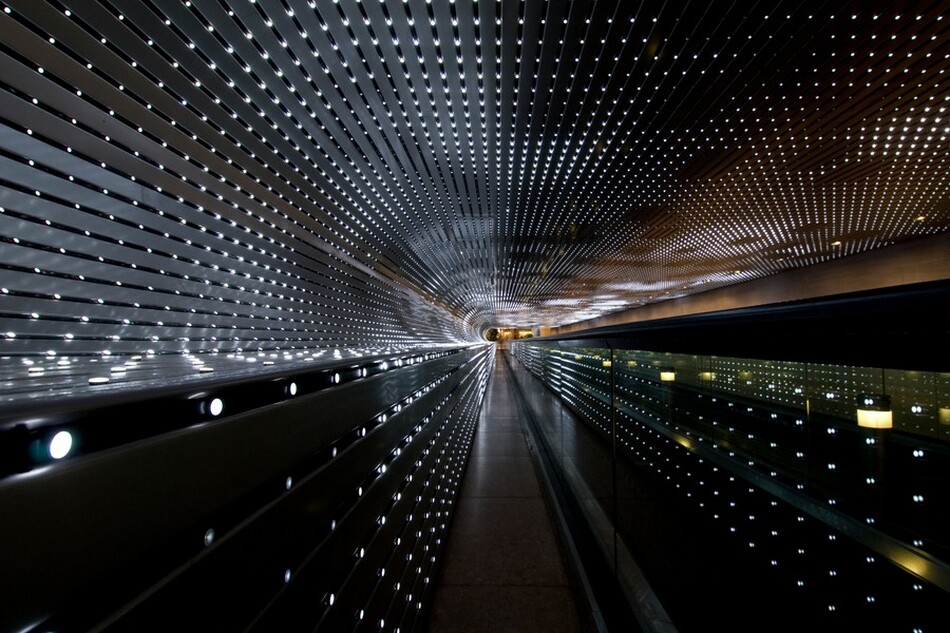
We look through a tunnel lined with dozens of strings of bright white lights nestled in silver-gray slats that zoom away from us in this horizontal photograph. At the far end of the tunnel, at the center of the photograph, the alternating lines of lights and slats almost come together around a narrow, capsule-shaped area of golden yellow light. The flat ceiling curves down to meet the wall to our left. The curve continues to make a C-shape before extending straight down the remaining height of the wall, turning the profile of the open space into a backward-facing P. Some of the lights are bright, some fading, and some are off to create a loose pattern of dark squares floating in a field of light. The lights seem brighter at the far end of the tunnel. The overall impact of the view is a starburst radiating in diagonal lines, coming from a point at the center of the photograph.

Time-Based Media Art

Time-based media art depends on technology and has a durational element that is experienced by viewers over time. The Gallery’s small but growing collection reflects artists’ diverse use of technology to create captivating and thought-provoking work.