American Art 1900–1950

Filter Results

38 artworks on view.

Results

This nearly square painting shows an industrial area with buildings, storage silos, a smokestack, and railroad tracks. A mound of brown dirt or other material is in shadow in the lower left corner of the painting. Next to the mound, railroad tracks extend diagonally from the lower center of the painting into the distance to our right. The tracks end at a white building with staggered gray rooflines to our right in the distance. A tall terracotta-red smokestack rises high beyond the white building, smoke pouring out of its top and blending into the clouds above. Just beyond the mound of dirt, piles of white material, perhaps in unseen bins, line the railroad track to our left and lead back to a row ten interconnected, coral-orange silos. The horizon comes about halfway up the painting, and it is lined with a row of long white and gray warehouses. The artist signed and dated the work with brown paint in the lower right corner: “Sheeler 31.”

Classic Landscape

Charles Sheeler

1931

Oil on canvas  Accession ID  2000.39.2

On View: East Building Ground Level, Gallery E106
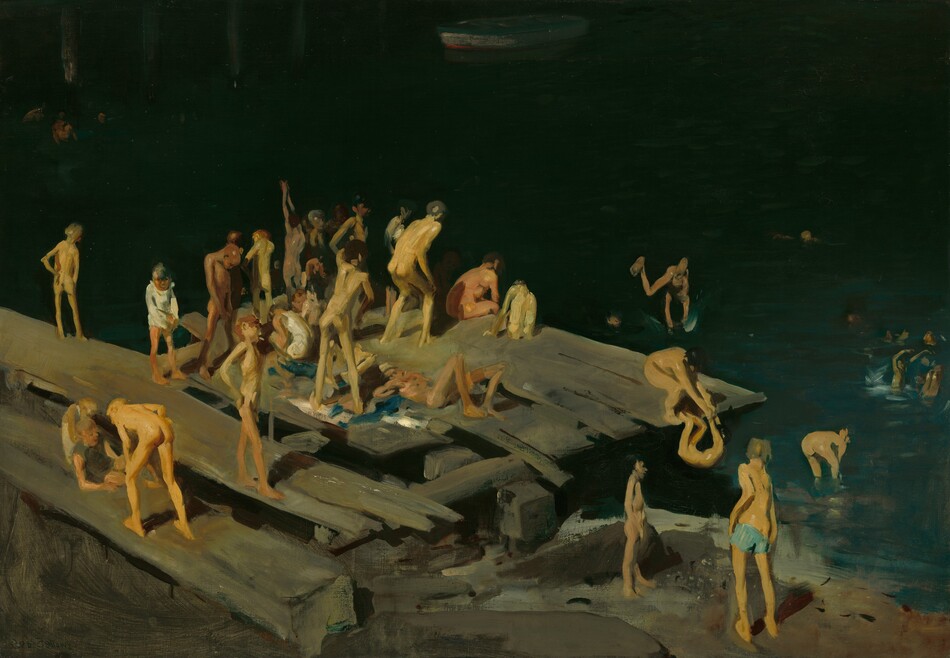
From a high vantage point, we look down ontp a group of dozens of boys who stand, sit, stretch, sprawl, or dangle their legs off a rough wooden pier that juts out from the lower left corner into a dark river in this horizonal painting. Their gangly bodies are loosely painted and brightly lit from the upper left. Most are nude, their skin tones ranging from cream white to medium brown. There are gaps between some of the planks of pier, and some of the boards hang off the sides, as if laid loosely across the supports beneath. One boy dives into the river near the center of the painting while another bends over to pull a boy back onto the pier. Several splash in the water near the right side of the painting. The river is emerald green near the brightly lit pier and becomes almost black across the upper half of the painting. An empty, small rowboat painted in stripes of white, white, and blue floats in the shadows along the top center edge of the canvas.

Forty-two Kids

George Bellows

1907

Oil on canvas  Accession ID  2014.79.2

On View: East Building Ground Level, Gallery E106
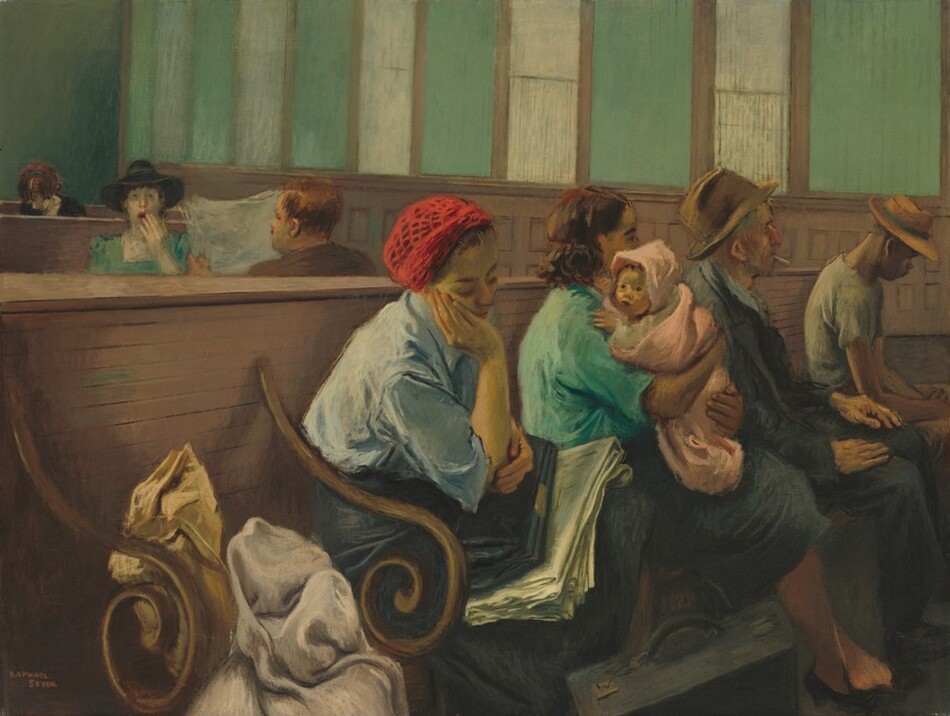
This is a painting of people sitting in a waiting area on long wooden benches, each engaged in their own thoughts. In the center, a woman in a red knit hat and a blue shirt rests her head on her hand, her bent arm placed on top of a blue bag and a folded newspaper stacked in her lap. There is a gray suitcase by her feet. On the right, a woman in a bright green-blue shirt faces away from us, holding a small infant wrapped in a light pink blanket. The child looks toward the woman in the red hat, their small eyes wide. Two more people sit on the right of this bench, with three more people sitting on other benches in the background. They smoke, doze, read newspapers, or yawn. Most of these people have pale yellow or white skin, but one man on the far right appears to have light brown skin. The benches have ornate, curling armrests, and the room is softly lit by large windows. The walls between the windows are a light seafoam green shade, with brown paneling in the lower half.

A Railroad Station Waiting Room

Raphael Soyer

c. 1940

Oil on canvas  Accession ID  2015.19.69

On View: East Building Ground Level, Gallery E106
A landscape seen through sheer lace curtains that billow in toward us from an open window nearly fills this horizontal painting. The window is angled slightly downward as it extends off the right side of the composition, so it does not line up with the edges of the rectangular painting. The narrow strip of dove-gray wall to the left of the window casement is cracked near the simple, deep gray molding that surrounds the window. Slivers of light peek through rips in the dark shade that covers upper third of the window. The right curtain panel surges toward us as the left panel flutters lightly off to our side. The inner edges are trimmed with subtle lace birds and flowers. The window looks down onto an expanse of olive-green grass and dark green trees line the far edge of the field. Tire tracks cross the field from near the lower left corner of the painting to our left, and into the distance to meet a sliver of white, perhaps a body of water.

Wind from the Sea

Andrew Wyeth

1947

Tempera on hardboard  Accession ID  2009.13.1

On View: East Building Ground Level, Gallery E106
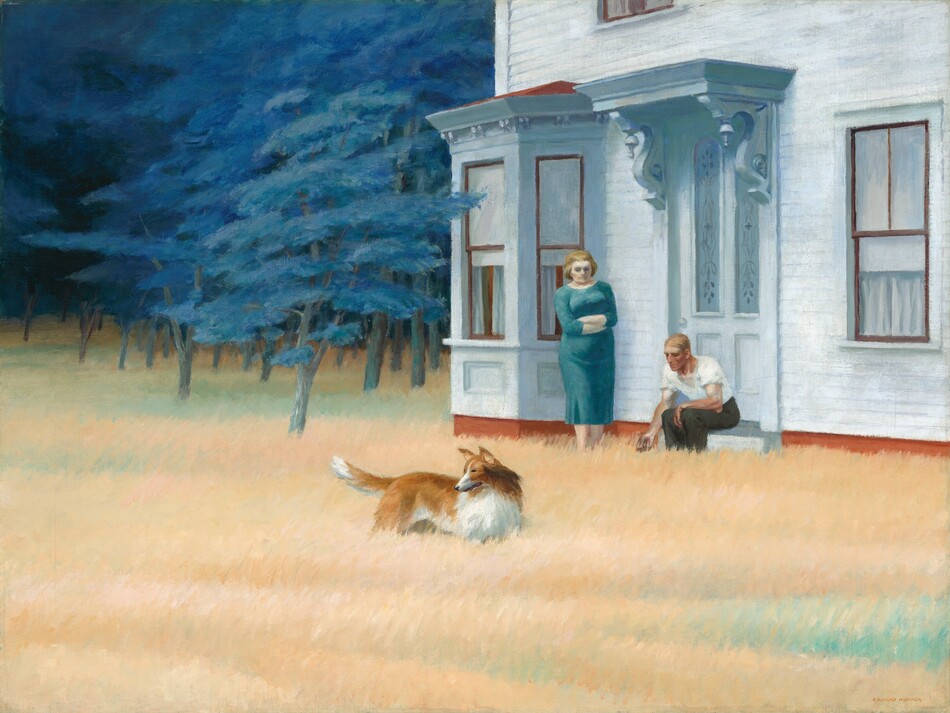
A light-skinned man and woman and a collie dog are outside a white house at the edge of a pale peach field of grass in this horizontal painting. Taking up a bit more than the top right quadrant of the composition, the house is white with pale blue shadows. Near the back, left corner of the house, the door has two tall, inset frosted glass panels and a shallow roof supported with scrolling, carved corbels. The door is flanked by a bay window on the left and a single window on the right. A shadowy grove of blue-green trees grows to the left of the house with one branch reaching toward the bay window. The woman faces us and stands between the bay window and door with downcast eyes and folded arms. Her blond hair is pulled or brushed back, and she wears a snug fitting, calf-length teal-blue dress. The man sits on the doorstep so his knees are angled to our left. His near arm drapes over his left knee and his far hand reaches toward the dog, his fingers and thumb touching. He has short blond hair and a ruddy face, and he wears a white t-shirt and olive-green pants. The dog stands in the middle of the field with its body angled to our right, its pointed ears and tail pricked up as it swivels its head to look to our left. It has an auburn-brown coat with white belly, chest, and tip of the tail. There are a few areas of spearmint green in the otherwise peach-colored grass, which is tall enough to brush the belly of the dog. The artist signed the lower right, “EDWARD HOPPER.”

Cape Cod Evening

Edward Hopper

1939

Oil on canvas  Accession ID  1982.76.6

On View: East Building Ground Level, Gallery E106
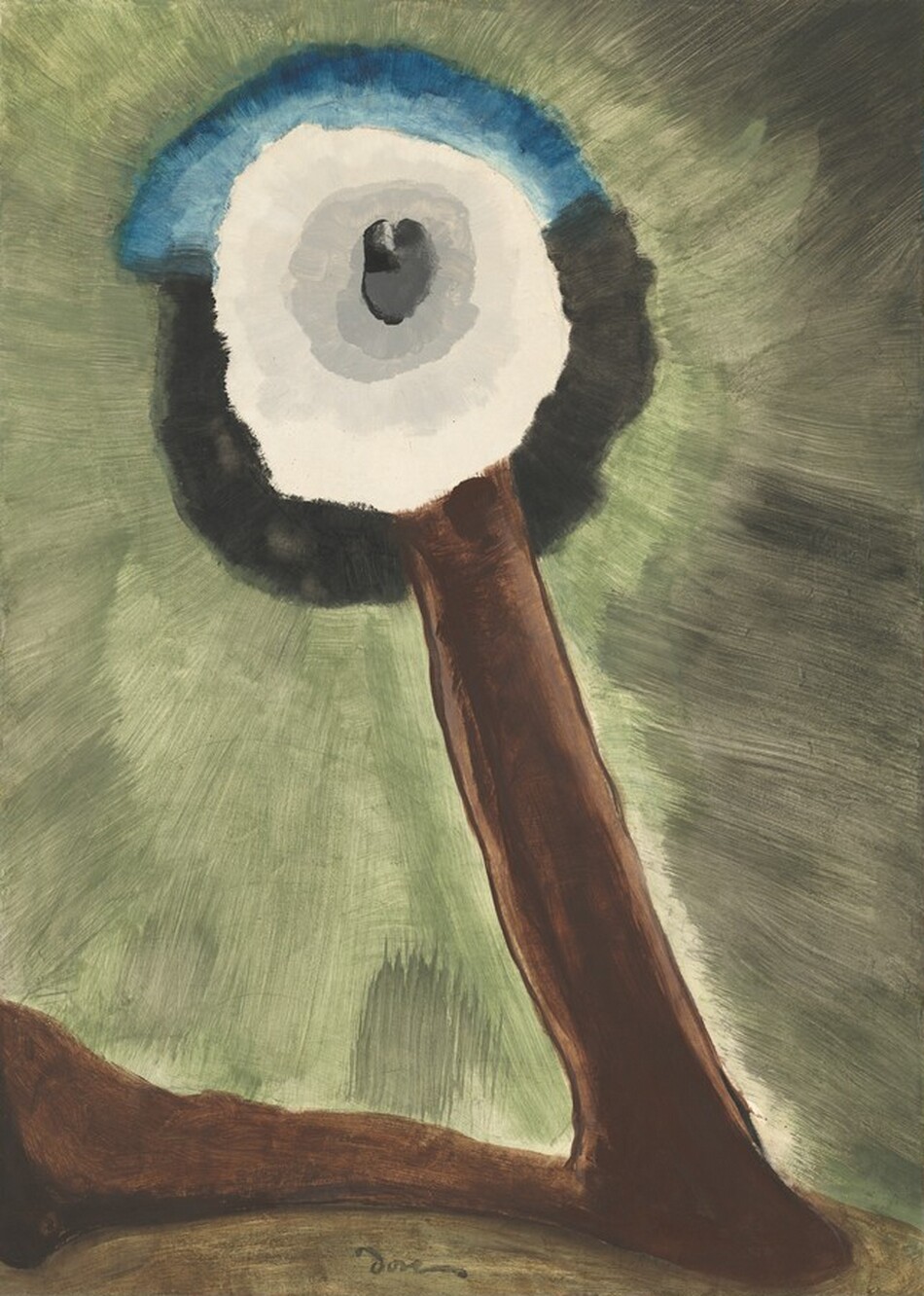
A brown tree trunk–like form rises diagonally from the bottom right corner of this vertical canvas and extends up to the top center of the composition, where it supports or overlaps a white disk in this abstracted painting. The disk has a dark gray, pupil-like dot at its center with rings of lighter gray around it, suggestive of the iris of an eye. Around the edges of the white disk is a band of azure blue on the top half and dark, charcoal gray on the bottom half.  Strokes in laurel and eucalyptus green emanate from the disk, suggesting rays. The brown trunk connects to a second long, brown form that nearly spans the bottom edge of the composition. The artist signed the bottom center of the painting, “Dove.”

Moon

Arthur Dove

1935

Oil on canvas  Accession ID  2000.39.1

On View: East Building Ground Level, Gallery E106
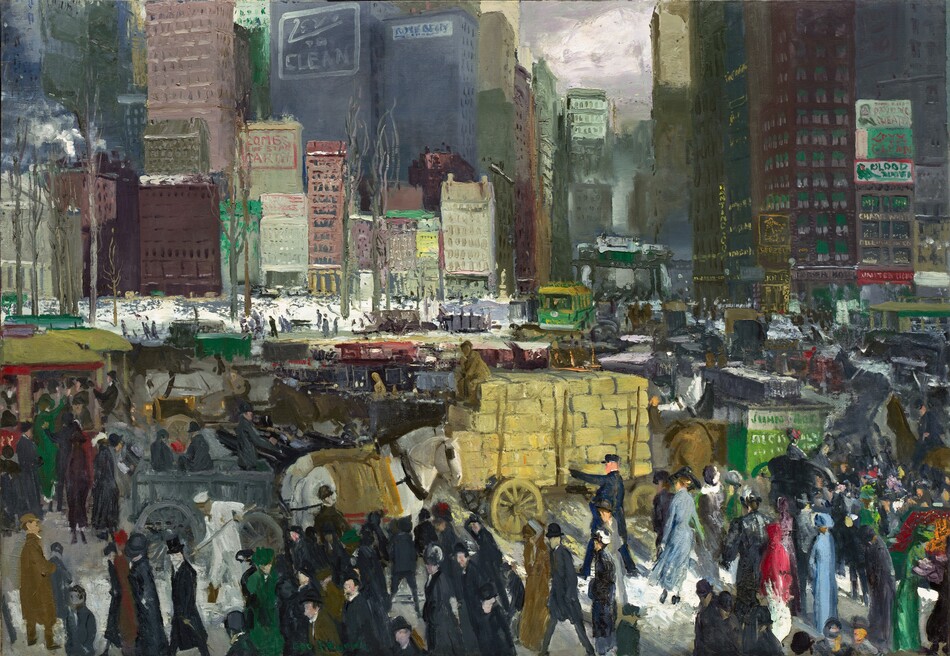
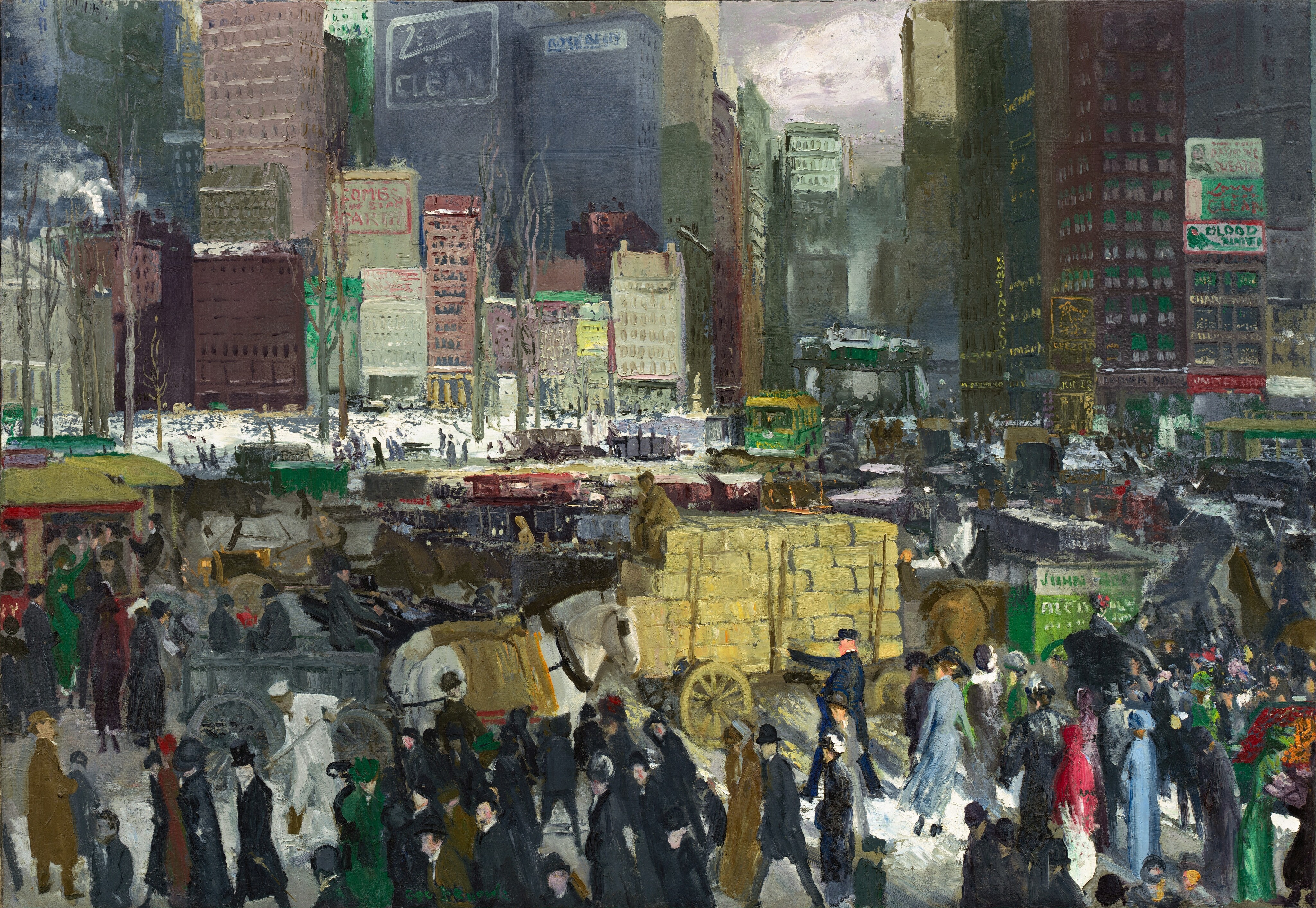
We look slightly down onto a crush of pedestrians, horse-drawn carriages, wagons, and streetcars enclosed by a row of densely spaced buildings and skyscrapers opposite us in this horizontal painting. The street in front of us is alive with action but the overall color palette is subdued with burgundy red, grays, and black, punctuated by bright spots of harvest yellow, shamrock green, apple red, and white. Most of the people wear long dark coats and black hats but a few in particular draw the eye. For instance, in a patch of sunlight in the lower right corner, three women wearing light blue, scarlet-red, or emerald-green dresses stand out from the crowd. The sunlight also highlights a white spot on the ground, probably snow, amid the crowd to our right. Beyond the band of people in the street close to us, more people fill in the space around carriages, wagons, and trolleys, and a large horse-drawn cart piled with large yellow blocks, perhaps hay, at the center of the composition. A little in the distance to our left, a few bare trees stand around a patch of white ground. Beyond that, in the top half of the painting, city buildings are blocked in with rectangles of muted red, gray, and tan. Shorter buildings, about six to ten stories high, cluster in front of the taller buildings that reach off the top edge of the painting. The band of skyscrapers is broken only by a gray patch of sky visible in a gap between the buildings to our right of center, along the top of the canvas. White smoke rises from a few chimneys and billboards and advertisements are painted onto the fronts of some of the buildings. The paint is loosely applied, so many of the people and objects are created with only a few swipes of the brush, which makes many of the details indistinct. The artist signed the work with pine-green paint near the lower left corner: “Geo Bellows.”

New York

George Bellows

1911

Oil on canvas  Accession ID  1986.72.1

On View: East Building Ground Level, Gallery E106
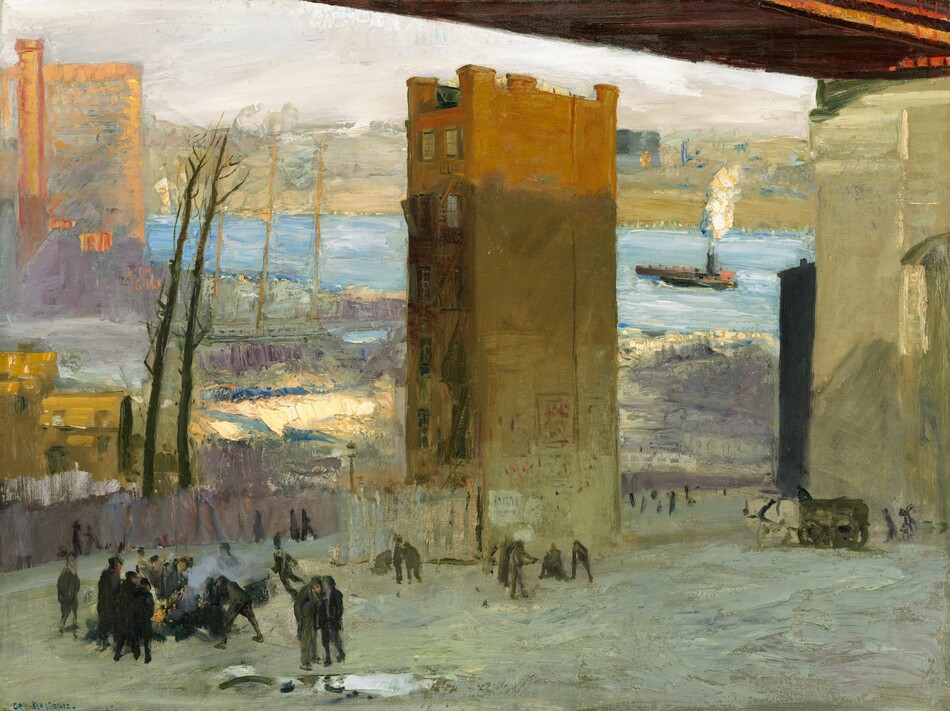
A six-story, narrow building stands alone in an otherwise unoccupied lot under the deck of a high bridge, with a river and cityscape in the background in this horizontal painting. Dozens of people, small in scale, are each painted with a few swipes of black and some with peach-colored faces. They gather at the foot of the building and around a fire to our left, near the lower left corner of the composition. The fire is painted with a dash of orange, a few touches of canary yellow, and a smudge of gray smoke. Several more people stand and sit against the building, which has a streetlamp near its entrance. The back end of the building angles away from us to our right, so we see the narrow, front entrance side to our left. Each of the six floors of the building has two windows with fire escape ladders on the narrow side we can see. Some strokes in red and white on the lower levels of the long, flat side of the building suggest signs or posters. The top story glows a warm sienna brown in sunlight, while the rest of the building and the scene below are in shadow. More people walk along a grayish-violet fence that encloses the lot beyond the building. The ground is painted thickly with slate gray, pale, sage green, and one smear of white to suggest snow. To our right and a short distance from us, a white horse pulls a carriage near the foot of the bridge. The ivory-white, concrete piling rises up and off the right edge of the canvas and supports the deck of the bridge above. Only a sliver of the brick-red underside of the bridge is visible, skimming the top edge of the painting in the upper right corner. Two twiggy, barren trees grow up beyond the muted purple fence, and the landscape beyond is bright in the sunlight. A terracotta-orange building rises along the left edge of the painting, with the area between it and the lot under the bridge filled with thickly painted patches of butter yellow, amethyst purple, and sage green. Beyond that, an ice-blue river flows across the composition. The shore beyond is lined with patches of beige and tan paint that could be buildings. A black tugboat puffs bright white smoke in the river. The sky above is frosty white. The artist signed the work with dark blue in the lower left corner of the painting, “Geo Bellows.”

The Lone Tenement

George Bellows

1909

Oil on canvas  Accession ID  1963.10.83

On View: East Building Ground Level, Gallery E106
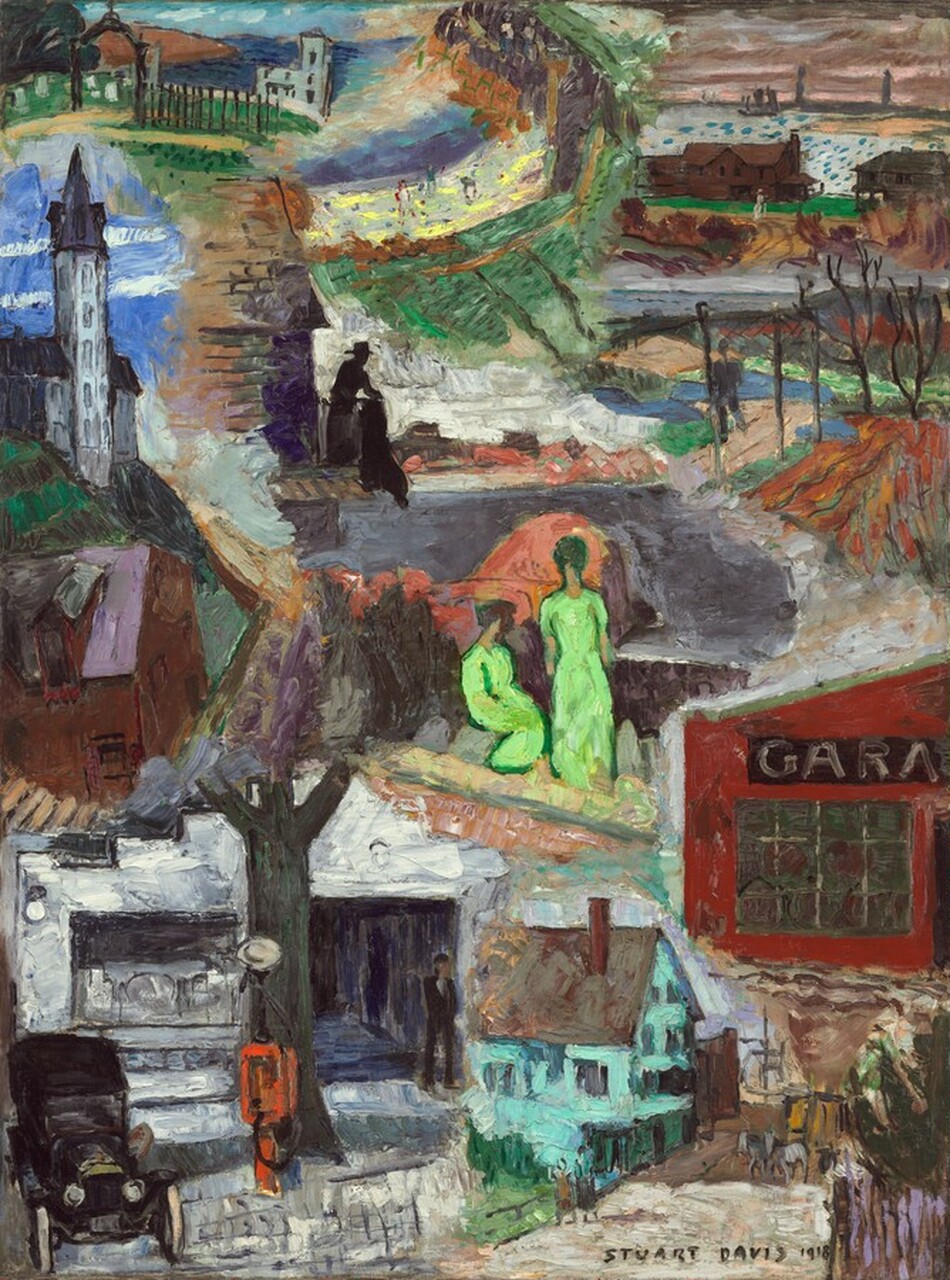
This vertical painting is made up of eleven vignettes loosely arranged in four rows. The scenes are roughly painted so many details are difficult to make out, and one flows into the other, creating a somewhat surreal impression. They seem to illustrate the people and places of a specific location. For example, just right of center are two women in acid-green dresses. One stands with her back to us while the other sits to our left with her head turned away . Directly above them, a man silhouetted in black stands at the corner of a purple and peach building. He wears a wide-brimmed hat and holds onto a tall black object that is hard to identify. He stands against an ivory-white sky with indistinct brown and coral-orange shapes below it. An area in tones of charcoal gray flows away from him toward the right. Another vignette in the upper right shows a black gate and fence that enclose a cemetery stretched out before a church. The lower left has a scene of a black Model-T car parked facing us in front of a white building. The structure has a large window next to a wide opening where a man in black coveralls leans against the right side. An orange, old-fashioned gasoline pump stands before a forest-green tree trunk to the right of the car. Finally, filling the lower right is a tan-colored street running past a turquoise-blue house with a peanut-brown roof. Quick strokes of color suggest two people in front of the house. Further back along the road are two nickel-gray horses. The overall palette is dominated by green, blue, white, black, red, orange, and brown. The artist signed and dated the lower right, “STUART DAVIS 1918.”

Multiple Views

Stuart Davis

1918

Oil on canvas  Accession ID  2008.124.1

On View: East Building Ground Level, Gallery E106
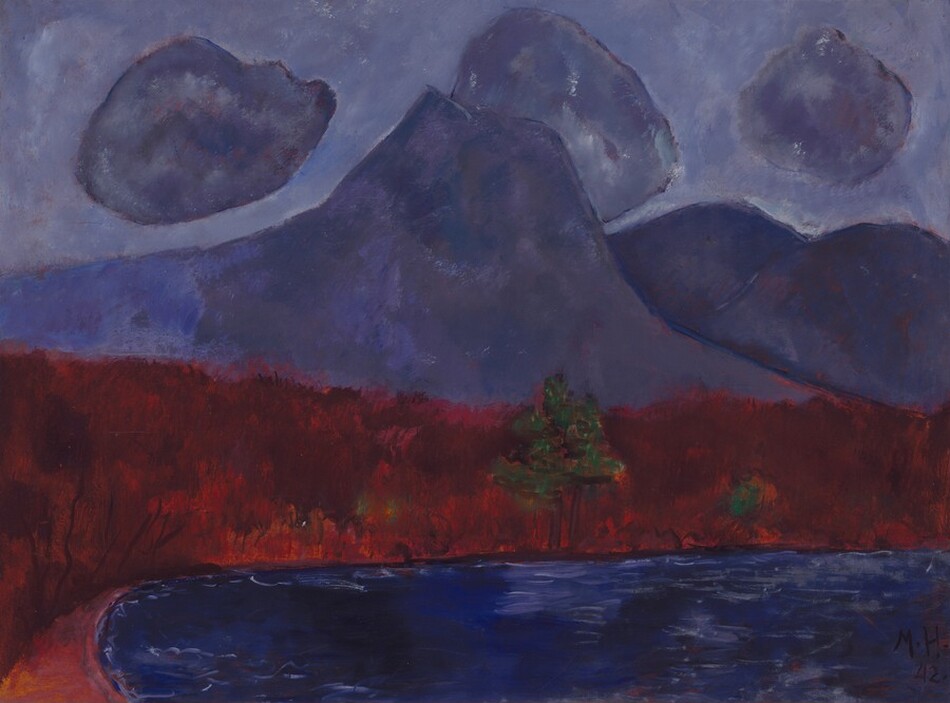
Amethyst-purple mountains and clouds against a slightly lighter, lavender-purple sky loom over a strip of land painted as bands of brick red and royal blue in this abstracted, horizontal landscape painting. One tall peak with a flattened top rises in front of a few more lower, rounded peaks to our right. Round clouds, like cotton balls, in the same amethyst-purple of the mountains, float against the lighter purple sky. The sky, clouds, and mountains are painted with areas of mottled purple over a red underlayer, all outlined in lapis blue. The horizon line created by the strip of deep red land comes about halfway up the composition. There is a pair of green trees with triangular canopies at the water’s edge near the center of the red band. A few touches of forest-green nearby suggest more trees or bushes. The red band is streaked vertically with visible brushstrokes in flame, ruby, and burgundy red. Along the bottom edge of the painting, the land curves toward us near the lower left corner, around a field painted with horizontal streaks of cobalt and navy blue with a few thin, white lines to suggest ripples. The artist signed and dated the painting in the lower right corner: “M.H. 42.”

Mount Katahdin, Maine

Marsden Hartley

1942

Oil on hardboard  Accession ID  1970.27.1

On View: East Building Ground Level, Gallery E106
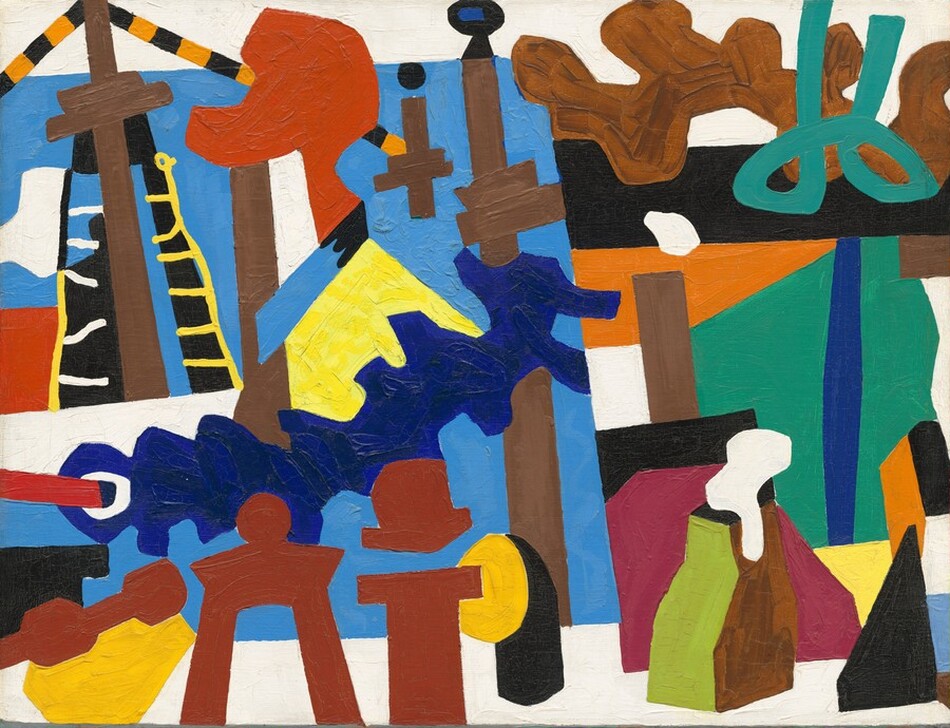
Vividly colored, curved and straight-edged geometric shapes are piled and layered against a background of chalk white in this horizontal abstract composition. The paint is applied thickly with visible brush strokes. The shapes that fill the canvas are painted in flat areas of canary and buttercup yellow, cobalt blue, beet and brick red, pumpkin orange, kelly green, white, or black. Three vertical, cinnamon-brown bands are spaced along a sky-blue square, which nearly spans the left half of the composition. The tall brown forms can be read as masts while some of the other shapes can be the water, sails, rigging, anchors, and the forms of ships.

Study for "Swing Landscape"

Stuart Davis

1937-1938

Oil on canvas  Accession ID  2014.79.15

On View: East Building Ground Level, Gallery E106
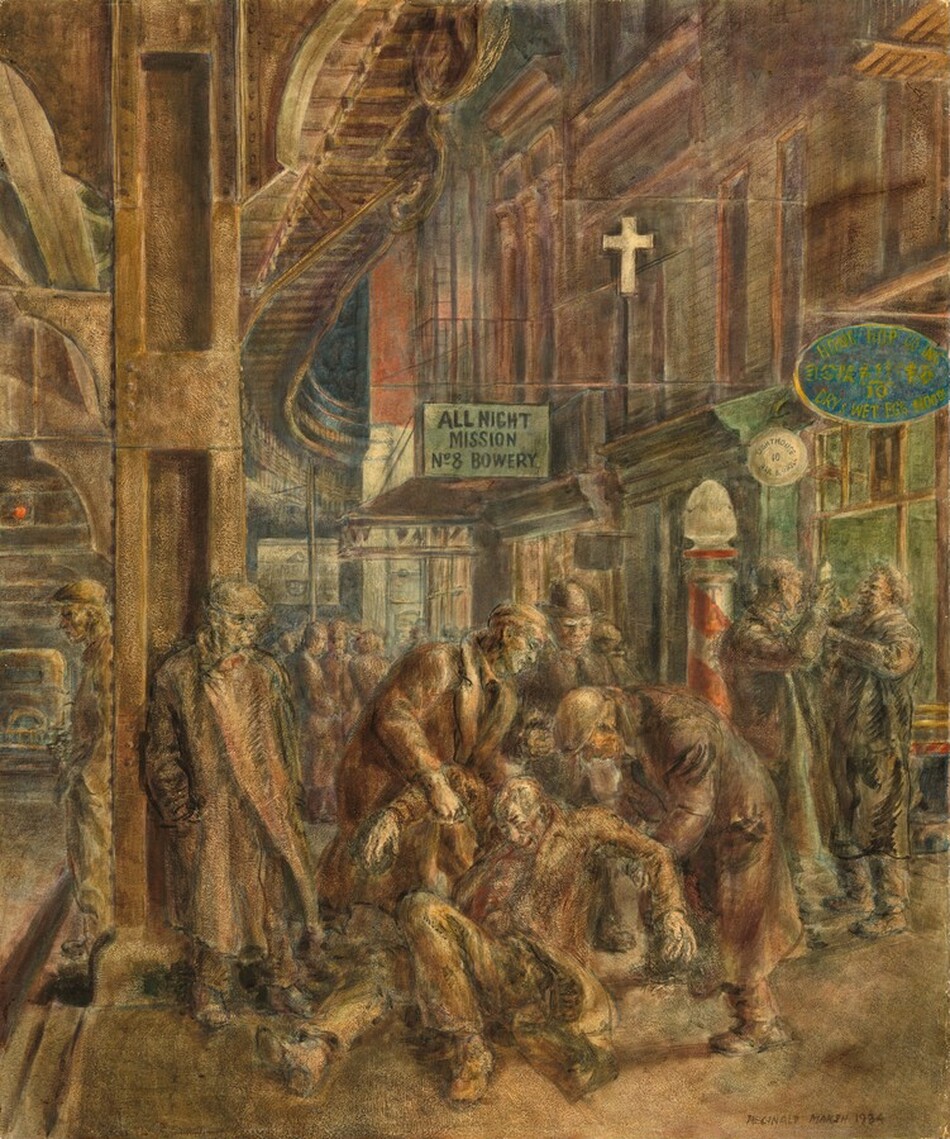
This is a painting of a busy urban street scene under an elevated train track at night. In the center, a group of people is clustered around a man on the ground. Two men hold his arms. Other people behind them look on or speak with one another. In the background is a blue sign advertising an "ALL NIGHT MISSION" near a large white cross. The colors are muddy and muted, with most of the scene painted in shades of brown.

Smokehounds

Reginald Marsh

1934

Egg tempera on hardboard  Accession ID  2014.136.78

On View: East Building Ground Level, Gallery E106

Loading Results