Corcoran Legacy Gallery

Filter Results

12 artworks on view.

Results

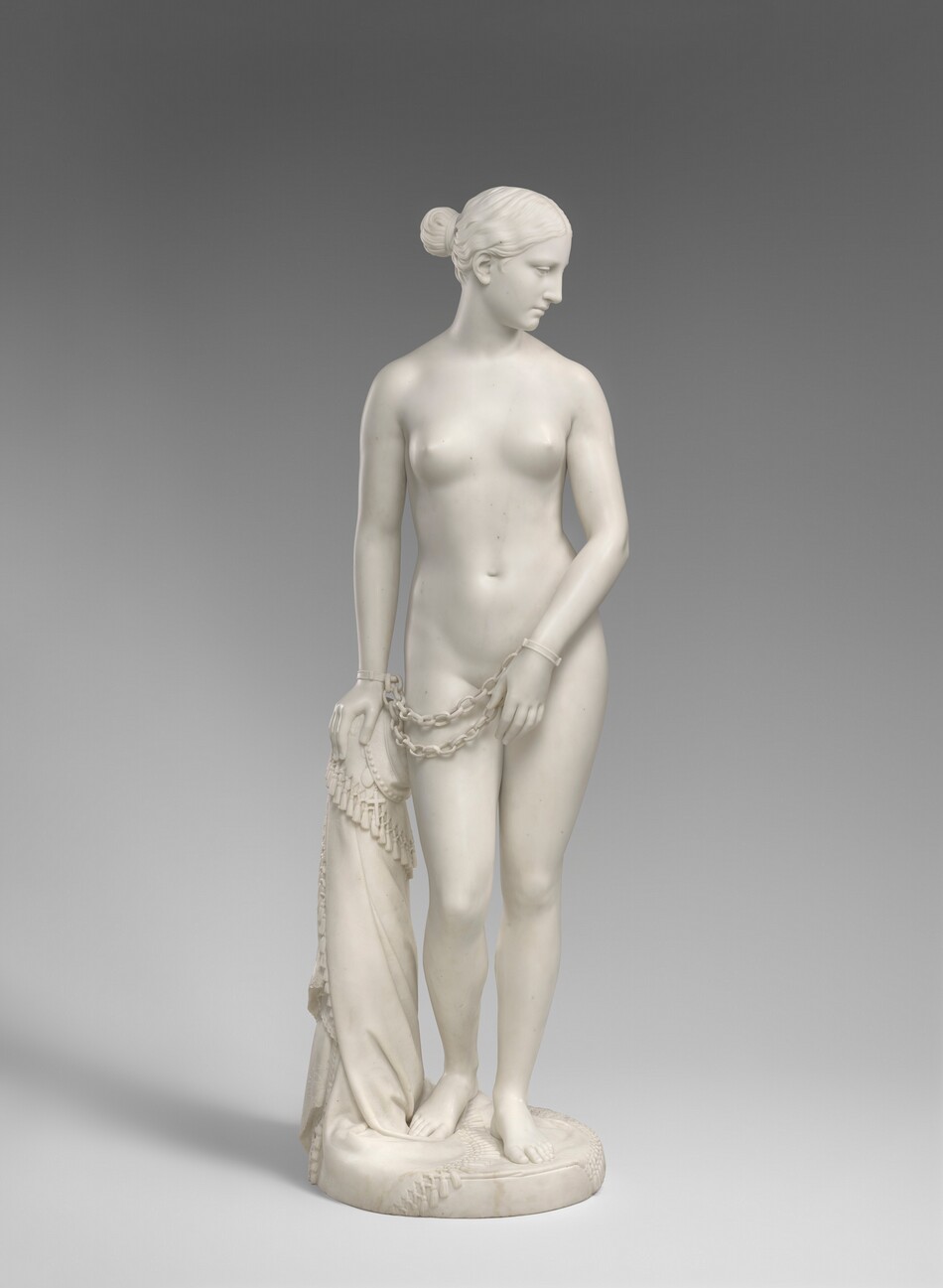
Carved from creamy white marble, a nude woman stands next to a hip-high support, perhaps a low post. In this photograph, her body faces us, and she looks down to our right in profile. Her wavy hair is tucked behind her ear and drawn back in a bun at the nape of her neck. Her weight rests on her left leg, on our right, and her other knee is bent. Her left arm is angled in front of her body so her hand covers her groin. Her other hand, on our left, rests on the post. Chains hang from shackles encircling her wrists. The post is covered with a cloth that gathers around the top and spirals to the ground beneath her feet, the edge trimmed with tassels. A cross and medallion peek out from under the cloth near her hand. She stands on a circular base.

The Greek Slave

Hiram Powers

model 1841-1843, carved 1846

Seravezza marble  Accession ID  2014.79.37

On View: West Building Main Floor, Gallery M71
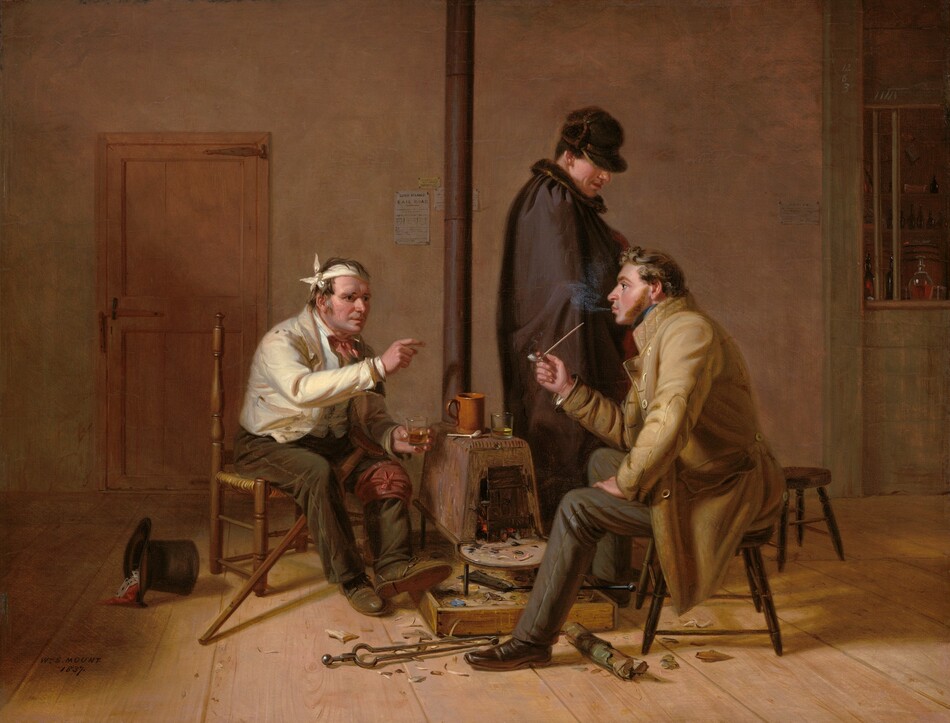
Three light-skinned men, one with his head and knee bandaged, sit and stand around a rusty, free-standing stove in a room with wide plank floors in this horizontal painting. In the center of the room and painting, glowing embers burn in the box-like stove and a long chimney pipe extends up off the back. A glass with amber liquid, a clay-brown mug, and a long, white pipe rest on top of the stove. To our left of the stove, the injured man sits on a broken-backed chair with his feet angled to our right. He leans forward and points at the man sitting across from him with his right hand. In his left hand, farther from us, he holds a half empty glass, also with amber-colored liquid. His head is wrapped in white cloth and his left knee in a red cloth. He rests that foot on the platform beneath the fireplace, and a wooden crutch leans on his leg. He has ash-brown hair and a five o’clock shadow. He has a rose-pink cravat tied at his throat and wears a cream-colored jacket over a white vest, olive-green pants, and brown shoes. To our right of the stove, a second man sits on a stool, his body angled to our left. He leans forward toward the other man with his feet straddling the platform under the stove. One hand is propped on his thigh and he leans on his other leg with his elbow, smoking a pipe held in that hand. He has curly blond hair, long sideburns, a long, prominent nose, and smoke wafts from his pursed lips. He appears to look past the injured man. He wears a camel-brown coat, charcoal-gray pants, and black shoes. A third man stands behind the smoking man. His body is angled to our right so he stands with his back to the injured man, has face in profile. His head is tipped down so his eyes are hidden under the brim of his hat, and he smiles slightly. He wears a dark brown cloak trimmed with fur and a fur hat with ear flaps folded up. In front of the stove, fire tongs, a log, and wood shavings litter the floor. To our left of the injured man, a black top hat lies on its side with playing cards and a spotted red handkerchief spilling out. Along the back wall, to our right, a built-in cabinet is filled with clear and dark glass bottles and small wooden barrels. A notice has been affixed to the taupe-brown wall, beyond the stove. It begins, “LONG ISLAND RAILROAD,” and is then indistinct. Two other slips of paper with indistinct writing have been nailed to the wall nearby. The artist signed the painting in the lower left corner: “Wm. S. Mount 1837.”

The Tough Story - Scene in a Country Tavern

William Sidney Mount

1837

Oil on wood  Accession ID  2014.79.28

On View: West Building Main Floor, Gallery M71
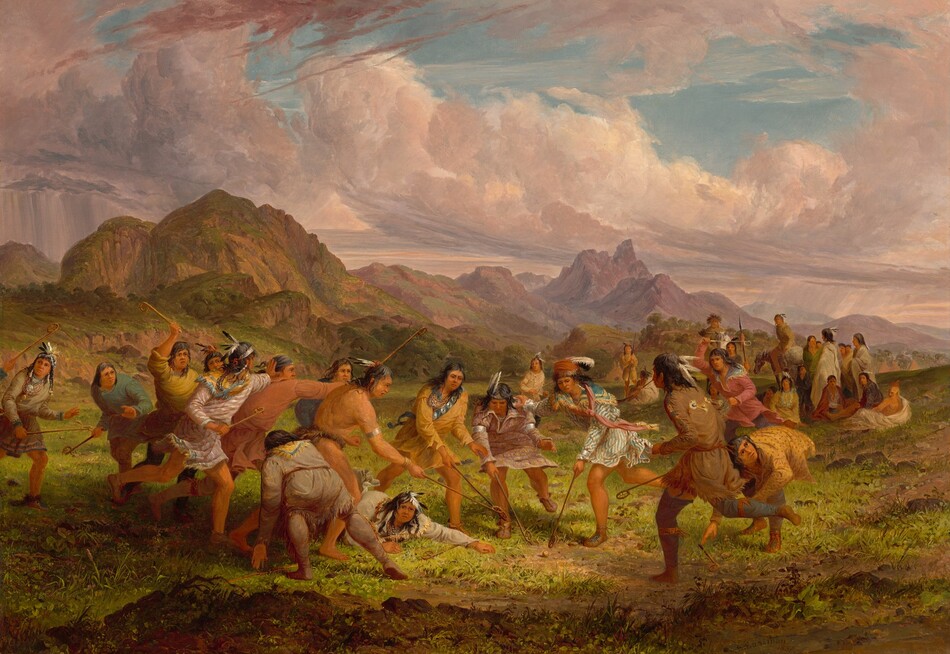
This painting shows a scene with people engaged in a sport or game. The people wear vibrant clothes in shades of brown, orange, yellow, pink, and green, embellished with feathers and silver jewelry. The people all have light brown skin and long dark hair, and many of them have feathers in their hair. All the people in the middle of the painting hold sticks with small nets at the end, and they all appear to be lunging towards a small ball on the ground. In the background is a dramatic landscape with tall purple mountains, green hills, and large pink-and-white clouds sweeping across the blue sky.

Ball Playing among the Sioux Indians

Seth Eastman

1851

Oil on canvas  Accession ID  2014.79.46

On View: West Building Main Floor, Gallery M71
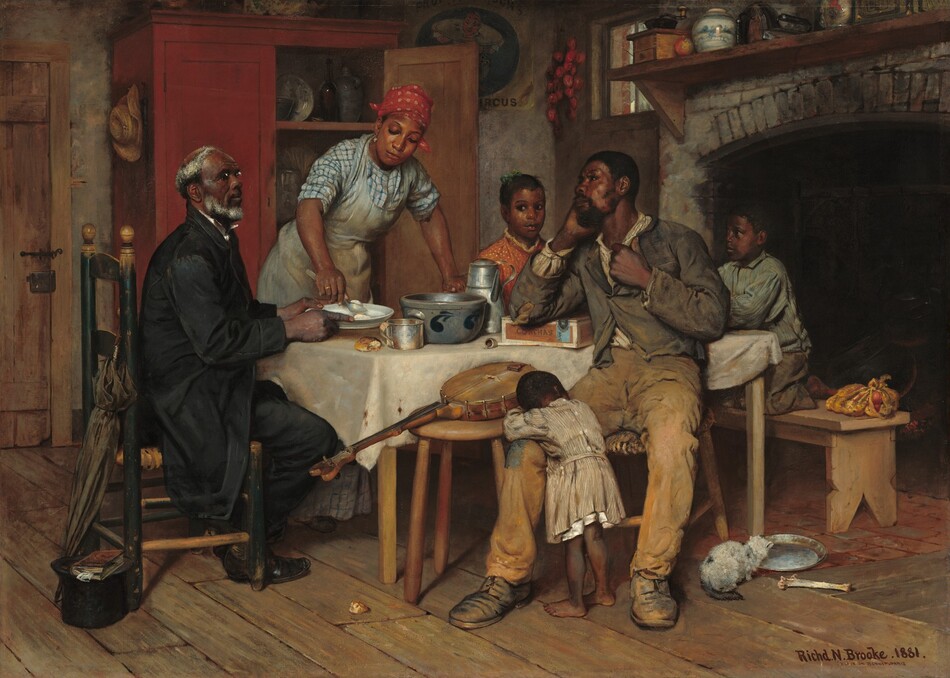
Two men, a woman, and three children, all with brown skin, gather around a table in a house in this horizontal painting. A bespectacled, white-haired man sits to our left, wearing a black coat and suit. He looks up and to our right, his chin slightly lifted. A black top hat and a book sit near his feet, and a gray umbrella leans against the back of his worn wooden chair. Opposite him, to our right, a younger man has short black hair and a trimmed beard. He props one elbow on a cigar box on the table and rests his chin in that hand. With his other hand, he grasps the lapel of his slate-blue jacket, which is worn over a cream-white shirt. There is a patch in one elbow of the jacket and on one of the knees in his tan-colored pants. Two small children gather around him. The smallest child turns away from us as they rest their folded arms and head on one of the man's knees. That child wears a knee-length, dress-like garment striped with parchment brown and beige. Behind the man, to our right, a slightly older boy kneels on a bench on the far side of the table and rests his elbows on the white tablecloth. That boy wears an aquamarine-blue shirt and dove-gray pants. Both children are barefoot. On the far side of the table, near the older man, a woman stands and leans forward to spoon food into the white dish he holds. She wears a red kerchief tied around her head and a fog-blue apron over a white shirt patterned with a muted indigo-blue grid. A young girl, the oldest child, stands on the far side of the table between the younger man and woman. Seen from the chest up, the girl's face and body are angled to our right, toward her father, but she looks to our left from the corners of her eyes. She wears a coral-red, high-collared garment with white polka dots. On the table is a serving bowl, cup, and a kettle. Behind the woman, one door of a tall  brick-red cupboard is ajar. Plates and vessels line the shelves within. A fireplace to the right has an opening as tall as the stooping woman. The mantle is lined with a manual coffee grinder, a white jar painted with a blue design, and clothes irons. A circus poster hangs behind the open door of the cupboard. A string of dried red chilis hangs next to a window between the poster and fireplace mantle. A banjo rests on a stool in front of the table, and a white cat licks a pie plate near the father's feet. The aritst signed and dated the painting in the lower right corner, "Richd. N. Brooke. 1881 (ELEVE DE BONNAT - PARIS)."

A Pastoral Visit

Richard Norris Brooke

1881

Oil on canvas  Accession ID  2014.136.119

On View: West Building Main Floor, Gallery M71
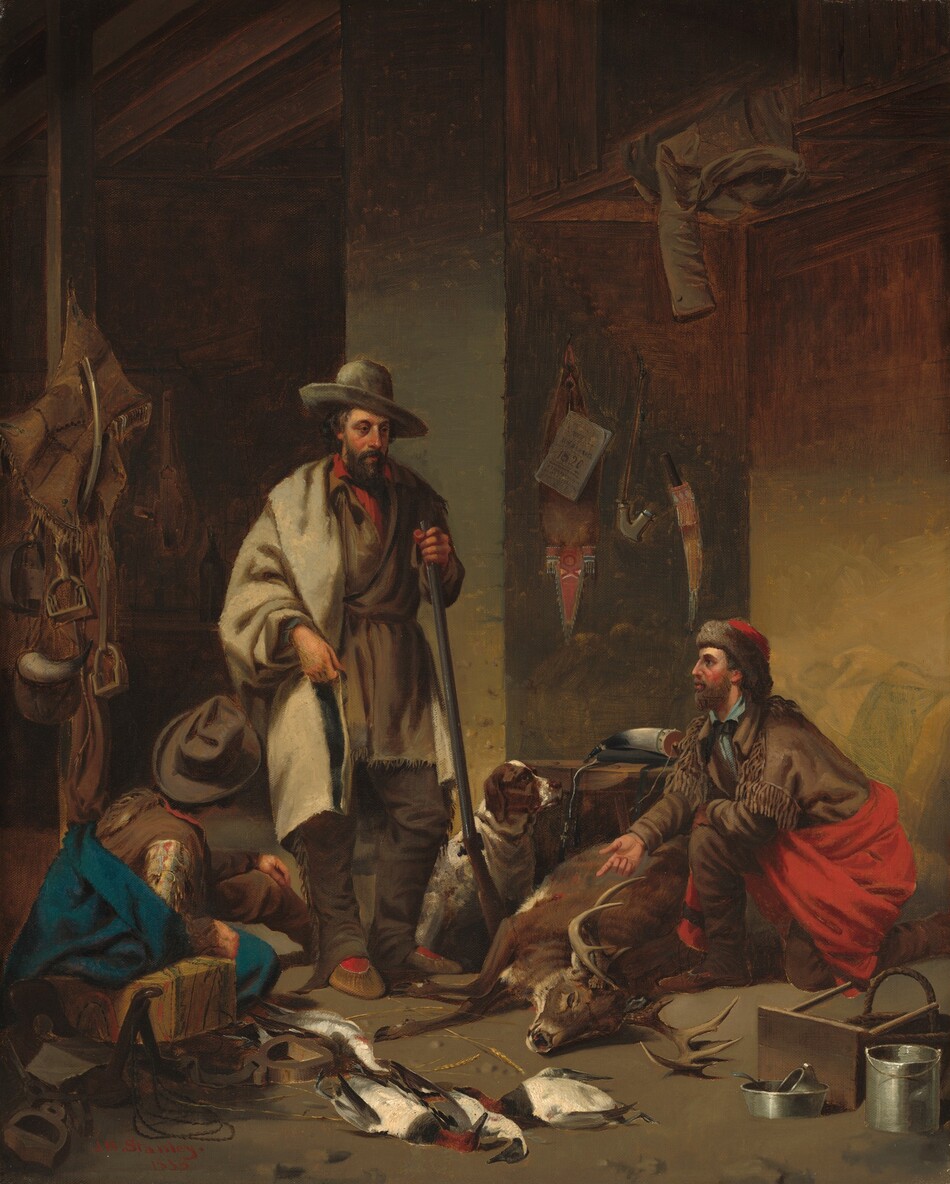
In this painting, three men are depicted in a rustic interior space. A man on the far left faces away from us, sitting on the ground and leaning against a wooden block or stool. He wears a gray hat and a brown vest, and a vivid blue blanket is wrapped around him. He is looking up at a man standing upright near the center of the painting. This man is holding a rifle, the bottom of which rests against the ground. This man has light skin with red cheeks, a long, straight nose, and a dark mustache and beard. His dark hair is hidden by a gray hat, and he wears a light gray coat over a darker gray tunic, with a bright red shirt poking out around his neck. He wears black pants with brown slippers and bright red socks. A white-and-brown dog sits next to his feet. The man on the right is kneeling, and gesturing towards a deer with sizable antlers that lays on the ground. This man has light skin, red cheeks, a light brown beard and mustache, and he looks up at the men across from him. He wears a brown jacket with tassels over a light blue shirt and has a bright red cloth wrapped around his waist over brown pants, as well as a red hat with a brown fur border. The room's walls are painted in shades of dark gray, brown, and yellow ochre, and various tools and leather saddles hang on them. The floor in front of the men is scattered with hunting-related items, such as metal tools and the bodies of small birds.

The Trapper's Cabin

John Mix Stanley

1858

Oil on canvas  Accession ID  2014.79.44

On View: West Building Main Floor, Gallery M71
In a verdant green landscape, a stone castle sits on a tree-lined hill in the distance in front of a high, craggy mountain peak while eighteen armored knights ride toward us along a bridge and path in this horizontal painting. The people whose faces we can see have pale skin. The knights are small in scale within the vast landscape, and they all hold long spears. Their procession is led by a knight on a white horse, which wears a gold bridle and lattice-like blanket. That knight has a ruby-red cloak over his armor, and his helmet has a red feathered plume. The other knights wear cloaks in tan, pale pink, or red, and some of their horses are covered with light brown blankets. Near the lower left corner, the path they ride on passes behind a tall, narrow plinth. The faces of the plinth are carved with pointed arches under ornate molding. A person atop the pointed, roof-like top of the structure stands facing away from us, wearing a robe. A gold halo is affixed to her head over long hair, and we see the small head of a baby over one crooked elbow. Near the base of the plinth, the horse at the head of the procession shies away from a man who stands to the side of the road a little farther along, near the bottom center of the painting. That man has a long white beard, and the brim of his hat is pushed back over his forehead, possibly pinned to the crown of the hat. He wears a loose brown robe and sandals, and a satchel is tied around his waist. He holds up one hand, palm out, toward the knights as he looks in their direction, facing our left in profile. In the other hand, he supports a tall staff with a knob at the center and a palm frond tied to the top. In that hand, he also holds a cross hanging from a string of red beads. As the path continues to our right, it passes an arched, free-standing structure, which has a fountain on the side facing us. A man holding a curved staff and a woman, both wearing togas, stand near the structure, looking at each other. On our side of the structure, a goat walks toward the fountain. A river extends behind the structure, back across the composition, and under the bridge leading from the castle. Tall or craggy trees grow along the side of the path as it winds into the distance to our left, and over the hill that rises to the crenelated castle complex. Touches of white and tan suggest people lining the walls of the castle and the tower over the drawbridge. A flat-topped, grassy butte rises beyond the castle, and a waterfall cascades over the edge near the drawbridge. Steep, hazy mountains rise sharply in the deep distance. Dashes of black paint indicate birds flying over the treetops near the castle, and minuscule white dots on the plateau could be grazing sheep. A town lines a body of water at the foot of the castle in the distance. White sailboats float in the water or are pulled up close to the shoreline. Opalescent white clouds curl up over the mountain top and ring the upper peaks in an otherwise clear, ice-blue sky.

The Departure

Thomas Cole

1837

Oil on canvas  Accession ID  2014.79.13

On View: West Building Main Floor, Gallery M71
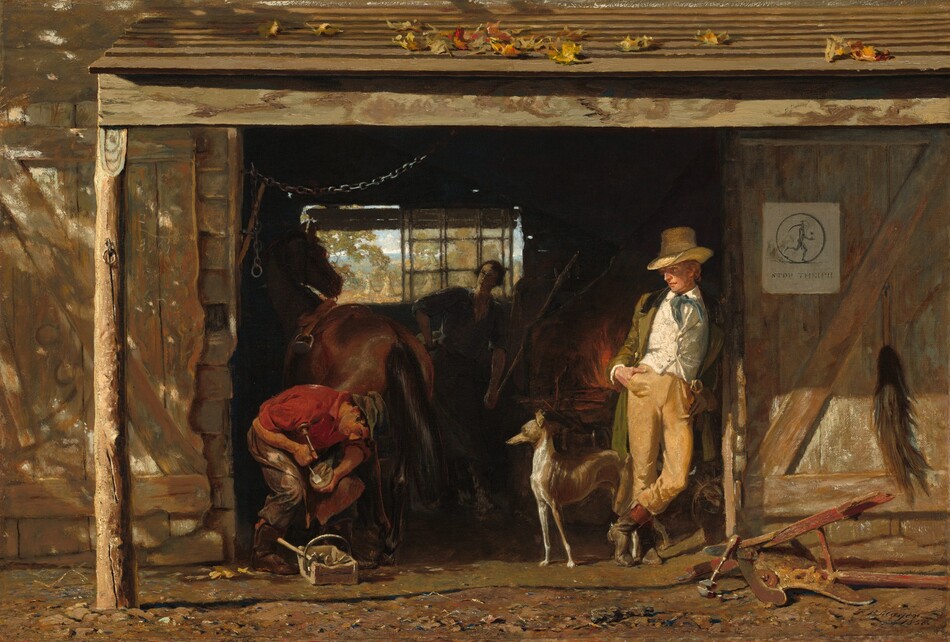
Two men, a dog, and a horse gather at the wide opening to a barn-like building that fills this horizontal painting. A light-skinned, blond man in a tall, brimmed, straw hat leans with his ankles crossed and hands in pockets against the right side of the opening. His body faces us and he turns his gaze toward the man to our left, whose face is in profile. The blond man's knee-length, olive-green jacket has black lapels, and it hangs open to reveal a close-fitting, ivory-white vest over a white shirt with a sea-blue tie. His brown, calf-high boots have a band of brick red around the top. A slender, brown and white grayhound stands facing our left in profile with its front legs stiffly straight and its hindquarters pressing against the man’s right leg. The tanned, dark-haired man near the jamb to our left bends over to work on the underside of a horse’s hoof, which he holds between his knees with his left hand. He wears a loose red shirt with an open collar and rolled-up sleeves, over wrinkled brown pants. Short black locks emerge under the edges of his olive-green cap. A wooden box of tools, with a handle for carrying, sits on the dirt ground in front of him. The horse being shod, overlapped by the workman, faces into the barn and to our left, but its head, turning to our right, is silhouetted against a landscape visible through an open window at the back of the barn. The view is dotted with haystacks and framed by tree branches. A stirrup hangs on a strap flung over a saddle on the back of the horse, whose rump stands between the laborer and a woman, who is deep in shadow. Placing her right hand, on our left, on her hip, she appears in front of the grids of window panes. She seems to have pale skin and dark, loosely bound-up hair, and she looks toward the horse. Red flames flicker in a fireplace between her and the standing blond man. The front opening of the structure is protected by a shallow wooden portico, supported on the left by a slender, trimmed tree trunk with a ring hanging from a screw near the top. Curling red and yellow leaves are scattered on the long, narrow, wooden boards that form the porch roof. Sunlight dapples the barn wall to our left, and a square patch of light falls on the face of the wall to our right, near the ground. A broken plow lies on the ground to our right, with the wooden handle of a tool propped against it. A tuft of long dark hair, like a horse’s tail, hangs on the wall over the tools. Closer to the head of the standing man, a poster is printed with black on white paper. A running man carrying an hourglass and a scythe is enclosed in a thin circle, over the words, “STOP THEIF!!!” in capital letters, though “thief” is misspelled.

Leisure and Labor

Frank Blackwell Mayer

1858

Oil on canvas  Accession ID  2014.136.111

On View: West Building Main Floor, Gallery M71
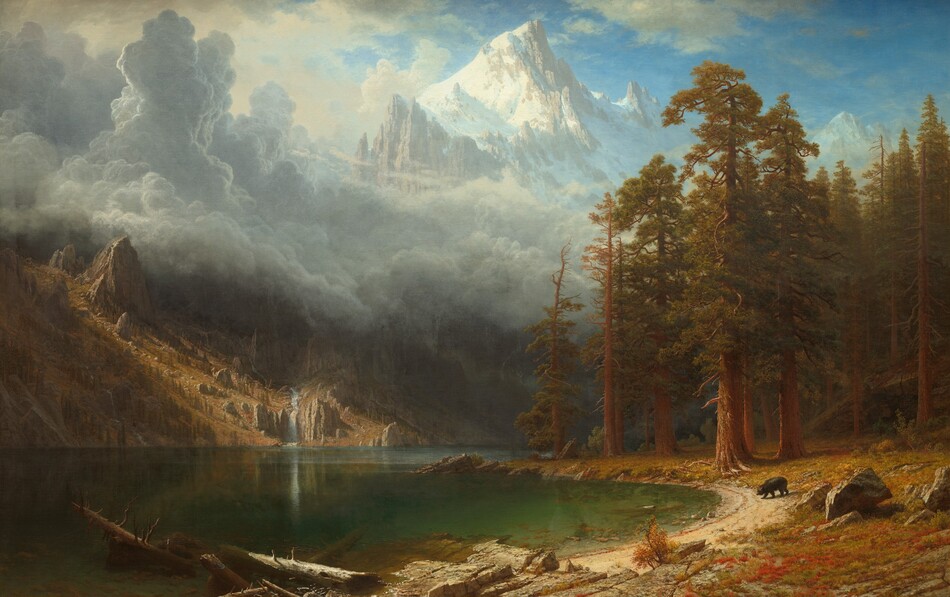
We look across the gleaming, forest-green surface of a lake at the foot of tall, jagged mountains in this horizontal landscape painting. The lake is flanked by a steep, gingerbread-brown hill on the left and a shoreline that forms a backward C curving from the lower center around and back along the right side of the composition. Strong sunlight from the upper left illuminates the center of the left-hand hill and the shoreline. The ground to our right is carpeted in rust-red, sage-green, and tan growth and is dotted with boulders. Tall trees with rust-brown trunks, crooked branches, and narrow canopies of caramel-brown and olive-green leaves fill the far end. Closest to us are dead tree trunks jutting out of the water and or lying on a flat, rocky outcropping nearby. Beyond the outcropping is a small black bear wandering down a sliver of sand-colored ground at the water’s edge. The hill on the left is covered with vertical rows of upright jagged boulders and slender, dark green trees marching up its slopes. A narrow, artic-blue waterfall cascades down its right side to empty into the lake. A thick layer of towering blue-gray clouds rises over the hill and lake, stretching back to the looming, snow-covered peaks that nearly brush the top edge of the canvas. The sky around the peak is vivid blue, scattered with high white clouds. The artist signed the lower right, “ABierstadt” with the A and B joined as a monogram.

Mount Corcoran

Albert Bierstadt

c. 1876-1877

Oil on canvas  Accession ID  2014.79.4

On View: West Building Main Floor, Gallery M71
This painting features a shoreline with the dark green ocean on the left and a small ship sailing in the distance. The color palette is soft and muted, with shades of blue, green, yellow, and very light gray. The shoreline is a sandy beach with gentle waves coming in from the left side of the painting and wet sand on the right reflecting the sky above. The vast sky is pale blue-gray with some white clouds, and some small seabirds are visible flying above the water.

On the Coast of New Jersey

William Trost Richards

1883

Oil on canvas  Accession ID  2015.19.119

On View: West Building Main Floor, Gallery M71
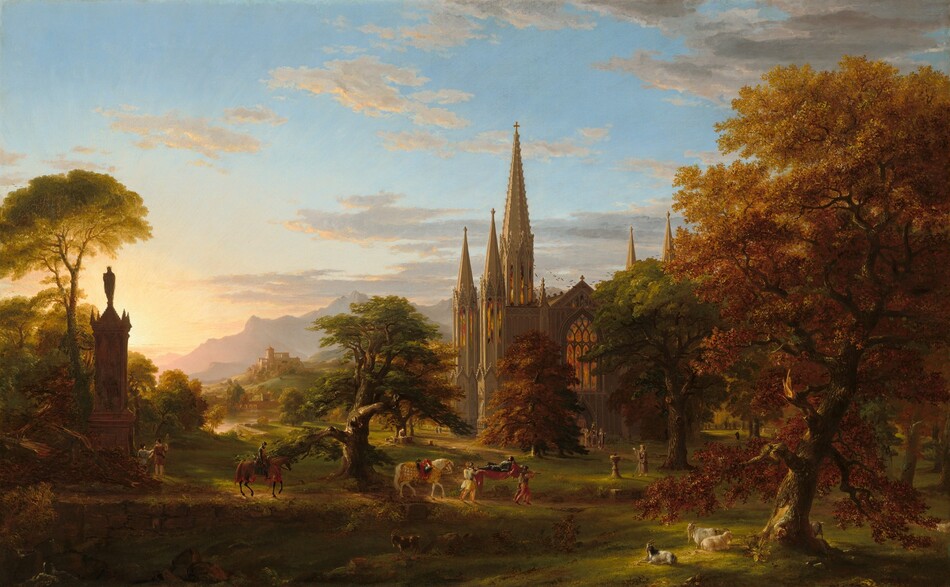
Honey-gold sunlight from low along the horizon to our left falls across the copper and bronze-colored canopies of trees that frame our view of a stone church with stained glass windows and ornate spires in this horizontal landscape painting. We look down onto the scene from a height, and from a distance. On a dirt path across the front of the picture, an armored man is carried on a red cloth-draped stretcher, which is supported over the shoulders of four men. The armored man has a black beard and hair, and his face is turned from us. The men carrying him wear togas in white, rose pink, slate blue, and mustard yellow. Three of them wear armored breastplates and helmets. A white horse draped with a gold, lattice-like blanket walks behind them. An empty saddle is strapped to its back, and the reigns rest around its neck behind the lowered head. A bit behind this grouping, to our left, another armored man holding a spear rides a brown horse, and, farther back along the path, a man holding a crooked staff and a woman stand near the base of a tall, narrow plinth. The plinth is backlit so ornate carving along the roof-like top creates a spiky silhouette. A sculpted person stands at the peak of the roof, a halo around the head. The area beyond the plinth is layered with trees and bushes extending into the distance, lit sage green by the setting sun. The path with the horses and men runs parallel to a ravine, so the grassy embankment closer to us is in deep shadow. At least two brown goats walk along in the shadows of the ravine near the white horse. Four more white goats, one with black spots, stand and lie near a tree that rises nearly the height of the painting along the right edge. The tree has rust-red leaves, and the trunk leans away from us, to our right. One massive branch has been shorn off, and the exposed wood is caramel brown against the darker, gnarled trunk. The church is beyond the path, to our right of center. Tall stained-glass windows, several stories high, are ablaze in red, orange, and topaz blue. Birds, painted with short strokes of black, flock around the church roofline. A procession led by a man wearing blue and red vestments and a tall, split cap emerges from the main, arched doorway. Another man wearing a brown robe stands near a sun dial between us and the procession coming from the church. The wide brim of that man’s hat is fastened at the front with a gold object. He lifts one hand and holds a long staff with a black knob at its center with his other. More people walk near the church, sit on a bench under a tree, and move through the landscape deep into the distance. All the people have light skin. Beyond the moss-green, grassy area around the path and church, a river winds under an arched bridge. A tan-colored building complex sits on a low hill to our left of center. Across the back of the scene, smokey purple and muted mauve-pink mountains line the horizon, which comes about halfway up the composition. The vivid yellow sun is low on the horizon to our left. A few light gray clouds skim across the sky, which deepens from pale yellow along the horizon to light blue along the top of the painting. The artist signed and dated the work on a stone near the man next to the sundial: “T. Cole 1837.” He also signed the front face of the tall pedestal to our left with the same text, though it is difficult to make out.

The Return

Thomas Cole

1837

Oil on canvas  Accession ID  2014.79.12

On View: West Building Main Floor, Gallery M71
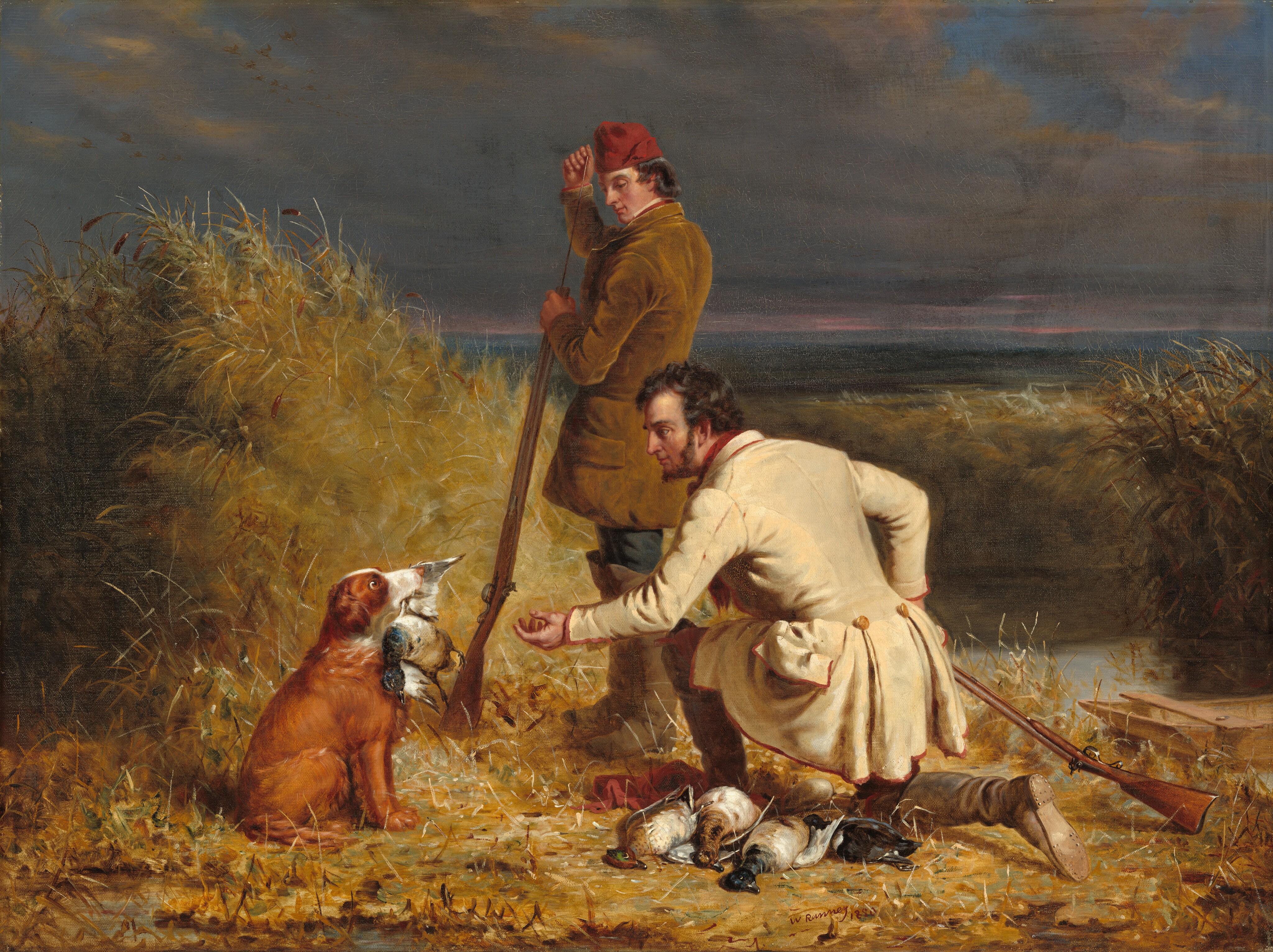
Two pale-skinned men in a marshy landscape look at a wide-eyed dog, which holds a dead duck in its mouth in this horizontal landscape painting. One man kneels facing our left in profile and holds one hand out toward the dog. The man has short, dark hair and a dark beard with no mustache. He wears a beige-colored jacket trimmed with red, dark brown pants, and knee-high brown boots. He holds a rifle by its barrel with his other hand so the stock rests on the ground in the lower right corner of the painting. Four dead ducks lie by his foot, where hobnails lining on the sole and heel gleam. The second man stands just behind and to the left of the kneeling fellow. The standing man is clean-shaven and wears a red, brimless, high-crowned cap on his dark hair. His jacket is golden brown, his pants are marine blue, and boots are pale brown. He loads or cleans the barrel of his rifle with a rod. He looks down at the dog, who looks intently at the kneeling man. The dog is mostly brown with long fur and white spots on its nose and down the front of its neck. The animal sits at attention with the bird’s wing clamped in its mouth. Tall marshy grasses and cattails grow around the men and dog, and around a narrow body of water in the near distance to the right. A larger body of water stretches to the horizon, which comes almost two-thirds of the way up the composition. The sky is streaked with pink along the horizon and blanketed with purple-tinged, gray clouds. The artist signed and dated the painting on the bottom edge, “W Ranney 1850.”

The Retrieve

William Tylee Ranney

1850

Oil on canvas  Accession ID  2014.79.29

On View: West Building Main Floor, Gallery M71
We look across a palm-tree lined river winding into the distance before a monumental, snow-covered mountain at the center of the composition in this horizontal landscape. The spit of land along the riverbank in the lower left corner is filled with lush vegetation, including waving ferns, vines, leafy trees, and palm trees. At the bottom center of the composition, along the shoreline, a boat with a pointed prow is occupied by three people wearing white pants. Two of the men are bare-chested and the third wears a red shirt. The boat is covered with a rounded, hut-like structure and tendrils of white paint, perhaps indicating smoke from a fire, waft up in front of the opening to the structure. The placid river widens beyond the boat and across from us, the distant shore is lined with white buildings with brown thatched roofs and a white church with two spires and a red tile roof. Trees around and beyond the buildings fill in the space before brown hills that eventually lead to the snowy peaks of the central mountain. The earthy moss and sage green and tawny brown of the vegetation and river closer to us fades to pale caramel and pinkish-tan in the hazy distance. A few birds fly across the pale blue sky to our left, and wisps of light gray clouds float in from our right. The artist signed and dated the work in the lower left corner: “Church 1854.”

Tamaca Palms

Frederic Edwin Church

1854

Oil on canvas  Accession ID  2014.79.11

On View: West Building Main Floor, Gallery M71

Loading Results