American Paintings 1750–1900

Filter Results

166 artworks on view.

Results

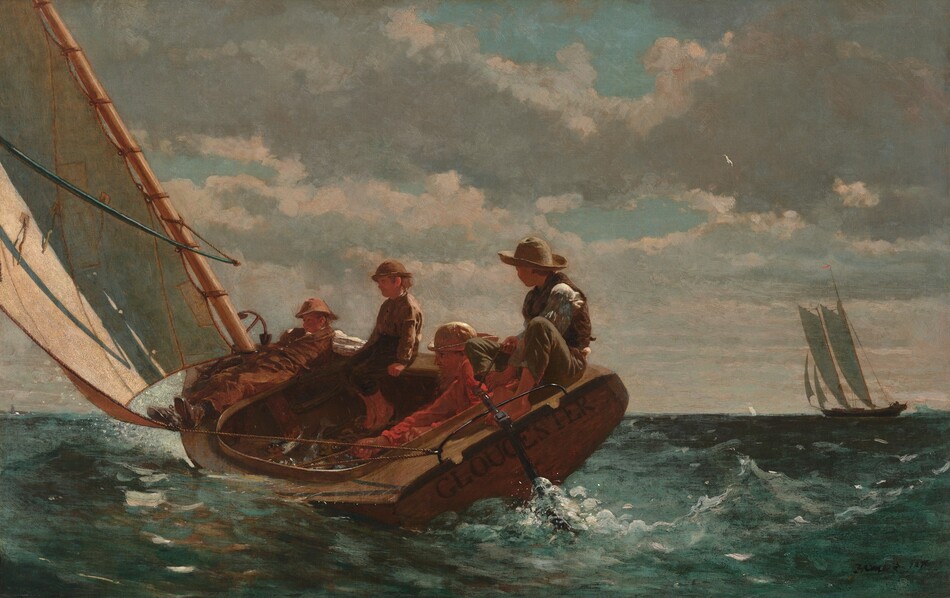
Close to us, a young man and three boys sit or recline in a small sailboat that tips to our left on a choppy dark green sea in this horizontal painting. The billowing sail extends off the top left corner of the canvas and is echoed in the background to our right by the tall sails of another ship in the distance. The horizon line comes about a third of the way up the composition, and puffy gray and white clouds sweep across the turquoise sky. The sun lights the scene from our right so the boys’ ruddy faces are in shadow under their hats. The young man and boys all face our left so they lean against and into the boat as it cants up to our right. The boy nearest the sail to our left reclines across the bow. Next to him to our right, a younger boy perches on the edge of the boat and holds on with both hands. The oldest, in a red shirt, sits on the floor of the boat as he maneuvers the sail with a rope. Closer to us and to our right, a younger boy sits with his bare feet pressed together in front of his bent knees on the back edge of the boat, gazing into the distance over his right shoulder as he handles the tiller. The artist signed and dated the painting in dark letters in the lower right corner: “HOMER 1876.”

Breezing Up (A Fair Wind)

Winslow Homer

1873-1876

Oil on canvas  Accession ID  1943.13.1

On View: West Building Main Floor, Gallery M68
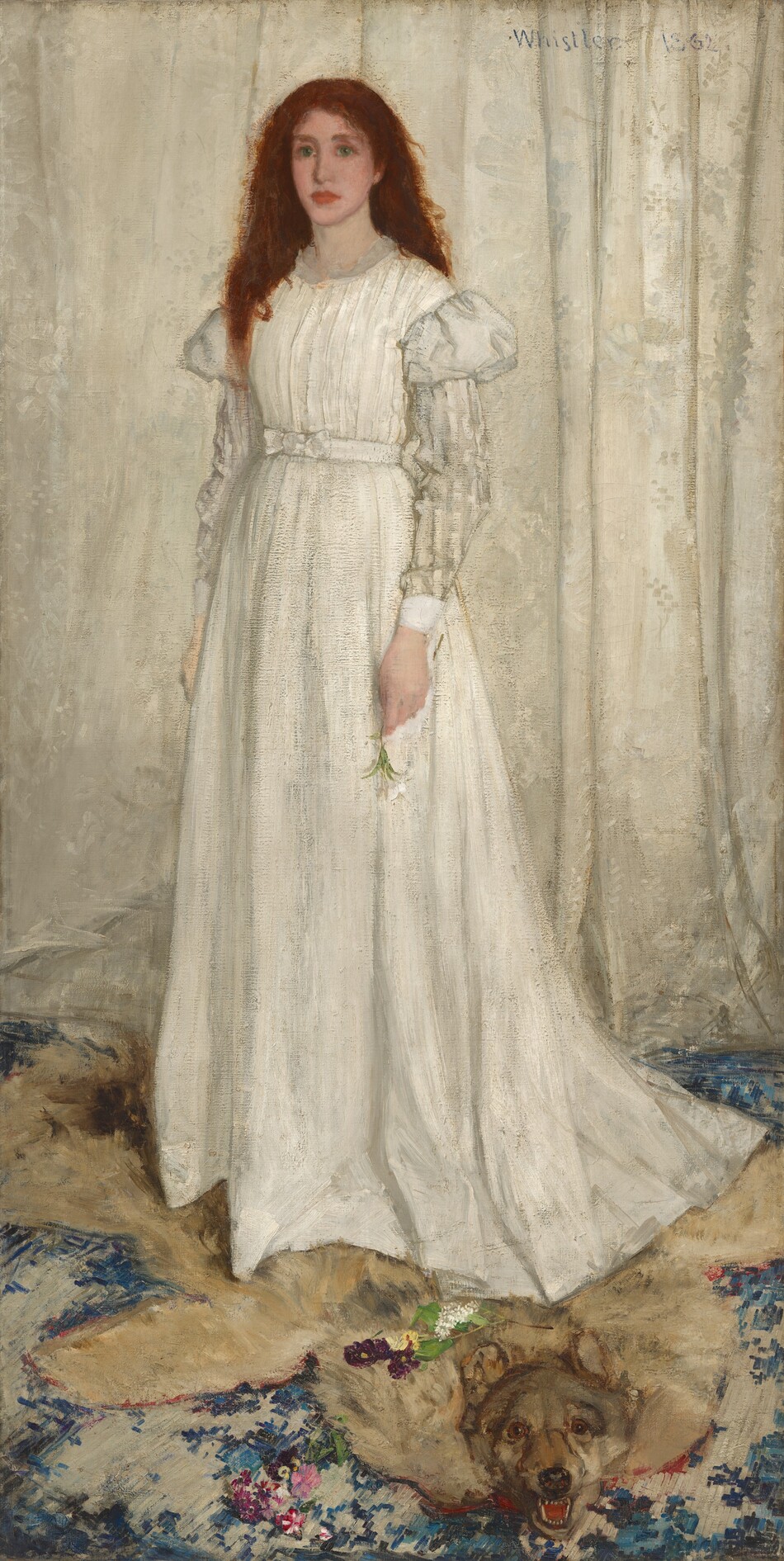
A young woman with pale, peachy skin, wearing a long, flowing white dress, stands in front of a white curtain in this vertical portrait painting. Her auburn-red hair cascades down over and behind her shoulders. She looks to our left with green eyes, and her pink, full lips are closed. Her dress has puffed shoulders above a white-on-white striped pattern on the long sleeves. She stands on an animal pelt; it is not clear whether it is a wolf or a bear. The pelt spans the width of the painting and overlaps a blue patterned carpet. The animal’s mouth gapes to show sharp teeth. Its glassy eyes are wide open, and it seems to look at us. The edges of the animal skin are red. The woman holds a white lily by her side in her left hand, while yellow and purple flowers lie scattered on the pelt.

Symphony in White, No. 1: The White Girl

James McNeill Whistler

1861-1863, 1872

Oil on canvas  Accession ID  1943.6.2

On View: West Building Main Floor, Gallery M69
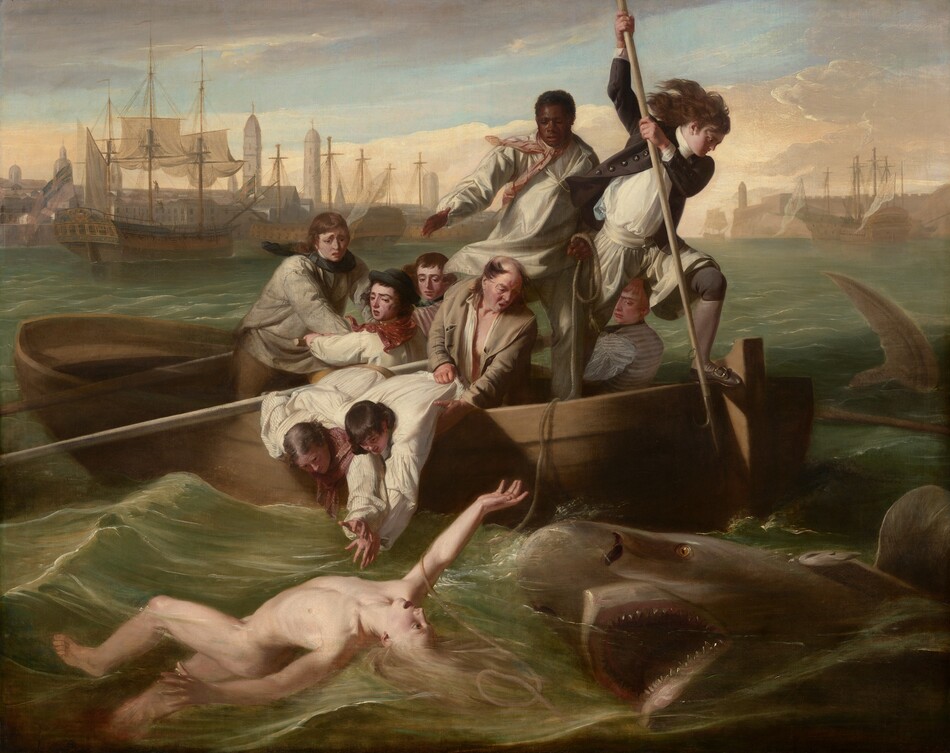
We look onto the side of a rowboat crowded with nine men trying to save a pale, nude young man who flails in the water in front of us as a shark approaches, mouth agape, from our right in this horizontal painting. In the water, the man floats with his chest facing the sky, his right arm overhead and the other stretched out by his side. Extending to our left, his left leg is bent and the right leg is straight, disappearing below the knee. His long blond hair swirls in the water and he arches his back, his wide-open eyes looking toward the shark behind him. To our right, the shark rolls up out of the water with its gaping jaws showing rows of pointed teeth. In the boat, eight of the men have light or tanned complexions, and one man has dark brown skin. The man with brown skin stands at the back center of the boat, and he holds one end of a rope, which falls across the boat and around the upper arm of the man in the water. Another man stands at the stern of the boat, to our right, poised with a long, hooked harpoon over the side of the boat, ready to strike the shark. His long dark hair blows back and he wears a navy-blue jacket with brass buttons, white breeches, blue stockings, and his shoes have silver buckles. Two other men wearing white shirts with blousy sleeves lean over the side of the boat, bracing each other as they reach toward the man in the water. An older, balding man holds the shirt and body of one of this pair and looks on, his mouth open. The other men hold long oars and look into the water with furrowed brows. The tip of a shark’s tail slices through the water to our right of the boat, near the right edge of the canvas. Along the horizon line, which comes three-quarters of the way up the composition, buildings and tall spires line the harbor. The masts of boats at port creates a row of crosses against the light blue sky. Steely gray clouds sweep across the upper left corner of the canvas and the sky lightens to pale, butter yellow at the horizon.

Watson and the Shark

John Singleton Copley

1778

Oil on canvas  Accession ID  1963.6.1

On View: West Building Main Floor, Gallery M60
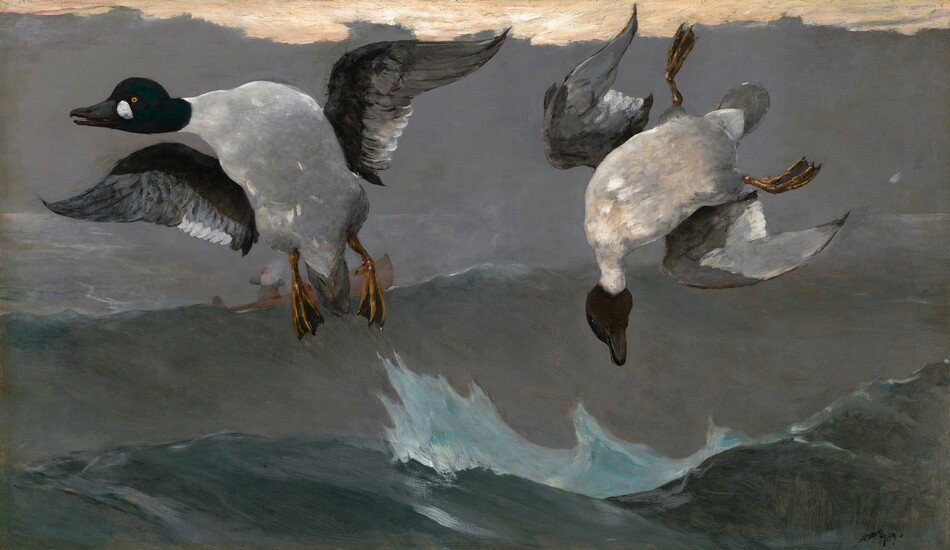
We look onto two black-headed ducks twisting and flailing midair against a slate-gray landscape in this horizontal painting. The silvery white body of the bird to our left faces us as its neck twists to our left, its black wings extended. The bird to our right falls with its head facing down, its gray wings partially contracted and its legs splayed. The landscape behind them is made up of a sliver of golden amber along the top edge above three wider bands of steel gray that darken toward the bottom of the canvas. A spray of turquoise near the bottom center of the painting indicates that the gray bands are cresting waves. Seen in the distance beyond the feet of the left bird, a gray smudge suggests smoke obscuring a man wearing a gray garment and vivid orange cap. His elbows are raised, presumably holding a shotgun. He sits in a long brown canoe that rides near the crest of the middle wave.

Right and Left

Winslow Homer

1909

Oil on canvas  Accession ID  1951.8.1

On View: West Building Main Floor, Gallery M68
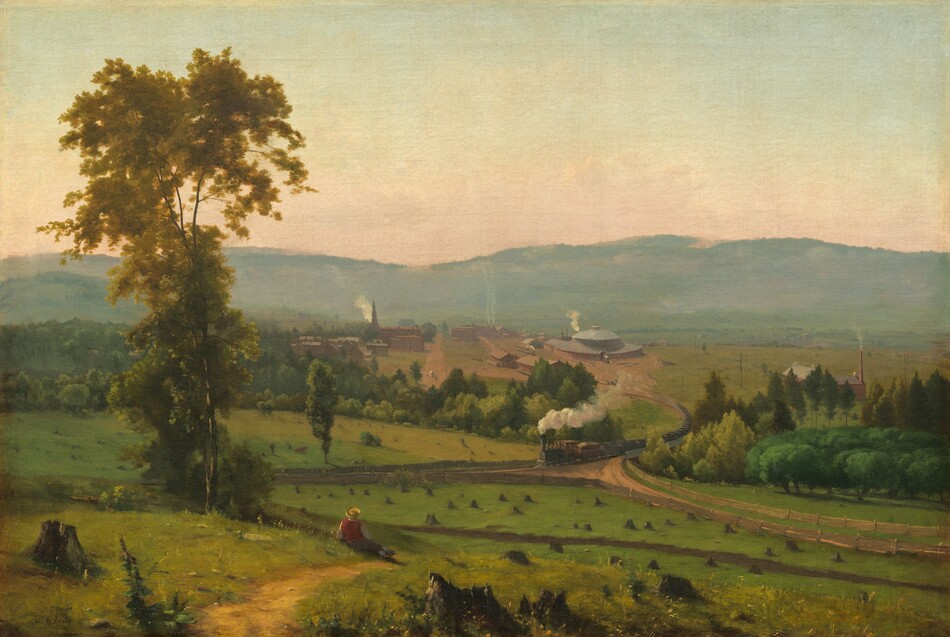
We look across and down into a valley with a person sitting near a tall tree and a train puffing smoke beyond, all enclosed by a band of mountains in the distance in this horizontal landscape painting. Closest to us, several broken, jagged tree stumps are spaced across the painting’s width. A little distance away and to our left, the person wears a yellow, broad-brimmed hat, red vest, and gray pants. He reclines propped on his left elbow near a walking path beside a tall, slender tree with golden leaves. The green meadow stretching in front of him is dotted with tree stumps cut close to the ground. Beyond the meadow, puffs of white smoke trail behind a long steam locomotive that crosses a bridge spanning a tree-filled ravine, headed to our left. The ravine creates a diagonal line across the canvas, moving subtly away from us to our left. The train has climbed out of the valley, away from a cluster of brick-red buildings. The most prominent structure is a train roundhouse, a large building with a high, domed roof to the right of the tracks. Smoke rises from chimneys on long, warehouse-like buildings, and a steeple and smaller structures suggest a church and homes to our left. Hazy in the distance, a row of mountains lines the horizon, which comes about halfway up the composition. The sky above deepens from pale, shell pink over the mountains to watery, pale blue above. The artist signed the work in tiny letters in the lower left corner: “G. Inness.”

The Lackawanna Valley

George Inness

c. 1856

Oil on canvas  Accession ID  1945.4.1

On View: West Building Main Floor, Gallery M64
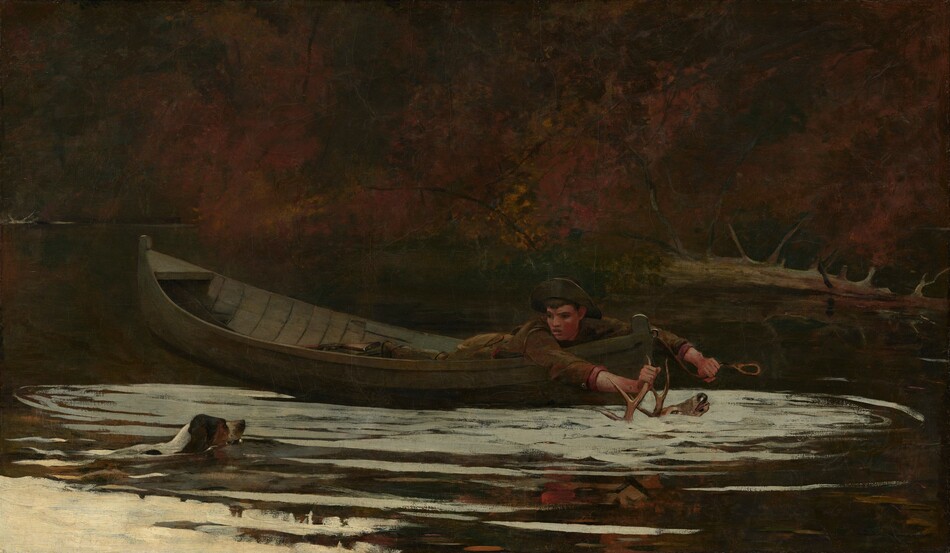
A young man with a peachy, ruddy complexion lies on his stomach in a wooden rowboat on a river, reaching forward to grasp the horn of a stag almost completely submerged in the rippling water with one hand. On the opposite riverbank, gold, rust, and scarlet-red trees span the width of this horizontal painting. The boy’s arms straddle the stern of the boat so one holds the antler with his right hand, closer to us, while the other clutches a rope with a loop at the end. He turns his face, mouth agape and cheeks flushed, over his right shoulder to look to our left, at a dog swimming toward the boat. The dog has white and caramel-brown markings, with dark brown ears. The boy wears earth-brown clothing and the front of his wide-brimmed hat is pushed up to reveal dark eyes and sable-brown bangs and brows. The stag and dog are between us and the boat, and are surrounded by thick brushstrokes of parchment white to create ripples in the forest-green water. Only the open muzzle, part of the eye, and the tips of the stag’s antlers are above the water’s surface. To our right, a bare, fallen tree lies along the far riverbank parallel to the boat. The boat and water fill the lower half of the scene and the autumn trees fill the upper half. The artist has signed and dated the painting in the lower right, “Winslow Homer 1892.”

Hound and Hunter

Winslow Homer

1892

Oil on canvas  Accession ID  1947.11.1

On View: West Building Main Floor, Gallery M68
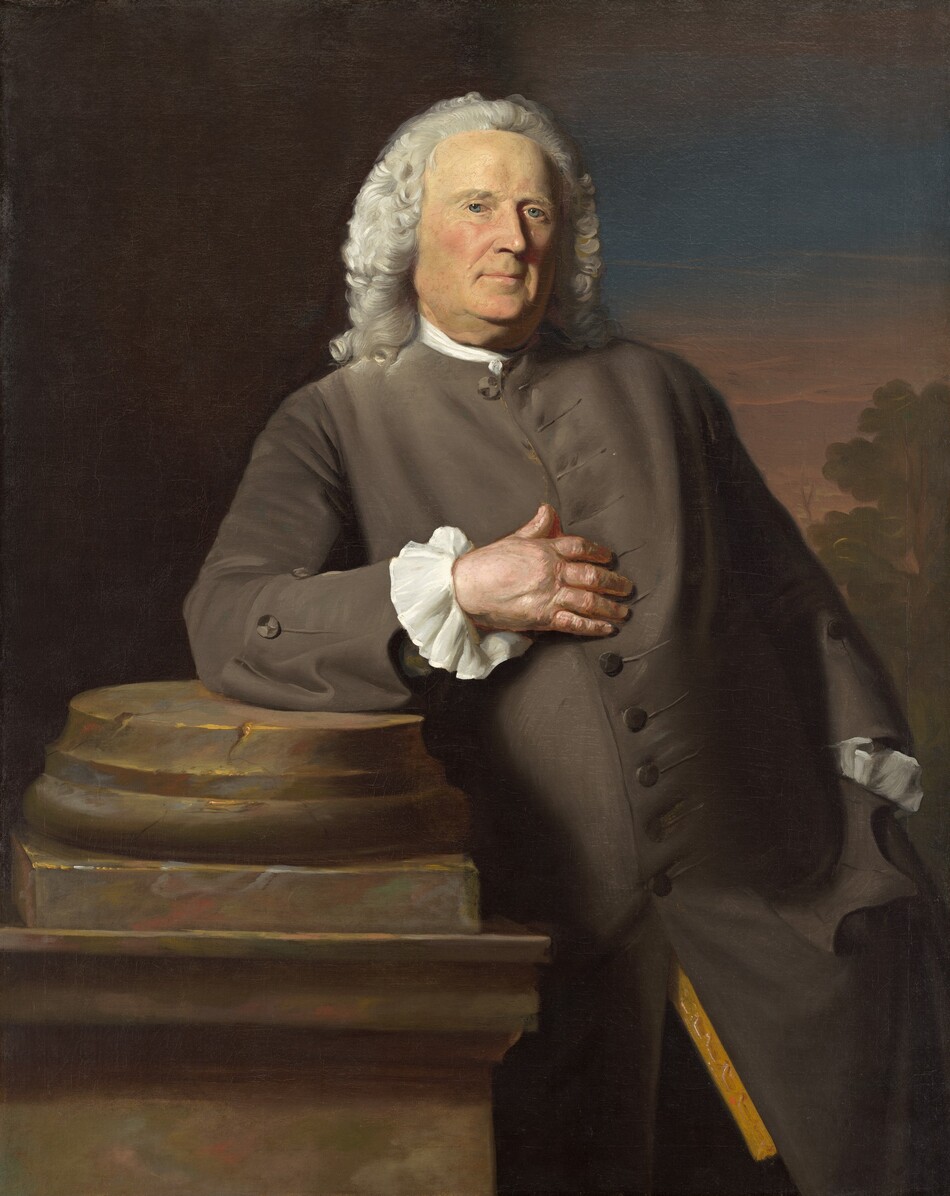
Shown from the knees up, and older, clean-shaven, pale-skinned man rests one elbow on a broken column in this vertical portrait painting. He rests on his right elbow, on our left, so his body creates a diagonal from the lower right to the top center of the composition. He looks at us with clear blue eyes under low brows. His fleshy cheeks are lightly flushed. Wrinkles line his mouth, which is closed in a slight smile. He has jowls and a double chin, and his face is marked with few flesh-colored bumps near his mouth and under one eye. Thick, white hair is brushed back from his forehead, and shoulder-length curls frame his wide face. His is lit from our left so the far side of his face is largely in shadow except for that eye. A strip of bright white fabric encircles his neck above the collar of his long, steel-gray coat. Only the bottom half of the buttons down the front are fastened. White ruffles line his wrists. A glimpse of a golden yellow garment and dark trousers are visible where the coat splits near the bottom of the painting. His left hand, to our right, is thrust into that coat pocket. The other elbow rests on the light brown stone column base on a tall pedestal, and he touches his midsection with those fingers. The left half of the background is dark brown and the right half opens onto a green tree silhouetted against a hazy-pink and aquamarine-blue sky.

Epes Sargent

John Singleton Copley

c. 1760

Oil on canvas  Accession ID  1959.4.1

On View: West Building Main Floor, Gallery M60
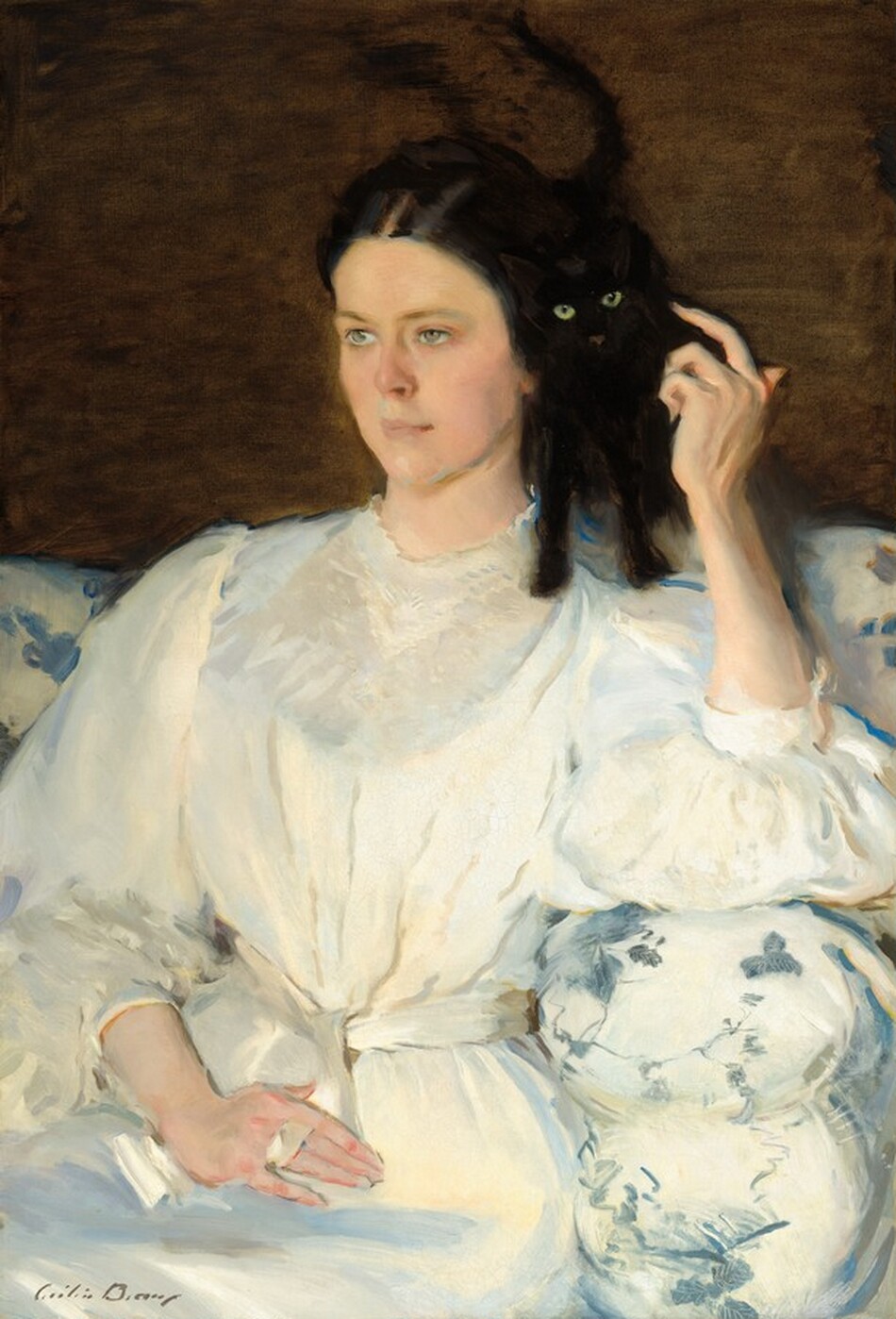
A woman with pale skin and dressed in white sits on a couch gazing into the distance to our left as she raises one arm to stroke a black cat perched on her shoulder in this vertical portrait. Shown from the lap up, the woman’s dress has voluminous, puffed, elbow-length sleeves and a high collar, and her narrow waist is cinched with a white sash. Her dark brown hair is parted down the middle and tied back, and she has pale blue eyes and pink lips. She reaches up to the cat with her left hand, on our right, and her other hand, farther from us, rests flat in her lap. The black cat looks at us with greenish-yellow eyes as it almost disappears into the dark brown background above the white couch, which is decorated with a blue pattern. The artist signed the work with dark letters in the lower left corner: “Cecilia Beaux.”

Sita and Sarita

Cecilia Beaux

c. 1921

Oil on canvas  Accession ID  2014.79.1

On View: West Building Main Floor, Gallery M69
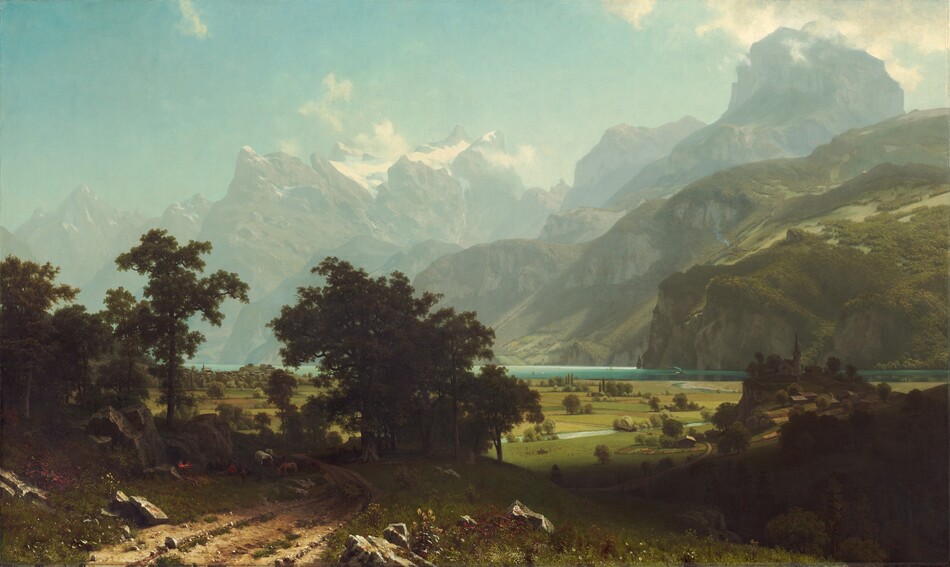
From a little above a dirt road, we look past a grove of trees to a broad plain and a lake at the foot of towering, hazy mountains in this horizontal landscape painting. The narrow, teal-blue lake runs from left to right along the horizon, which comes about a third of the way up the composition so the hills and mountains take up most of the picture. On the far shore of the lake, steep hills are thick with fern-green trees and growth. Beyond these hills, muted gray and green rocky mountains reach precipitously into the clear, robin’s egg-blue sky so some nearly touch the top edge of the canvas. Snow nestles in the mountain peaks while gauzy mist hovers among the mountain tops. The meadow below is a patchwork of avocado-green and sand-brown fields. An ice-blue stream winds from the lake across the plain while olive-green trees and shrubs dot the fields. Closest to us, in the lower left corner of the painting, small stones and clumps of green grass run along the dirt road, and boulders line it to either side. A band of dark green spanning the road creates a screen a short distance from us, in the lower left quadrant of the composition. Through the trees is a view of minuscule buildings lining the lakeside. In the shadows, under the trees, people camp with a covered wagon covered in white fabric and several animals including a donkey. A red and yellow fire glows, almost lost in the deep shadows of the trees, next to the people. On our right, about a dozen people with a horse-drawn wagon, all tiny in scale, work in the field next to the stream. Farther along the stream, another wagon approaches a covered bridge. On our right and close to us, a dark shadow falls across the landscape. Beyond the shadow, a group of buildings with a church in the center sit on a low hill.

Lake Lucerne

Albert Bierstadt

1858

Oil on canvas  Accession ID  1990.50.1

On View: West Building Main Floor, Gallery M64
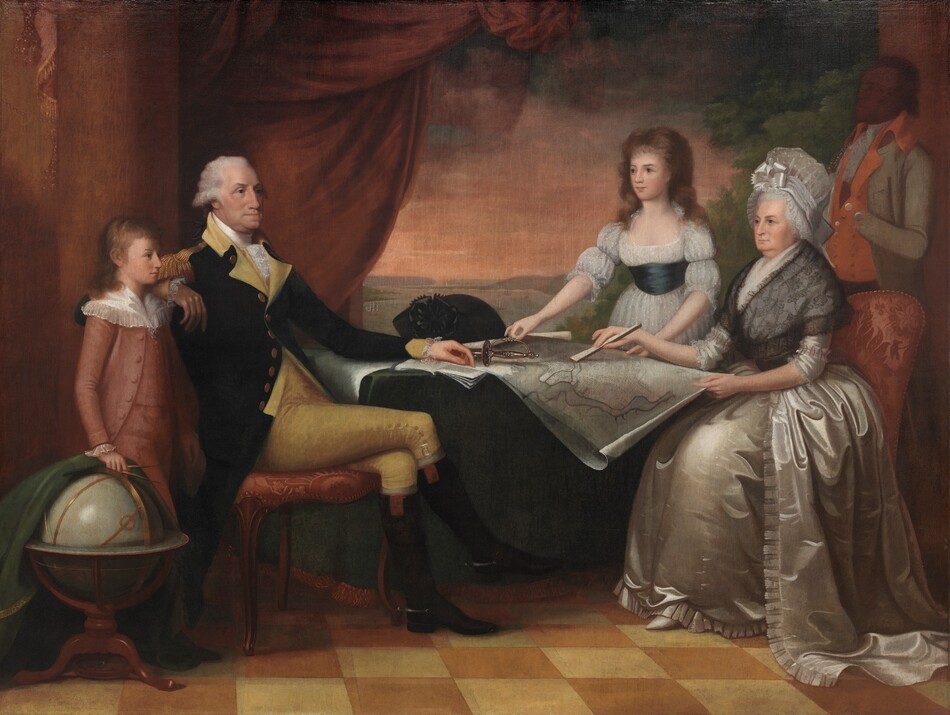
A light-skinned man, woman, boy, and girl, and a brown-skinned man sit and stand around a table spread with papers and a map in this horizontal portrait. The light-skinned man sits on a red upholstered chair at the table to our left, and his body faces our right in profile. His legs are crossed, and he rests his right elbow, closer to us, on the back of the chair. He has a sloping, rounded nose, dark eyes, jowls along his jawline, and his closed mouth juts forward. His left arm rests on an open pamphlet on the table next to a sword with a delicate silver hilt. To our left, the young boy stands also looks to our right in profile, next to the older man's chair. The boy wears a dusky rose-pink suit with a white lacy collar. With his right hand, he pulls back a dark green cloth covering a globe on a wooden stand along the left edge of the canvas. The woman sits at the right side of the table, across from the man. She has dark eyes, full cheeks, a double chin, and her pale lips are closed. She wears a voluminous ivory satin gown and petticoat with a black lace shawl, and an ivory cap with a satin bow covers her gray hair. She points to a spot on a map on the table with a closed fan held in her right hand. The young girl, wearing a gauzy white dress with a pine-green sash at the waist, stands on the far side of the table near the woman, holding the curling edges of the map. Behind the women, the brown-skinned man wears a rust-orange and gray uniform, and stands with one hand tucked into his vest in the shadows at the edge of the composition. His features are indistinct but he faces our left in profile. The room has a gold-and-yellow checkerboard floor, and a red cloth drapes from columns frame the scene to each side. It is unclear whether a river view at the back of the room is seen through an open window or door, or if it is a large painting behind the people.

The Washington Family

Edward Savage

1789-1796

Oil on canvas  Accession ID  1940.1.2

On View: West Building Main Floor, Gallery M62
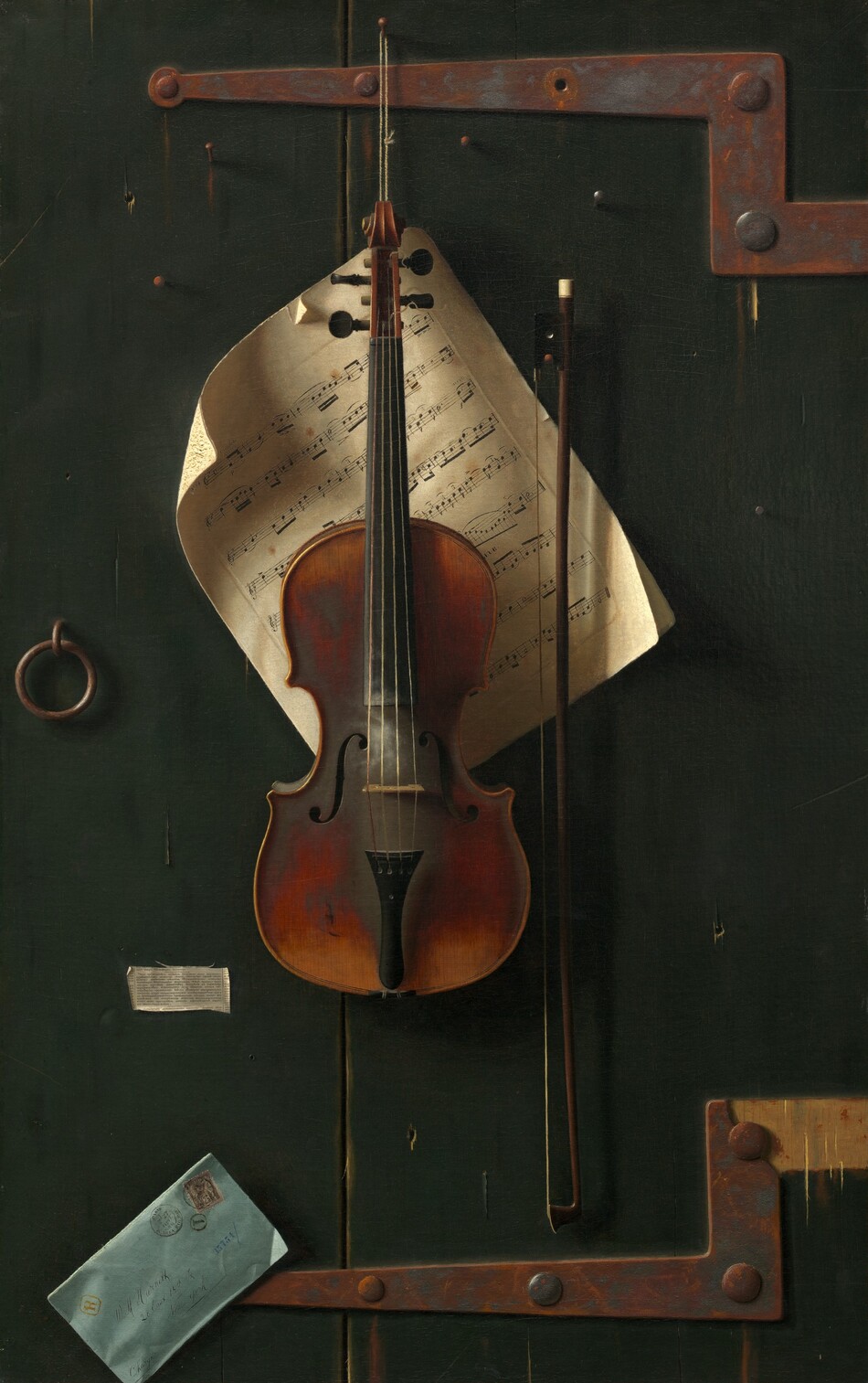
A violin, bow, and at least two pages of sheet music hang from a dark, forest-green, wooden door in this vertical painting. The string holding the violin hangs from a nail at the top center of the composition. The violin takes up the top two-thirds of the painting. The wood body of the instrument is a deep chestnut brown alongside the fingerboard, and it lightens to tawny brown at the corners. White powder coats the strings near the bridge and gathers on the instrument beneath it, where the strings are played. The bow hangs to our right, and it and the violin overlap sheets of music, which curl at the corners. Several pins or nails are pounded into the wooden door, and a few small holes and vertical cracks mar its surface. The door’s handle is a metal ring hanging at the center to our left, and bracket-shaped arms of two rusty hinges nearly span the width of the painting from the right edge. A bolt is missing from the top hinge, and the rightmost section of the bottom hinge has been broken off. A scrap of newspaper is pasted on the door just below the violin, to our left, but the text is illegible. Finally, the corner of a pale blue envelope has been tucked into the edge of the painting near the lower left. A black and white postage stamp with the number 25 is affixed to the upper right corner, and the envelope has been stamped several times. Cursive writing of the address reads, “W. M. Harnett 28 East 14th St New York.” The word “Chargé” has been penned in the lower left corner of the envelope. A circular cancelation stamp near the postage stamp locates and dates the envelope: “PARIS 3 27 AVRIL 86.”

The Old Violin

William Michael Harnett

1886

Oil on canvas  Accession ID  1993.15.1

On View: West Building Main Floor, Gallery M65

Loading Results