Calder

Filter Results

28 artworks on view.

Loading Results

Results

Artwork

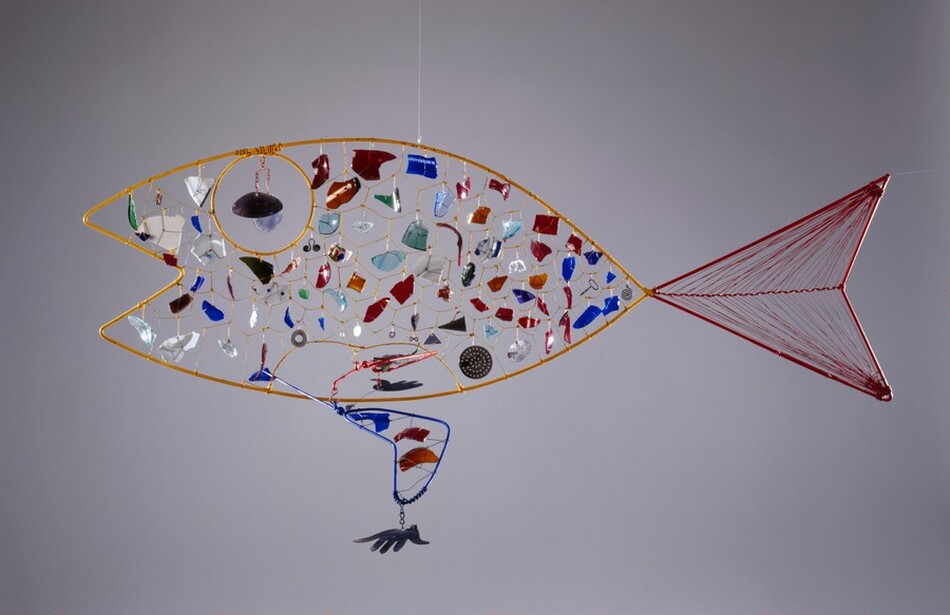
The outline of a fish is made with bent, colored wire and then hung with fragments of colored glass to loosely resemble scales in this free-floating sculpture. In this photograph, the open mouth faces our left. The body is made with a thick gauge, mustard-yellow wire. Finer, gold-colored wire creates a honeycomb-like pattern within the body. Pieces of colored glass hang within most of the cells. The irregularly shaped pieces are clear or in tones of brick red, indigo or sky blue, amber brown, pearl white, or emerald green. A few cells have little bits of metal, including a washer, a disk pierced with holes, and a spiraling piece of wire. The thicker yellow wire makes a circle near the mouth, creating an eye, which is hung with two pieces of glass in plum purple and pale lilac. To our right, the tail is as tall as the body and half its length. It is outlined with thick, red wire. Another piece of wire runs along the middle of the tail, and thinner red wire is strung from the central wire to the upper and lower edges, mimicking the rays of the fish’s fin. A fin along the bottom center of the fish’s body is made with thick, royal-blue wire that balances across the bottom rim of the fish. On the side closer to us, the blue wire is bent into a boomerang shape. It is suspended within a cell close to the bottom of the fish’s body, and is balanced on the far side with a piece of cobalt-blue glass. A hand-shaped pendant hangs from the point of the fin closest to us. The wall behind the hanging sculpture is fog gray.

Finny Fish

Alexander Calder

1948

Steel rod, wire, glass, objects, and paint Accession ID 1996.120.15

On view: East Building, Tower Level, Gallery E606

Artwork

This free-floating sculpture, called a mobile, hangs from the ceiling. Thirteen flat, uniquely shaped paddles are suspended on curving, painted wires in bowing, branch-like forms. Three black crescent shapes hang to our right in this photograph. Ten crimson teardrops, ovals, and rounded triangular forms float in two tiers in an arc that descends gently to our left. The red shapes get smaller as they move away from the black forms. Three of the red shapes are pierced with holes.

Triple Gong

Alexander Calder

1951

Steel, wire, brass, and paint Accession ID 1996.120.27

On view: East Building, Tower Level, Gallery E606

Artwork

This sculpture is made up of ten shapes connected with rigid, straight brown wire to create an interlocking, web-like formation that rests on the floor. Five of the shapes appear to be raw wood and the other five are painted. Four of the painted shapes are dark gray. The fifth painted piece, at the upper left in this photograph, has a wooden cone-shaped tip pointing downward beneath a black and white mid-section, and an angular, hourglass-shaped tail painted in triangular blocks of red, blue, and black. The other wooden and painted shapes range in size and form, with an almond-shaped piece at the center, rounded pieces throughout, and two rounded hour-glass shaped pieces near the upper left.

Vertical Constellation with Bomb

Alexander Calder

1943

Wire, wood, and paint Accession ID 1996.120.8

On view: East Building, Tower Level, Gallery E606

Artwork

The artwork features a sculpture composed of a combination of geometric shapes. It includes a series of four white, petal-like forms connected by thin, black rods, creating a mobile structure. The base of the sculpture is constructed from black metal, with angular and curved shapes that provide a sturdy foundation. The entire piece rests on a wooden floor, and the background features white walls and a tiered platform, enhancing the contrast between the sculpture's colors and its surroundings.

Four White Petals

Alexander Calder

1960

Sheet metal, rod, bolts, and paint Accession ID 1996.120.16

On view: East Building, Tower Level, Gallery E606

Artwork

This free-standing sculpture is made up of a sweeping, backward-facing C shape supporting a series of ten curving, interlocking, thin wires that cascade down and to our left in this photograph, each one ending in a flat, leaf-like paddle on either end. The C-shaped arm forks into three feet, on which the sculpture sits so the other branches float freely. The S-shaped arms are linked by tiny rings at the center of each arm, and they descend in size as they arc down and to our left. Each S-shaped arm has a black, roughly triangular paddle at the top; the third paddle from our right has a hole in it. The paddles at the bottom of each arm are each a different color, with ruby red to our right, then marigold orange, pine green, honey yellow, and the final four to our left are white. The size of the paddles also descend in size from our right to left. The branch connecting the S-shaped branches to the C-shaped base is curvier, and has one black paddle, the largest of all, at the bottom point.

Little Spider

Alexander Calder

c. 1940

Sheet metal, wire, and paint Accession ID 1996.120.18

On view: East Building, Tower Level, Gallery E606

Artwork

This free-floating sculpture, called a mobile, hangs from a wall or the ceiling. At the top, four wires curve upward in a spray, two to each side. Below, six wires bow in descending branch-like forms. Eleven small shapes, each in the form of a ball, comma, hourglass-like shape, or paddle, is affixed to or hangs from the end of each wire, and each is a single color in black, yellow, or red.

Untitled (The Constellation Mobile)

Alexander Calder

1941

Wire, wood, and paint Accession ID 1996.120.7

On view: East Building, Tower Level, Gallery E606

Artwork

Two disks, one black and one white, and ten smaller red disks hang from eleven red wire branches in this free-floating sculpture, called a mobile. The uppermost branch ends with the white disk jutting out to our right, and the next ends with the black disk, projecting out and slightly up to our left. The red disks cluster in a loose line below, some higher and some drooping down. The mobile is suspended with an unseen filament in a white room in this photograph.

Black, White, and Ten Red

Alexander Calder

1957

Sheet metal, wire, and paint Accession ID 1996.120.3

On view: East Building, Tower Level, Gallery E606

Artwork

A tomato-red, oval floating in a field of blue-violet nearly fills this horizontal abstract painting. A thin, vertical, gently waving line and a black dot float near the red oval, near the upper right corner of the canvas. The red oval is wider at our right side, like an egg. The oval, wavy line, and the dot are all outlined in white. The blue-violet background is painted with short, visible strokes, giving it a mottled look.

Flight of the Dragonfly in Front of the Sun

Joan Miró

1968

Oil on canvas Accession ID 1983.1.23

On view: East Building, Tower Level, Gallery E606

Artwork

The artwork "Ruby-Eyed" is a modern sculpture resembling a stylized fish. It features a streamlined body with elongated, curved fins. The sculpture is primarily black with vivid red on the tips of its fins, creating a contrast. A small red detail is on the head. The material appears to be metal, giving the piece a smooth and polished finish. Its abstract form and bold color choices make it a visually engaging piece.

Ruby-Eyed

Alexander Calder

1936

Sheet metal, glass, and paint Accession ID 1996.120.23

On view: East Building, Tower Level, Gallery E606

Artwork

The sculpture depicts two wire human figures interacting in a playful or acrobatic motion. One figure stands with an extended arm reaching up, while the other figure appears upside down, balancing on one hand with legs in the air. Crafted from dark-colored wire, the sculpture captures the delicate contours of the figures' posture and movement. It stands on a rectangular wooden base, providing contrast and stability. The base is light brown with visible wood grain texture. The wire figures have a two-dimensional appearance, inviting viewers to appreciate their form and dynamism from all angles.

The Acrobats

Alexander Calder

1929

Wire Accession ID 2025.16.1

On view: East Building, Tower Level, Gallery E606

Artwork

The sculpture is an abstract mobile suspended in the air, composed of intersecting metal rods painted in red, yellow, and black. It includes suspended elements, such as white and wooden forms, dangling below. The mobile incorporates geometric and organic shapes in a complex and balanced composition. The contrast between bright and dark colors alongside wooden and metallic materials creates a visually striking effect. Shadows are cast onto nearby surfaces, enhancing its intricate design.

Tower with Pinwheel

Alexander Calder

1951

Sheet metal, wire, wood, string, and paint Accession ID 1996.120.25

On view: East Building, Tower Level, Gallery E606

Artwork

Three geometric structures are suspended with wire from a rod in this free-floating sculpture called a mobile. The supporting rod is black and hangs from the ceiling by a clear filament. To the left is a curved, twisting, C-shaped piece of sheet metal painted black on one side and cobalt blue on the other. To the right, a red ball and a yellow, toothpick-shaped shaft are connected by a second black rod. A wire connects the two rods so the ball and shaft balance to either side.

Untitled (The McCausland Mobile)

Alexander Calder

1937

Sheet metal, wood, wire, string, and paint Accession ID 1996.120.19

On view: East Building, Tower Level, Gallery E606