A flatboat with eight light-skinned men floats toward us down a wide river in this horizontal painting. The boat nearly spans the width of the composition and has low sides and a shallowly arched, low cabin upon which the men gather. At the center, a man with dark hair and wearing light blue trousers and a pink shirt dances with one foot and both arms raised. To our right a seated musician plays a fiddle, and to our left a smiling man holds up a metal pot and strikes the flat bottom with the back of his fingers. The remaining men sit or recline around the musicians and dancing man, some looking toward the dancer and two looking out at us. Bedrolls and animal skins are stored in the cabin below. The olive-green surface of the river is streaked with pale blue. The horizon line comes about a third of the way up the composition. The trees and riverbanks in the distance are hazy beneath a watery blue sky.
George Caleb Bingham, The Jolly Flatboatmen, 1846, oil on canvas, Patrons' Permanent Fund, 2015.18.1

Must-Sees of American Art

As part of our celebration of 250 years of American creativity, we recently unveiled a fresh take on our American art galleries in the West Building.

Grab a map and take a self-guided tour of 10 iconic works made from the colonial era to the early 20th century.
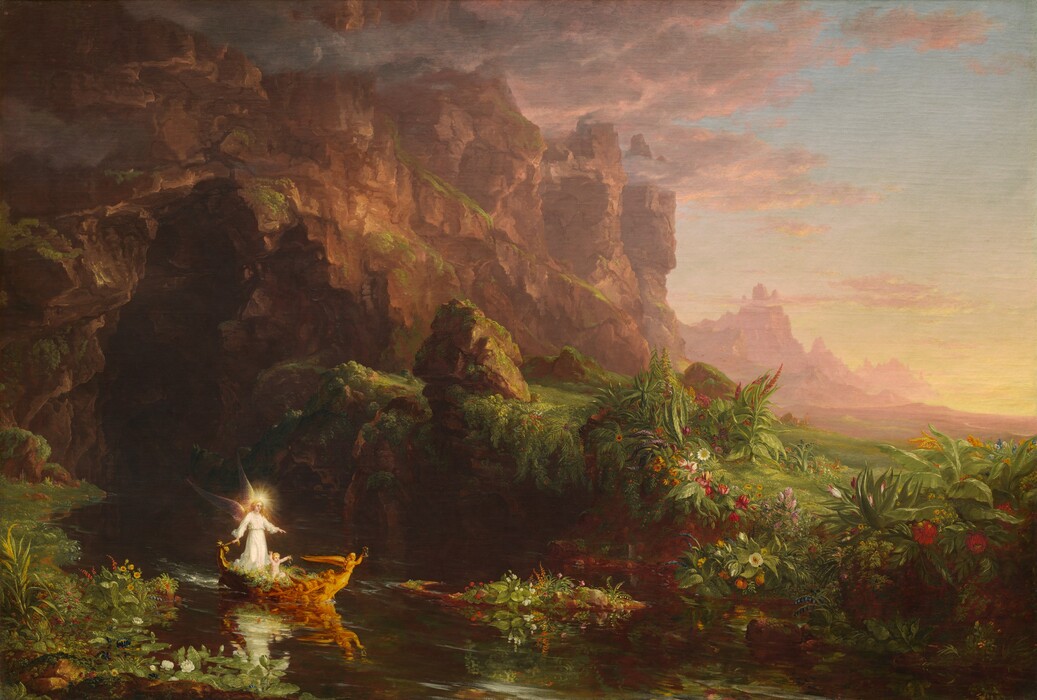
Near a verdant riverbank against soaring, hazy cliffs, a nude, chubby baby sits in a golden boat on a bed of pink and white flowers in this horizontal painting. A winged angel wearing a white robe with a glowing starburst hovering overhead stands behind the child with one hand resting on the tiller of the boat. The angel and child both have pale skin and blond hair. The baby holds up handfuls of flowers and looks forward. The bow of the boat is angled to our right as it glides along the glassy surface of the river. The boat seems to be made of or carved to look like a mass of gold, winged angels clustered to make the vessel. They reach toward a single angel thrust forward from the bow, like a masthead, who holds up an hourglass. The boat has just emerged from a dark cave at the base of rocky, rose-pink cliffs that reach off the top left edge of the canvas. The jagged peaks become pale pink as they march into the distance. A spit of the lush riverbank fills the lower left corner of the composition; it and the far bank are dotted with white waterlilies and a profusion of yellow, blue, pink, purple, and red flowers. Celery and moss-green growth carpets the boulders on either side the cave mouth and the ground stretching beyond the riverbank. The growth becomes mauve-purple as it recedes to the horizon, which comes a third of the way up the composition and is lit by a golden glow. Petal-pink and gray clouds float among the cliff-tops against an otherwise pale blue sky. The artist dated and signed the lower left, “1842 T. Cole Rome.”
Thomas Cole, The Voyage of Life: Childhood, 1842, oil on canvas, Ailsa Mellon Bruce Fund, 1971.16.1

1. Thomas Cole, The Voyage of Life

Thomas Cole’s four-part series traces a voyager’s journey through time and changing landscapes along the “Stream of Life” from birth to the “Ocean of Eternity” and death. These allegorical scenes were the Hudson River School painter’s interpretation of the passage of life, from the innocence of childhood to the flush of youthful confidence, through the trials of adulthood, and finally to old age. Cole's intrepid voyager can also be seen as a personification of the United States, a nation then in its own hopeful early years.

Main Floor, Gallery 60
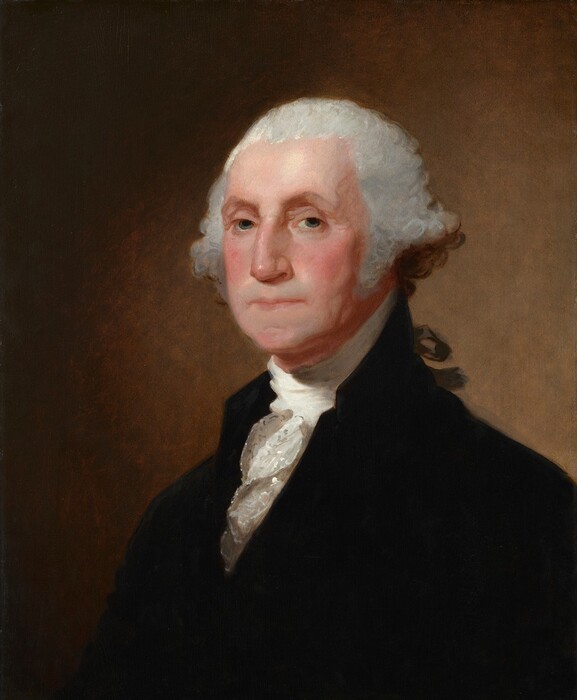
 

Shown from the chest up, a cleanshaven, middle-aged man with pale skin and silvery gray hair, wearing a white, ruffled shirt under a velvety black, high-necked jacket, looks out at us in this vertical portrait painting. His body is angled to our left, and he turns his face slightly to look at us with gray eyes under slightly arched eyebrows. He has a long nose and his thin lips are closed in a straight line. Shadows define slightly sagging jowls along his jawline and down his neck. His light gray hair is pulled back from his forehead and swells in bushy curls over his ears. Part of a black ribbon seen beyond his shoulder ties his hair back. Light illuminates the person from our left and creates a golden glow on the light brown background behind him.
Gilbert Stuart, George Washington, c. 1821, oil on wood, Gift of Thomas Jefferson Coolidge IV in memory of his great-grandfather, Thomas Jefferson Coolidge, his grandfather, Thomas Jefferson Coolidge II, and his father, Thomas Jefferson Coolidge III, 1979.5.1

2. Gilbert Stuart, George Washington

Even if you no longer carry dollar bills, you’re probably familiar with this bust-length view of George Washington, which appears (in reverse) on paper currency.

Gilbert Stuart painted Washington’s portrait three times from life. Always short of cash, Stuart made over a hundred copies of the trio of portraits to meet the demand of Americans and Europeans who were eager to own a likeness of the Revolutionary War hero and first president. The artist admitted, “I expect to make a fortune by Washington alone.”

Main Floor, Gallery 60A
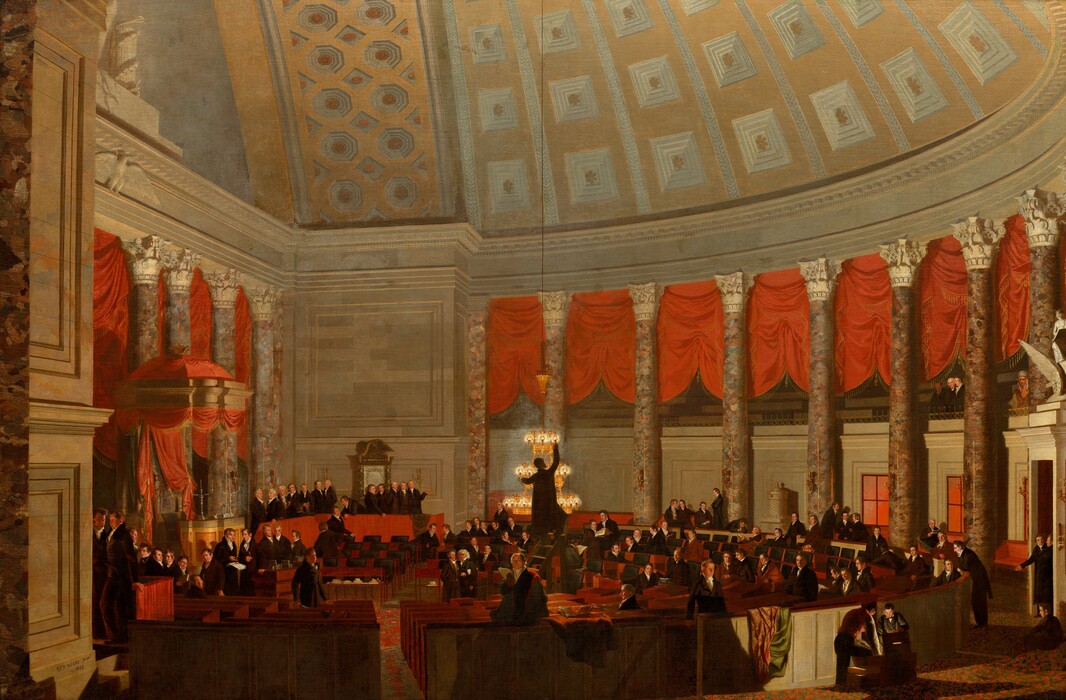
 

We look across a cavernous room with a half-domed ceiling where more than a hundred men are gathered at desks and theater-like boxes in this horizontal painting. Almost all of the men have pale, peachy skin and wear black suits with white high-pointed collars. The desks curve in a half-circle facing our left, where two candelabras sit on a dais, a canopied space with polished columns. Seven more columns lining the rounded space are also speckled with fawn brown, bronze, copper, and muted moss green. They have white capitals carved with leaves ands scrolls. Crimson-red curtains hung between the columns have been gathered up along their centers so they drape down to each side. The space is lit by a three-tiered chandelier near the center of the composition. The chandelier has been lowered and a man, backlit in silhouette, stands on a ladder and reaches for a light on the top tier. The other men sit singly or in groups at the desks or gather in small groups throughout the space. The D-shaped rows of desks are enclosed within a curving, waist-high wall. To our right, on our side of the wall, a pair of boys or men lean over an open box that is lit inside. A few people look on from a second-level balcony to our right. This includes a trio of men all wearing black. In the next bay, a man with medium-brown skin wears Pawnee attire with a tall headdress, necklaces, and what seems to be a fur-lined cloak. He looks out at us. A clock on the wall near him reads 6:14. The domed space has nested, ivory-white square or octagonal panels within gold borders. At the center of each panel is a six-petaled, gold flower. The artist signed the work as if he had written his name and date on the base of the wall to our left: “S.F.B. MORSE pinx 1822.”
Samuel F. B. Morse, The House of Representatives, 1822, probably reworked 1823, oil on canvas, Corcoran Collection (Museum Purchase, Gallery Fund, 1911), 2014.79.27

3. Samuel Morse, House of Representatives

With this monumental painting, Samuel F. B. Morse wanted to glorify US democracy in action. He depicts the grand House of Representatives chamber glowing in lamplight before an evening session. The artist spent four months in Washington painting the individuals seen here: congressmen, staff, Supreme Court justices, and members of the press. At the far right in the visitors’ gallery is Chief Petalesharo, a leader of the Skidi Pawnee who visited President James Monroe in 1821.

Morse put this painting on tour in 1823, but it didn’t attract much public attention. He went on to pursue his scientific interests and became famous as the primary inventor of the telegraph.

Main Floor, Gallery 62
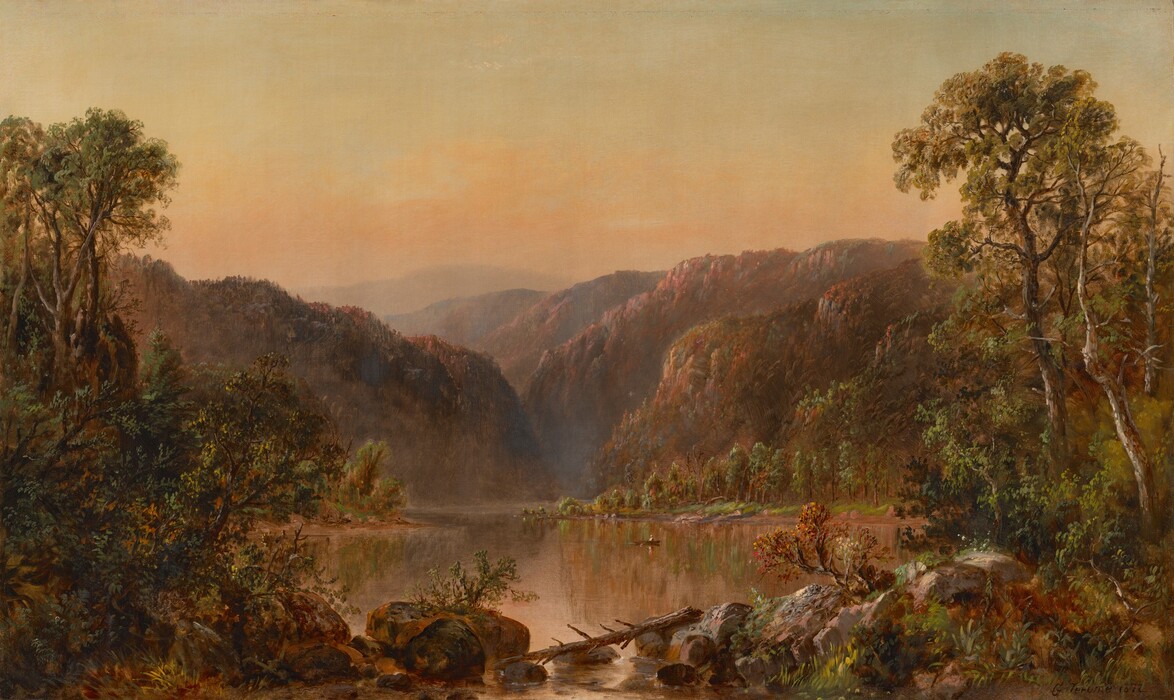
 

The painting features a valley with purple and brown mountains in the distance, surrounding a reflective body of water with a small rowboat floating on it. Closer to us, there are gray rocks, brown tree trunks and branches, and lush green vegetation at the edge of the water. The sky above is painted in warm shades of yellow, peach, and orange, which transition to pale greenish-blue at the top. The water below reflects these colors, as well as those of the distant mountain and surrounding trees.
Elizabeth Gilbert Jerome, American Landscape, 1872, oil on canvas, Gift of Funds from James and Christiane Valone in honor of Franklin Kelly, 2025.25.1

4. Elizabeth Gilbert Jerome, American Landscape

Her family, men, and society: they all said she couldn’t do it, but Elizabeth Gilbert Jerome persisted. Male artists thought she and other women were too fragile to sketch directly from nature. She nevertheless traveled into the wilderness to study the trees, rocks, bushes, and grasses seen in the foreground of this carefully composed landscape. To discourage Jerome, her stepmother destroyed the artist’s early works.

Years later, Jerome resumed painting, ultimately creating this scene of a lake set against mountains below a glowing sky. Jerome worked at a time when women rarely pursued careers, let alone became professional artists. She sometimes exhibited her paintings under the name E. Gilbert Jerome or signed them G. Jerome, as she did here.

Main Floor, Gallery 64
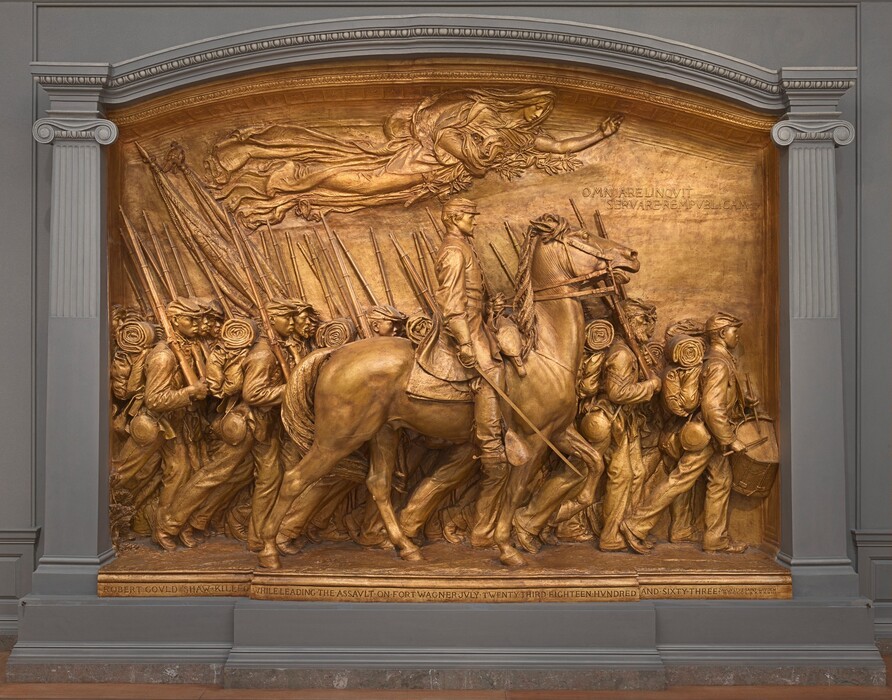
 

A white man in military uniform rides a horse in front of a regiment of five rows of Black troops in this sculpture, which is painted entirely in gold. The artist created a shallow, stage-like space with an arched top so the men are sculpted in three dimensions, though they become more compressed as they move back in space. The men and horse face our right in profile in this view. The man on the horse has a pointed, straight nose and a goatee. He wears a cap with a flat top and narrow brim, a knee-length coat, gloves, and knee-high boots with spurs. He holds a thin sword down by the side of the horse with his right hand and holds the reins of the horse with his left. The horse’s head is pulled upward by the short reins, and its mouth is open around the bit. About twenty soldiers are lined up in rows beyond the horse, and they march in unison. They carry blankets rolled atop knapsacks, canteens, and rifles resting on their right shoulders. However, the details of how their uniforms bunch up around their equipment and the way their caps have been molded and fit is unique to each person. Their ages also vary from young and cleanshaven to bearded, older men. Two men carry furled flags near the back, to our left, and a drummer boy plays at the head of the regiment, to our right. All the men look straight ahead, their lips closed. A woman in a billowing robe floats above them under the arched top of the sculpture with her eyes closed. Her left arm is outstretched, and she holds a laurel branch and poppies close to her body with her right arm. An inscription in the upper right corner is created with raised capital letters: “OMNIA RELINQVIT SERVARE REMPVBLICAM.” A longer inscription is carved into the base along the bottom edge of the memorial, also in all caps: “ROBERT GOVLD SHAW KILLED WHILE LEADING THE ASSVLT ON FORT WAGNER JVLY TWENTY THIRD EIGHTEEN HVNDRED AND SIXTY THREE.” The artist’s signature is inscribed In the lower right corner, in smaller letters: “AVGVTVS SAINT GAVDEN M-D-C-C-C-L X X X X V I I I.”
Augustus Saint-Gaudens, The Shaw 54th Regiment Memorial, 1900, patinated plaster, U.S. Department of the Interior, National Park Service, Saint-Gaudens National Historic Site, Cornish, New Hampshire, X.15233

5. Augustus Saint-Gaudens, The Shaw 54th Regiment Memorial

Commissioned from the celebrated American sculptor Augustus Saint-Gaudens in the early 1880s and dedicated as a monument in Massachusetts’ Boston Common in 1897, The Shaw 54th Regiment Memorial was acclaimed as the greatest American sculpture of the 19th century. The memorial commemorates the valiant efforts of Colonel Robert Gould Shaw and the men of the 54th Massachusetts, one of the first Civil War regiments of African Americans enlisted in the North.

This plaster version from 1900 features slight differences to the earlier bronze version. Saint Gaudens refined the sculpture into his final vision prior to its exhibition in the 1901 Pan-American Exposition held in Buffalo, New York.

Main Floor, Gallery 66
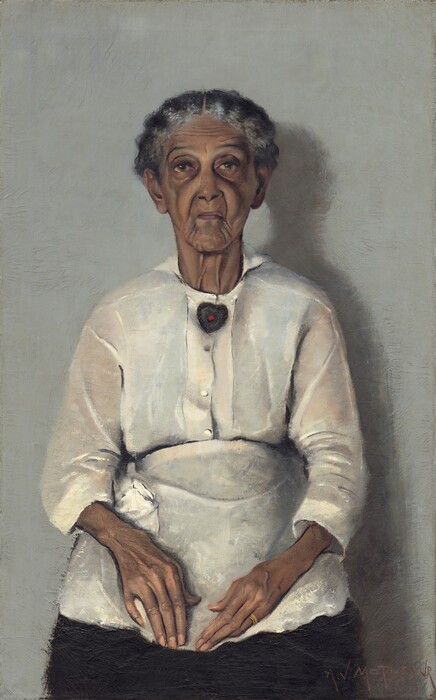
 

Shown from the knees up, a woman with brown, wrinkled skin, wearing a white blouse, apron, and black skirt is shown in front of a pale gray background in this vertical portrait painting. Straight-backed, she faces and looks at us with her hands resting in her lap. Her wavy, iron-gray hair is parted in the center and pulled back from her face. Her eyebrows are slightly raised, and her face is deeply lined down her cheeks and around her mouth. She wears a heart-shaped brooch with a red stone at its center at her neck and a gold band on her left ring finger. The light coming from our left casts a shadow against the wall to our right. The artist signed and dated the painting in the lower right corner: “A.J. MOTLEY. JR. 1922.”
Archibald John Motley Jr., Portrait of My Grandmother, 1922, oil on canvas, Patrons' Permanent Fund, Avalon Fund, and Motley Fund, 2018.2.1

6. Archibald John Motley Jr., Portrait of My Grandmother

When 80-year-old Emily Sims Motley posed for her grandson, her eyes focused on the artist working in front of her. That direct gaze now invites us to look carefully at this portrait. We take in the details of her lined yet regal face. Her white blouse is fastened with a heart-shaped pin. Her hands, worn and somewhat arthritic, rest gently in her aproned lap. Her slight shadow is behind her.

After a while, we sense the love and respect that artist Archibald John Motley Jr. felt for this dignified elder, who was born enslaved and endured to live with four generations of her family in Chicago.

Main Floor, Gallery 66
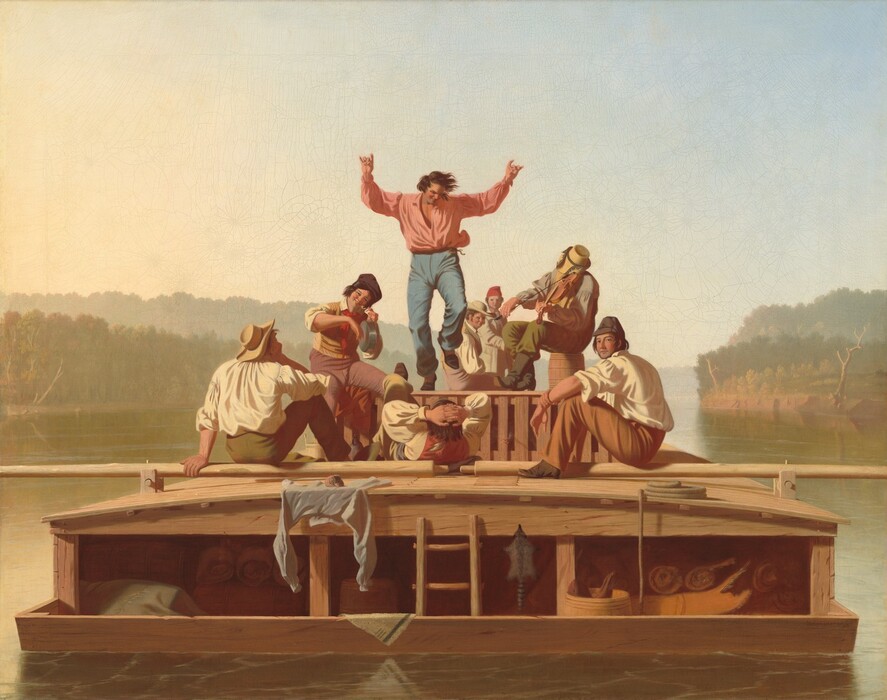
 

A flatboat with eight light-skinned men floats toward us down a wide river in this horizontal painting. The boat nearly spans the width of the composition and has low sides and a shallowly arched, low cabin upon which the men gather. At the center, a man with dark hair and wearing light blue trousers and a pink shirt dances with one foot and both arms raised. To our right a seated musician plays a fiddle, and to our left a smiling man holds up a metal pot and strikes the flat bottom with the back of his fingers. The remaining men sit or recline around the musicians and dancing man, some looking toward the dancer and two looking out at us. Bedrolls and animal skins are stored in the cabin below. The olive-green surface of the river is streaked with pale blue. The horizon line comes about a third of the way up the composition. The trees and riverbanks in the distance are hazy beneath a watery blue sky.
George Caleb Bingham, The Jolly Flatboatmen, 1846, oil on canvas, Patrons' Permanent Fund, 2015.18.1

7. George Caleb Bingham, The Jolly Flatboatmen

Sunlight bathes the landscape and warms the men floating downriver on a flat-bottomed boat. A man dances joyfully to music provided by his companions. Others look on, except for one who gazes directly at us.

George Caleb Bingham’s knowledge of life on the Missouri and Mississippi Rivers is evident in the abundance of details, including a raccoon pelt, a coiled rope, a blue shirt hanging to dry, and a turkey peeking through a slatted crate. Absent, however, is evidence of the men’s arduous journey to trading posts upriver. Many Americans were familiar with Bingham’s painting through the thousands of prints that reproduced this idealized scene of western expansion.

Main Floor, Gallery 65
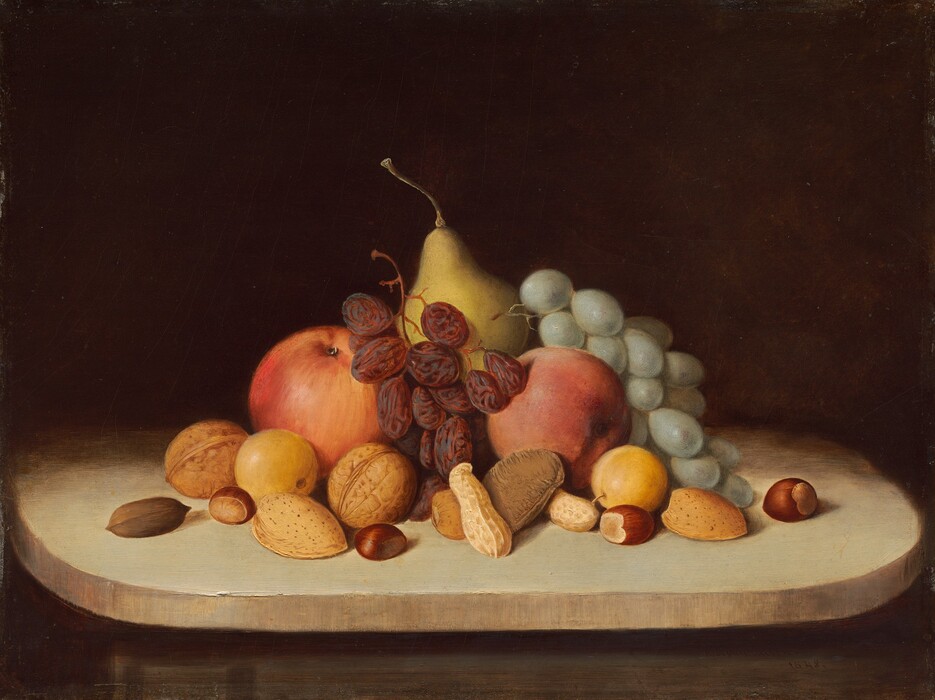
 

Several pieces of fruit, a bunch of green grapes, a stem of raisins, and several types of nuts in their shells are piled on a putty-brown tabletop or ledge with rounded corners against a dark background in this horizontal still life painting. The food is brightly lit from the front, and we look slightly down onto the table. There are two round red apples and two pieces of small yellow fruit, perhaps quinces, flanking a golden yellow pear at the back center. The bunch of grapes drapes over the fruit to our right and the raisins lie between the apples. Thirteen walnuts, peanuts, almonds, hazelnuts, and perhaps a brazil nut are scattered in a loose band in front of the fruit. The surface on which the still life sits becomes swallowed in shadow behind the fruit, and blends into the dark brown background. The artist signed and dated the work in dark paint in the lower right corner, almost lost in shadow under the ledge: “R.S. Duncanson 1848.”
Robert Seldon Duncanson, Still Life with Fruit and Nuts, 1848, oil on board, Gift of Ann and Mark Kington/The Kington Foundation and the Avalon Fund, 2011.98.1

8. Robert Seldon Duncanson, Still Life with Fruit and Nuts

Notice how Robert Seldon Duncanson painted the different textures of this still life, from the smooth skin of the apple to the shriveled grapes.

This painting comes from a small group of still lifes the artist made early in his career while he lived in Cincinnati, Ohio. Duncanson was primarily recognized for his pastoral landscapes that often carried religious or moral messages. He was one of the first African American artists whose work became popular abroad.

Main Floor, Gallery 69A
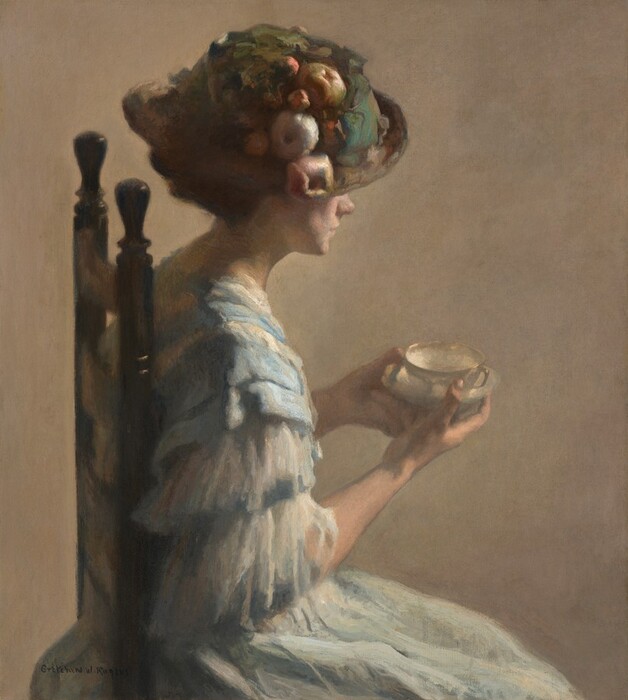
 

This painting depicts a side view of a seated woman facing the right, showing the upper half of her body and the top of her legs. She is sitting on a dark wooden chair with horizontal slats visible at the back. The woman is positioned in profile, looking slightly downward, and holding a white cup and saucer with both hands. The woman has fair skin, a small nose, and a small chin. The top of her face and her hair are hidden by the large hat she wears, which is adorned with colorful fruits and flowers in shades of white, yellow, light pink, and light green. She wears a blue and white dress with frilled sleeves. The background is a beige wall.
Gretchen W. Rogers, Five O'Clock, c. 1910, oil on canvas, Gift of Funds from James and Christiane Valone in memory of James F. Penrose, 2022.131.1

9. Gretchen W. Rogers, Five O’Clock

An elaborate hat decorated with fruit, flowers, and leaves partially obscures the face of a well-dressed woman. Although she sits alone against a plain background, the cup and saucer she cradles suggest she may have a teatime companion just outside the picture frame.

This scene captures a routine occurrence in the life of artist Gretchen Rogers. Each day at five o’clock, Rogers and other aspiring women artists gathered for tea and community in the Fenway Studio Building, where they studied art in Boston. This social ritual supported the independent young women who might have felt isolated away from home.

Main Floor, Gallery 70
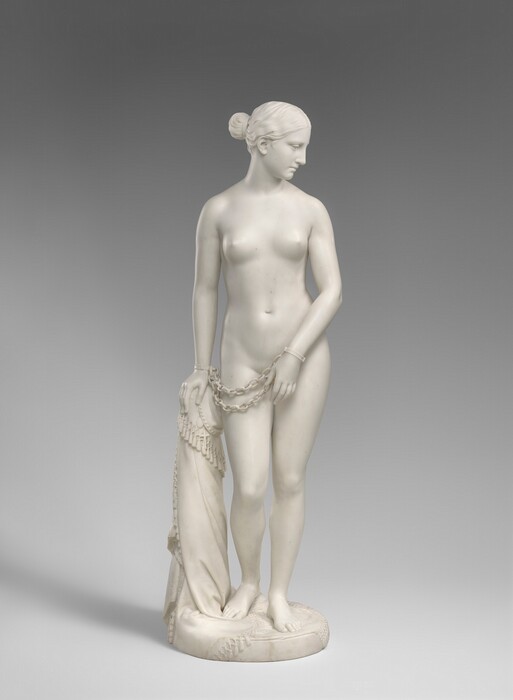
 

Carved from creamy white marble, a nude woman stands next to a hip-high support, perhaps a low post. In this photograph, her body faces us, and she looks down to our right in profile. Her wavy hair is tucked behind her ear and drawn back in a bun at the nape of her neck. Her weight rests on her left leg, on our right, and her other knee is bent. Her left arm is angled in front of her body so her hand covers her groin. Her other hand, on our left, rests on the post. Chains hang from shackles encircling her wrists. The post is covered with a cloth that gathers around the top and spirals to the ground beneath her feet, the edge trimmed with tassels. A cross and medallion peek out from under the cloth near her hand. She stands on a circular base.
Hiram Powers, The Greek Slave, model 1841-1843, carved 1846, Seravezza marble, Corcoran Collection (Gift of William Wilson Corcoran, 1873), 2014.79.37

10. Hiram Powers, The Greek Slave

This figure by Hiram Powers caused a frenzy when it was first exhibited in the mid-19th century. American audiences, unused to seeing classically nude statues of women, thought the sculpture was sensational and scandalous. Curious viewers came in droves to see the versions Powers sent from Italy, where he was then working.

Greece’s struggle for independence in the 1820s inspired Powers to create this sculpture, but both abolitionists and anti-abolitionists adopted it as a symbol for their efforts. The controversial artwork became America’s most famous sculpture. Powers made numerous smaller versions, and the image soon graced everyday items, from sheet music to tobacco tins.

Main Floor, Gallery 71


You may also like

America’s 250th

Join us as we explore 250 years of American creativity from across the nation.
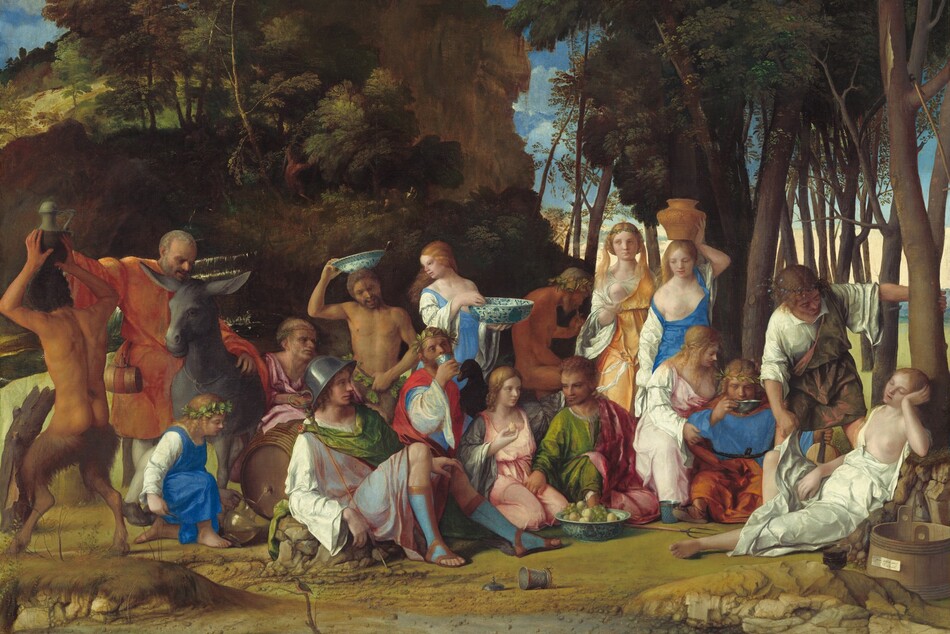
Six women, eight men, two satyrs, and one child gather in pairs and trios in a loose row that spans the width of this nearly square painting. They are set within a landscape with craggy rocks, cliffs, and trees. Most of the people face us, and the men, women, and child have pale skin. The two satyrs have men’s torsos and furry goat’s legs, and they have darker, olive complexions. Most of the men wear voluminous, knee-length togas wrapped in short robes in shades of white, topaz blue, grass green, coral orange, or rose pink. Most of the women wear long, dress-like garments in tones of shell pink, apricot orange, or lapis blue over white sleeves. For all but one woman, their garments have fallen off one shoulder to reveal a round, firm breast. Several objects are strewn on the rocky, dirt ground in front of the group, including a wide, wooden bucket with a piece of paper affixed to its front to our right, a glass goblet, a pitchfork, a large blue and white ceramic dish filled with grapes and small yellow fruits, and an overturned cup near the center. Cliff-like, craggy rocks rise steeply behind the group to our left, filling much of the sky opposite a tall grove of leafy, dark green trees to our right. A few puffy white clouds float across the vivid blue sky. The slip of paper on the barrel has been inscribed, “joannes bellinus venetus p MDXIIII.”

Must-Sees at the National Gallery

Visiting for the first time? Only have an hour to spend? That's enough time to connect with intimate portraits, discover "action painting," and meet a 14-foot-tall rooster.