


Sculpture Garden Self-Guided Tour
Use this self-guided tour to explore the Sculpture Garden's monumental modern sculptures. The tour is designed to start from the north west entrance on Constitution Avenue, moving clockwise.
Marc Chagall, Orphée, 1969
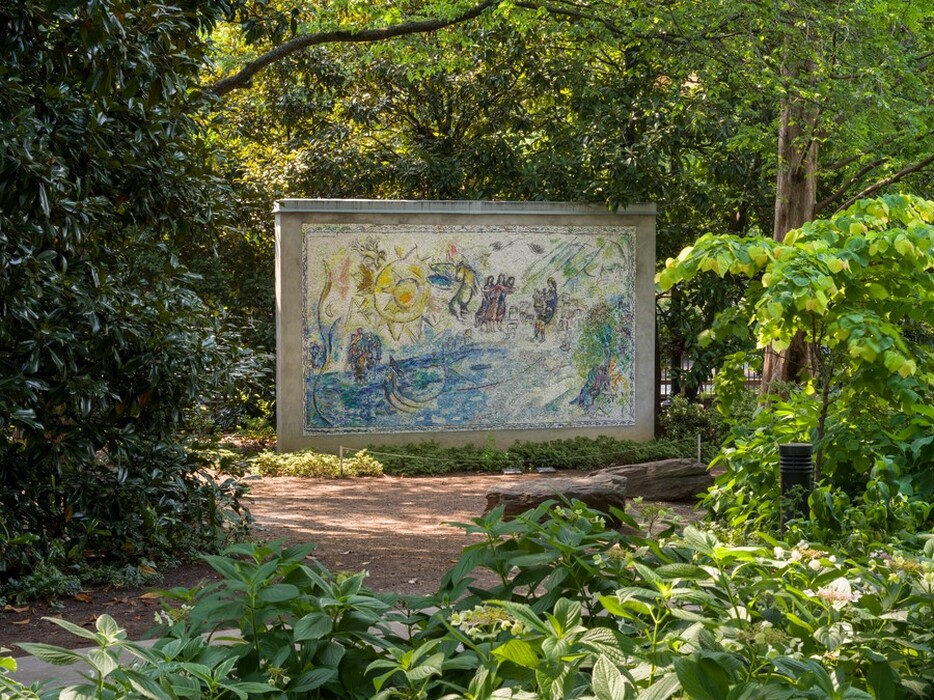
In 1968, Marc Chagall visited the Washington, DC, home of his friends and patrons Evelyn and John Nef and decided that he would design a mosaic for their garden. There the work remained until it was given to the National Gallery of Art by Evelyn (1913–2009) as part of a larger bequest.
The mosaic's large scale—approximately 10 by 17 feet and 1,000 pounds—is belied by its ethereal figures and shimmering surface. The colorful, layered narratives are loosely drawn from Greek mythology and from the artist's personal experience. At center, Orpheus charms animals with his lute, accompanied by the Three Graces and the winged stallion Pegasus. In the bottom left corner of the mosaic, a group of people wait to cross a large body of water. According to Chagall, this alludes not only to the general immigration of Europeans to America, but also to his own experience: smuggled out of Nazi-occupied France by the International Rescue Committee during World War II, the Jewish artist found safe haven in New York. In the lower right corner, two lovers nestle in the greenery. Evelyn asked the artist if the figures depicted her and John; Chagall replied, "If you like."
Claes Oldenburg and Coosje van Bruggen, Typewriter Eraser, Scale X, model 1998, fabricated 1999
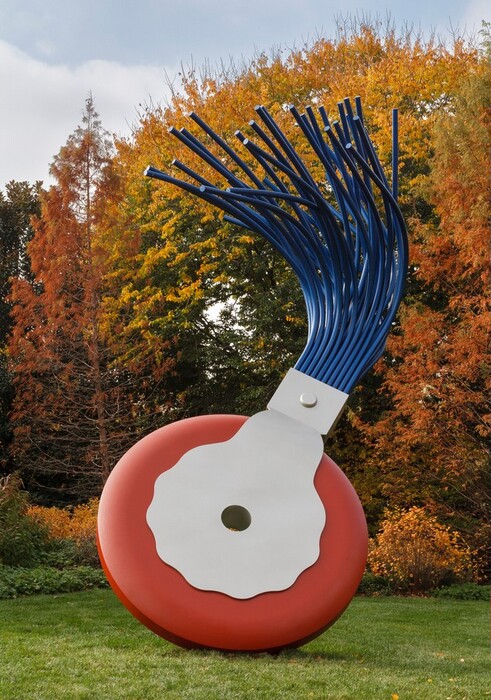
In the mid-1960s, Claes Oldenburg began to visualize public monuments based on common objects, such as a clothespin or a pair of scissors, instead of historical figures or events. The artist chose the (now obsolete) typewriter eraser as his model for this work based upon childhood memories of playing with the object in his father's office. In the late 1960s and 1970s he used the eraser as a source for drawings, prints, sculpture, and even a never-realized monument for New York City. Here the giant brush arcs back, conveying a sense of motion, as if the wheel-like eraser were rolling down the hill and making its way toward the gate of the garden.
Joan Miró, Personnage Gothique, Oiseau-Éclair (Gothic Personage, Bird-Flash), 1974, cast 1977

Until his 70th birthday in 1963, Joan Miró was best known for his surrealist paintings and drawings. However, in the last two decades of his life he created more than 150 sculptures. These late works mostly fall into two categories: those cast from forms created by the artist, and those cast from found objects. One of Miró's largest sculptures, Personnage Gothique relates to both types: the bird was cast from an object the artist created, while the top portion was cast from a cardboard box and the arch-shaped form from a donkey's collar. The objects combine to suggest a figure, while at the same time the empty box and unoccupied harness imply absence. Personnage Gothique embodies Miró's lifelong concern with richly imaginative imagery that he said was "always born in a state of hallucination."
Louise Bourgeois, Spider, 1996, cast 1997

Louise Bourgeois used the spider as the central protagonist in her art during the last decades of her life. For the artist, whose work explored themes of childhood memory and loss, the spider carried associations of a maternal figure. Bourgeois associated the "Spider" series with her own mother, who died when the artist was 21 years old. From drawings to large-scale installations, Bourgeois's spiders appear as looming and powerful protectresses, yet are delicate and vulnerable.
Tony Smith, Wandering Rocks, 1967
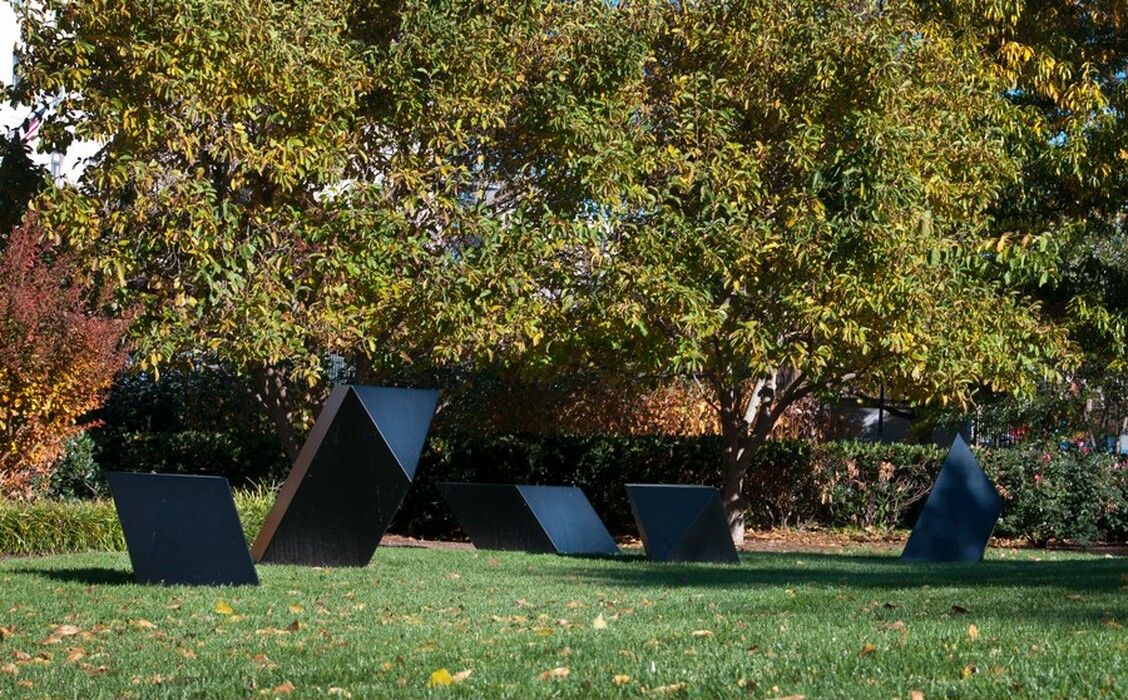
Tony Smith was a man of many talents: he was a successful architect who trained at the New Bauhaus school and worked with Frank Lloyd Wright before turning to painting and, eventually, sculpture. Only in his late 40s did Smith begin making sculpture full-time. Smith's Wandering Rocks joins tetrahedrons and octahedrons to create five individual but related objects that eschew the monumental (see Moondog, 1964) and rational (see #Die, 1962/68) approaches of his earlier works. Each element in Wandering Rocks has a separate name—Crocus, Shaft, Dud, Slide, and Smohawk. The arrangement of the individual elements is flexible as long as they are grouped together and responsive to the site.
Magdalena Abakanowicz, Puellae (Girls), 1992
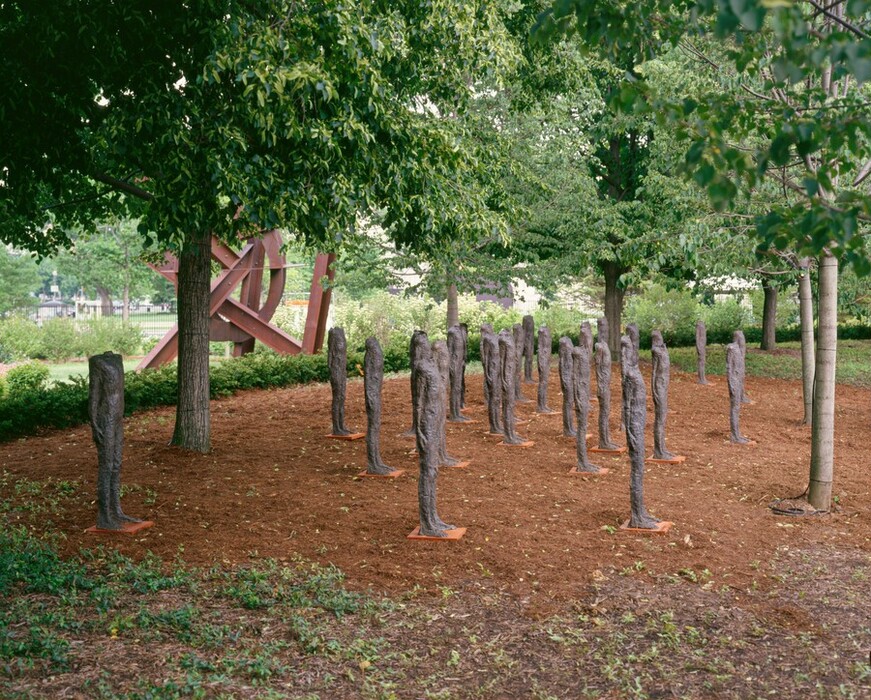
The sculpture of Polish artist Magdalena Abakanowicz is largely drawn from her experience of World War II and its aftermath. She is best known for her "crowds" (as she called them) of headless, rigidly posed figures whose anonymity and multiplicity have been regarded as the artist's personal response to totalitarianism.
Each of the thirty bronzes in Puellae (meaning "girls" in Latin) is unique, made from individually sculpted wax forms based on a body cast of a single child model. Abakanowicz applied burlap to each of the forms prior to casting to give them a rough, organic texture. This work refers to an account the artist heard while growing up in Poland about a group of children who froze to death as they were transported in cattle cars from Poland to Germany during the war.
Mark di Suvero, Aurora, 1992 – 1993
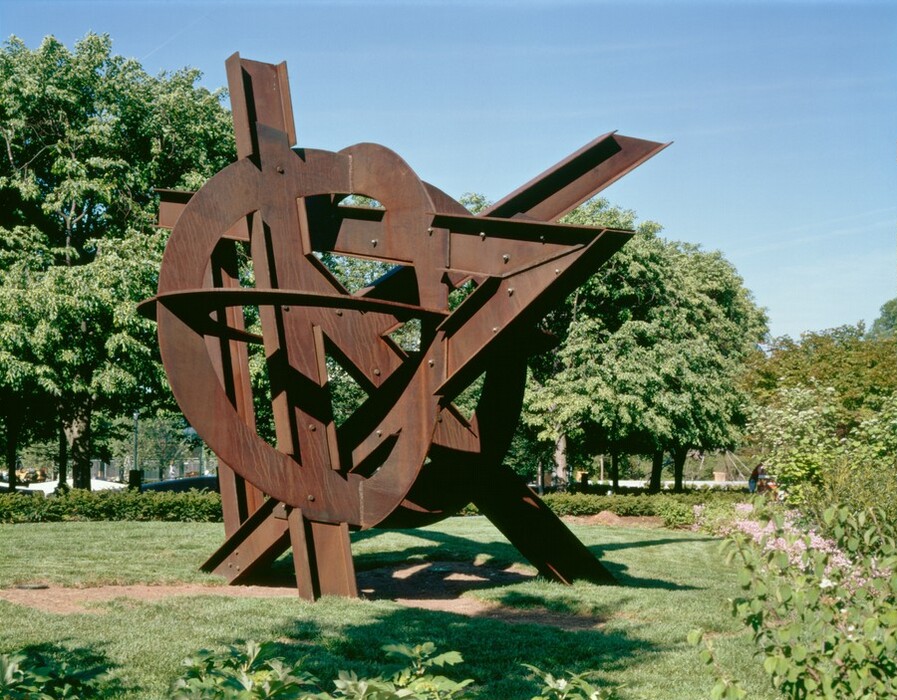
Mark di Suvero began making sculpture in the late 1950s with massive, weathered timbers and found objects such as barrels, chains, and tires. Bold and gestural, the dramatically cantilevered forms in di Suvero's early works were considered the sculptural equivalents of abstract expressionist paintings. In the 1960s di Suvero began to craft works from steel beams that he moved with cranes and bolted together to create large outdoor pieces. Aurora is a tour de force of design and engineering. Its sophisticated structural system distributes eight tons of steel over three diagonal supports to combine massive scale with elegance of proportion. Several beams converge within a central circular hub and then explode outward, imparting tension and dynamism to the whole. The title comes from a poem about New York City by Federico García Lorca (Spanish, 1898–1936). The steel forms a letter "k": the artist has said the work is a portrait of his wife, Kate.
Scott Burton, Six-Part Seating, conceived 1985, fabricated 1998
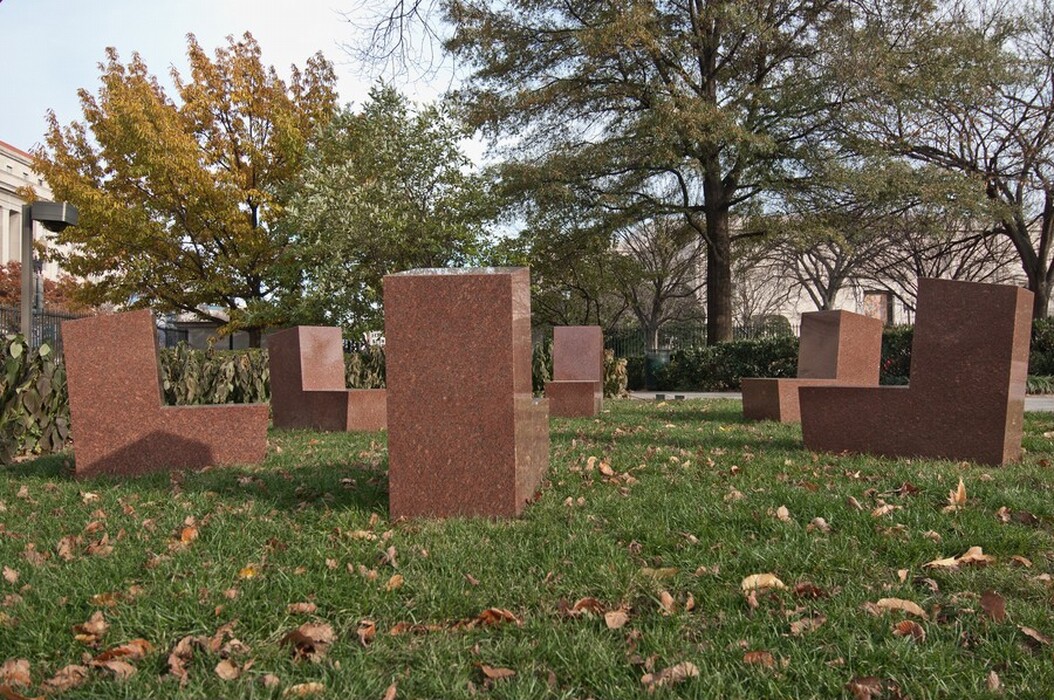
Scott Burton believed that art should "place itself not in front of, but around, behind, underneath (literally) the audience." In this way, he challenged ideas about sculpture's monumentality, formality, and status as an object to be looked at on a pedestal. Instead, he wanted his sculpture to occupy the same space as its beholder, to be functional and, preferably, placed in a public setting. Burton openly acknowledged a debt to Constantin Brancusi, an early modern sculptor who challenged the conventional distinction between aesthetic and utilitarian form. Here, the blunt geometry of Burton's seats contrasts with the material (red granite) that is visually sumptuous and warm. The artist specified two possible configurations to encourage social interactions and gathering: a ceremonial circle, as the work appears here, or side-by-side to form a long bench.
Joel Shapiro, Untitled, 1989
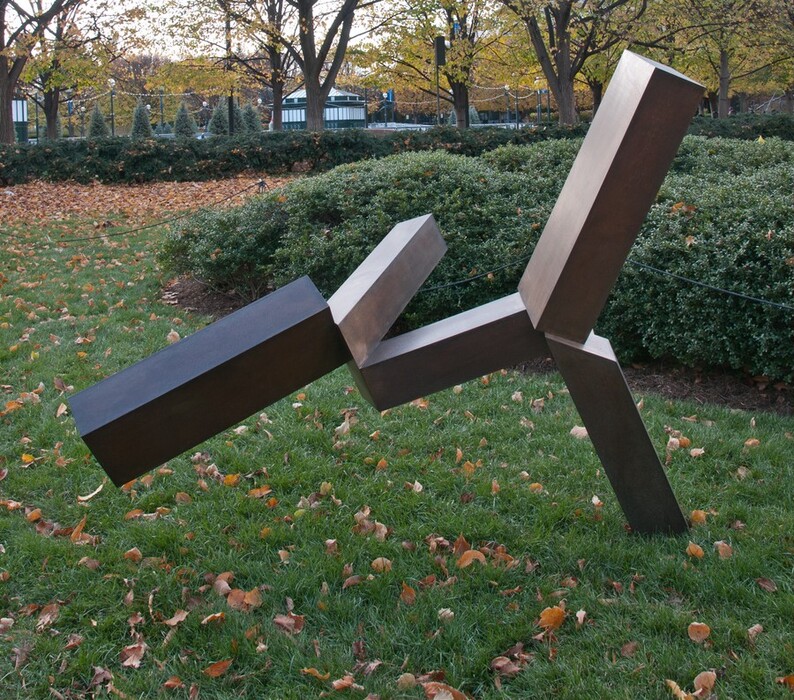
Joel Shapiro's Untitled may bring to mind a human figure in motion, yet at the same time it can be understood as an abstract sculpture that explores the properties of balance and gravity. The impression changes as you move around the object and encounter a variety of animated compositions. Originally constructed from plywood sheets, the elements of this work were carefully cast to retain the wood grain pattern.
Robert Indiana, AMOR, conceived 1998, fabricated 2006
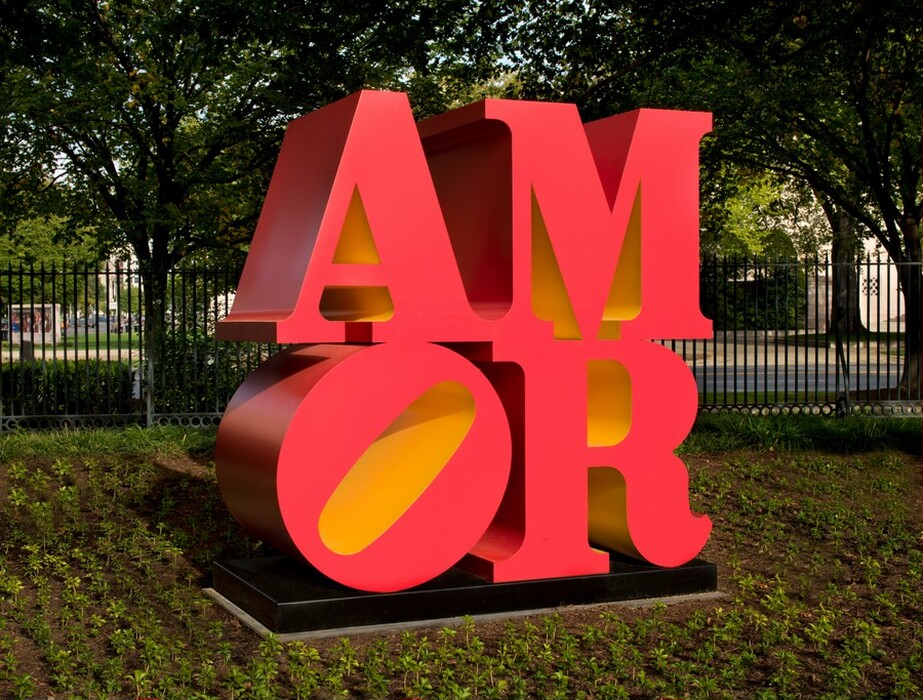
Born in New Castle, Indiana, in 1928, Robert Clark changed his last name to the state of his birth in 1958, signifying his strong identification with American culture as well as his urge for self-invention. A play on Robert Indiana's famous LOVE sculpture, AMOR is constructed from red and yellow polychrome aluminum.
Indiana originally conceived the familiar "Love" graphic in drawings, paintings, and sculptures between 1964 and 1966. The image became most widely known through a commission for a Museum of Modern Art card in 1965 and the 8-cent "Love" stamp issued in 1973 by the United States Postal Service. It became an emblem of the 1970s in the US, associated with youth-driven counter-culture during the Vietnam conflict.
Indiana's design, with its distinctively inclined O, has been translated into several languages, materials, and colors. This Spanish (or possibly Latin) example made its first appearance on a plaza in Madrid in 2006.
Ellsworth Kelly, Stele II, 1973
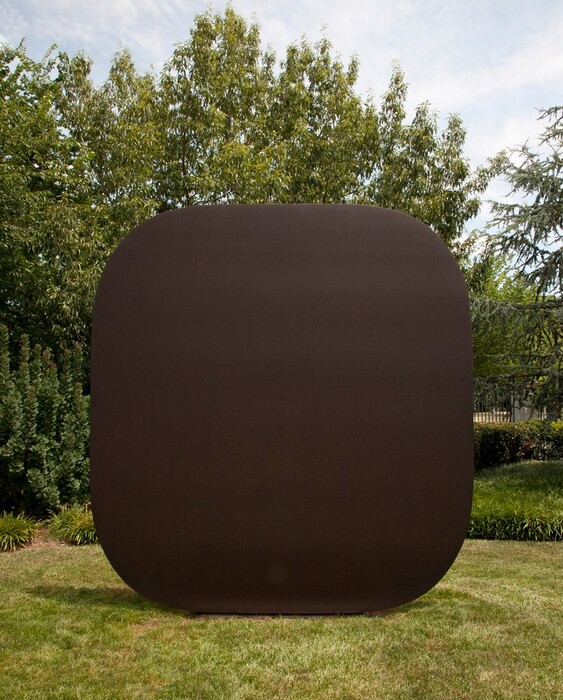
After moving from Manhattan to the countryside in 1970, Ellsworth Kelly began to make large outdoor sculptures. The distinctive shape of Stele II had already appeared in the artist's abstract paintings and is loosely based on a French kilometer marker, an object Kelly observed during his years in Paris after World War II. The title refers to a type of ancient stone monument that traditionally served a commemorative function. Like most stelae, this sculpture is also essentially planar and upright. Over time, the steel weathers from exposure to the elements, developing an evenly corroded, non-reflective surface.
Barry Flanagan, Thinker on a Rock, 1997
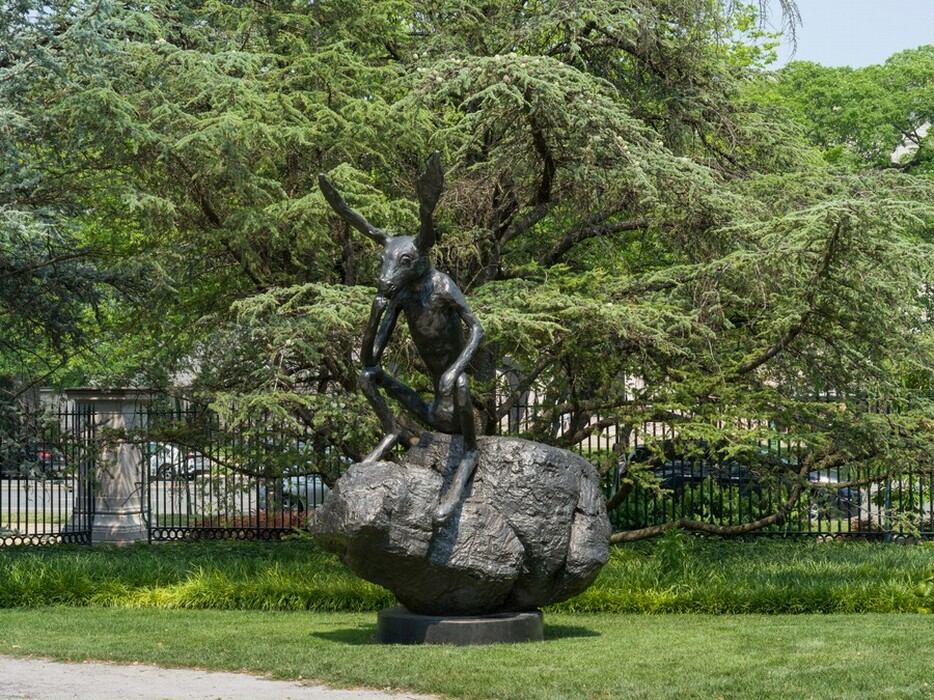
Barry Flanagan explored painting, dance, and installation work as alternatives to the constructed metal sculptures that were the prevalent idiom when he was in art school in London in the 1960s. His inventive and varied body of work is filled with humor and poetic associations, often evoked by the particular organic materials he employed. While working with clay in the early 1980s, Flanagan perceived the image of a hare "unveiling" itself before him. The hare motif has appeared in a variety of guises in Flanagan's bronzes. In Thinker on a Rock the artist substitutes the hare for Rodin's Thinker (1880), making an irreverent reference to one of the world's best-known sculptures, a version of which may be seen in the West Building sculpture galleries.
Alfredo Halegua, America, 1970
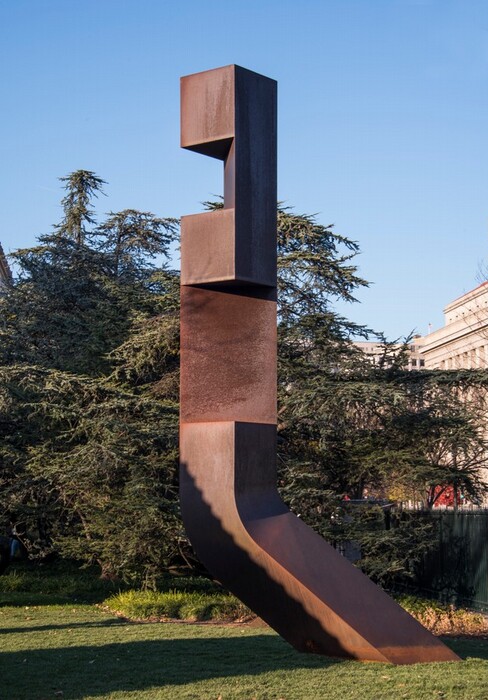
A sweeping gesture in cor-ten steel rising to a height of 25 feet, Alfredo Halegua's notched-and-bent sculpture strikes up interesting conversations with other abstract sculptures in the Sculpture Gallery also made of steel. The title America was inspired by the form of the work, particularly where it bends near the base. The artist said that the bend reminded him of something that grew with great difficulty at first but resulted in “something positive”—like the United States. A sculptor of monumental works, Halegua was born in Uruguay and is based in Washington, DC.
Sol LeWitt, Four-Sided Pyramid, first installation 1997, fabricated 1999
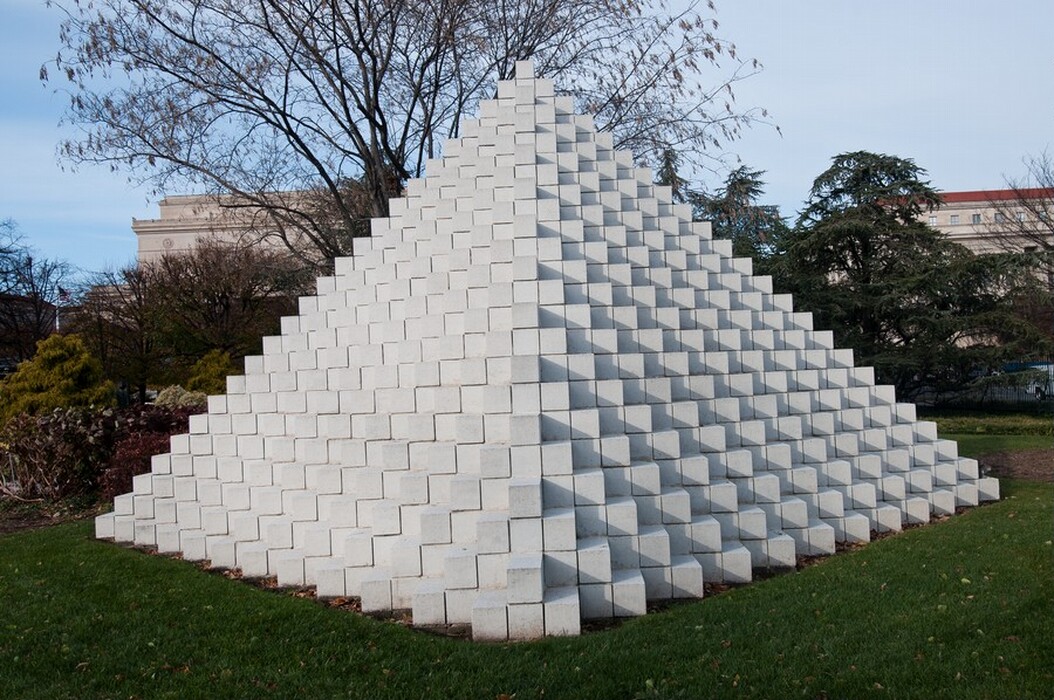
For nearly five decades, starting in the early 1960s, Sol LeWitt was at the forefront of minimal and conceptual art. LeWitt's structures (a term he preferred to sculpture) are generally composed with modular, quasi-architectural forms. For Four-Sided Pyramid, as with many of his works, LeWitt created a plan and a set of instructions to be executed by others. In collaboration with the artist, a team of engineers and stonemasons constructed Four-Sided Pyramid on this site. The terraced pyramid, first employed by LeWitt in the 1960s, relates to the 1961 repeal of early 20th-century setback laws for New York City skyscrapers. The geometric structure of Four-Sided Pyramid also alludes to the ziggurats of ancient Mesopotamia.
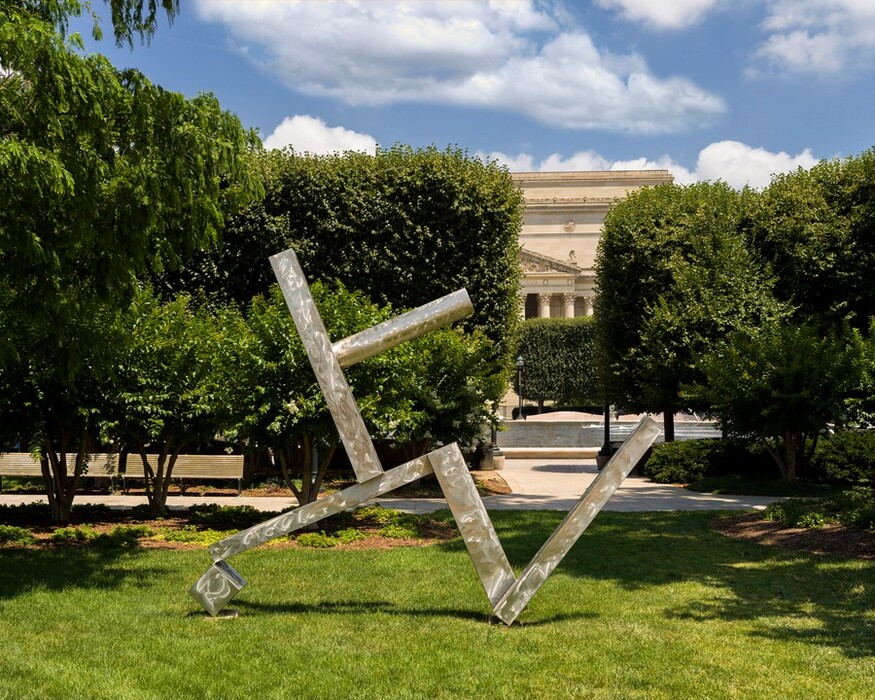
Lucas Samaras, Chair Transformation Number 20B, 1996

Since the 1960s, Lucas Samaras has made series of obsessional, sometimes hallucinatory objects. Prominent among his motifs is the chair, which Samaras has executed in a variety of materials such as fabric, wire mesh, and mirrored glass, thereby turning a utilitarian object into a fantastic one, the product of a dreamlike metamorphosis. Here, Samaras explores the dual meaning of "flight," referring to both the stairlike form created by the stacked chairs, and to the locomotion of a single chair moving diagonally through space. From different viewpoints, the sculpture appears to be upright, leaning back, or springing forward. From the side, it even appears as a two-dimensional, zigzagging line.
Tony Smith, Moondog, model 1964, fabricated 1998–1999
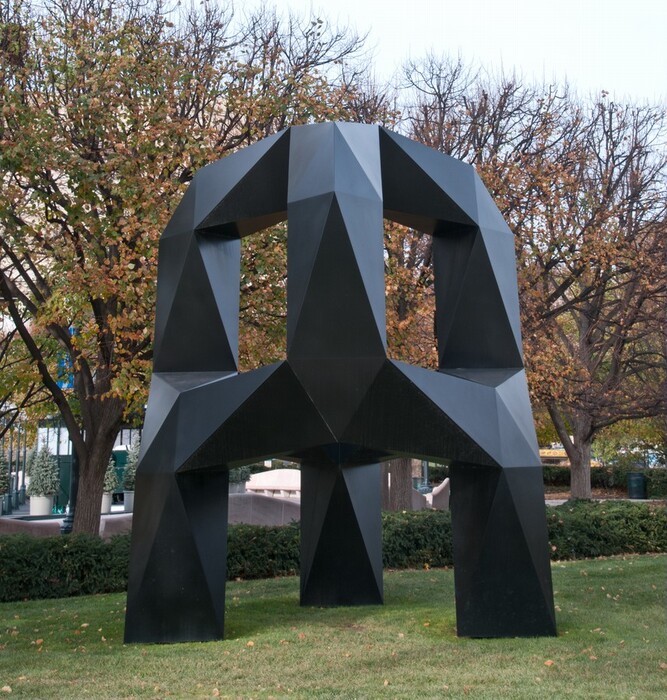
The structure of Moondog is based on a lattice motif and comprises a configuration of geometric shapes (15 octahedrons and 10 tetrahedrons). While its rational geometry conveys a grounded regularity, Moondog also has a startling tilt from certain viewpoints, giving an impression of instability. Tony Smith compared this sculpture to a variety of forms, including a Japanese lantern and a human pelvic bone. The title itself derives from two sources: Moondog was the name of a blind poet and folk musician who lived in New York City, and Smith has also likened this sculpture to Dog Barking at the Moon, a painting by Joan Miró. He first created Moondog in 1964 as a 33-inch cardboard model and cast it in bronze as a garden sculpture in 1970. This version was planned by Smith, but it was not fabricated until after his death.
David Smith, Cubi XXVI, 1965
David Smith worked as a welder in a car factory as a young man. Later, he emerged as a sculptor within the context of the New York School in the 1940s and 1950s, and applied his industrial skills to his art-making practice. He said of his preferred medium, welded steel: "The metal itself possesses little art history. What associations it possesses are those of this century: power, structure, movement, progress, suspension, brutality." Smith most often created works in series, culminating in the 1960s with his celebrated "Cubi" sculptures made of cubic or cylindrical shapes precisely crafted, assembled, and polished by the artist. "I depend a great deal on the reflective power of light," he said.
Alexander Calder, Cheval Rouge (Red Horse), 1974
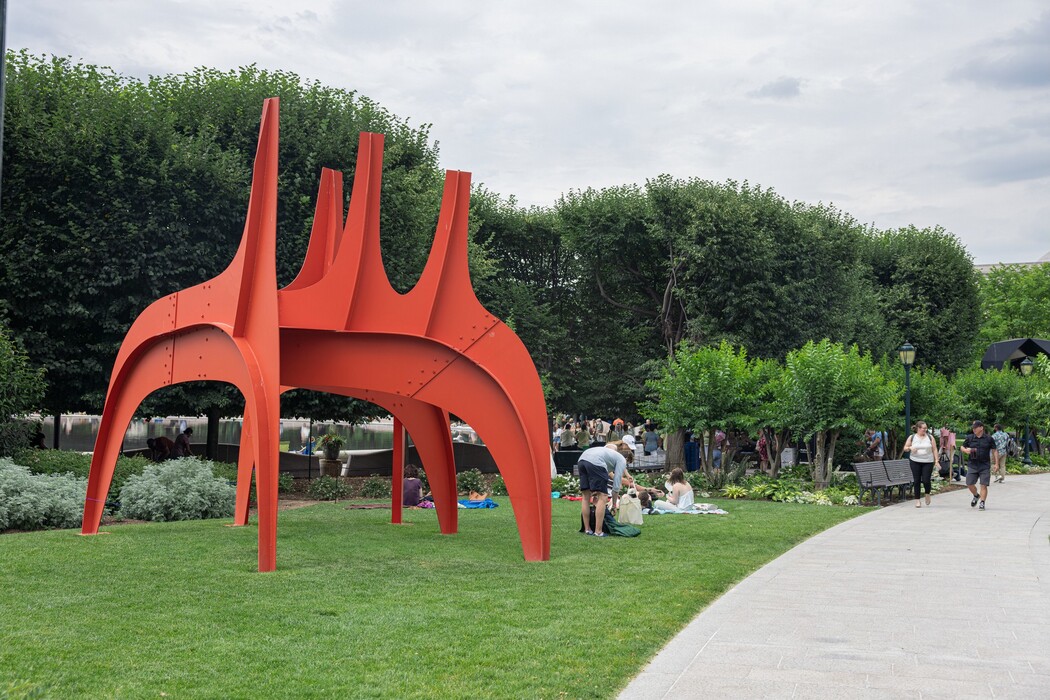
During the last two decades of his life Alexander Calder devoted his greatest efforts to large-scale mobiles and stabiles, many of which have become popular public landmarks in cities around the world. Unlike his earlier works, these huge objects required a collaborative effort. To fabricate Cheval Rouge the artist worked with skilled technicians and metalworkers at the Biémont Foundry in Tours, France.
Calder's outdoor stabiles such as Cheval Rouge exhibit an appealing grace and, though steadfastly abstract, evoke a friendly resonance with natural forms. Here the sleek, tapering legs and tensile up-thrust "neck" recall the muscularity and power of a thoroughbred. This stabile reflects Calder's assertion: "I want to make things that are fun to look at, that have no propaganda value whatsoever."
Roy Lichtenstein, House I, model 1996, fabricated 1998
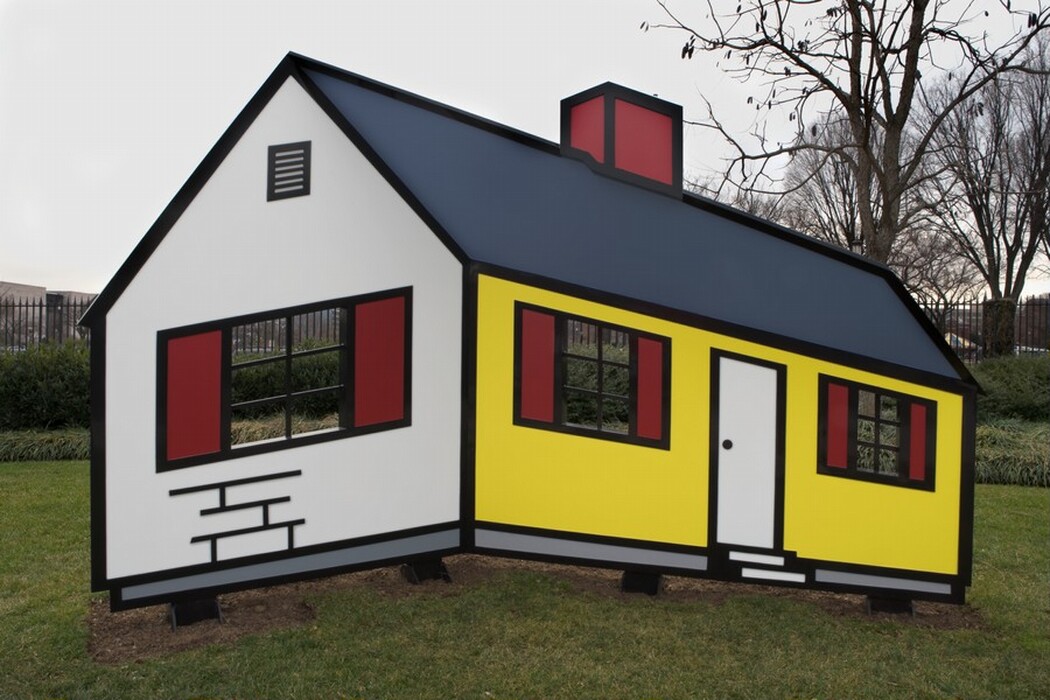
Roy Lichtenstein may be best known for his 1960s pop art paintings based on advertisements and comic strips, yet he also produced a significant body of sculpture, including large-scale works designed for the outdoors. House I incorporates the hallmarks of the artist's style: crisp, elemental forms, heavy black outlines, and a palette based on primary colors. Whereas most of the artist's sculpture approximates freestanding paintings in relief rather than volumetric structures in the round, some of his late sculpture, such as House I, exploits the illusionistic effects of a third dimension. The side of the house seems to project toward the viewer while actually receding into space. As a result, the object appears to move as you move past it. This intentionally plays with the laws of parallax, which govern the perspective of an observer moving past a fixed scene.
Roxy Paine, Graft, 2008–2009

At first glance, this sculpture's composition of trunk and branches, and its scale, relate Graft to mature trees in the garden. Yet the differences outweigh the similarities, starting with its shiny, stainless steel exterior. One set of branches appears orderly and rational in its progression upward, while the other set exhibits crabbed, twisted, and fraught boughs. The work's title refers to the horticultural procedure of joining one tree or plant to the bud, stem, or root of another in order to repair it, adapt it to climate or soil change, propagate it, or produce new fruits or flowers. The conjoining of two distinct sides in Graft may also be seen to connect the binary historical tropes in the history of art—classical on the one hand, and romantic on the other. Another definition of "graft" refers to the means by which an individual or entity gains power unfairly. This sculpture is part of a series of stainless steel sculptures the artist refers to as "Dendroids," a term that describes a tree-like, branching form, but also evokes an artificially engineered or mutant body. Graft was added to the Sculpture Garden on the 10th anniversary of its opening.
Hector Guimard, An Entrance to the Paris Métropolitain, model 1902, fabricated 1902/1913
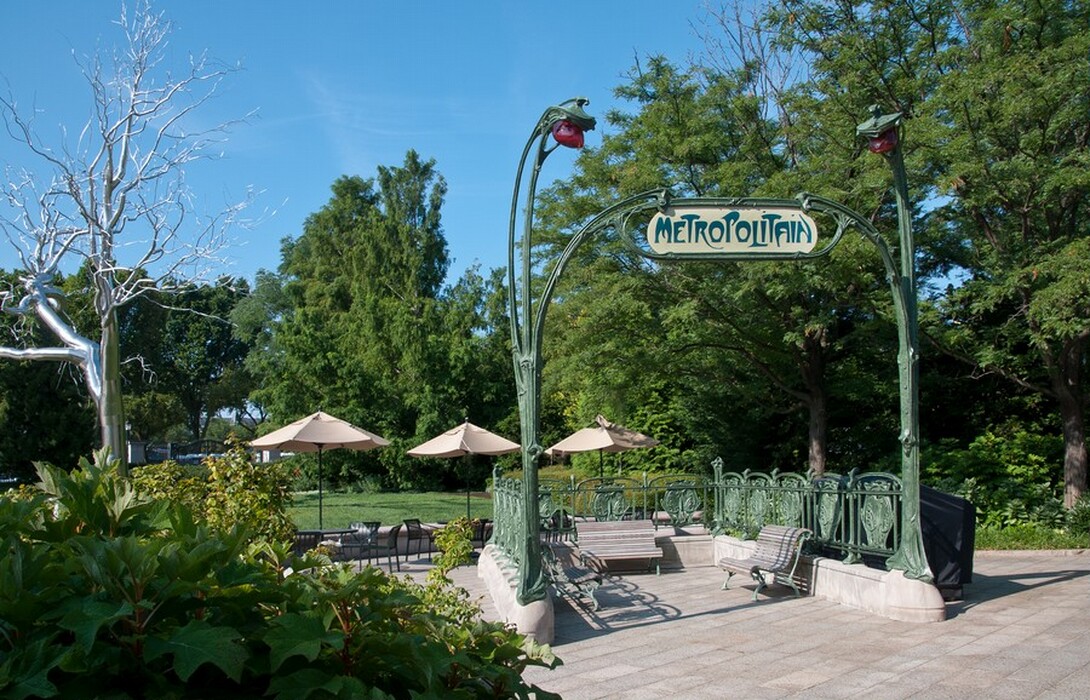
Architect Hector Guimard was the principal designer of the Paris Métro system, which opened in 1900 at the time of the Exposition Universelle. His work is associated with art nouveau, a style of art and architecture that is based largely on organic forms from nature. Guimard's designs were meant to clearly mark the new subway entrances and make the novel form of mass transportation more attractive to riders. The three entrance styles he designed were industrially produced in cast iron until 1913. The entrances became so iconic that Parisian art nouveau came to be known as le style Métro and le style Guimard. This version, with its graceful upward reaching tendrils and vines, can still be seen at 86 station entrances in Paris today. Between the 1930s and 1960s, the Métro removed a number of Guimard entrances in poor condition and sold some to collectors and museums who restored and displayed them. In 1978 the remaining intact Guimard entrances were registered in Paris as Monuments Historiques.
Christopher Wool, Untitled, 2017
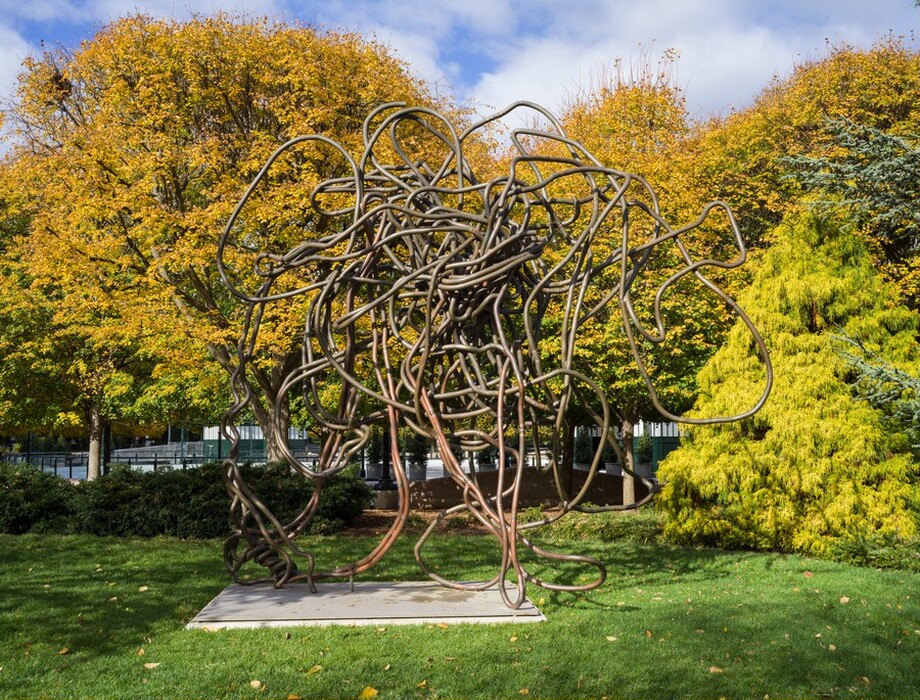
The National Gallery has acquired its first sculpture by Christopher Wool (b. 1955). Untitled (2017) was installed in the Sculpture Garden in early summer 2021. The work’s serpentine lines are a careful compositional choice that reflects Wool’s recent gestural paintings. Given to the National Gallery in honor of Wool’s parents, this sculpture joins the artist’s color screenprint My House (2000) in the National Gallery’s collection.
For more than 30 years, Wool has pursued his career as a painter with focus and intensity, working almost entirely in black and white, reflecting the urban grit of his New York surroundings by using either large stenciled words or by exploring abstract lines, shapes, and patterns. Since 2007 Wool has been living part-time in Marfa, Texas, where he began to make sculptures inspired by tangles of old fencing and hay-baling wire that he finds on his property. He uses the wire to create small maquettes, some of which are then subjected to an elaborate process of 3D-scanning, computer-aided enlargement, and fabrication using metal alloys engineered for structural integrity.