


Artwork overview
-
Medium
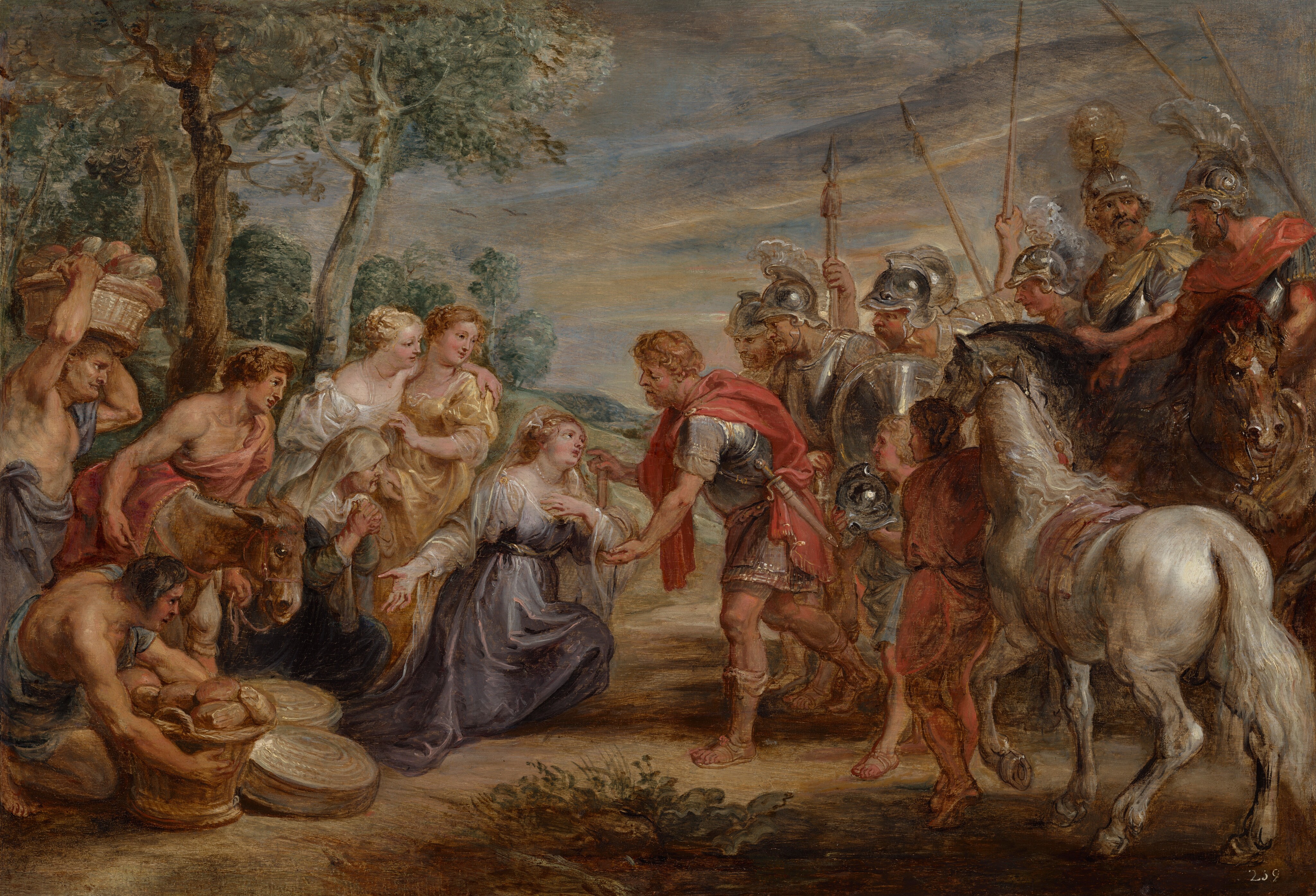
oil on panel
-
Credit Line
Bequest of Lore Heinemann in memory of her husband, Dr. Rudolf J. Heinemann
-
Dimensions
overall (without added strip): 44.7 x 66.3 cm (17 5/8 x 26 1/8 in.)
overall (with added strip): 46.4 x 68 cm (18 1/4 x 26 3/4 in.)
framed: 67 x 88.3 x 7.9 cm (26 3/8 x 34 3/4 x 3 1/8 in.) -
Accession Number
1997.57.8
Artwork history & notes
Provenance
Stanisław August Poniatowski, King of Poland [1732-1798], Łazienki Palace, Warsaw; by inheritance to his nephew Prince Józef Poniatowski [1763-1813]; by inheritance to his sister Maria Teresa Tyszkiewiczowa (née Poniatowska) [1760-1834]; sold 27 October 1821 to (Antonio Fusi, Milan and later St. Petersburg).[1] Andrzej Wierzbicki, Warsaw, 1935(?).[2] Princess Eleonore Radziwiłł Tyskiewicz [1918-1997]; consigned May 1957 to (M. Knoedler & Co., New York); 1/2 share purchased 9 January 1958 by (Pinakos, Inc., New York);[3] full ownership by c. 1963, Dr. and Mrs. Rudolf J. Heinemann, New York;[4] by inheritance 1975 to Lore [Mrs. Rudolf J.] Heinemann [d. 1996], New York; her estate; bequest 1997 to NGA.
[1] This information was kindly provided by Marek Płuciniczak, who discovered the painting in an 1783 inventory of the royal collection, under the number 1186, as “school of Rubens.” (see emails of 15 December 2025). It was displayed in the Łazienki Palace, the king’s private summer residence. According to Płuciniczak, the white number 259 in the bottom right corner of the painting was added in 1809, when the painting was kept in the Palace Pod Blachą (the number appears on an inventory made at the time,Spécification des Tableaux de Łazienki et Belvedere placés dans Appartements du Palais dit á la Blacha, 1809, Zakład Narodowy im. Ossolińskich (ZNiO), rps 5714/III, copy in CRF curatorial files). The painting’s last known appearance in the inventories was 1819. Maria Teresa sold the Łazienki palace and its furnishings to Tsar Alexander I and the rest of the art and collection to Fusi, a jewelry and painting dealer from Milan who apparently took the painting to St. Petersburg.
[2] Records received with the Heinemann bequest (in NGA curatorial files) mention a painting in a 1729 sale (unidentified seller[s], The Hague, 3 May 1729, no. 34) described as "Een nette Schets, zynde de Ontmoeting van David en Abigaël, zeer fray, door denzelven [Rubbens (sic)]" (translation: "A handsome sketch, being the Meeting of David and Abigail, very fine, by the same;" see Gerard Hoet, Catalogus of naamlyst van schilderyen, met derzelver pryzen, zedert een langen reeks van jaaren zoo in Holland als op andere plaatzen in het openbaar verkogt, benevens een verzameling van listen van verscheyden nog in wezen zynde cabinetten, 3 vols., The Hague, 1752-1770, reprint ed. Soest, 1976: 3[1770]:5). The existence of several copies of the Gallery's painting makes it impossible to confirm to which painting this entry refers.
The Wierzbicki provenance is based on a photograph of the Gallery's painting that Wilhelm Valentiner gave Michael Jaffé, which the latter noted in his 1972 Burlington article was taken in Warsaw and annotated on the back with a name that Jaffé spelled Wieszbicki. Monika Krol at the Royal Castle Museum, Warsaw, has kindly researched the name and suggested this owner was likely Andrzej Wierzbicki (1877-1961), who was born in Warsaw, studied at The Technology Institute in St. Petersburg, Russia, then returned to his birthplace in 1913 to begin a career as an industrialist and politician. Nothing is known about his art collecting; if the painting remained in St. Petersburg through the early 20th century, it is possible he came across it there. However, the name Wierzbicki also belonged to a printing company in Warsaw, Graphic Works B.Wierzbicki and Co., founded by Bolesław Wierzbicki (1869-1923), a photographer who built a photochemical plant that focused on art printing, lithography, offset section, light-printing, photo-chemigraphy, zincography and bookbinding. It is perhaps possible the name on the back referred back to this company.
When Jaffé first saw the actual painting in about 1963, it had been "recently acquired by Dr. Rudolf Heinemann from another collection in the U.S.A." (Jaffé, Michael. "Rubens's 'David and Abigail.'" The Burlington Magazine 114, December 1972: 863.) Roger A. d'Hulst and M. Vandenven, Rubens: The Old Masters, Suffolk, 1989: no. 41a, give the date of Wierzbicki ownership as 1935, without documentation.
[3] Knoedler Stock Book 10, Page 201, Row 35, Stock No. A6717, digitized at Getty Provenance Index, copy in NGA curatorial file. Heinemann’s firm Pinakos was active during the 1940s and 1950s, frequently buying works in Europe on joint account with Knoedler. Eleonore Tyskiewicz was the daughter of Archduchess Renata of Austria and Prince Hieronim Mikołaj Radziwiłł. Her first husband was Count Benedykt Władysław Tyszkiewicz [1905-1956]. She married Roger de Froidcourt in 1959 and lived the remainder of her life in Paris.
[4] This date comes from Jaffé 1972 (see footnote 1).
Associated Names
- Poniatowski, Stanislaw August King of Poland
- Poniatowski, Józef Prince
- Tyszkiewiczowa, Maria Teresa
- Wierzbicki, Andrzej
- Knoedler & Company, M.
- Heinemann, Rudolf J.
- Heinemann, Rudolf J., Mrs.
Exhibition History
2000
Art for the Nation: Collecting for a New Century, National Gallery of Art, Washington, D.C., 2000-2001, unnumbered catalogue, repro.
Bibliography
1953
Jaffé, Michael. "Rubens' Sketching in Paint." Art News 52 (May 1953): 36, 64, repro.
1964
Die Sammlung Heule. Aus dem grossen Jahrhundert der niederländischen Malerei. Exh. cat. Wallraf-Richartz Museum. Cologne, 1964: unpaginated, under no. 31.
1972
Jaffé, Michael. "Rubens's 'David and Abigail.'" The Burlington Magazine 114 (December 1972: 863, repro.
1980
Held, Julius S. The Oil Sketches of Peter Paul Rubens. A Critical Catalogue. 2 vols. Princeton, 1980: 1:435-436, no. 315; 2:repro.
1989
d'Hulst, Roger A., and M. Vandenven. Rubens: The Old Testament (Corpus Rubenianum Ludwig Burchard, Part 3). London, 1989: 134-136, no. 41a, repro.
1992
Mai, Ekkehard, and Hans Vlieghe, eds. Von Bruegel bis Rubens: Das goldene Jahrhundert der flämischen Malerei. Exh. cat. Wallraf-Richartz-Museum, Cologne; Kunsthistorisches Museum, Vienna. Cologne, 1992: 594, under no. 184.1.
2005
Wheelock, Arthur K., Jr. Flemish Paintings of the Seventeenth Century. The Collections of the National Gallery of Art Systematic Catalogue. Washington, D.C., 2005: 206-210, color repro.
2020
Libby, Alexandra. “From Personal Treasures to Public Gifts: The Flemish Painting Collection at the National Gallery of Art.” In America and the Art of Flanders: Collecting Paintings by Rubens, Van Dyck, and their Circles, edited by Esmée Quodbach. The Frick Collection Studies in the History of Art Collecting in America 5. University Park, 2020: 142.
Inscriptions
lower right: 2[3 or 5?]9
Wikidata ID
Q9202858