


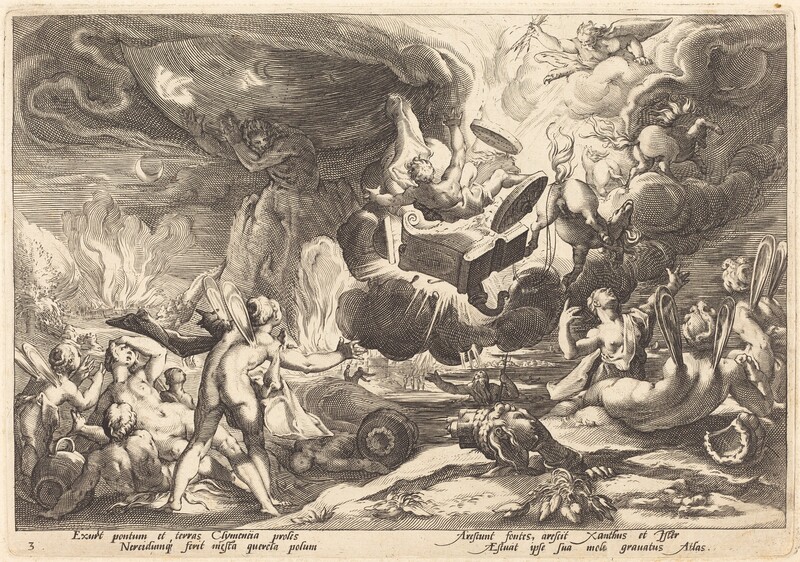
Artwork overview
-
Medium
engraving on laid paper
-
Credit Line
-
Dimensions
plate: 17.5 x 25.2 cm (6 7/8 x 9 15/16 in.)
sheet: 23.2 x 29.4 cm (9 1/8 x 11 9/16 in.) -
Accession Number
2003.143.3
-
Catalogue Raisonné
New Hollstein 1996, no. 554, State i/ii
-
Series Title
Ovid's Metamorphoses

Artwork history & notes
Provenance
(James A. Bergquist, Newton Centre); purchased by NGA 2003.
Associated Names
Bibliography
1802
Bartsch, Adam. Le peintre graveur. 21 vols. Vienna, 1802-1821: Adam. Le peintre graveur. 21 vols. Vienna: J.V. Degen, 1802-1821.
1993
The New Hollstein Dutch & Flemish Etchings, Engravings and Woodcuts, 1450-1700. Rotterdam: Sound & Vision Interactive, 1996-: no. 554, i/ii.
Inscriptions
numbered in plate, in margin at bottom left: 3; in margin below image, in plate: Exurit pontum et terras Clymeneia proles / Nereidumque ferit maesta querela polum. / Arescunt fontes, arescit Xanthus et Ister / Aestuat ipse sua mole gravatus Atlas. (Clymene's son scorches the sea and the earth, the sad lament of the Nereids touches heaven. Springs run dry, the Xanthus and the Danube dry up, and Atlas himself, with his heavy loan on his back, is burning hot.) [Latin translation from Leeflang, Huigen, and Ger Luijten. Hendrick Goltzius (1558-1617): Drawings, Prints and Paintings. Amsterdam: Rijksmuseum, 2003, p. 111.]
Wikidata ID
Q76360392