


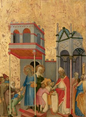
Artwork overview
-
Medium
tempera on poplar panel
-
Credit Line
-
Dimensions
painted surface: 44 × 32.3 cm (17 5/16 × 12 11/16 in.)
overall: 45.7 × 33.8 × 0.6 cm (18 × 13 5/16 × 1/4 in.)
framed: 48.2 x 36.8 x 4.1 cm (19 x 14 1/2 x 1 5/8 in.) -
Accession Number
1939.1.41


Artwork history & notes
Provenance
This panel, along with NGA 1939.1.42 and 1939.1.43, are stated to have come from the collection of a contessa Giustiniani, Genoa;[1] (Count Alessandro Contini Bonacossi, Rome); sold July 1930 to the Samuel H. Kress Foundation, New York;[2] gift 1939 to NGA.
[1] See the bill of sale described in note 2. No documented collection of the conti Giustiniani at Genoa seems to have existed, at least in the early years of the twentieth century. The works that Elisabeth Gardner (_ A Bibliographical Repertory of Italian Private Collections_, ed. Chiara Ceschi and Katharine Baetjer, 4 vols., Vicenza, 1998-2011: 2(2002):183) cites as formerly the property of the contessa Giustiniani almost all seem to have been purchased on the art market shortly before 1930, when Contini Bonacossi sold them to Samuel H. Kress. The contessa is thus more likely to have been a dealer, or agent, than a collector. See also Miklós Boskovits and David Alan Brown, Italian Paintings of the Fifteenth Century, National Gallery of Art Systematic Catalogue, Washington and New York, 2003: 616 n. 3.
[2] The painting is included on a bill of sale dated 15 July 1930 that included eight paintings from the Giustiniani collection (copy in NGA curatorial files); see also The Kress Collection Digital Archive, https://kress.nga.gov/Detail/objects/2274.
Associated Names
Bibliography
1941
National Gallery of Art. Book of Illustrations. Washington, 1941: 51 (repro.), 236.
Preliminary Catalogue of Paintings and Sculpture. National Gallery of Art, Washington, 1941: 3, no. 152, as The Presentation in the Temple.
1942
Book of Illustrations. National Gallery of Art, Washington, 1942: 242, repro. 53, as The Presentation in the Temple.
1944
Frankfurter, Alfred M. The Kress Collection in the National Gallery. New York, 1944: 23, repro., as The Presentation in the Temple.
1949
Brandi, Cesare. Quattrocentisti senesi. Milan, 1949: 243.
1955
Ferguson, George. Signs and Symbols in Christian Art. 2nd ed. New York, 1955: pl. 22.
1959
Paintings and Sculpture from the Samuel H. Kress Collection. National Gallery of Art, Washington, 1959: 36, repro., as The Presentation in the Temple.
1964
Mojzer, Miklós. "Vier sienesische Quattrocento-Tafeln des Christlichen Museums zu Esztergom." Pantheon 22 (1964): 2 (repro.), 6 n. 5.
1965
Summary Catalogue of European Paintings and Sculpture. National Gallery of Art, Washington, 1965: 7.
Boskovits, Miklós, Miklós Mojzer, and András Mucsi. Das Christliche Museum von Esztergom (Gran). Budapest, 1965: 44.
Boskovits, Miklós, Miklós Mojzer, András Mucsi, Alfréd Schiller, Elizabeth Hoch, and Susanna Horn. Christian Art in Hungary: Collections from the Esztergom Christian Museum. Budapest, 1965: 52.
1966
Shapley, Fern Rusk. Paintings from the Samuel H. Kress Collection: Italian Schools, XIII-XV Century. London, 1966: 65-66, fig. 177.
Boskovits, Miklós. Early Italian Panel Paintings. Budapest, 1966: 40.
1968
Berenson, Bernard. Italian Pictures of the Renaissance. Central Italian and North Italian Schools. 3 vols. London, 1968: 1:8.
National Gallery of Art. European Paintings and Sculpture, Illustrations. Washington, 1968: 1, repro.
1971
Carli, Enzo. I pittori senesi. Siena, 1971: 138.
Os, Hendrik W. van. "Andrea di Bartolo’s Assumption of the Virgin." Arts in Virginia 2 (1971): 4.
1972
Fredericksen, Burton B., and Federico Zeri. Census of Pre-Nineteenth Century Italian Paintings in North American Public Collections. Cambridge, Mass., 1972: 6, 300, 645.
1975
Mucsi, András. Katalog der Alten Gemäldegalerie des Christlichen Museums zu Esztergom. Budapest, 1975: 42.
European Paintings: An Illustrated Summary Catalogue. National Gallery of Art, Washington, 1975: 10, repro.
1979
Shapley, Fern Rusk. Catalogue of the Italian Paintings. 2 vols. Washington, 1979: 1:4-5; 2:pl. 4.
1981
Carli, Enzo. La pittura senese del Trecento. 1st ed. Milan, 1981: 238.
1982
Il gotico a Siena: miniature, pitture, oreficerie, oggetti d’arte. Exh. cat. Palazzo Pubblico, Siena. Florence, 1982: 317.
1983
L’Art gothique siennois: enluminure, peinture, orfèvrerie, sculpture. Exh. cat. Musée du Petit Palais, Avignon. Florence, 1983: 284.
Kasten, Eberhard. "Andrea di Bartolo." In Allgemeines Künstlerlexikon: Die bildenden Künstler aller Zeiten und Völker. Edited by Günter Meissner. 3 vols. Leipzig, 1983-1990: 2(1986):974, 976.
1984
Walker, John. National Gallery of Art, Washington. Rev. ed. New York, 1984: 82, no. 39, color repro.
1985
European Paintings: An Illustrated Catalogue. National Gallery of Art, Washington, 1985: 18, repro.
1986
Maderna, Valentina, ed. Il polittico di Andrea di Bartolo a Brera Restaurato. Exh. cat. Pinacoteca di Brera, Milan. Florence, 1986: 17.
Kanter, Laurence B. "Giorgio di Andrea di Bartolo." Arte cristiana 74 (1986): 21-22, 24, repro. 28.
1991
Chelazzi Dini, Giulietta. "Andrea di Bartolo." In Enciclopedia dell’arte medievale. Edited by Istituto della Enciclopedia italiana. 12 vols. Rome, 1991-2002: 1(1991):595.
1992
Kasten, Eberhard. "Andrea di Bartolo." In Allgemeines Künstlerlexikon: Die bildenden Künstler aller Zeiten und Völker. Edited by Günter Meissner. 87+ vols. Munich and Leipzig, 1992+: 3(1992):512, 514.
1994
Lorentz, Philippe. "De Sienne a Strasbourg: posterité d’une composition d’Ambrogio Lorenzetti, la Nativité de la Vierge de l’Hôpital Santa Maria della Scala à Sienne." In Hommage à Michel Laclotte: Etudes sur la peinture du Moyen Age et de la Renaissance. Edited by Luciano Bellosi, Pierre Rosenberg, Cécile Scailliérz, and Dominique Thiébault. Milan and Paris, 1994: 130-131 n. 45.
1997
Chelazzi Dini, Giulietta. "La cosidetta crisi della metà del Trecento (1348-1390)." In Pittura senese. Edited by Giulietta Chelazzi Dini, Alessandro Angelini and Bernardina Sani. 1st ed. Milan, 1997: 200.
Chelazzi Dini, Giulietta, Alessandro Angelini, and Bernardina Sani. Sienese Painting From Duccio to the Birth of the Baroque. New York, 1997: 200-201.
1998
Frinta, Mojmír S. Punched Decoration on Late Medieval Panel and Miniature Painting. Prague, 1998: 69.
2008
Entre tradition et modernité: peinture italienne des XIVe et XVe siècles. Exh. cat. Galerie G. Sarti, Paris; Fürstlich Liechtensteinsche Gemäldegalerie, Vienna. Paris, 2008: 117.
2009
Bellosi, Luciano, et al., eds. La collezione Salini: dipinti, sculture e oreficerie dei secoli XII, XIII, XIV e XV. 4 vols. Florence, 2009, 2015: 1(2009):238.
2016
Boskovits, Miklós. Italian Paintings of the Thirteenth and Fourteenth Centuries. The Systematic Catalogue of the National Gallery of Art. Washington, 2016: 14-25, color repro.
Wikidata ID
Q20173376