Virgin and Child

c. 1680/1686

Luisa Roldán

Associated Names
Luisa Roldán

Artist, Spanish, 1650 - 1704
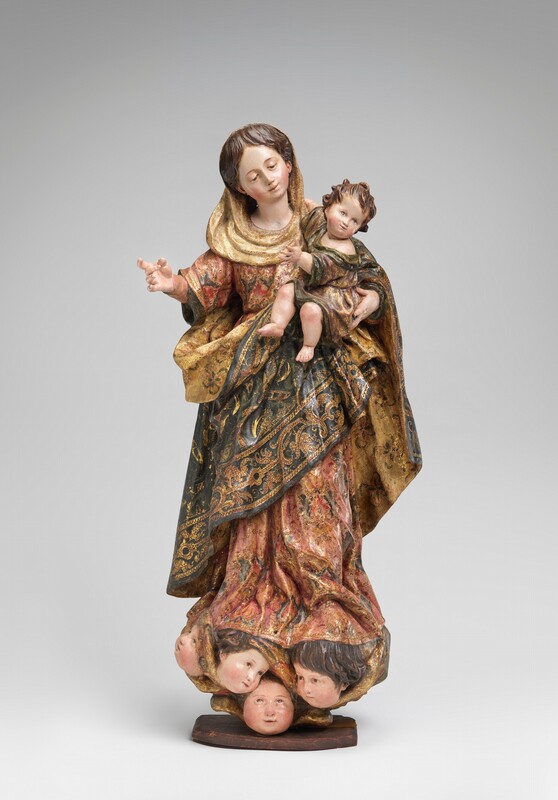
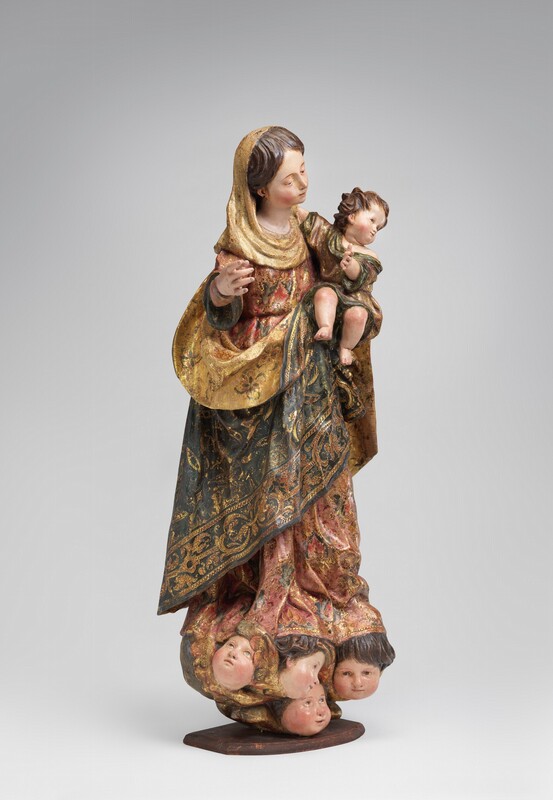
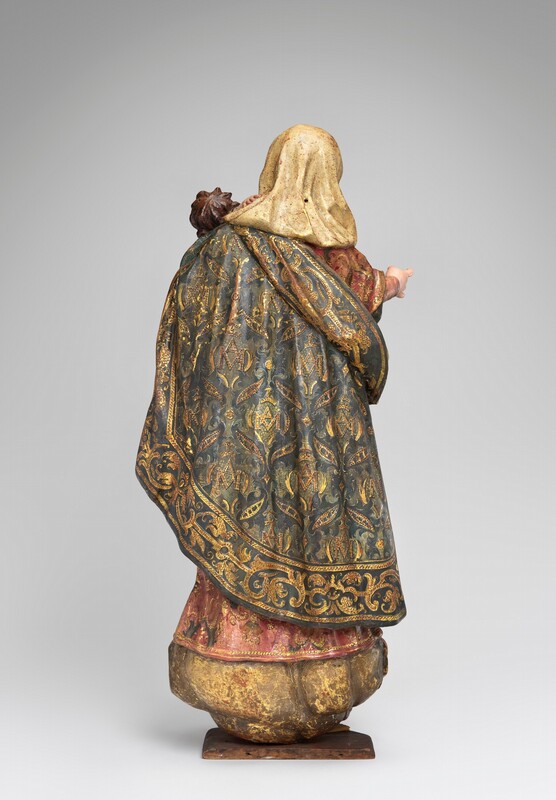
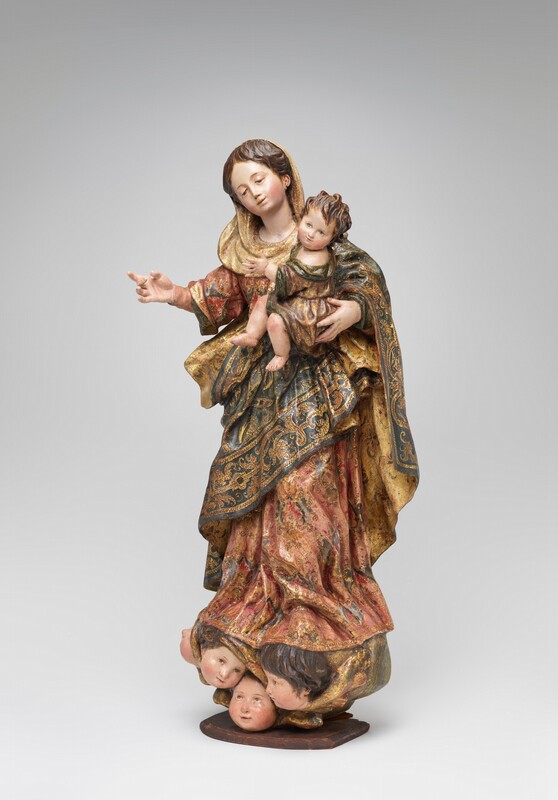
The sculpture depicts a woman in a flowing robe holding a child. The woman has short, dark hair, rosy cheeks, and wears a serene expression. Her eyes are looking downward. She is dressed in richly patterned and colorful garments with a palette of gold, red, and dark green hues. One of her hands is extended outward, while the other holds a child. The child, dressed in a brown garment, looks directly ahead with wide eyes and a calm demeanor. The child has curly brown hair and extends one arm outward. At the base of the sculpture, four cherubic faces emerge from the bottom of the woman's robes. Two of them look upward, towards the woman, while the other two look off to the sides.

Media Options

Skip thumbnail navigation Back to thumbnail navigation
This object’s media is free and in the public domain. Read our full Open Access policy for images.

Spanish women artists of the 17th century worked anonymously. They were not publicly acknowledged, and today we rarely know their names. Luisa Roldán—later called La Roldana—is an exception. She learned her trade from her father, a noted sculptor in Seville, and established her own workshop in Cádiz. Later, she served as court sculptor to King Carlos II and his successor, Felipe V, in Madrid. Her hard-won recognition for her work did not guarantee financial success: Roldán died in poverty.
On View

West Building Main Floor, Gallery M34


Artwork overview

More About this Artwork

Shown from the shins up, two elegantly dressed women and two young boys, all with light skin, sit together on a bench in front of a stone balustrade with a forest landscape beyond in this horizontal portrait painting. The people are brightly lit from our left but the darkened sky suggests dusk. The boys lean onto the woman at the center of the composition, and the second woman sits to her right, our left. All of the people have pale skin, rosy cheeks, delicate noses, and their pink lips all turn up in slight smiles. The woman on our left sits with her body angled toward her friend but she turns her face to look at us with brown eyes under curving brows. Her wavy, flint-gray hair is loosely bound up so it frames the sides of her face and curls over her shoulders. Her swirling, white head covering is edged in gold and tied in a bow over her left ear, on our right. Her long-sleeved dress has a tight-fitting bodice and a low, scooped neckline lined with pleated white fabric. Her dress shimmers from sapphire blue to dusky pink, suggesting it is iridescent taffeta. Large pearls hang off the end of round, gold, hoop earrings, and a glimmering gold sash is tied around her waist. She sits with her left hand resting on her friend’s right shoulder, closer to her, and she gestures toward one of the young boys leaning on the friend’s lap with her other hand. The second woman sits with her body facing us, and she looks off to our left with gray-blue eyes. Her silvery gray, upswept hair is covered with a long piece of white fabric with pink stripes, twisted loosely into a turban-like head covering. She wears dangling gold earrings, and her dress is striped with parchment white and rust red. Her right hand, on our left, rests on her friend’s knee, and her other arm is wrapped around the older boy. He kneels on the bench and leans forward, wrapping the arm we can see around her torso. His face near hers, he looks up at her from under his lashes. A dimple marks the flushed cheek we can see. His chestnut-brown hair falls around his shoulders, and he wears a gingerbread-brown suit. The smaller and younger of the two boys rests his head on his crossed hands on her thigh, and looks out at us. He wears a white garment with a lilac-purple sash tied in a bow around his waist. There is a pale pink rosebush in the lower right corner of the painting, near the kneeling boy’s foot. The landscape beyond the balustrade is filled with dark green trees against a slate-blue sky. The painting is created with blended brushstrokes, giving it a soft look.

Article:  Your Tour of Women Artists at the National Gallery

See these 10 works by trailblazing women artists during your next visit.


Artwork history & notes

Provenance

Vicente de Medina y Carvajal, X Conde de Mejorada [1903-1967], Seville; by gift or sale to Ramón Charlo Rodríguez [1902-1996], Seville; by gift c. 1970 to Rafael de Lama, Seville; by gift or inheritance during the 1980s to Manuel de Lama, Germany; (sale, Auktionshaus zeitGenossen, Münster, 24 April 2021, no. 928); Carteia Fine Arts, Madrid; purchased May 2022 by NGA.

Associated Names

Bibliography

2022

  • Dickerson III, C. D. "Gifts & Acquisitions." Art for the Nation no. 66 (Fall 2022): 31-32, repro.


You may be interested in

Loading Results