


When Your Purse Is Empty, You Eat Bones Not Bacon
c. 1592
Hendrick Goltzius
Related Artist, Dutch, 1558 - 1617
Artist After, Netherlandish, 1548 - 1606
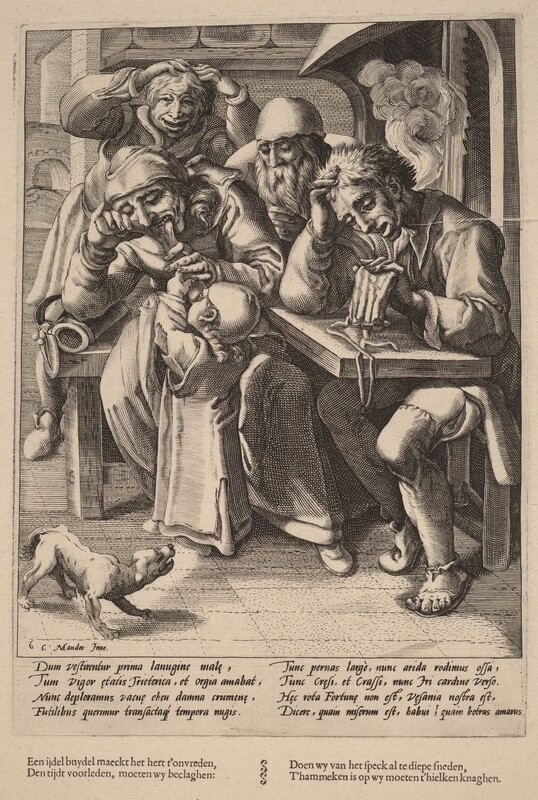

Artwork overview
-
Medium
engraving and letterpress on laid paper
-
Credit Line
-
Dimensions
plate: 24 x 17.2 cm (9 7/16 x 6 3/4 in.)
sheet: 39.7 x 27.4 cm (15 5/8 x 10 13/16 in.) -
Accession Number
2004.2.6
-
Catalogue Raisonné
New Hollstein, no. 100, State i/iii
-
Series Title
Six Proverbs (plate 6)
Associated Artworks
See all 6 artworks
Do Not Spend Your Savings Too Soon
1590
Six Proverbs
1590
The Scales of Marriage
1590
Artwork history & notes
Provenance
Château de la Roche-Guyon, France (part of an album)1; (Paul Prouté S.A., Paris); purchased by NGA, 2003.
1 The album was bound in vellum, with "Abraham" on the cover and "Ligeoys" on the back cover. The Château de la Roche-Guyon stamp was on some of the pages, which included a variety of northern mannerist prints by Goltzius, Matham, Saenredam, and others. It was apparently dismantled by Prouté for sale of some of the prints to the NGA.
Associated Names
Bibliography
1949
Hollstein, F.W.H. et al. German engravings, etchings and woodcuts ca. 1400-1700. 8 vols. Amsterdam: Menno Hertzberger, 1954-1868. Dutch and Flemish etchings, engravings and woodcuts, ca. 1450-1700. Vols. I-XV, XVIII, XIX. Amsterdam: Menno Hertzberge
1993
The New Hollstein Dutch & Flemish Etchings, Engravings and Woodcuts, 1450-1700. (Karel van Mander, Marjolein Leesberg, author). Rotterdam: Sound & Vision Interactive, 1996-, no. 100, state i/iii.
Inscriptions
lower left, in image, in plate: 6; lower left, in image, in plate: C. Mander Inve.; below image in plate: Dum vestirentur prima lanugine mal[a]e, / Tum vigor [a]etatis Trieterica, et orgia amabat; / Nunc deploramus vacu[a]e eheu damna crumen[a]e, / Futilibus querimur transactaq[ue] tempora nugis. Tunc pernas largè, nunc arida rodimus ossa, / Tun Cr[a]esi, et Crassi, nunc Iri cardine verso. / H[a]ec rota Fortun[a]e non est, v[a]esania nostra est, / Dicere, quain miserum est, habui, quain botrus amarus. (When our jaws were first covered with down, that vital age loved triennial Bacchus banquets. Now we regret, ah, the disadvantage of the purse being empty and complain about the time spent on useless small talk. Then we chewed on hams aplenty, now on dry bones, then the wheel revolved around Croesus and Crassus, now aroudn Irus. I must say: this is not the wheel of fortune, it is our own insanity. How wretched it is, how sour the grapes.); below plate, in letterpress: Een ijdel buijdel maecket hert t'onvreden / Den tijt voorleden, moeten wij beclaghen / Doen wij van het speck al te diepe sneden / Thammetgen is op wij moeten thieltgen knaghen. (An empty purse will make a sorry heart, / For to amend whats past the time is gone. / Wee ranted high, which makes us now to smart, / When the meats off wee're forst to pick the bone.)
[translations by Jan Bloemendal in The New Hollstein Dutch & Flemish Etchings, Engravings and Woodcuts, 1450-1700. (Karel van Mander, Marjolein Leesberg, author). Rotterdam: Sound & Vision Interactive, 1999, no. 98, pp. lxxvi-lxxvii.]
Wikidata ID
Q76360458