


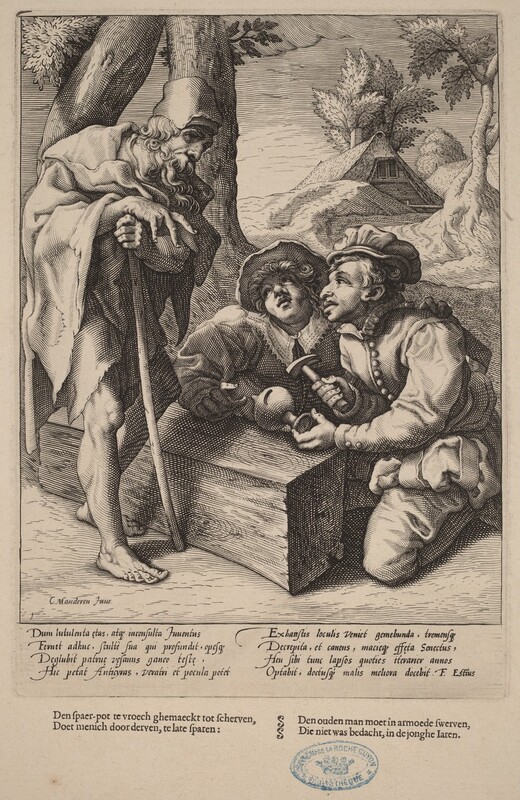
Do Not Spend Your Savings Too Soon
c. 1592
Hendrick Goltzius
Related Artist, Dutch, 1558 - 1617
Artist After, Netherlandish, 1548 - 1606

Artwork overview
-
Medium
engraving and letterpress on laid paper
-
Credit Line
-
Dimensions
plate: 24.4 x 17.5 cm (9 5/8 x 6 7/8 in.)
sheet: 39.6 x 27.4 cm (15 9/16 x 10 13/16 in.) -
Accession Number
2004.2.1
-
Catalogue Raisonné
New Hollstein, no. 95, State ii/iv
-
Series Title
Six Proverbs (plate 1)
Associated Artworks
See all 6 artworksSix Proverbs
1590
The Scales of Marriage
1590
The Bagpipe Must Be Filled
1590
Artwork history & notes
Provenance
Château de la Roche-Guyon, France (part of an album)1; (Paul Prouté S.A., Paris); purchased by NGA, 2003.
1 The album was bound in vellum, with "Abraham" on the cover and "Ligeoys" on the back cover. The Château de la Roche-Guyon stamp was on some of the pages, which included a variety of northern mannerist prints by Goltzius, Matham, Saenredam, and others. It was apparently dismantled by Prouté for sale of some of the prints to the NGA.
Associated Names
Bibliography
1949
Hollstein, F.W.H. et al. German engravings, etchings and woodcuts ca. 1400-1700. 8 vols. Amsterdam: Menno Hertzberger, 1954-1868. Dutch and Flemish etchings, engravings and woodcuts, ca. 1450-1700. Vols. I-XV, XVIII, XIX. Amsterdam: Menno Hertzberge
1993
The New Hollstein Dutch & Flemish Etchings, Engravings and Woodcuts, 1450-1700. (Karel van Mander, Marjolein Leesberg, author). Rotterdam: Sound & Vision Interactive, 1996-, no. 95, state ii/iv.
Inscriptions
lower left, in image, in plate: 1; lower left, in image, in plate: C. Mander Inve.below image, in plate: Dum lutulenta [a]etas, atq[ue] inconsulta luuentus / Feruet adhuc, stultè sua qui profundit, opesq[ue] / Deglubit patru[a]e v[a]esanus ganeo test[a]e / Hic petat Anticyras, veratri et pocula potet / Exhaustis loculis veniet gemebunda, tremensq[ue / Decrepita, et canens, macieq[ue] eff[a]eta Senectus, / Heu sibi tunc lapsos quoties iterarier annos / Optabit, doctusq[ue] malis meliora docebit. F. Estius (When still in the prime of life and in rash Youth, he who foolishly squanders his possessions and madly dissipates his father's wealth before the eyes of revellers, should to to Anticyra and drink cups of hellebore. Because Old Age, moaning, shaking, decrepit, grey and exhausted from emaciation, will come with an empty coffer: ah, and how often will Old Age wish to recover the years past and having learned through bitter experience be better able to impart wisdom); below plate, in letterpress: Den spaer-pot te vroegh ghemaeckt tot scherven, / Doet menich door derven,, te late sparen: / Den ouden man moet in armoede swerven / Die niet was bedacht, in de jonghe jaren. (Tis yet to soon to breake this Money Pot, Yet all run's out till 'tis to late to hold, Soe who in's youth to get bethinks him not, Must want and beg when once hee doth grow old.)
[translations by Jan Bloemendal in The New Hollstein Dutch & Flemish Etchings, Engravings and Woodcuts, 1450-1700. (Karel van Mander, Marjolein Leesberg, author). Rotterdam: Sound & Vision Interactive, 1999, no. 95, p. lxxv.)]
Wikidata ID
Q76360461