


Arms of Filiberto Impalling Those of Margaret [reverse]
1502
Jean Marende
Artist, French, active 1502/1504
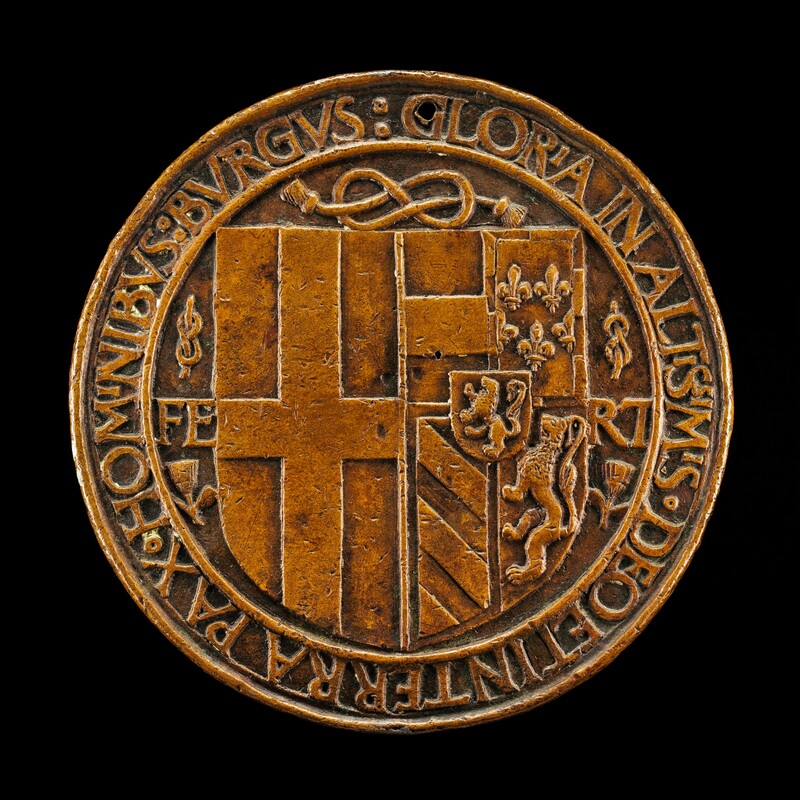

Artwork overview
-
Medium
bronze
-
Credit Line
-
Dimensions
overall (diameter): 10.35 cm (4 1/16 in.)
gross weight: 213.49 gr (0.213 kg)
axis: 12:00 -
Accession Number
1942.9.164.b
Associated Artworks
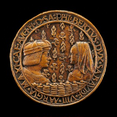
Filiberto II le Beau (the Fair), 1480-1504, 8th Duke of Savoy 1497, and Margaret of Austria, 1480-1530, His Wife [obverse]
Jean Marende
1502
Artwork history & notes
Provenance
Oscar Hainauer [d. 1894], Berlin; by inheritance to his widow, Mrs. Julie Hainauer, Berlin; purchased 1906 by (Duveen Brothers, Inc., London, New York, and Paris); by exchange 21 October 1920 to Joseph E. Widener, Lynnewood Hall, Elkins Park, Philadelphia;[1] gift 1942 to NGA.
[1] A typed manuscript, “List of medals from the Hainauer Collection sold to Joseph Widener, Esq.” dated “October Twenty-First 1920,” is kept inside the front cover of the NGA Library’s copy of A Cabinet of One Hundred & Thirty-Three Bronze Plaques and Medals of the Renaissance Period from the Collection of the Late Herr Oscar Hainauer of Berlin, ed. Duveen Brothers, London, n.d. (but 1908), which came to the Gallery from the Widener library. Elsewhere in the Widener records, the circumstances of the acquisition are recorded by Edith Standen, the Widener’s curator: “Plaques and medals. These, formerly in the Hainauer Collection, were presented to Mr. [Joseph] Widener by Lord Duveen (then Sir Joseph) as a peace-offering. Mr. Widener had broken off relations with the firm two years before over a disputed enamel he had purchased from them and the medals, though originally offered at a much higher price, were given in lieu of the purchase money of the enamel.” (Gallery Archives, Record Group 3, Records of the Office of the Deputy or Assistant Director, Donor Files Relating to Major Collections, Box 21.)
Associated Names
Bibliography
1908
A Cabinet of One Hundred & Thirty-Three Bronze Plaques and Medals of the Renaissance Period from the Collection of the Late Herr Oscar Hainauer of Berlin. Ed. Duveen Brothers. London, n.d. (but 1908): no. 33, repro.
2007
Pollard, John Graham. Renaissance Medals. The Collections of the National Gallery of Art Systematic Catalogue. 2 vols. Washington, 2007: 2:no. 603, repro.
Inscriptions
around circumference: GLORIA IN ALTISSIMIS DEO ET IN TERRA DAX HOMINIBVS BVRGVS; across center: FE RT
Wikidata ID
Q63809762