


He Disappeared into Complete Silence, Plate 9
1947
Louise Bourgeois
Artist, American, born France, 1911 - 2010
Printer
Publisher
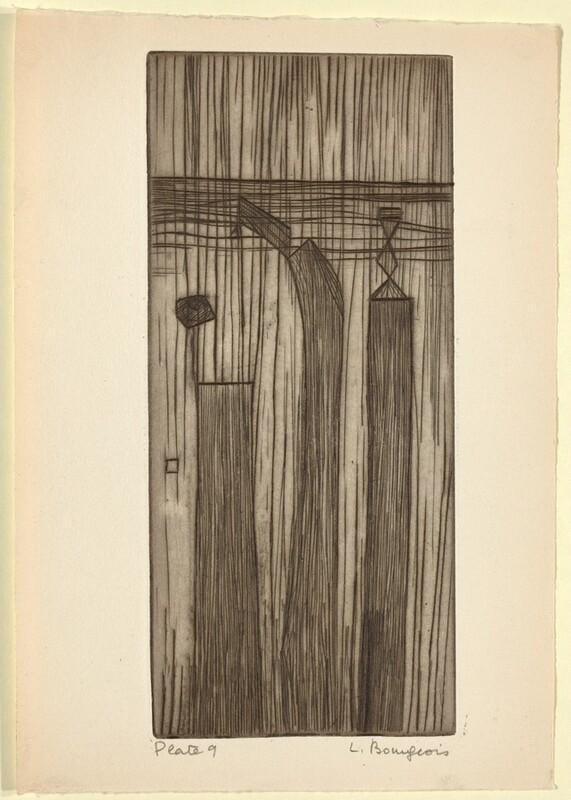
The nine engravings and parables that make up He Disappeared into Complete Silence, 1947, signal the imagery and themes that would engage Louise Bourgeois for the remainder of her career, among them isolation and human folly. Bourgeois, who was born in France and moved to New York in 1938, made the engravings at Stanley William Hayter’s renowned Atelier 17 printshop, which was temporarily displaced from Paris to Manhattan during the Second World War. While many artists working at Atelier 17 tried to match the sweeping elegance of Hayter’s engraved line, Bourgeois adhered to her own vision. Indeed there is something bracingly genuine about her approach to the medium, as if she had chiseled rather than engraved her imagery into the copper plates.
The parables, written by Bourgeois, are described in the suite’s introduction as "tiny tragedies of human frustration," and their subjects range from a little girl who buried her coveted candy in the ground, neglecting to realize that the damp earth would spoil it, to a man who tells a story so fast that no one can understand him. Representing Bourgeois at her most surreal, He Disappeared into Complete Silence is an affecting work of art. Only a few complete copies, issued in 1947, are extant, and the Gallery’s is particularly noteworthy for its having been personally inscribed to Alfred Barr (1902–1981)—the first director of New York’s Museum of Modern Art—and his wife, Margot.
Bourgeois was never willing (or perhaps able) to disentangle herself from the past. Deeply fixed memories inspired her oeuvre over the course of a remarkably long career. This reluctance to let go meant that she rarely considered a work finished, generally leaving open the possibility of a future iteration. Bourgeois twice reissued He Disappeared into Complete Silence—in 1984 and 1990—but both times the prints were made from completely new plates, resembling the originals but lacking their freshness and authenticity.
Artwork overview
-
Medium
engraving on wove paper
-
Credit Line
-
Dimensions
plate: 22.54 x 10 cm (8 7/8 x 3 15/16 in.)
sheet: 25.4 x 17.78 cm (10 x 7 in.) -
Accession Number
2010.132.9
-
Catalogue Raisonné
Wye/Smith 1994, 37, VI/VI
Associated Artworks
See all 9 artworks
He Disappeared into Complete Silence, Plate 1
Louise Bourgeois, Atelier 17, Gemor Press
1947
He Disappeared into Complete Silence
Louise Bourgeois, Atelier 17, Gemor Press
1947
He Disappeared into Complete Silence, Plate 2
Louise Bourgeois, Atelier 17, Gemor Press
1947
Artwork history & notes
Provenance
(Cheim & Read, New York); purchased by NGA, 2011
Associated Names
Exhibition History
2015
Louis Bourgeois: No Exit, National Gallery of Art, Washington, DC, 2015-2016.
Louise Bourgeois: No Exit, National Gallery of Art, Washington, 2015 - 2016, unnumbered catalogue.
Bibliography
1994
Deborah Wye and Carol Smith. The Prints of Louise Bourgeois. New York, 1994.
2011
Brodie, Judith. "Louise Bourgeois, He Disappeared into Complete Silence." Bulletin / National Gallery of Art, no. 45 (Fall 2011): 21.
Inscriptions
lower left in graphite: Plate 9; lower right in graphite: L. Bourgeois
Wikidata ID
Q76560588