


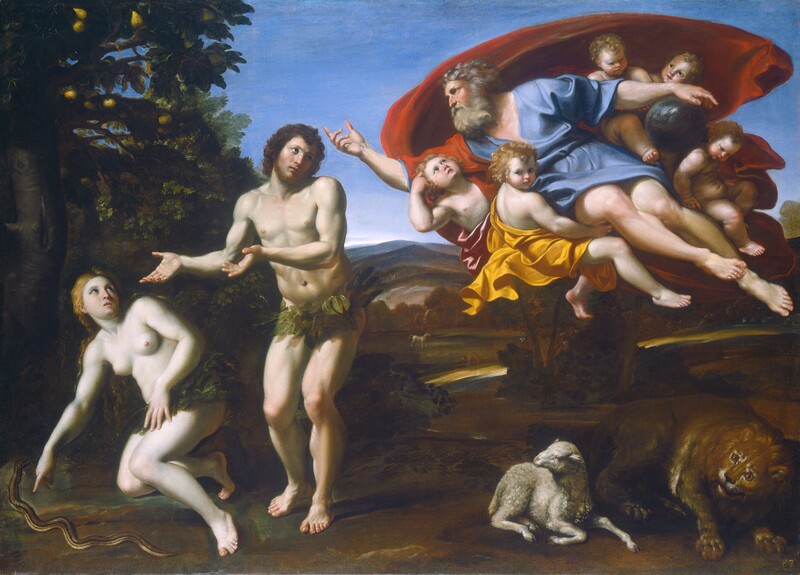

Artwork overview
-
Medium
oil on canvas
-
Credit Line
-
Dimensions
overall: 121.9 x 172.1 cm (48 x 67 3/4 in.)
framed: 158.3 x 204.8 x 7.9 cm (62 5/16 x 80 5/8 x 3 1/8 in.) -
Accession Number
2000.3.1
Artwork history & notes
Provenance
Purchased 1670 by Lorenzio Onofrio Colonna, Roma;[1] Colonna family, Rome, likely until at least 1802.[2] Barberini family, Rome, by 1844;[3] sold 1948 through (Studio d'art Palma, Rome) to Machado Coelho [member of the Chamber of Deputies], Rio de Janeiro; sold 1976 to private collection, Rio de Janeiro; (sale, Sotheby's, New York, 4 June 1987, no. 96); (Richard L. Feigen & Co., New York); sold July 1989 to Saul P. Steinberg, New York; (sale, Sotheby's, New York, 28 January 2000, no. 63); purchased 8 February 2000 through (Kate Ganz, New York) by NGA.
[1] The NGA painting certainly corresponds to the "original painting by Domenichino with the figure of Adam" that Lorenzo Onofrio Colonna bought from two Roman dealers in 1670 for 700 scudi; see Natalia Gozzano, La Quadreria di Lorenzo Onofrio Colonna. Prestigio nobiliare e collezionismo nella Roma barocca, Rome, 2004: 111, 147, 192, and 238. It is described as a painting of Adam and Eve chased from the Garden of Eden by Domenichino in the 1679 inventory of Colonna's collection, and, having only been purchased in 1670, does not appear in the family's inventory drawn up in 1664; see Eduard A. Safarik, Collezione dei dipinti Colonna: Inventari 1611-1795, Munich, 1996: 124, item 61, described as "Un Quadro di p.mi 5 1/4, e 6 1/2 con Adamo, et Eva scacciati dal paradiso terrestre con cornice intagliata e dorata opera del Domenichini."
[2] A report drawn up in 1802 by C. Dufourny in preparation for the shipment of works of art from Italy to France discusses the cartoon (now in the Louvre, Paris) for the NGA painting, and indicates that the painting was still in the possession of the Colonna family: "Cartons. . .5. Adam et Eve, chassés du Paradis terrestre, fig. demi-nat., carton du tableau de la Gallerie [sic] Colonna par le Dominiquin" (cited by Sylvie Béguin, "Tableaux provenant de Naples et de Rome en 1802 restés en France," Bulletin de la Société de l'Histoire de l'Art français [1959]: 194). Unless Dufourny's information was based on outdated hearsay, this would confirm continued ownership by the family to at least the year of the report. A later entry for the cartoon ("notice de Musée Napoléon") reiterates this information.
[3] The painting appears in an unpublished 1844 inventory of the Barberini family collection.
Associated Names
- Colonna, Lorenzo Onofrio
- Barberini Collection
- Studio d'art Palma
- Coelho, Machado, Deputado
- Private Collection (NGA Former Owner)
- Feigen, Richard L.
- Sotheby's
- Steinberg, Saul P.
- Kate Ganz Ltd.
Exhibition History
2000
Art for the Nation: Collecting for a New Century, National Gallery of Art, Washington, D.C., 2000-2001, unnumbered catalogue, repro.
Bibliography
1959
Béguin, Sylvie. "Tableaux provenant de Naples et de Rome en 1802 restés en France." Bulletin de la Société de l'Histoire de l'Art français (1959): 194.
1982
Spear, Richard. Domenichino. 2 vols. New Haven, 1982: 1:16-17, 82, 103, 108, 124, 259, 264-265, no. 95; 2:pl. 313.
1996
Safarik, Eduard A. Collezione dei dipinti Colonna. Inventari 1611-1795. Munich 1996: 124, no. 61.
2000
Vogel, Carol. "A Thriving Market for Old Masters." New York Times (31 January 2000): E3.
2004
Hand, John Oliver. National Gallery of Art: Master Paintings from the Collection. Washington and New York, 2004: 160-161, no. 121, color repro.
Gozzano, Natalia. La Quadreria di Lorenzo Onofrio Colonna. Prestigio nobiliare e collezionismo nella Roma barocca. Rome, 2004: 111.
Inscriptions
lower right, an inventory number: .7
Wikidata ID
Q20177066