Teaching Packet

Transportation

Part of Uncovering America

Grade Level

Subject

Language

Download Image Set

On this page:

  1. Overview
  2. Selected Works
  3. Activity: Selecting, Ordering, Reasoning
  4. Activity: Bikes—Past, Present, Future
  5. Additional Resources
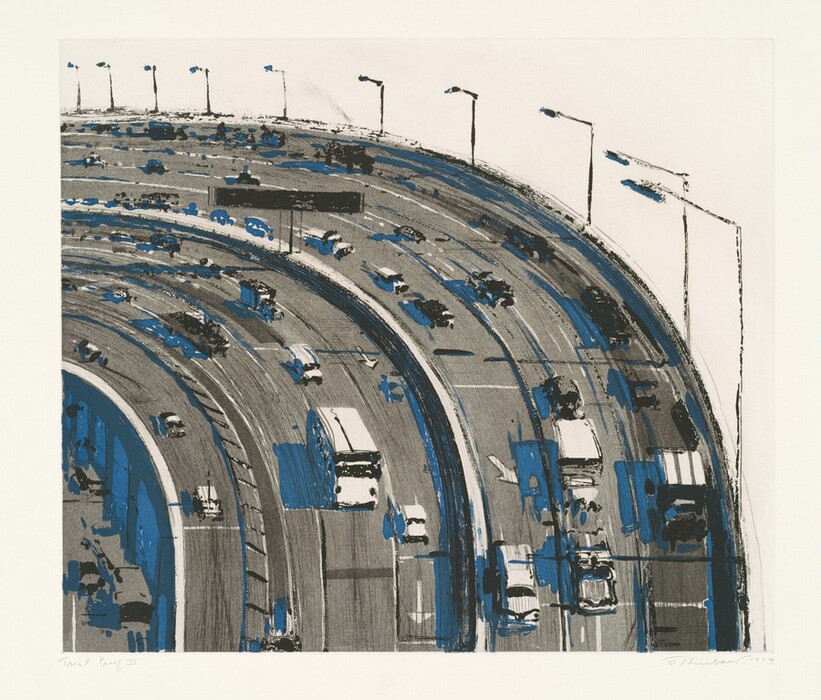
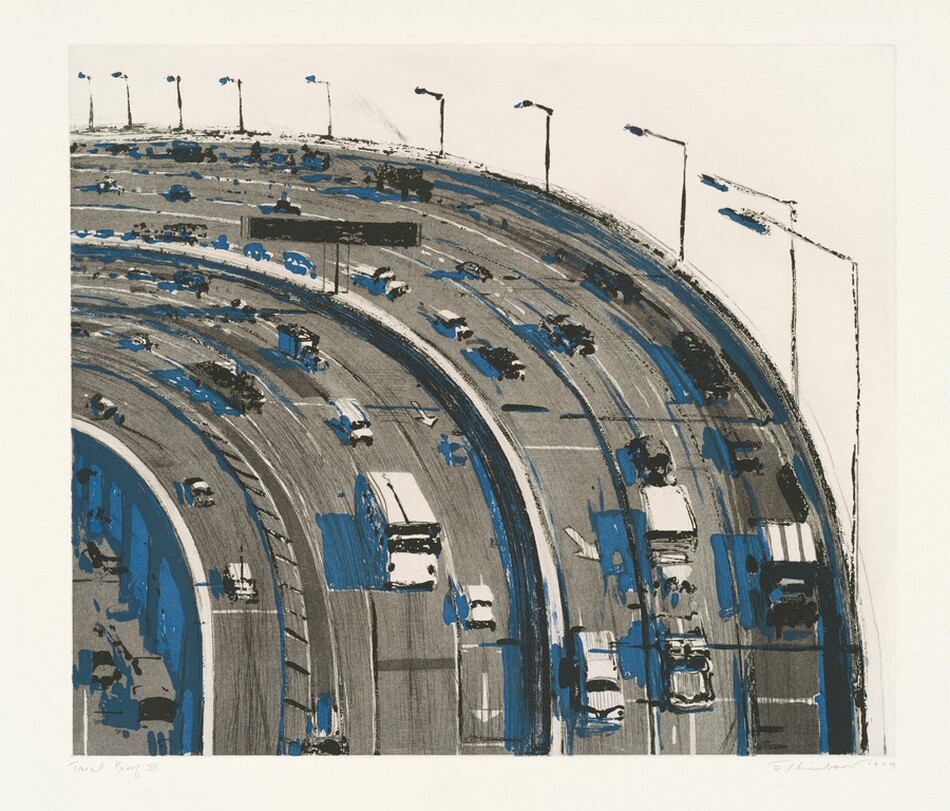
A multi-lane highway curves from the upper left corner to the bottom right edge of this nearly square aquatint and drypoint print. A row of sketchily drawn street lamps lines the top and right edge of the freeway. Black and white trucks and cars cast lapis-blue shadows on the charcoal-gray road. The artist wrote “Trial Proof III” in graphite in the lower left margin under the print and signed it with a heart and text reading, “Thiebaud 1979" in the lower right.
Wayne Thiebaud, Stephen Thomas, Parasol Press, Freeway Curve, 1979, color sugarlift aquatint and drypoint on wove paper, Corcoran Collection (Gift of the Women's Committee of the Corcoran Gallery of Art), 2015.19.3164

Overview

How does transportation affect our daily lives?

What can we learn about transportation and travel from works of art?

Planes, trains, and automobiles.

Perhaps horses, trucks, or jets?

Maybe ferries, scooters, buses, or bicycles.

Consider your typical day. What do you do and where do you go? More importantly: how do you get there?

The United States is a geographically diverse and large country, which means that people, goods, and information travel in a variety of ways.

For centuries, artists—keen observers of life—have depicted these modes of transportation and the ways people, cultures, and societies are affected by them.

How have the ways people get around changed over time? Where does public transportation exist, who are the people using it, and what are their stories? What do salty sea air, the noise of a city, and the rigging of a ship really look like?

Selected Works
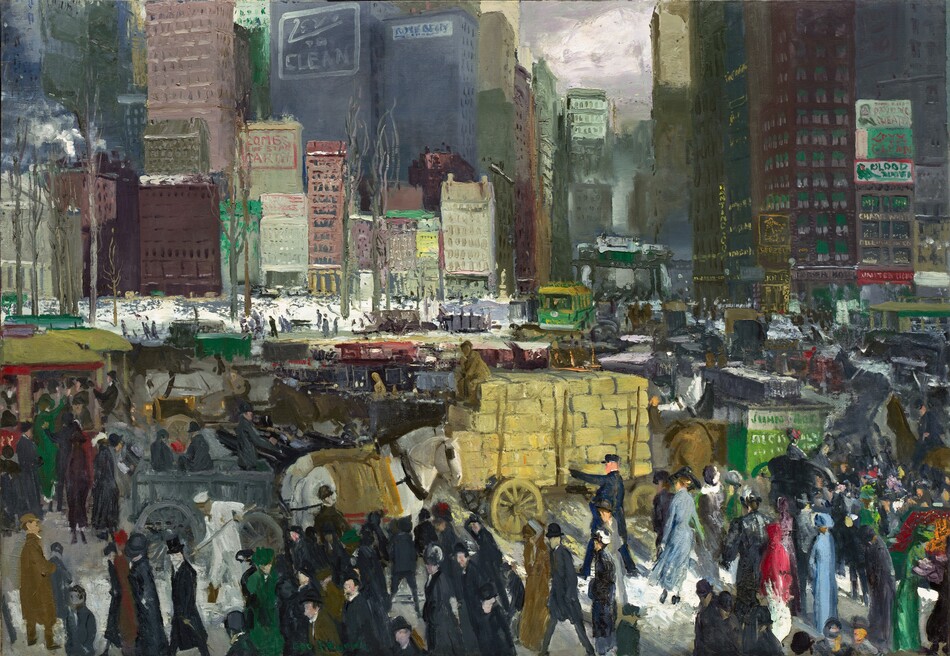
  • We look slightly down onto a crush of pedestrians, horse-drawn carriages, wagons, and streetcars enclosed by a row of densely spaced buildings and skyscrapers opposite us in this horizontal painting. The street in front of us is alive with action but the overall color palette is subdued with burgundy red, grays, and black, punctuated by bright spots of harvest yellow, shamrock green, apple red, and white. Most of the people wear long dark coats and black hats but a few in particular draw the eye. For instance, in a patch of sunlight in the lower right corner, three women wearing light blue, scarlet-red, or emerald-green dresses stand out from the crowd. The sunlight also highlights a white spot on the ground, probably snow, amid the crowd to our right. Beyond the band of people in the street close to us, more people fill in the space around carriages, wagons, and trolleys, and a large horse-drawn cart piled with large yellow blocks, perhaps hay, at the center of the composition. A little in the distance to our left, a few bare trees stand around a patch of white ground. Beyond that, in the top half of the painting, city buildings are blocked in with rectangles of muted red, gray, and tan. Shorter buildings, about six to ten stories high, cluster in front of the taller buildings that reach off the top edge of the painting. The band of skyscrapers is broken only by a gray patch of sky visible in a gap between the buildings to our right of center, along the top of the canvas. White smoke rises from a few chimneys and billboards and advertisements are painted onto the fronts of some of the buildings. The paint is loosely applied, so many of the people and objects are created with only a few swipes of the brush, which makes many of the details indistinct. The artist signed the work with pine-green paint near the lower left corner: “Geo Bellows.”
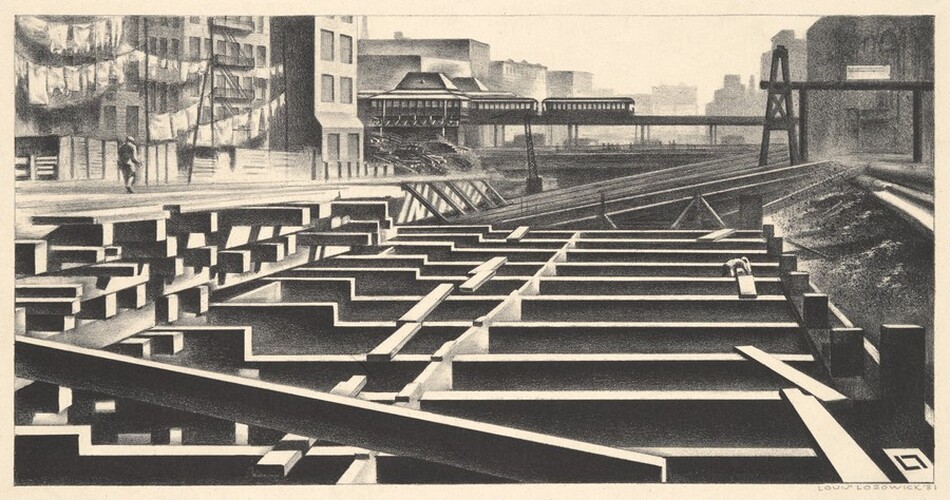
  • The image depicts an urban scene with construction work visible. There are large, geometric iron beams arranged in a structured pattern casting shadows. A solitary figure walks along a street with buildings and laundry lines. In the distance, elevated train tracks and buildings create a skyline against the horizon. The style is graphic, with varying shades of black, white, and gray.
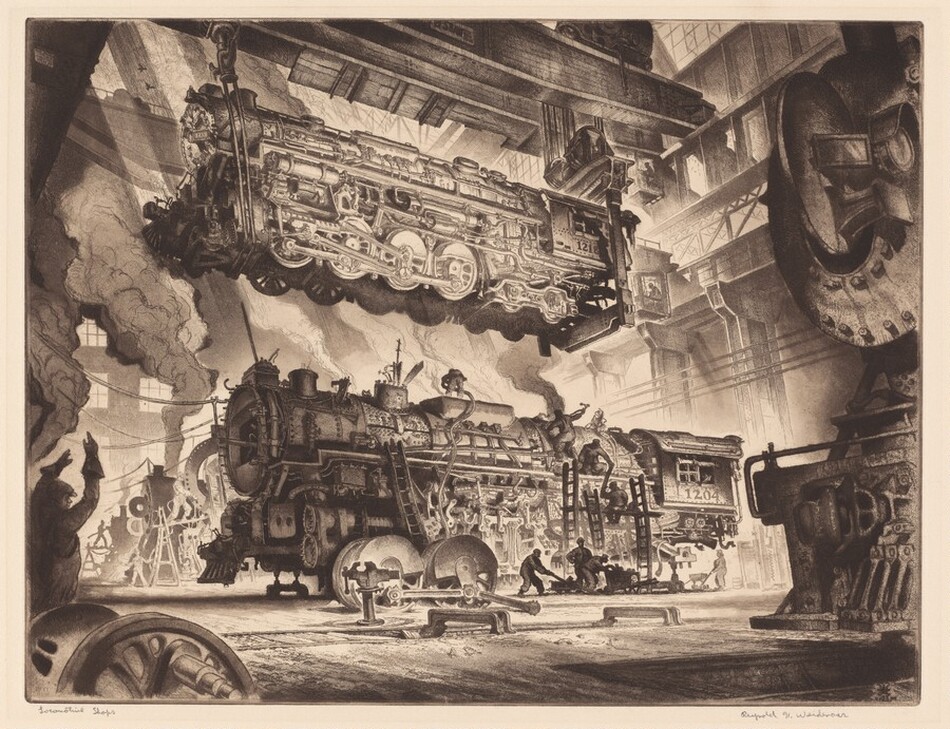
  • This is an image of a steam locomotive being constructed or repaired in an industrial workshop. The scene shows a large steam locomotive as the central focus, with another locomotive engine being suspended in mid-air by a hoisting mechanism. The workshop is filled with industrial details such as structural beams, wheels, pipes, and vents. Light streams in from overhead or background windows, casting shadows on the metallic surfaces. Smoke or steam adds to the atmosphere, making the workshop appear active and bustling. The image captures the early-to-mid 20th-century industrial revolution spirit.
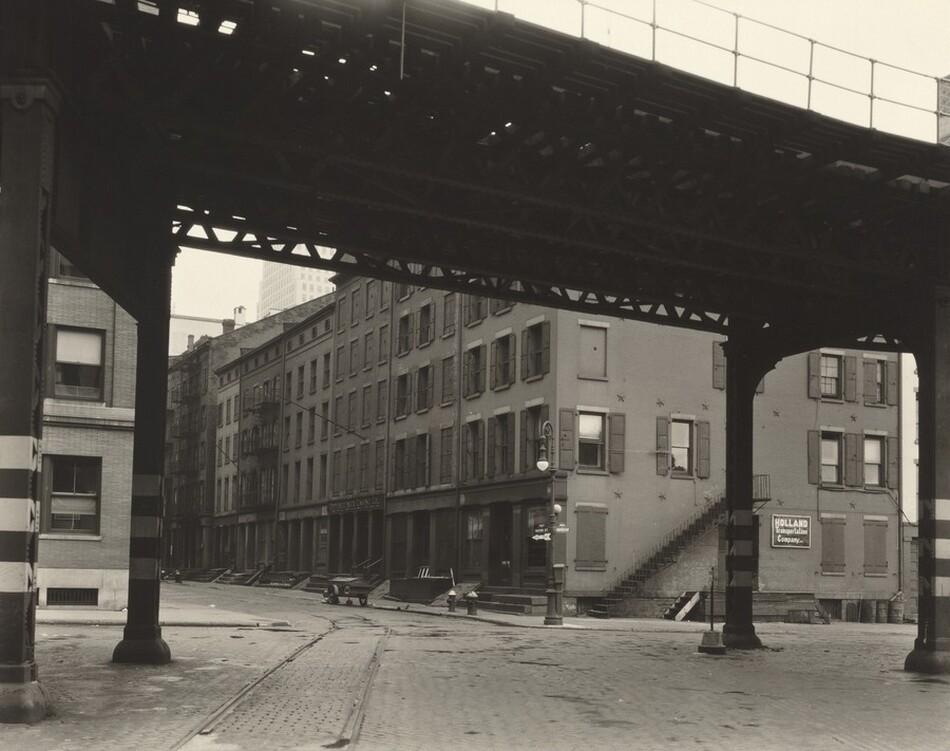
  • The image shows a street-level view under an elevated train track. The horizon is blocked by buildings and the track, which stretches across the width of the image. Beyond the structure, brick buildings with shuttered windows and a fire escape are symmetrically arranged. The track's metal latticework casts shadows on the road below. The color scheme is black, white, and gray, highlighting urban architecture and the cobblestone street texture. The image conveys stillness and architectural symmetry in a quiet city street.
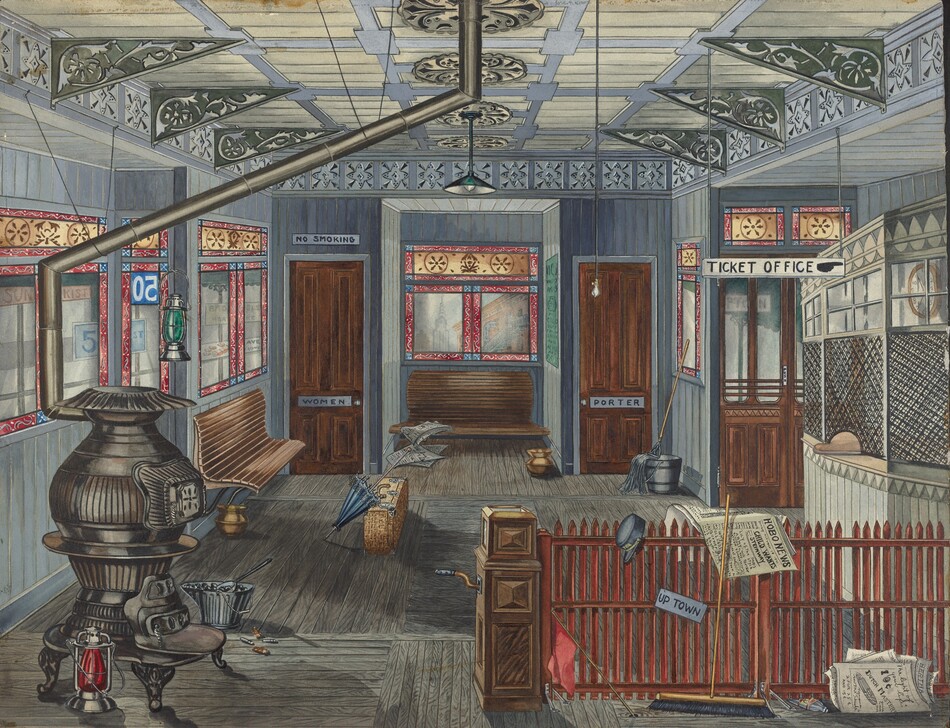
  • This is a painting of the interior of a train station or waiting room. The room has wooden benches, a central potbelly stove, and vintage advertisements in the windows. The space has intricate woodwork and a patterned ceiling. Signs denote locations for "Women," "Porter," and the "Ticket Office." A broom and bucket are near the doorway, newspapers are thrown over a railing, and umbrellas and a cane are on the benches. A small red lantern hangs by the stove, and a green lantern is by one of the windows. The painting depicts an early 20th-century public interior space.
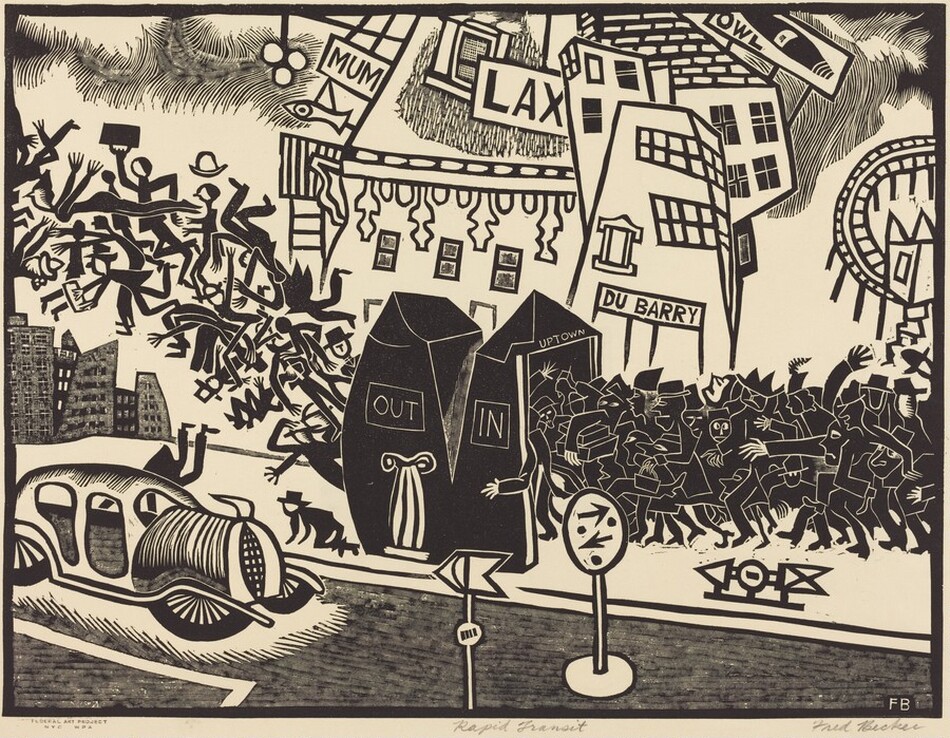
  • This abstract image features a variety of bold, jagged lines and angular shapes creating a cityscape scene. The composition includes wavy lines, sharp angles, a vintage car on the left, fragmented buildings with signs like "MUM," "LAX," and "DU BARRY," and abstract figures resembling people. The overall impression is one of a bustling urban environment, with curved and overlapping shapes suggesting movement and confusion often found in busy city intersections.
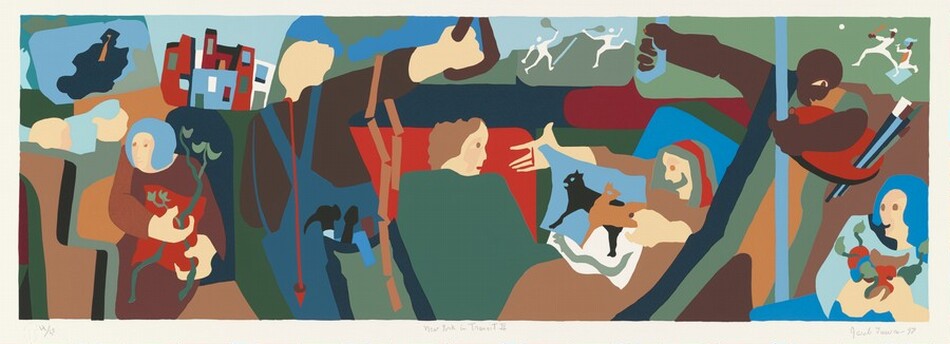
  • The image features an arrangement of distinct, rounded and angular shapes interwoven with bold lines to create an abstract composition. The shapes resemble familiar objects such as human figures in various actions and activities, surrounded by shapes reminiscent of buildings, a guitar, and tools. The abstract quality blends these elements to evoke a bustling urban environment.
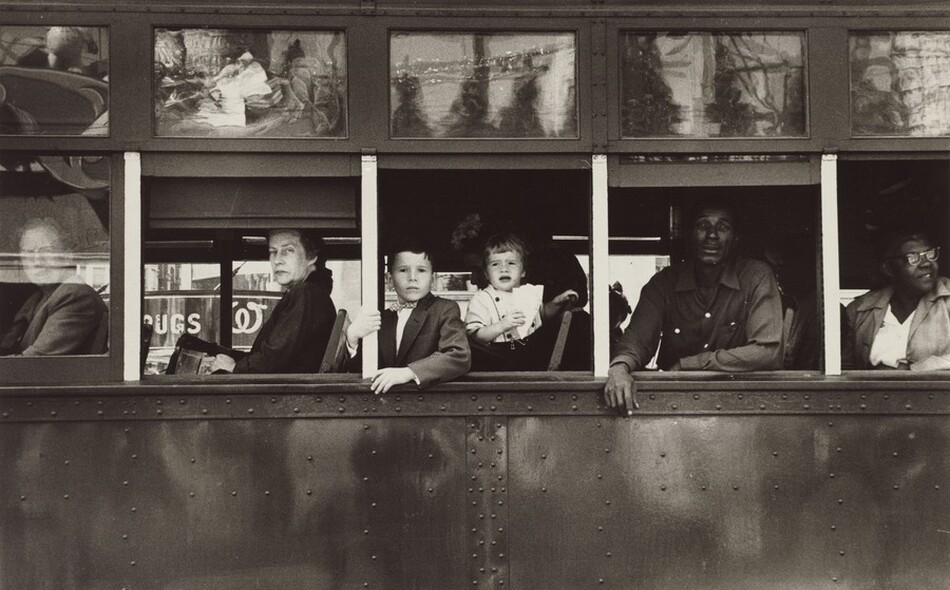
  • This horizontal black and white photograph shows the exterior of a trolley car cropped to show only the mid-section with six passengers inside. The passengers look out of five windows on the left side of the trolley, so their bodies face our left in profile. The four people at the front end, to our left, are white; two people at the back, to our right, are Black. From left to right: a man looks out through the glass of the closed window along the left edge of the photograph. The remaining windows are open. An older woman wearing a dark coat looks at us from under arched eyebrows, lips pursed, out of the next window, to our right. A boy and a young girl look out of the central window. Closer inspection reveals the dark form of a woman next to them, lost in the shadowy interior of the trolley. In the next window, a Black man wearing a long-sleeved, button-down shirt leans onto the window ledge with both forearms, and, in the right-most window, a woman wearing glasses looks over her shoulder, up and away from us. That last window is cropped by the edge of the photograph. The scene behind us is reflected in glass panes above the seats on the exterior of the trolley.
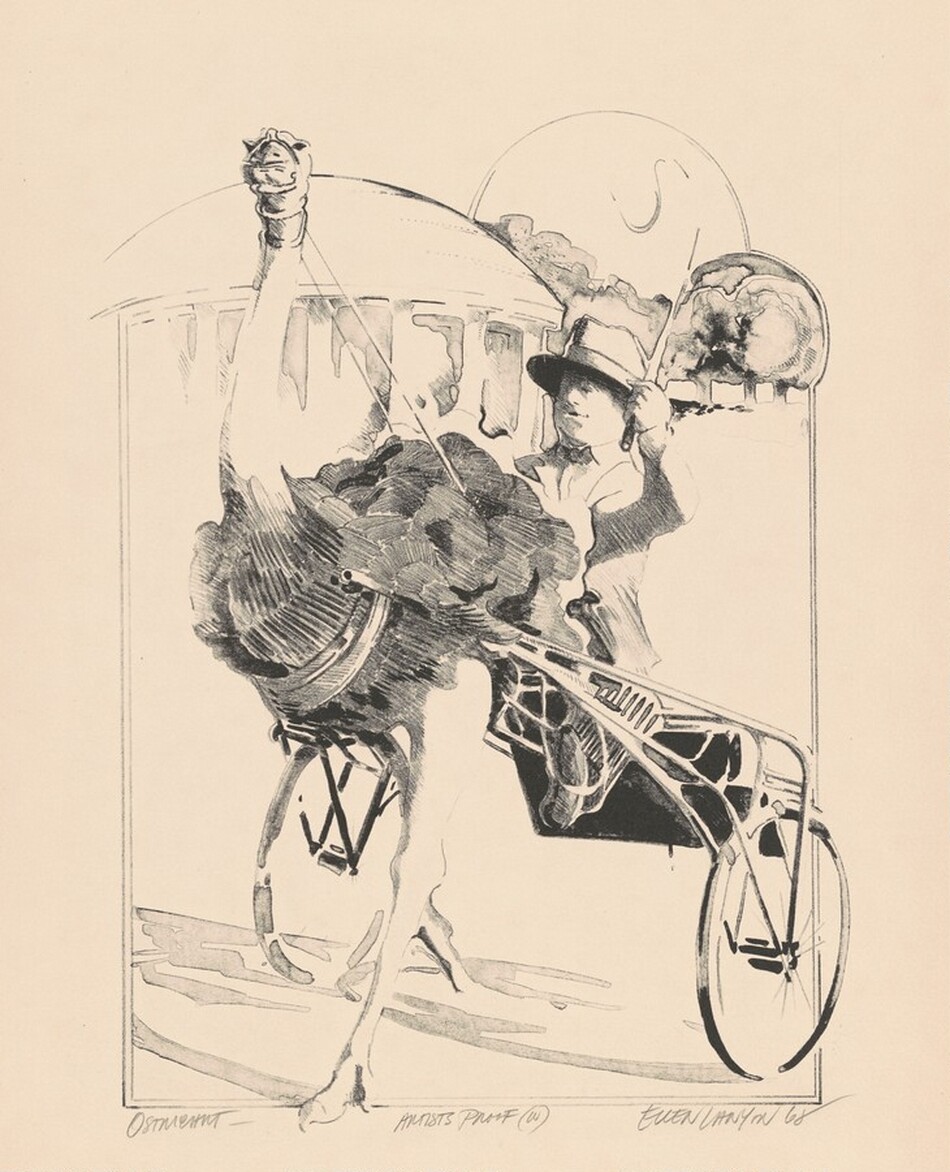
  • This is a drawing of an ostrich pulling a wheeled cart. The image shows an ostrich with a harness around its neck, linked to a light cart with large spoked wheels. The background features architectural elements that resemble arches or colonnades. The style is reminiscent of early 20th-century art, with strong outlines and a focus on dynamic motion. The drawing combines detailed and sketchy techniques, blending realism in the ostrich's feathers with impressionistic elements in the background.
  • A multi-lane highway curves from the upper left corner to the bottom right edge of this nearly square aquatint and drypoint print. A row of sketchily drawn street lamps lines the top and right edge of the freeway. Black and white trucks and cars cast lapis-blue shadows on the charcoal-gray road. The artist wrote “Trial Proof III” in graphite in the lower left margin under the print and signed it with a heart and text reading, “Thiebaud 1979" in the lower right.
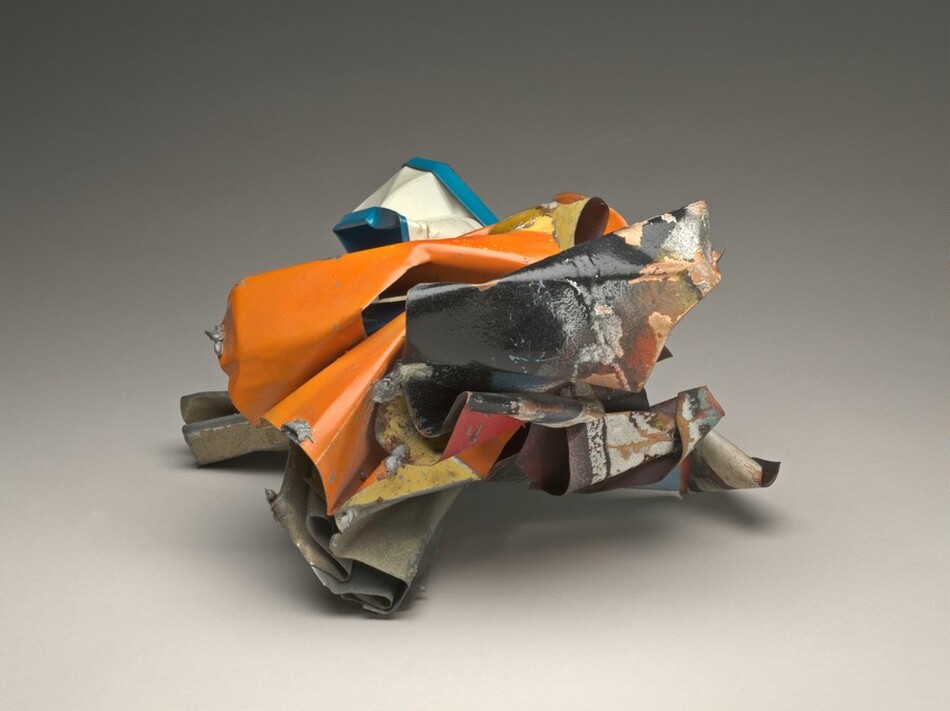
  • The sculpture is an abstract assemblage of twisted and folded metal parts. It features a bold color palette with prominent sections of bright orange, along with patches of blue, black, and various distressed shades indicating rust and wear. The materials appear to be primarily metal, incorporating various industrial fragments. The piece is compact with jagged and irregular edges, creating a dynamic structure that evokes the look of crumpled metal. Relative to the viewer, the sculpture seems to be a small-scale piece sitting on a neutral background.
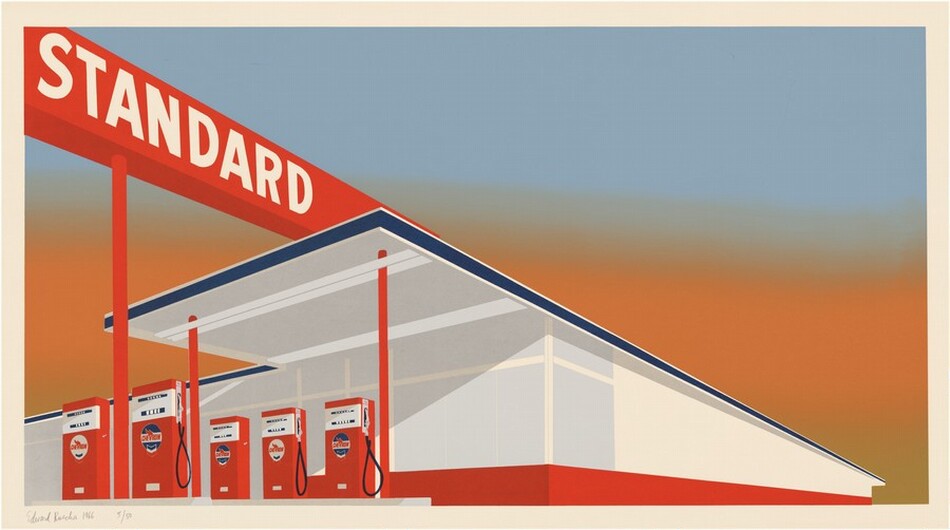
  • This is a print of a gas station made with clean, sharp lines and bright colors. The building is angled, with all of the gas pumps on the left, and above them is a large red sign with the word "STANDARD." The pumps are also bright red and appear to have the Chevron logo. The building itself is white, with a flat dark blue roof extending outward to create a covered area over the pumps and a strip of red at the bottom of the building. The background behind the gas station is a vivid gradient of cool blue at the top blending into warm orange at the bottom. Surrounding the print is a border of off-white paper.
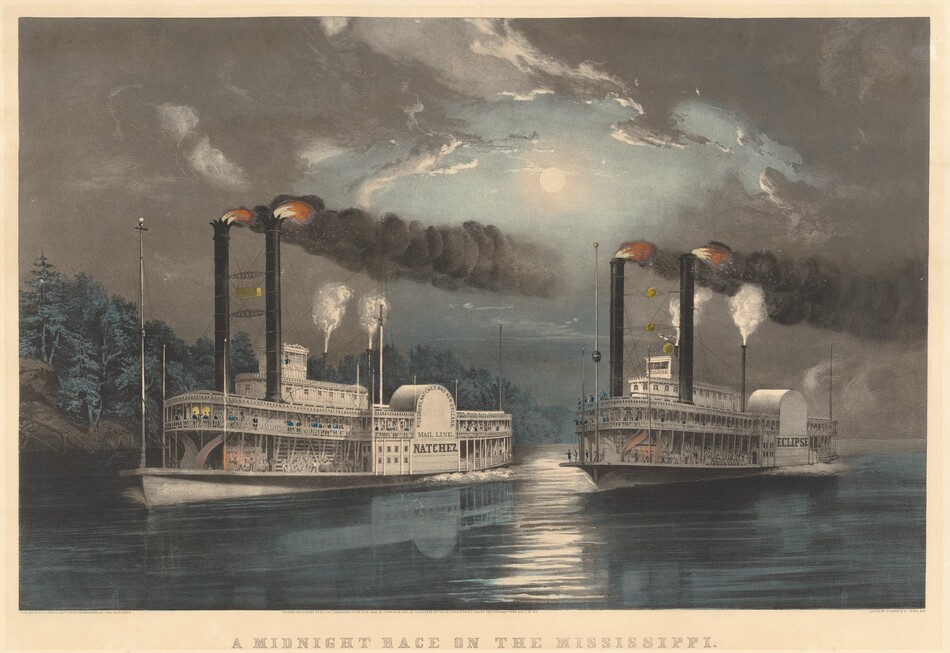
  • Fire burps out the top of a pair of smokestacks on two steamboats that power down a wide river at night in this color lithograph. Black smoke billows back from the flames, and steam hisses from smaller smokestacks at the back of the boats. The boat to our left is the Natchez, and writing around its name reads, “Vicksburg, Natchez and New Orleans Mail Line.” The other boat is the Eclipse. People line the decks of both as the boats race under the moonlit sky. A blanket of gray clouds breaks in front of the luminous moon. Printed text below the image reads, “A MIDNIGHT RACE ON THE MISSISSIPPI.” Tiny text printed under the lower left corner of the image reads, “F.F. PALMER DEL. FROM A SKETCH BY H.D. MANNING OF THE NATCHEZ” and “LITH. OF CURRIER & IVES, N.Y.” in the lower right.
  • This is a photograph of the bow of a sailing ship. The image highlights the intricate rigging and chains attached to the ship's masts and bow. The ship's name, "BRADFORD," is partially visible on the side with a small emblem. Ropes and chains create a complex network in the composition, showcasing the craftsmanship in the ship's construction. The photograph has a sepia tone, giving it a historical or vintage feel. The perspective is up-close, focusing on the ship's prow and the geometric patterns formed by the rigging.
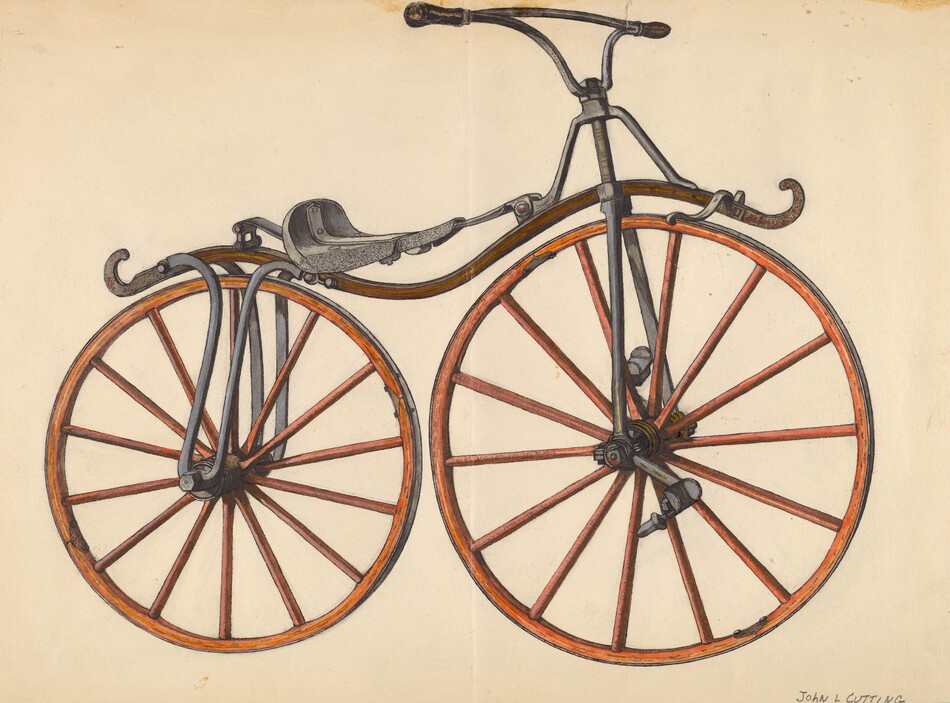
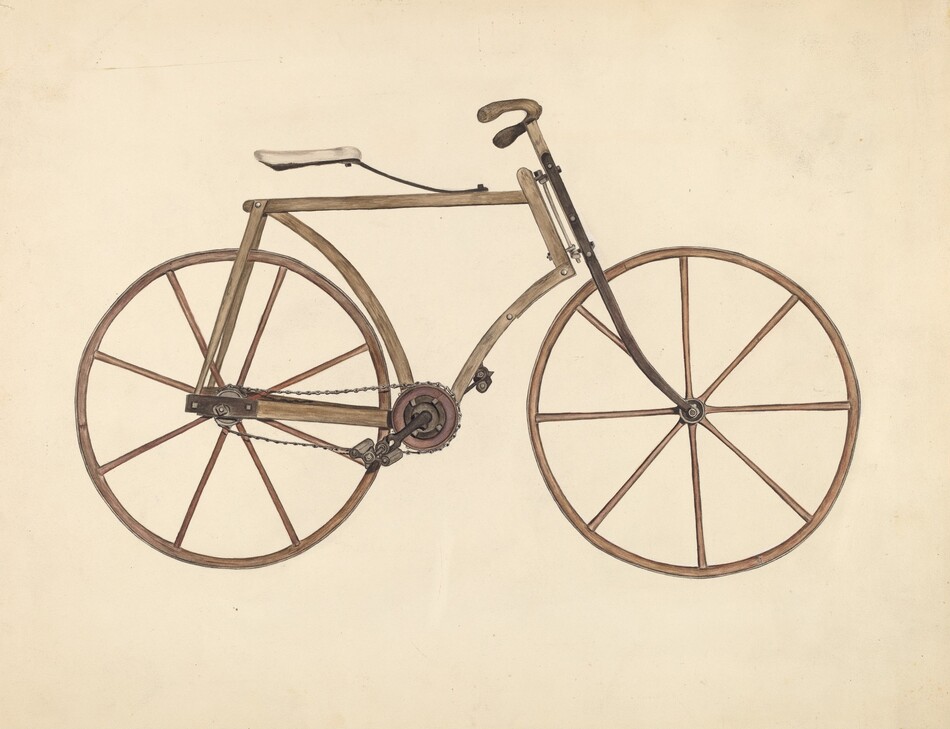
  • This is a painting of a vintage bicycle. The bicycle has large spoked wheels, a wooden frame with a reddish hue, curved handlebars, a metal frame, a curved saddle, and detailed metal components like pedals and handle grips. The background is a plain, neutral tone.
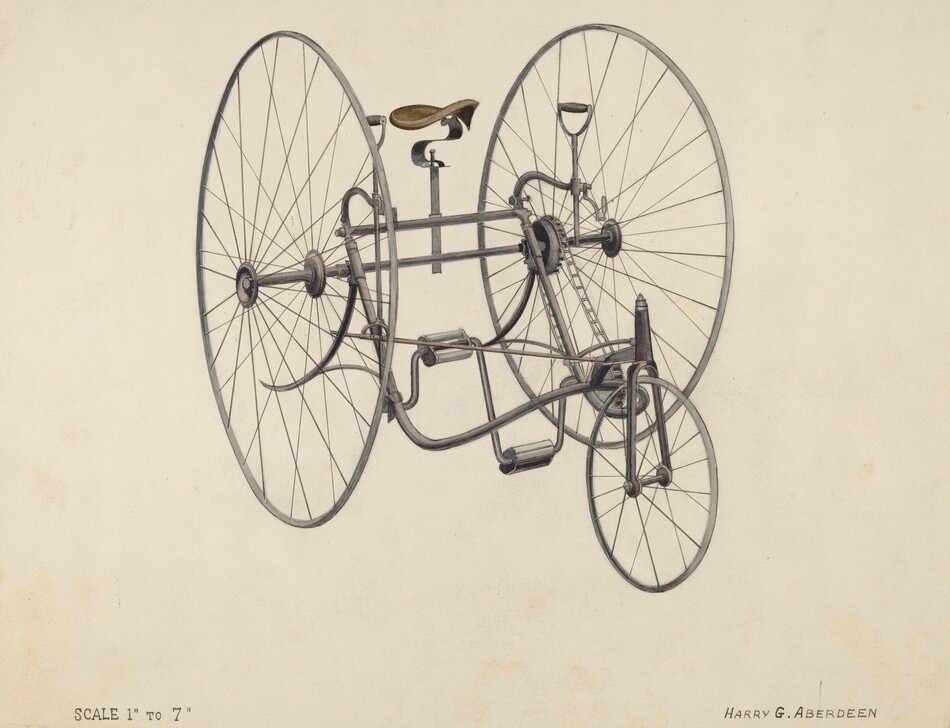
  • This is a drawing of a three-wheeled velocipede. It features a vintage, intricate depiction of the velocipede, characterized by two large wheels on either side and a smaller wheel at the front. The metal frame is detailed with pedals connected through a series of gears. The seat is positioned high above the ground. The image is detailed with light pencil or ink lines.
  • This is a painting of an old-fashioned bicycle. The image shows a bicycle with a wooden frame and spoked wheels. The design is simplistic, with a large chain and sprocket connecting the pedals to the rear wheel. The handlebars are curved and the seat is mounted on a metal post. The background is neutral, highlighting the detail of the bicycle.
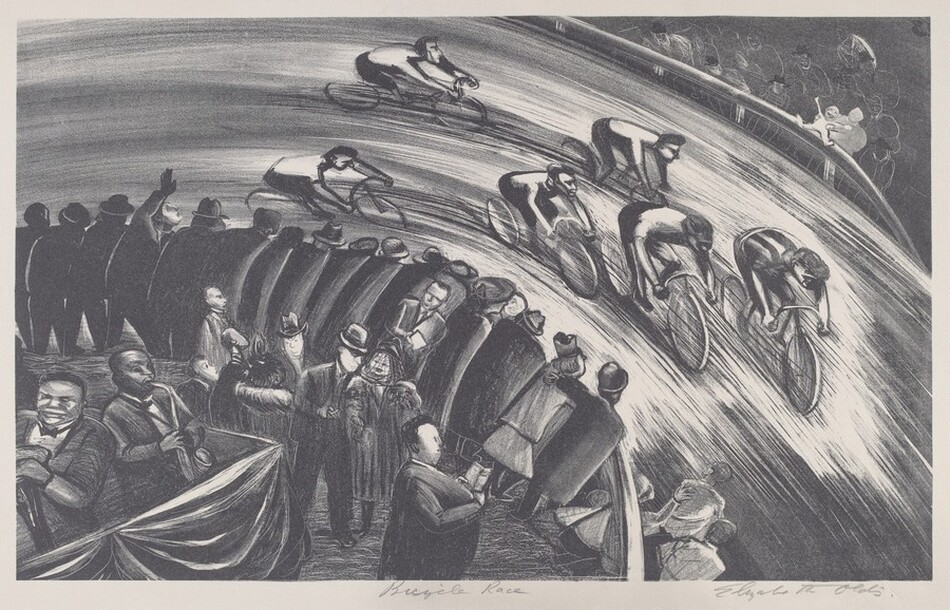
  • This is a drawing of a bicycle race. It shows a competitive cycling event on a velodrome. The artwork features cyclists leaning into a curve on the oval track. Spectators line the edge of the track, with some raising their hands. The drawing conveys speed and movement through lines and shading. Shadows and figures are depicted wearing hats and coats, indicating a formal event. The scene is monochromatic, using light and dark contrasts to emphasize the action and audience engagement, creating depth and energy in the drawing.
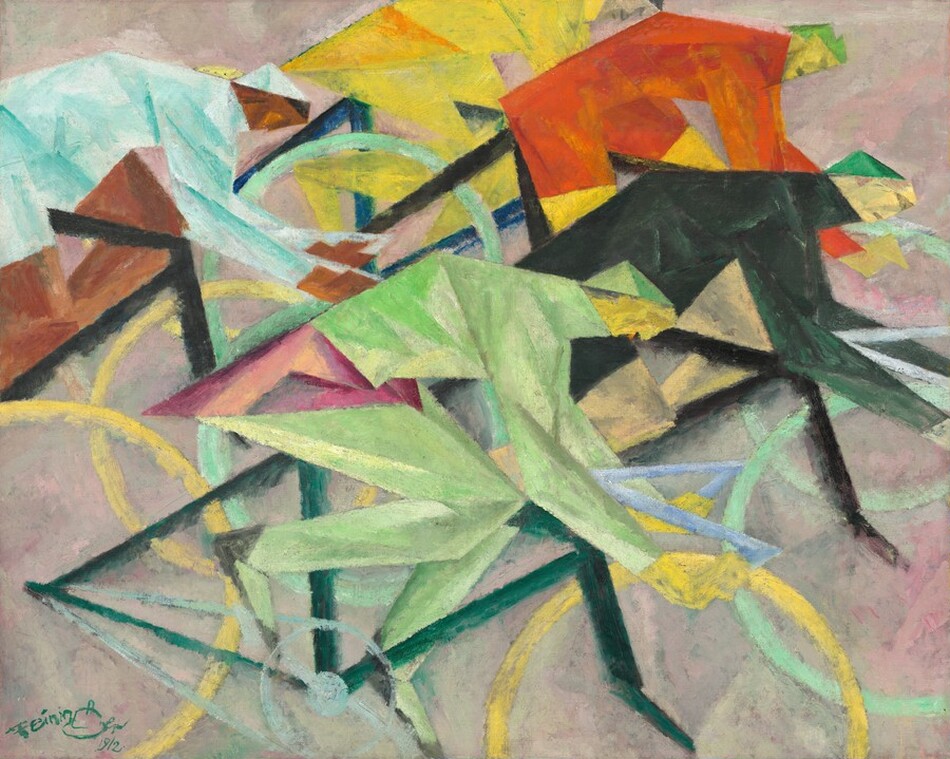
  • The bodies and bicycles of five stylized cyclists fill this nearly square painting so parts of some of their bodies and bicycles are cut by the edges of the canvas. Shown against a background of mottled shell pink and light gray, the riders are closely packed, their wheels and bodies overlapping, and they seem close to us as they race to our right in profile. All lean low over their handlebars. The faces of the three riders at the front of the pack have lemon-yellow skin. The person at the top of the composition, seeming the farthest away from us, has ivory-colored skin, and the person at the back, to our left, has brown skin. They all wear different colored clothing. The racer at the front wears all black, and the one closest to us celery green with fuchsia around the hips. The cyclists farthest from us wear rust orange or canary yellow. The racer with brown skin wears frosty blue. The frames of the bicycles are dark forest green or black, and the colors of the wheels are either yellow or turquoise. The people’s faces and bodies are abstracted into flat, hard-edges shapes. The angles formed by their torsos, arms, and legs are echoed by the angles of their bicycles’ dark metal frames.
  • This is a painting of two military aircraft flying in a vibrant blue sky. The painting features a dynamic depiction of the two aircraft, one grey and white in the upper part, with "USAF" and a star emblem, and the other in a bold brownish-orange hue with a red star, placed below it. The brushstrokes are expressive and bold, creating a sense of movement through the sky. The painting's background is dominated by swirling, textured strokes of various shades of blue, mimicking the open sky. The nameplate at the bottom reads "THEM AND US."
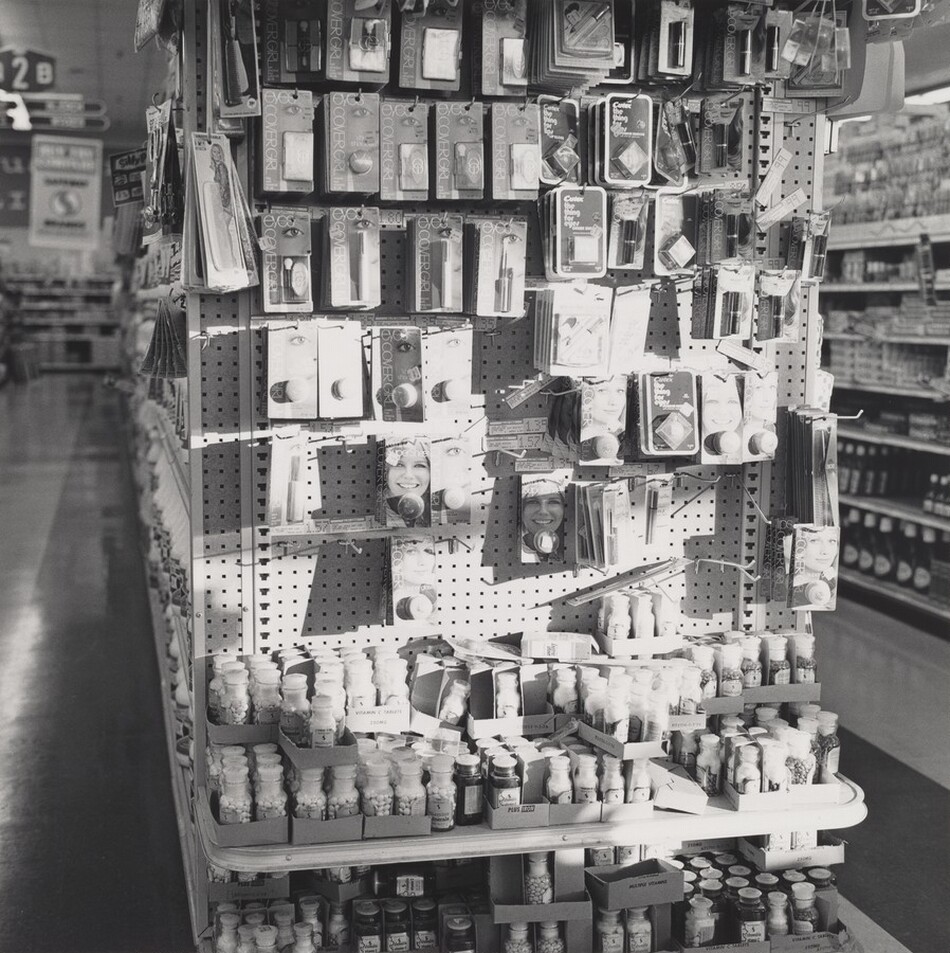
  • The image displays a stand filled with beauty and personal care products, including bottles and blister packs hanging from hooks. The photo is black and white, showing various shades from dark black to light gray and white. The display stand is in the center, capturing multiple rows of items organized neatly on shelves in a shopping aisle. Additional aisles and shelves stocked with products are visible in the background.
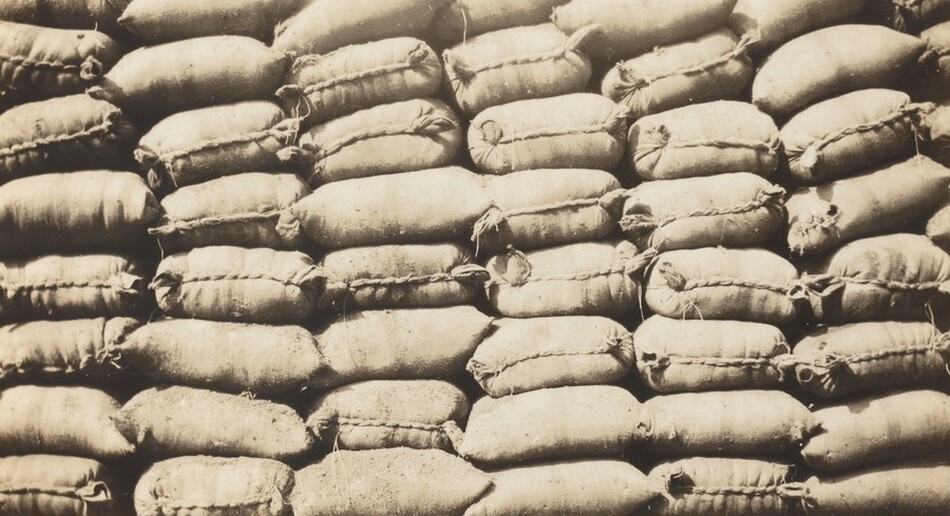
  • This is a photograph of a stack of sandbags. The image shows a tightly packed and organized arrangement of sandbags positioned horizontally in multiple layers. Each sandbag is filled to capacity, with the fabric bulging slightly to accommodate the granular contents. The bags are tied securely at each end with thick twine, and their surface texture is visibly rough and grainy. The sepia tone of the photograph gives it a vintage or historical feel, emphasizing the monotone palette of the sandbags and highlighting the shadows and creases between the layers.
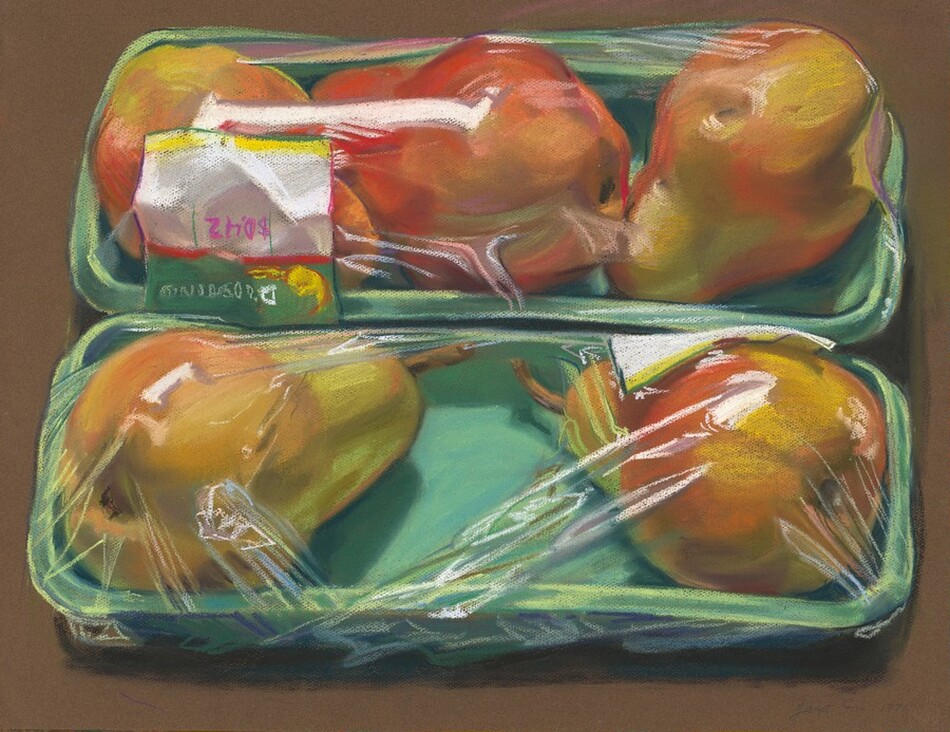
  • In this drawing, two packs of pears wrapped in plastic are placed on turquoise trays against a brown background. The pears vary in shades of yellow, green, red, and orange. The tray on the top has three pears, while the one on the bottom has two. The top tray has a white rectangular label on the left side, oriented upside down. The clear plastic over the pears reflects light and is bunched or puckered in some places.
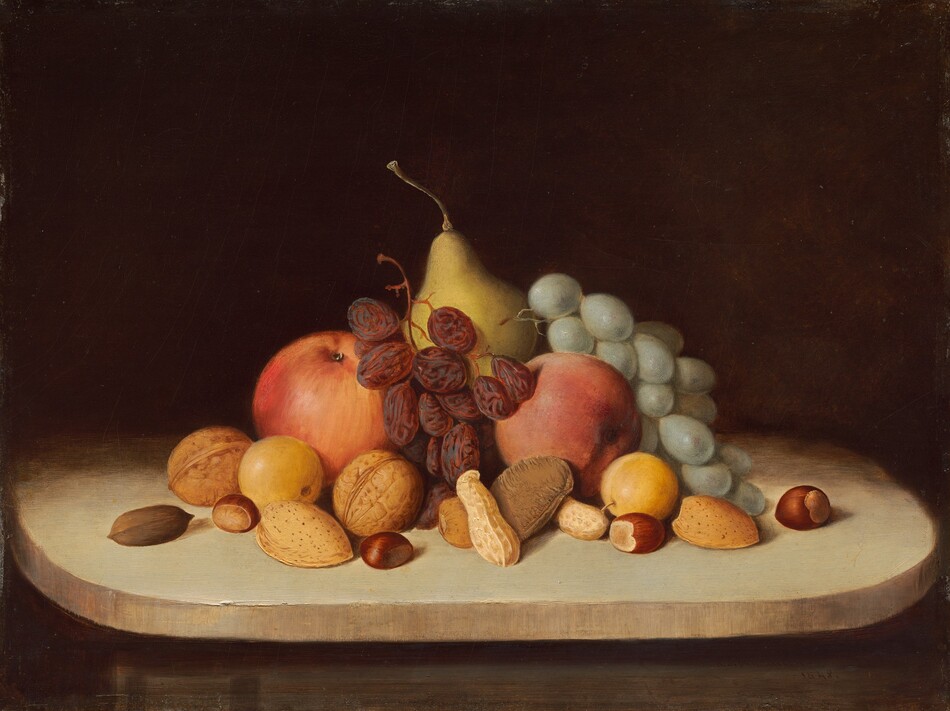
  • Several pieces of fruit, a bunch of green grapes, a stem of raisins, and several types of nuts in their shells are piled on a putty-brown tabletop or ledge with rounded corners against a dark background in this horizontal still life painting. The food is brightly lit from the front, and we look slightly down onto the table. There are two round red apples and two pieces of small yellow fruit, perhaps quinces, flanking a golden yellow pear at the back center. The bunch of grapes drapes over the fruit to our right and the raisins lie between the apples. Thirteen walnuts, peanuts, almonds, hazelnuts, and perhaps a brazil nut are scattered in a loose band in front of the fruit. The surface on which the still life sits becomes swallowed in shadow behind the fruit, and blends into the dark brown background. The artist signed and dated the work in dark paint in the lower right corner, almost lost in shadow under the ledge: “R.S. Duncanson 1848.”
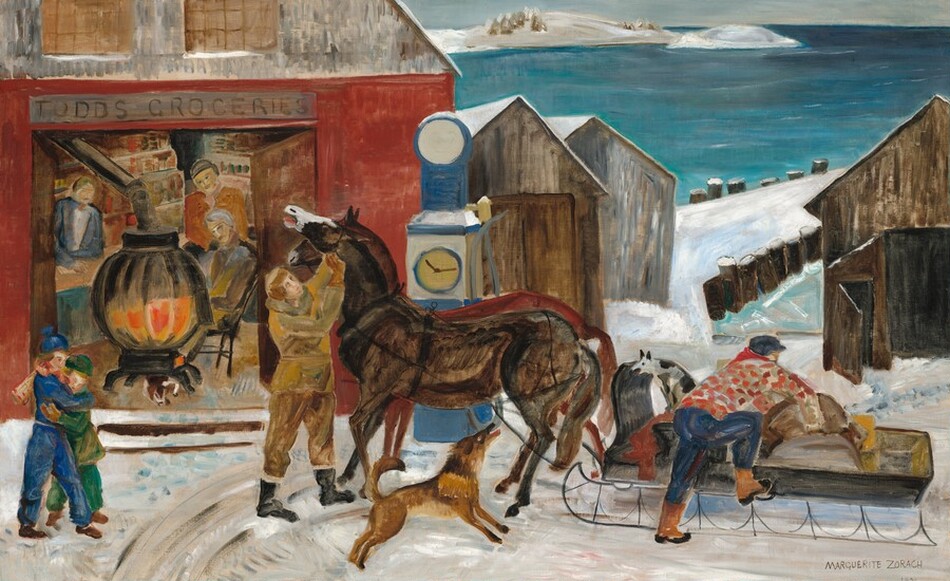
  • This painting depicts a winter scene outside of a red building on the left, with a sign at the top labeling it 'Todd's Groceries'. Inside the store, three people gather around a large black fireplace full of red and orange flames. Behind them are shelves lined with boxes and cans, and the brown front doors are open. Outside the store, near the bottom left corner, two children embrace, one in a blue outfit and the other in a green outfit, both wearing jackets, pants, and hats. On the right, in front of a tall blue clock, a man in brown clothes tends to two horses that are tied to a black sled in the bottom right corner. In front of the horses is a large brown dog, and a smaller dog sits on the sled. Another person is climbing into the sled, carrying a large brown object. All the people in the painting have light skin. In the background on the right are wooden structures, snowy terrain, and a blue body of water. The horizon shows icy formations. The brushstrokes are expressive and visible.

Activity: Selecting, Ordering, Reasoning
Select 3–5 works of art from this module that feature different modes of transportation, such as boats, trains, planes, cars, and bikes. Using the following prompts, ask students to work together in small groups to identify modes of transportation and arrange images along a continuum. These questions may have a range of correct answers, but students should provide support for their choices, using prior knowledge and evidence found in the images.

  • Which form of transportation do you think is the fastest? Which one might be the slowest? Arrange the images in order from fastest to slowest transportation.
  • Which form of transportation might use the most fuel? Which one might use the least?
  • Which form of transportation might go the longest distance? Which one might go the shortest distance?

Ask students to think about how grownups in their lives get around. Where do they go? What modes of transportation do they use? How much time do they spend getting from one place to another?

Activity: Bikes—Past, Present, Future
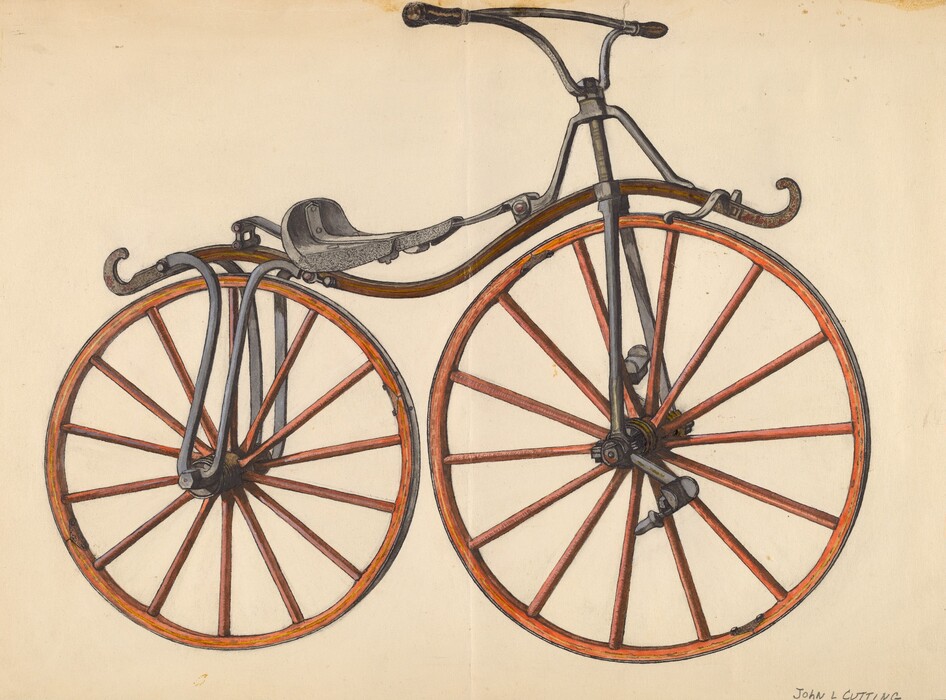
This is a painting of a vintage bicycle. The bicycle has large spoked wheels, a wooden frame with a reddish hue, curved handlebars, a metal frame, a curved saddle, and detailed metal components like pedals and handle grips. The background is a plain, neutral tone.
John Cutting, Bicycle, 1935/1942, watercolor, graphite, pen and ink, and gouache on paper, Index of American Design, 1943.8.8655

Collect your students’ current knowledge, experiences, and questions about bikes. What do your students know about bicycles? What does it feel like to ride one? What questions do they have about bikes? Document their responses publicly in the classroom. Ask them to draw what they think a bike looks like.

Next, share images of bikes from the works of art in this module with students. Ask them to look closely and describe the bikes. What do they notice about these bikes? How would it feel to ride the bikes in the artworks, especially the historic bikes? What do they wonder about these bikes?

Then, bring in an age-appropriate bike for them to study. Invite students to draw it, try riding it, and ask more questions about how it works. Ask students to compare the real-life bike to the bikes featured in the works of art. What is similar, and what is different? Deepen their learning by inviting a bike advocate, rider, or mechanic to visit your classroom and share more information about bike design and use. If possible, visit a local bike path or bike store, or observe a bike race.

Finally, invite students to design a bike for the future. What features would their new bike include? Ask them to think about the materials, tires, seat, safety features, and overall appearance. Show them Ellen Lanyon’s Ostricart for inspiration. Where would they like to travel on this new bike? Students may work individually or in groups; their final product might be a drawing or painting, or they can use recyclable materials to construct a three-dimensional model.

Assess their individual learning by asking them to draw a bike again and share what they think is most important for other people to know about bikes.

Additional Resources

Getting to the Game, a PBSKids interactive

You may also like

This sepia-toned photograph depicts a young girl standing next to a piece of machinery in an industrial setting. The girl has pale skin and dark hair that is tied up behind her head, and she looks out at us with large eyes and a neutral expression. She is wearing a plaid apron over a patterned dress with rolled-up sleeves, and her feet are bare and dirty. She has one of her arms bent behind her, resting casually on the large machine, which is full of spindles and spools loaded with white thread. Debris is scattered on the dark wooden floor.

Educational Resource:  Industrial Revolution

In 1899 an unknown photographer documented the interior of a cotton gin operation in Dahomey, Mississippi. The image reveals the challenging and stifling work of processing raw cotton in the humidity of the southern United States. In the foreground, African Americans pack and press cotton into a massive bale.

Educational Resource:  Harlem Renaissance

How do visual artists of the Harlem Renaissance explore black identity and political empowerment? How does visual art of the Harlem Renaissance relate to current-day events and issues? How do migration and displacement influence cultural production?