Color in "The Railway" (1873) by Edouard Manet

Image of a woman holidng a puppy in her lap while a young girl hold the bars of a gate near the railway station.

Coloring page reproduction of Edouard Manet, The Railway, 1873. This is an auto-generated image.
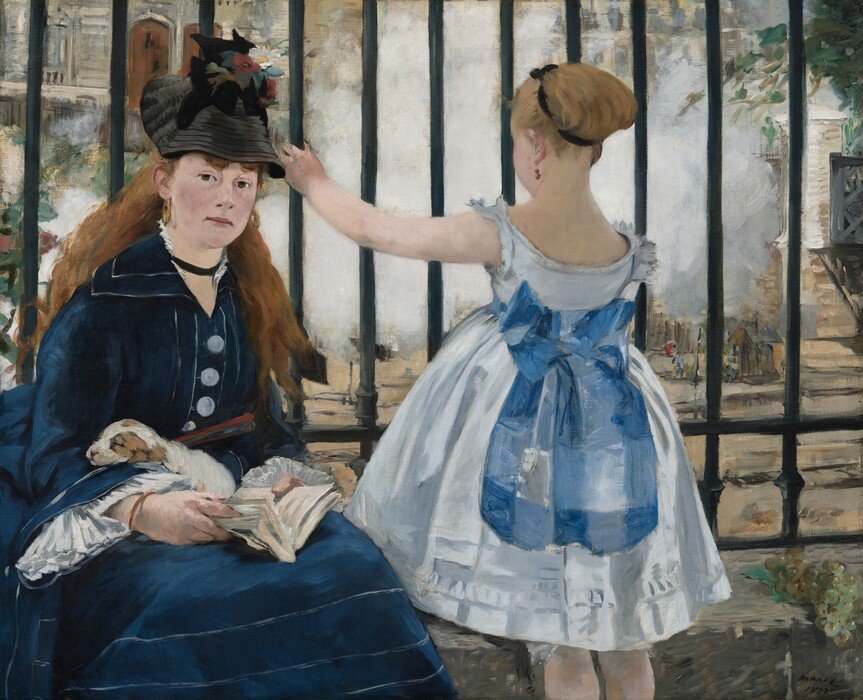
To our left, a young woman sits facing us on a low stone wall at the base of the vertical, black bars of an iron fence and a young girl stands facing away from us to our right in this horizontal painting. Both have pale skin. The woman looks directly at us with dark eyes as she holds an open book, a closed red fan, and a sleeping brown and white puppy in her lap. Her long auburn hair falls down over her shoulders. Her navy-blue dress is accented with white piping on the skirt, collar, and sleeves, and has three large, white buttons down the front and her black hat is adorned with two red poppies and a daisy. The girl wears a sleeveless white, knee-length dress belted with a marine-blue sash tied in a large bow at her back. The girl’s blond hair is pulled up and tied with a black ribbon. She raises her left hand to grasp the bar of the fence she faces. A bunch of green grapes lies on the low wall to our right. A plume of steam fills much of the space beyond the black fence, which spans the width of the painting and extends off the top edge. A few details can be made out beyond the fence, including a stone-gray building with two wooden doors to our left and a bridge along the right edge.
Edouard Manet, The Railway, 1873, oil on canvas, Gift of Horace Havemeyer in memory of his mother, Louisine W. Havemeyer, 1956.10.1

Edouard Manet offers an intriguing study in contrasts and ambiguity in The Railway, starting with the relationship between the two figures. Are they mother and daughter? A nanny with a child? The girl gazes through the iron fence, where steam billows up from the tracks below. Wearing a white dress with an enormous blue bow, she is the visual opposite of the seated woman, who wears a blue ensemble with white trim topped by a fashionable black hat. The girl’s locks are held up by a thin black ribbon, while the other figure’s long hair is down. The child keeps her back to us; the woman looks us in the eye.