Color in "The Marquesa de Pontejos" (c. 1786) by Francisco Goya

Woman wearing a hat and a long dress standing facing forward with a small dog at her feet.

Coloring page reproduction of Francisco Goya, The Marquesa de Pontejos, c. 1786. This is an auto-generated image.
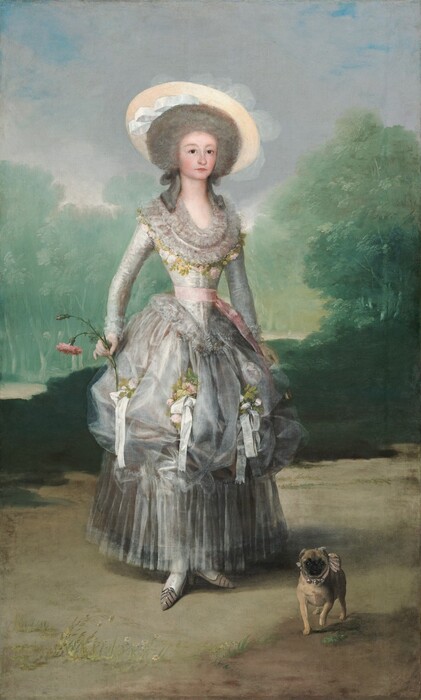
A woman with pale skin, wearing a silvery-gray dress adorned with white ribbons and light pink roses, stands looking out at us with a small, pug dog by her feet in this vertical portrait painting. The woman’s body is angled slightly to our right but she looks at us with dark eyes under faint, arched brows. Her nose is rounded, her cheeks smooth and flushed, and her pale pink lips are closed. Her face is framed in a cloud of nickel-gray hair, and tendrils curl down over her shoulders. She wears a wide-brimmed straw hat with a white ribbon set on the back of her head and slightly off to one side. The bodice of her dress has a low, curving neck. This area is loosely painted to create the impression of layers of lace. A band of intertwined pale pink roses and delicate green leaves borders the outer edge of the lace. The dress has long, tight sleeves with lace at the cuffs and the notably narrow waist is tied with a blush-pink ribbon. The full, silver skirt is picked up to create a row of puffs, like the top of a muffin, around her knees. Bunches of pink roses and white ribbons are nestled into the puffs, and below, the skirt falls in long, vertical pleats to her ankles. She wears white stockings and pointed, petal-pink shoes. In her left arm, on our right, she holds a closed fan loosely at her side, almost lost behind the skirt. She holds a pink carnation with a full bloom and a bud on a long, curving stem in her other hand, by her hip. A caramel-brown pug with a black face, wearing a pink collar lined with three bells, stands facing us with one front paw lifted, to our right of the woman's feet. The landscape is painted in tones of mint and sage green for grass beneath trees enclosing the space the woman stands in, sand brown for the ground, and icy blue for the sky above.
Francisco Goya, The Marquesa de Pontejos, c. 1786, oil on canvas, Andrew W. Mellon Collection, 1937.1.85

Trees, grass, and shrubbery, simplified almost to abstraction, set off the fragile, wasp–waisted figure of María Ana de Pontejos y Sandoval, the Marquesa de Pontejos. Splendidly attired, she typifies those ladies of the Spanish aristocracy who affected the "shepherdess" style of Marie Antoinette, so popular in pre–revolutionary France.

The 18th century’s sentimental fondness for nature, influenced by the writings of Jean–Jacques Rousseau, is alluded to in the parklike setting, the roses arranged around the bodice of the gown and tucked into the folds of the voluminous overskirt, and in the carnation that the marquesa holds with self–conscious elegance. Framing her artfully arranged coiffure, the broad–brimmed picture hat again bespeaks high fashion, perhaps imported from England; such hats were often seen in contemporary portraits by Gainsborough and other British painters. While the painting’s pale tones reflect the last stages of the rococo in Spanish art, the overall silvery gray–green tonality is equally reminiscent of the earlier Spanish master, Velázquez, whose paintings Goya had studied and copied.

Goya probably painted this portrait on the occasion of the marquesa’s first marriage, to Francisco de Monino y Redondo, brother of the all–powerful Count of Floridablanca, another of Goya’s noble patrons.