National Gallery of Art National Gallery of Art

Directions

  • Open 10:00 a.m.–5:00 p.m.
  • Directions
  • Visit

    • Plan Your Visit
    • Accessibility
    • Visiting with Kids
    • Food and Drink
    • Tours and Guides
    • Explore the Campus

    Admission is always free

    6th and Constitution Ave NW 
    Washington, DC 20565

    East building

    Must-Sees at the National Gallery

    Make the most of your visit

    Learn more
  • Exhibitions & Events

    • Exhibitions
    • Calendar
    • Kid-Friendly Events

    America’s 250th

    Celebrating American art and artists
  • Art & Artists

    • Artworks
    • Artists
    • Stories
    • Fun and Games
    • Educational Resources
    • Research

    Open Call

    Artists Reimagining the Collection

    Meet the 50 makers selected from more than 1,600 submissions

Utility

  • Support
  • Shop
  • Become a Member

Open 10:00 a.m.–5:00 p.m.

National Gallery of Art
  • Visit

    • Plan Your Visit
    • Accessibility
    • Visiting with Kids
    • Food and Drink
    • Tours and Guides
    • Explore the Campus

    Admission is always free

    6th and Constitution Ave NW 
    Washington, DC 20565

    East building

    Must-Sees at the National Gallery

    Make the most of your visit

    Learn more
  • Exhibitions & Events

    • Exhibitions
    • Calendar
    • Kid-Friendly Events

    America’s 250th

    Celebrating American art and artists
  • Art & Artists

    • Artworks
    • Artists
    • Stories
    • Fun and Games
    • Educational Resources
    • Research

    Open Call

    Artists Reimagining the Collection

    Meet the 50 makers selected from more than 1,600 submissions

Utility

  • Support
  • Shop
  • Become a Member

Directions

  • Open 10:00 a.m.–5:00 p.m.
  • Directions

Global Search

Autocomplete Suggestions
    No Results
    Keep typing to get suggestions
    Loading Results

    Top Searches:

    • Free images
    • Van Gogh
    • Landscape
    • National Gallery Nights
    • Matisse
    Advanced Artwork Search

    Results

    Scholarly Article

    French Paintings of the Fifteenth through Eighteenth Centuries: A Lady in Her Bath, c. 1571

    January 1, 2009
    by:
    • John Oliver Hand
    Red satin drapes are drawn back to either side of this vertical painting to reveal a nude woman with pale, white skin sitting upright in a narrow bathtub. The woman occupies the right half of the painting. To our left, another woman nursing a swaddled baby and a child, all also with pale skin, gather near the tub. The bathing woman’s body is angled slightly to our left but she looks into the distance to our right. She has a straight nose, small pink lips, dark eyes, and smooth skin. Her brown hair is pulled up under a jeweled cap, and she wears pearl earrings, a gold bracelet on each wrist, and a gold ring with a pink stone on her left pinky finger. She holds a carnation with her right hand, on our left. The inside of the tub is draped with white fabric, which folds over the sides. A bowl of fruit and flowers are scattered on what must be a board spanning the tub, which is also covered with a white cloth. From the far side of the tub, the child reaches for the fruit. The woman nursing the baby has one breast exposed but is otherwise fully dressed in a garment with red sleeves and a white cap. The woman has a prominent nose, and she smiles as she looks at us from the corners of her eyes. The room behind these women has fireplace with an ornate mantel and windows open to a landscape to our left. A picture showing a unicorn resting in front of a tree and a dark mirror hangs on the wall between the fireplace and windows. At a table placed in front of the fireplace, a third light-skinned woman leans over and lifts a jug.
    Scholarly Article

    French Paintings of the Fifteenth through Eighteenth Centuries: The Happy Family, c. 1775

    January 1, 2009
    by:
    • Richard Rand
    In a deeply shadowed room, two women and several children are gathered at the center of this wide, oval painting, looking toward a young man and donkey who peer in over a half-door to our left. The people all have light skin, and all of the children have blond hair. Light coming into the darkened room falls on a young woman holding a baby at the center of the composition. The woman sits facing our left in profile, looking at or toward the baby with brown eyes and parted lips. She has a long, straight nose, flushed cheeks, and her brown hair is pulled back into a bun at the back of her head. She wears a low-cut, ivory-white bodice with puffy sleeves, a black sash tied around her waist, and a voluminous crimson-red skirt. She props the baby so the child stands braced on chubby legs against her lap as the woman supports the torso and backside. One of the baby’s hands reaches for the woman’s neck and the other for her forehead as the head twists back to look to our left. The child wears a white garment. Two more children rest near the woman, with one leaning back against the woman’s shins and the other sitting with a white dog at the woman’s side, closer to us. Both children wear brown, white, and teal blue. Behind this group, another woman, seen mostly silhouetted against the shadows, reaches back and braces another child who seems to sit on a box or chest. The fifth and final child stands at the head of the donkey who peeks in over the half-door to our left. Above the donkey, a young, cleanshaven man wearing a wide-brimmed hat and baggy coat leans into the room and looks toward the central woman, a smile on his lips. His features are cast into shadow by the light coming in behind him but he has dark hair and dark eyes. The room beyond the women and children is draped with a gray cloth, as if hung over a low beam. The upper regions of the room are swallowed in shadow.
    Scholarly Article

    French Paintings of the Fifteenth through Eighteenth Centuries: The Love Letter, 1750

    January 1, 2009
    by:
    • Richard Rand
    Two pale-skinned women sit together surrounded by five sheep and a dog in a lush forest in this vertical painting. The woman to our right sits slightly above the other, with her arm draped around the shoulders of her companion. The woman to our right wears a low-cut, rose-pink dress with a full skirt and voluminous, gossamer sleeves. Blond curls are pulled back behind a headband, which is adorned over one ear with three large, pink flowers and smaller yellow and blue flowers. She tips her head to our right as she gazes down to her left at her friend. She has blue eyes, flushed cheeks, a delicate nose, and her grapefruit-pink lips curl in a gentle smile. She crosses one knee over the other and leans toward the other woman. Tucked into her side, the second woman looks up at the first in profile facing our right. Her low-cut, lavender-purple dress has a gold shimmer that suggests silk. Her ash-brown curls are pulled back and decorated with small sea-blue flowers. One toe peeks out from her long skirt, and both women are barefoot. The woman in purple holds a white dove on her friend’s lap, and the woman in pink holds a small envelope closed with a shell-pink seal next to the bird. The dove’s wings are slightly outspread, and a blue ribbon is tied around its neck. Just behind the pair, a towering tree with a silvery-gray trunk grows up and off the top edge of the painting. It angles to our left, and green branches hang down into the picture. To our right of the tree, a rectangular sand-brown stone structure is topped with a male lion carved from the same stone, near the upper right corner. The ground beneath the women is covered with moss-green growth and the space around them filled with verdant bushes and plants. A single, cream-colored sheep stands to our right, facing the women, next to a basket of flowers near the lower right corner. Four more sheep stand and lie together beyond the women to our left, while a black-bodied hound with a white muzzle sits watching the women. A pile of broken branches, perhaps forming a fence, lies behind the sheep. Grassy hills and trees become hazy in the distance beyond, and the sky above is slate blue with a few white and pale pink clouds. The upper and lower right corners and the lower left corner are deep in shade. The artist signed and dated the painting as if he had inscribed the stone in the shadow just below the lion, “f. Boucher 1750.”
    Scholarly Article

    French Paintings of the Fifteenth through Eighteenth Centuries: Diana and Endymion, c. 1753/1756

    January 1, 2009
    by:
    • Richard Rand
    Close to us, a woman and a winged, child-like putto float on clouds above a clean-shaven young man in a forest setting in this horizontal painting. All three people have smooth, pale skin, rosy cheeks, and ash-blond hair. The man reclines with his torso propped so his feet extend along the rocky ground to our left. He rests his head in his right hand, farther from us, with that elbow resting on a rock. We look up onto the underside of his chin and delicate features. A scarlet-red robe falls from his shoulders and across his hips. One knee is propped up, and that foot is tucked behind his other ankle. His muscular torso, arms, and legs are bare. His left hand, closer to us, rests by his side and loosely holds a staff. Three tan-colored sheep with long faces lie or stand behind the man, in the lower right corner of the painting. A light gray hound dog with floppy ears sleeps with its drooping muzzle resting on its paws in the shadows at the man’s feet. The woman floats just above the man, reclining on a fog-gray cloud with her feet angled toward the man’s torso. Her curls are held back by a topaz-blue ribbon, and she looks down at the man, a faint smile on her lips. A loose white garment partially covered by a blue robe falls from her shoulders, leaving one breast and one leg bare. She reaches outward with her left hand, palm out, and the other hand rests down on the cloud alongside her. A sharply pointed, luminous crescent moon curves up to each side behind the cloud. The chubby, nude, baby-like putto nestles on his belly in a cloud between the man and woman. He has short, tousled hair, stubby wings, and his skin is flushed pink. An arrow held in one hand points toward the man, and the putto rests his other hand in a bunch of pink roses. Plants and flowers grow in patches on the ground around the man. The sky above is framed with steel-gray clouds against pale blue.
    Scholarly Article

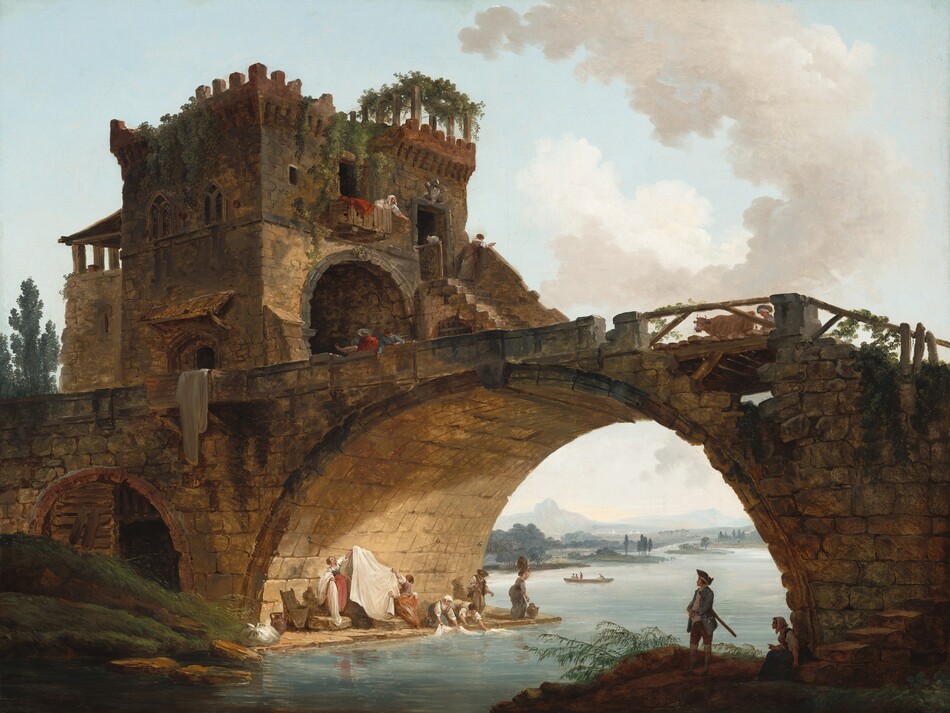
    French Paintings of the Fifteenth through Eighteenth Centuries: The Ponte Salario, c. 1775

    January 1, 2009
    by:
    • Joseph Baillio
    A rustic, arched, stone bridge spanning a shallow river nearly fills this horizontal landscape. From low to the ground, we look up into and through a large arch, which occupies the lower half of the picture and frames a view that opens to a wide expanse of calm, pale blue water, wooded green riverbanks, and a misty, distant view of a village and a mountain. The horizon line comes a quarter of the way up the painting, and a smoke-colored cloud formation curves like a backward C against the ice-blue sky above. The bridge structure is made from stacked, sandstone-colored stone blocks to form heavy piers. Vegetation grows on the crumbing bridge and gaps indicate other stones are missing. The bridge’s deck runs across the center of the painting, rising slightly from left to right. Atop it, occupying the top left quadrant of the painting, sits a square stone two-story tower that encloses an arched passage over the bridge’s roadway. Groups of people, small in scale, are positioned on and around the bridge. At the river level, on a platform around a bridge footing, four women do laundry. Two pull sheets from the water and two bend on their knees to wash the linens in the river. They wear long skirts of slate blue, cranberry red, and ochre yellow with pinafores and white blouses rolled up to the elbows, with their hair pinned up. A bearded man in brown trousers, white shirt, and brown hat appears to talk to them. Another woman standing nearby in a dark, slate-gray dress balances a large, dark brown ceramic ewer on her head and reaches to pick up another resting at her feet. Warm yellow light illuminates this scene and the underside of the bridge, and reflects on the river. On the bridge deck above, a brown steer is herded across the bridge by a person wearing a wide brown hat, while three people in red, slate-blue, and white clothing are about to pass through the tower passage on the left. Immediately above them, a woman in a white blouse and head scarf appears at a small balcony with what looks like a red dress draped over it and gestures with an extended arm toward a white cat crouched on a railing below. Another woman to our right, in a brown dress, white blouse, and brown hair, stands at the top of a flight of steps leading up the far side of the tower with her back toward us, and she gazes out at the view. On the water below, a small boat with several people is rowed across the river in the middle distance. In a shadowed area at the foot of the bridge, closer to us, a man stands wearing a pointed hat, blue jacket with buttons, and high boots with a sword tucked under his arm. Behind him, a woman in a dark green dress and kerchief sits on a stone step. Both look toward the scene under the bridge with the washerwomen.
    Scholarly Article

    French Paintings of the Fifteenth through Eighteenth Centuries: Love the Sentinel, c. 1773/1776

    January 1, 2009
    by:
    • Richard Rand
    This painting image depicts a cherubic child in a garden setting. The child is standing with one foot in front of the other and has small wings on their back. The child has light skin, curly blond hair, rosy cheeks, and a playful expression. They are mostly nude, except for a cloth that wraps around their back and covers their groin. The child is holding a golden arrow. They are standing in front of a light green bush with pink flowers. In the bottom left, there is a dark blue object in the green grass that looks like a torch or cylindrical quiver. The setting includes lush greenery and more clusters of pink and white flowers. The background features a pastel blue sky with soft pink clouds.
    Scholarly Article

    French Paintings of the Fifteenth through Eighteenth Centuries: Love as Folly, c. 1773/1776

    January 1, 2009
    by:
    • Richard Rand
    This oval painting shows a cherubic figure floating in mid-air with one leg bent and arms outstretched. The cherub has curly hair, a round face, and rosy cheeks, and they are smiling gently. The figure is nude with a cloth draped over one shoulder, and in one hand they hold a flaming torch. Surrounding the cherub are white birds in flight. The background consists of pale blue and soft white clouds, with blooming pink flowers and foliage on the pale green ground.
    Scholarly Article

    French Paintings of the Fifteenth through Eighteenth Centuries: The Visit to the Nursery, c. 1775

    January 1, 2009
    by:
    • Richard Rand
    Two women, a man, and three small children gather around a baby sleeping in a wicker cradle near an open window in this horizontal painting. The people all have pale skin with rosy cheeks. The cradle is just to left of center of the composition. It has a half canopy to shade the baby, and it sits on rockers. The baby sleeps with chubby arms over the covers tucked around the body. A woman sits on a low chest next to and on our side of the crib, near the lower left corner of the canvas. She has a prominent nose and jutting chin. She wears an oatmeal-brown bonnet and apron, and a muted red dress. She holds a staff with fabric or a spindle at the top tucked in one elbow, and the other hand rests on the canopy. A white cat lies like a loaf next to her feet. On the far side of the crib, a clean-shaven man kneels on a low platform covered by a pillow at the foot of the cradle and leans into the arms of a standing young woman. The man has a pointed nose and rounded chin, and he looks with heavy-lidded eyes at the baby. His long gray hair is tied at the nape of his neck, and he wears an ice-blue and tan long-tailed coat, breeches, and stockings. He rests one cheek against the arm of the woman who stands at his far shoulder. Her body faces the man, and she rests her other hand on his shoulder as she turns to look at the baby. A round, broad-brimmed hat casts a shadow over her delicate nose and round cheeks, and she wears a white dress with elbow-length sleeves and a full skirt. Three children stand behind the man’s feet and along the right edge of the canvas. The child closest to us has carrot-orange hair tied in a bun with a blue ribbon. She wears a white, puffy-sleeved shirt, and a parchment-white apron bunched over a pale pink skirt. She faces our left in profile, looking at the man, and holds one end of a ball of yarn that has rolled away from her. The boy behind her stands with his body facing us as he looks up and to our left. He wears a yellow jacket and a broad-brimmed hat pushed back on his head. Only the forehead and eyes of an even smaller child standing behind this pair are visible. Voluminous curtains part to either side of a window at the head of the cradle, near the upper left corner of the composition. An unlit lantern sits on the sill, and the sky beyond is dusk-blue. Bright light shines into the room, especially onto the man and woman and three children. A piece of furniture, perhaps a wardrobe, is on the far wall behind the woman, and the door to the room is open behind the children.
    Scholarly Article

    French Paintings of the Fifteenth through Eighteenth Centuries: A Game of Hot Cockles, c. 1775/1780

    January 1, 2009
    by:
    • Richard Rand
    Towering, pale, celery-green trees frame a view of a lush park with about a dozen elegantly dressed, light-skinned men and women in this vertical landscape painting. The color palette is dominated by moss and lemon-lime green, golden yellow, and spruce blue. The men all wear jackets with long tails over knee-breeches, and their long hair is pulled back at the napes of their necks. The women wear long dresses with full skirts and hints of lace at the sleeves and bust, and their brown or white hair is pulled up. Nine of the men and women gather to our right on a stone terrace along the bottom edge of the painting. A man in butter yellow kneels in front of a woman wearing rose pink. Around this pair, people stand, kneel, sit, or recline wearing aquamarine blue, light turquoise, or ivory white. A man and woman sit on a bench to our left, a little removed from the larger group. This woman wears ruby red and the man leaning toward her wears topaz blue. Two people in the park beyond these groups are painted with only a few strokes of pale blue and white paint, and they look over a low hedge row lining the walking path. Beds of red flowers fill the lower corners of the composition in front of a statue of a woman to our left and a person, perhaps on a fountain, to our right. The grassy walking path and trees become more blue as they fade into the hazy distance between the tall tress to either side. The sky fades from pale blue along the horizon to a silvery blue, almost white, at the top.
    Scholarly Article

    French Paintings of the Fifteenth through Eighteenth Centuries: A Game of Horse and Rider, c. 1775/1780

    January 1, 2009
    by:
    • Richard Rand
    In a lush, tree-lined park, filtered light falls across a group of about a dozen light-skinned people lounging and frolicking along the banks of a river in this vertical landscape painting. A man wearing a shell-pink jacket and pants and woman wearing a topaz-blue, full-skirted dress and rose-pink bonnet sit near each other in the lower left corner. Several younger boys pile up in a game where one person tries to ride on the back of another, to our right. They wear rolled-up pants, open-necked shirts, and some wear straw-colored hats. Tall aspens, with smooth greenish-white trunks and soft, golden leaves, are among the trees that line this placid river. A gnarled trunk twists against the cloudless blue sky above the revelers to our right. Other couples board a long, narrow boat at the riverbank in the distance.

    Pagination

    • Previous page
    • First page 1
    • …
    • Page 271
    • Page 272
    • Page 273
    • Current page 274
    • Page 275
    • Next page
    Subscribe to

    Site Footer

    Home National Gallery of Art

    Hours

    Admission is always free.
    Open 10:00 a.m.–5:00 p.m.

    Locations

    • West Building

      6th St and Constitution Ave NW
      Washington, DC 20565

    • East Building

      4th St and Constitution Ave NW
      Washington, DC 20565

    • Sculpture Garden

      7th St and Constitution Ave NW
      Washington, DC 20565

    Newsletter Sign Up Form

    Art news every week

    Subscribe

    * indicates required

    Follow us

    Social Media

    • Facebook
    • Instagram
    • Pinterest
    • Twitter
    • YouTube

    Footer Primary Menu

    • About
      • About Us
      • Press
      • Contact Us
    • Visit
      • Plan Your Visit
      • Calendar
      • Today's Tours
      • Accessibility
      • Exhibitions
    • Get Involved
      • Donate
      • Opportunities
    • Research
      • Free Images for Download
      • Artwork Search
      • The Center
      • Conservation
      • Library
      • Archives
      • Past Exhibitions
      • Publications
    © 2026 National Gallery of Art

    Legal Links

    • Notices
    • Privacy Policy