Past Exhibitions

Learn about past exhibitions going back as far as 1941 when the National Gallery of Art first opened to the public.

Filter Results

1227 results found

Results

Alfred Stieglitz and His Circle
Closed April 11, 2017

Best known as an early promoter and practitioner of photography as a fine art, Alfred Stieglitz was also a champion of modern painting and sculpture. Between 1908 and 1917 his gallery, 291 (named for its address on Fifth Avenue), introduced New York audiences to almost every new European art movement and to many of the American artists on view in this room — including Georgia O’Keeffe, whom he married in 1924.

Pools of sapphire, aquamarine, and cobalt-blue watercolor puddle and bleed together in this abstract painting on paper. Most of the horizonal sheet is taken up with a dark blue form reminiscent of a hill. The upper corners of the sheet are painted powder blue, suggesting sky. The sheet is edged with the white of the paper, and the darker and lighter blue areas are also mostly separated by a thin white line.
Los Angeles to New York: Dwan Gallery, 1959–1971
Closed January 29, 2017

This exhibition will trace Virginia Dwan's activities and the emergence of an avant-garde gallery in an age of mobility, when air travel and the interstate highway system linked the two coasts and transformed the making of art and the sites of its exhibition.

In the Tower: Barbara Kruger
Closed January 22, 2017

A focused exhibition of Kruger’s conceptual work of related images of faces and figures in profile over which striking phrases and figures of speech are superimposed. Active verbs and personal pronouns contrast with selected images of side-glancing figures, receiving and averting the viewer’s gaze.

A grainy black and white photograph showing a close-up of a woman’s profile is overlaid with three horizontal red bands with white text at the top, center, and bottom edges of this horizontal composition. The woman seems to lie down and look up at a metal instrument, perhaps a piece of medical equipment, with a long, eye-dropper-like tube extending close to her face. Her cheeks and profile appear between the central and bottom bands of text. Lit from our left, she has dark eyebrows and eyelashes, a straight nose, and her lips are closed. She seems to have pale skin and her hair is covered by a fold of fabric, perhaps a hat. The eye we see is open and the metal instrument points to the bridge of her nose, seeming to close in on her right eye. Light colored fabric behind her could be the uniform of a person standing opposite us. The red bands have white lettering saying, “Know nothing” across the top; “Believe anything” across the center; and “Forget everything” across the bottom.
Damien Hirst: The Last Supper
Closed November 27, 2016
This is a painting of a medication label with the word "Chicken" featured. The painting showcases a design reminiscent of a pharmaceutical label. It prominently displays the word "Chicken®" in black font. Below it, in black and red text, the painting states "Concentrated Oral Solution Morphine Sulphate" with a dosage of "20mg/ml" and volume "120ml". The design includes blocks of orange and blue lines at the top, and the artist's name "Damien Hirst" printed at the bottom. The painting conveys a clinical yet playful tone, reflecting Hirst's interest in medical themes.
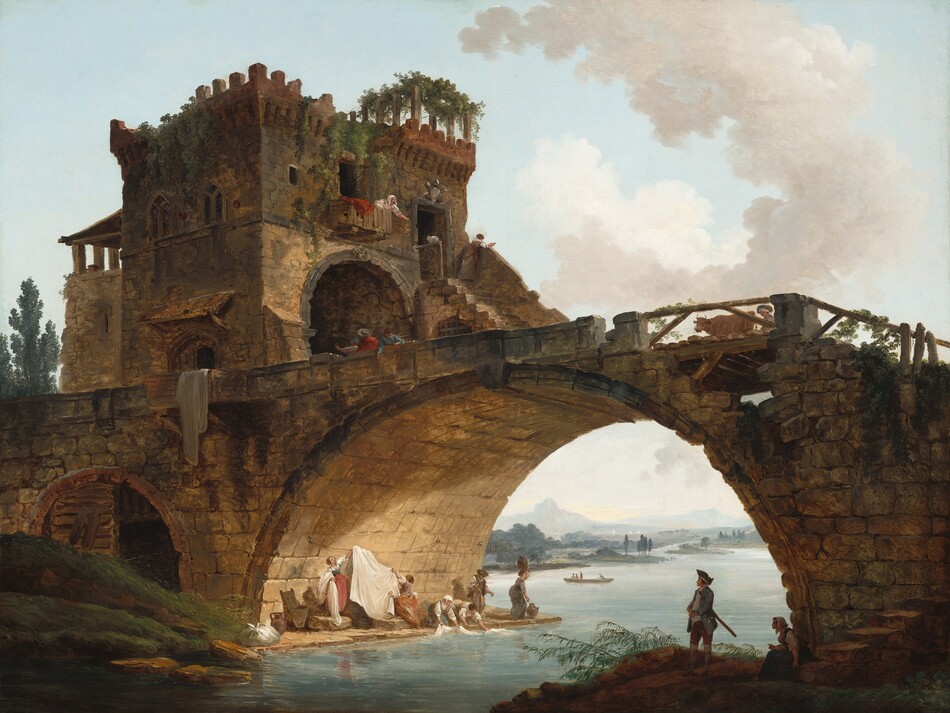
Exhibition: Hubert Robert, 1733–1808
Closed October 2, 2016

With some 50 paintings and 50 drawings, this monographic exhibition, is the first in more than 80 years to encompass Robert’s entire career and to survey his achievements as both a painter and a draftsman.

A rustic, arched, stone bridge spanning a shallow river nearly fills this horizontal landscape. From low to the ground, we look up into and through a large arch, which occupies the lower half of the picture and frames a view that opens to a wide expanse of calm, pale blue water, wooded green riverbanks, and a misty, distant view of a village and a mountain. The horizon line comes a quarter of the way up the painting, and a smoke-colored cloud formation curves like a backward C against the ice-blue sky above. The bridge structure is made from stacked, sandstone-colored stone blocks to form heavy piers. Vegetation grows on the crumbing bridge and gaps indicate other stones are missing. The bridge’s deck runs across the center of the painting, rising slightly from left to right. Atop it, occupying the top left quadrant of the painting, sits a square stone two-story tower that encloses an arched passage over the bridge’s roadway. Groups of people, small in scale, are positioned on and around the bridge. At the river level, on a platform around a bridge footing, four women do laundry. Two pull sheets from the water and two bend on their knees to wash the linens in the river. They wear long skirts of slate blue, cranberry red, and ochre yellow with pinafores and white blouses rolled up to the elbows, with their hair pinned up. A bearded man in brown trousers, white shirt, and brown hat appears to talk to them. Another woman standing nearby in a dark, slate-gray dress balances a large, dark brown ceramic ewer on her head and reaches to pick up another resting at her feet. Warm yellow light illuminates this scene and the underside of the bridge, and reflects on the river. On the bridge deck above, a brown steer is herded across the bridge by a person wearing a wide brown hat, while three people in red, slate-blue, and white clothing are about to pass through the tower passage on the left. Immediately above them, a woman in a white blouse and head scarf appears at a small balcony with what looks like a red dress draped over it and gestures with an extended arm toward a white cat crouched on a railing below. Another woman to our right, in a brown dress, white blouse, and brown hair, stands at the top of a flight of steps leading up the far side of the tower with her back toward us, and she gazes out at the view. On the water below, a small boat with several people is rowed across the river in the middle distance. In a shadowed area at the foot of the bridge, closer to us, a man stands wearing a pointed hat, blue jacket with buttons, and high boots with a sword tucked under his arm. Behind him, a woman in a dark green dress and kerchief sits on a stone step. Both look toward the scene under the bridge with the washerwomen.
In Celebration of Paul Mellon
Closed September 18, 2016
This drawing is a portrait showing the upper half of a woman's body. She is positioned facing us, her head turned slightly to the right. Her facial features include pale skin, blue eyes, thin eyebrows, a long nose, and pink lips in a calm expression. Her brown hair is partially hidden under a large, black, feathered hat. She is dressed in a light blue outfit with puffed sleeves and a high collar with black trim. The background is a simple, muted grayish-brown color.

Loading Results