Past Exhibitions

Learn about past exhibitions going back as far as 1941 when the National Gallery of Art first opened to the public.

Filter Results

1222 results found

Results

Shock of the News
Closed January 27, 2013
John Cage: Rocks, Paper, Fire
Closed September 16, 2012

Featuring six prints from the Gallery's collection, this exhibition explores Cage’s experimental approach to creating visual art. The selection of prints highlights his unconventional utilization of fire as a printmaking medium and his systematic employment of stones as templates for tracing.

The image includes circular shapes and brushstroke lines arranged in a seemingly random manner. The abstract composition features colors like blue, brown, red, and yellow, with some shapes resembling overlapping rings or loops. The scattered arrangement of elements may evoke a playful jumble of bubbles or soap suds. The soft, muted background contrasts with the defined, colorful shapes in the foreground, enhancing the abstract nature of the piece.
Elegance and Refinement: The Still-Life Paintings of Willem van Aelst
Closed October 14, 2012

The first exhibition devoted solely to Willem van Aelst brings together 28 paintings and his only known drawing. His renowned still lifes are remarkable for their fine finish, carefully balanced composition, jewel-toned palette, and elegant subject matter.

Two roosters, a rabbit, and three small birds hang from the top of this vertical still life painting, so the heads of one white rooster and the rabbit come to rest on a dark stone ledge, about a third of the way up the composition. To our left, the tawny-brown rabbit’s nose faces us as the head rests on an azure-blue purse with silver lining. A pair of scissors is tucked behind the strap, which falls down over the ledge. To our right, the head of the rooster curves away with its red coxcomb coming toward us. A black fly rests on the rooster’s comb. The black tail feathers of another rooster arc out behind it, near the upper right corner of the painting. In front of the rabbit's bound, hind legs is a small bird with puffed, silvery-gray feathers, and one black leg tied up with a dark cord. To our left are two more small birds, one with gray, cream, and tan feathers, the other with cream, golden orange, and lapis blue. These two are secured with their beaks pointing upward. Two white and scarlet-red caps, falcon’s hoods, are strung up by white ribbon near the pair of birds. Below the ledge is a carved scene with nude or nearly nude people, but this area is mostly in shadow. Behind the animals is a dark, nearly black wall.
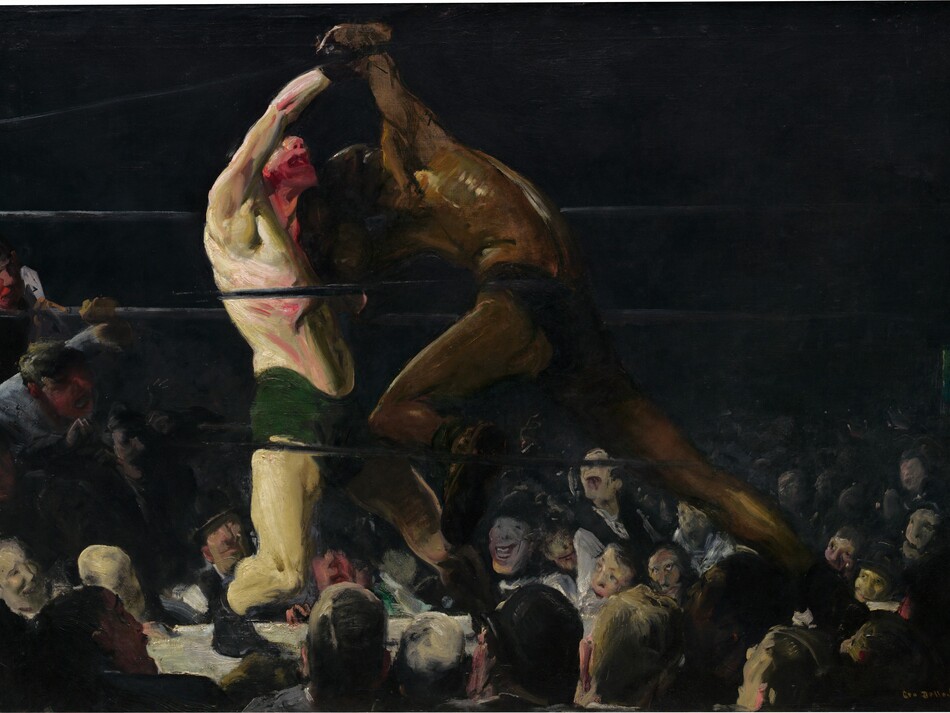
Exhibition: George Bellows
Closed October 8, 2012
From a darkened arena around a boxing ring, we look up at two bare chested men, one with pale, white skin and the other with brown skin, who lock arms in a boxing match in this horizontal painting. The brushstrokes are loose and visible throughout, making some details difficult to make out. The boxer to our left wears drooping, forest-green trunks and black shoes. He leans back on his bent right leg, closer to us, and tilts his face up. His mouth gapes open and his nose, chin, and neck are smeared with scarlet red, suggesting blood. His pale skin has a green cast, and his chest, arms, and legs are sinewy and muscular. His right arm is raised or pulled up overhead by the boxer to our right. Wearing dark briefs, the second boxer hunches over with head lowered toward the other man’s shoulder. He surges forward onto his deeply bent left knee, closer to us, pushing powerfully off his back leg. His face is lost in shadow and his body has less detail than his opponent, though light glints off his arching back to create gold highlights against his brown skin along his spine, ribs, and muscles of the shoulder. The men’s bodies nearly span the height of the canvas. The black ropes of the boxing ring pass in front of and behind the boxers, and the space around the ring in the top half of the painting is nearly black. Heads and faces of the spectators in the first few rows are lit by the main event and are crowded into the bottom third of the painting. Two spectators on our far left have climbed up and lean on and through the ropes, their mouths open. The crowd, which appears to be all light-skinned men and boys, are painted loosely but their mouths widen in toothy grins or are agape. The artist signed the work in yellow letters against black in the lower right corner: “Geo Bellows.”
In The Tower: Barnett Newman
Closed February 24, 2013

This exhibition presents two crucial periods in Newman’s career. His paintings and drawings of the 1940s reveal a shift from biomorphic imagery to simple linear forms, while The Stations of the Cross, a cycle of 14 paintings plus a coda (Be II), dominated his mature career from 1958 to 1966.

Two black bands span the height of this vertical canvas against a field of white mottled with shades of ivory, bone, and parchment in this abstract painting. A narrow, solid black stripe lines the left edge of the canvas, like the spine of a book. About a quarter of the way in from the right edge, black paint swirls and wafts like smoke on either side of a narrow white stripe the same color as the background. The artist signed and dated the painting in black paint in the lower right corner of the canvas: “Barnett Newman 1958.”
Deacon Peckham's Hobby Horse
Closed October 28, 2012
Two children with pale, peachy skin stand and sit on a rocking horse in a wallpapered interior in this square painting. Both children have short, honey-brown hair, high foreheads, dark blue eyes, and small, rounded noses. Their cheeks are smooth and the corners of their thin, pale pink lips curl slightly up. Both wear dresses with puffy, elbow-length sleeves, white collars, calf-length skirts, and wide, white pantaloons over white stockings. At the center of the composition, one child sits astride the rocking horse, which faces our right in profile. The skirt of the forest-green dress splits at the waist to fall open on either side of a white garment underneath. That child’s head turns back over one shoulder to look down and to our left. One black shoe rests in a stirrup, and the child holds a riding crop in one hand. The horse is dappled with fawn brown and white, and has a parchment-brown mane and tail. The horse’s eye we can see is black and its red mouth is open around the bridle and reins. The second child stands at the back of the rocking horse, hands resting on the crossbar that connects the toy's long, curving rockers. That child wears a crimson-red dress and holds the red ribbon of a straw bonnet in one hand. The hair is parted down the middle and that child looks at us. A black cap with a curved, shiny visor and tassels hanging from the crown rests on the base of the rocking horse. The rug has a stylized, terracotta-orange floral pattern against a pine-green background. The wall behind the children is striped with wide bands of golden yellow and moss green. A door with a gold-colored doorknob is swung inward to our left, behind the child in red, to reveal the profile of a staircase beyond. To our right, just behind the horse’s head, a wooden table is draped with a cloth patterned with vines and leaves in dark green against a pea-green background. A lamp with a tall, spindly brass base is topped with a squat, round white globe. A folded newspaper behind the child in green could rest on the table, or could be held by that child. An inscription on the masthead of the paper begins, “Dai.”
Joan Miró: The Ladder of Escape
Closed August 12, 2012

Through some 120 paintings, drawings, sculptures, and prints from a career spanning almost a century, the exhibition reveals a politically engaged side to Miró's work, including his passionate response to one of the most turbulent periods in European history as well as his sense of Spanish—specifically Catalan—identity.

Two angular, cream-white buildings flanking a central, stylized tree are surrounded by brown soil, small animals, and farmhouse objects like watering cans and buckets beneath a clear, azure-blue sky in this square landscape painting. We look straight onto the buildings and slightly down onto the earth in front of us. About a third of the way up the composition, the horizon is lined with trees and mountains in the deep distance. The long, spindly branches of the central tree nearly reach the top edge of the painting and abstracted, sickle-shaped leaves are silhouetted against the sky so no leaves overlap. The far edge of the whitewashed structure to our left is cropped. The façade is pierced by two small rectangular windows and an arched hatch at the top under a winch. The back end of a horse is visible through an open door at the bottom center. Horizontal bands in front of the building suggest furrows in plowed earth, and a single stalk of corn grows up into the scene, seeming close to us. A pen protected by netting stretches out in front of the second structure, to our right of center. That wood-frame building has a triangular peaked roof, and the left half is open, like a lean-to. A goat, rooster, birds, and several rabbits occupy the pen. Watering cans, buckets and pails, a hoe, newspaper, lizard, and snail are spaced around the buildings. A tiny stylized person, perhaps a baby, appears in the distance between the buildings near a well where a woman works. A covered wagon, a round mill, trees, and plants fill the rest of the space between the buildings. A disk-like moon hangs in the sky to the right of the tree. The artist signed and dated the lower left corner, "Miro. 1921-22."
Colorful Realm: Japanese Bird-and-Flower Paintings by Itō Jakuchū (1716–1800)
Closed April 29, 2012

Celebrating the centennial of Japan's gift of cherry trees to the nation's capital, this exhibition features one of Japan's most renowned cultural treasures, the 30-scroll set of bird-and-flower paintings by Itō Jakuchū.

Loading Results