


The Exceptional Emotion of Artemisia Gentileschi’s "Mary Magdalene in Ecstasy"
One of the Italian baroque painter’s finest works recently joined our collection.

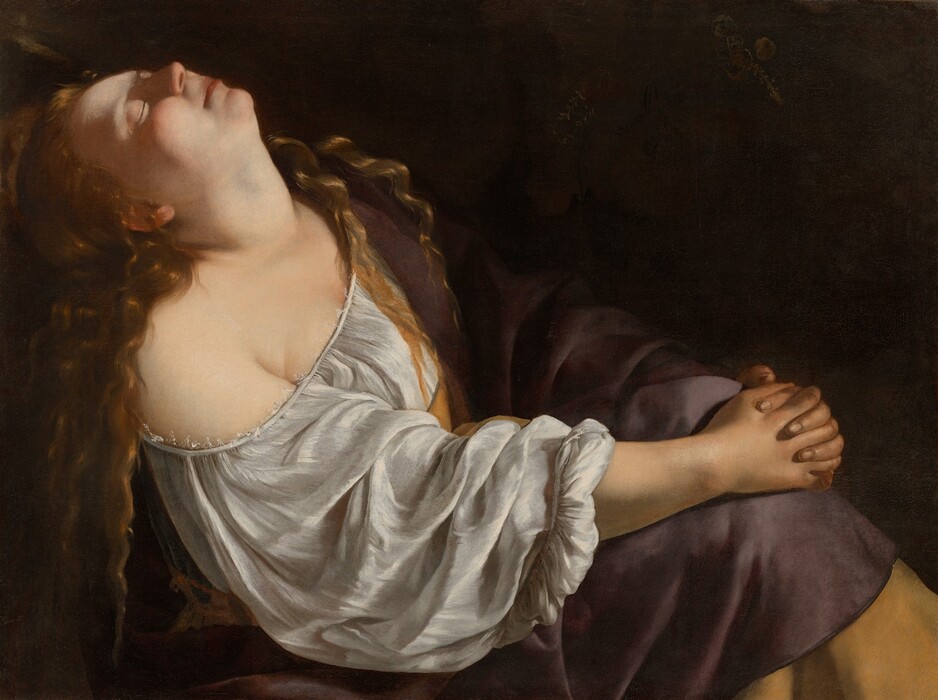
Visitors admire Artemisia Gentileschi's Mary Magdalene in Ecstasy in gallery 29 on the West Building's Main Floor.
The mystery of Artemisia Gentileschi’s Mary Magdalene in Ecstasy began with a black-and-white photograph. Until scholar Gianni Papi’s discovery of that photograph in an archive in Siena, Italy, in 2011, the painting had disappeared from public record. Soon after, the real thing—even more captivating in color and full scale—surfaced in a family’s collection in southern France, where it had been held for centuries.
That painting, considered one of the Italian artist’s most significant works, now hangs in our West Building. Beyond the story of its remarkable rediscovery, the canvas shows the 17th-century painter Artemisia Gentileschi at the pinnacle of her powers as an artist.
Artemisia Gentileschi’s Return to Rome
Somewhere around 400 years ago, circa 1625, Gentileschi lifted her brush from the canvas of Mary Magdalene in Ecstasy and decided she was done. In that moment, did she know what she had achieved? Did she consider it one of her finest works, as art historians would do centuries later?
A few years before that moment, Gentileschi had moved from Florence and resettled in Rome, where she had been born to Prudenzia di Ottaviano Montoni and the painter Orazio Gentileschi in 1593. She’d originally left Rome to further her profession and to secure the patronage of the powerful Medici family in Florence. She’d also escaped the city where she’d been sexually assaulted by the artist Agostino Tassi in 1611 and where she was later subjected to a humiliating public trial.

Artemisia Gentileschi, Self-Portrait as the Allegory of Painting (La Pittura), c.1638–1639, oil on canvas, Royal Collection Trust
In a letter, she assured Cosimo II de Medici, the grand duke of Tuscany and her patron in Florence, that she would be in Rome for only a few months to settle some family business. In the end, she stayed six or seven years. The reason Gentileschi returned (at least in part) was to secure the second half of her dowry from her father. She may have feared he had learned that she and her husband, Pierantonio Stiattesi, had been living apart. If so, Orazio might not have made good on the marriage contract’s promise to pay the remainder of the dowry in 1620. She and Pierantonio needed the dowry to survive—it equaled several years’ worth of work.
The ever-resilient Gentileschi soon settled back into life in Rome. Even though her hurried departure from Florence alienated her from her primary patron, she quickly cultivated new clients. As she worked through their commissions, Gentileschi reached the height of her artistic abilities. She used a highly saturated palette to paint boldly expressive figures, reaching the zenith of her narrative and expressive potential. Few paintings represent that peak better than Mary Magdalene in Ecstasy.
The Inescapable Ecstasy
The painting focuses on Mary Magdalene, a follower of Christ who witnessed both his crucifixion and resurrection. According to legend, Mary spent the end of her life in a cave in France. Pictured here is the moment of her conversion from her worldly life to a devout and chaste follower of Christianity, in this instance, Catholicism.

Artemisia Gentileschi, St. Mary Magdalen, c. 1620, oil on canvas, Pitti Palace, Le Gallerie Degli Uffizi
Artemisia Gentileschi painted several versions of this moment. In most of them Mary Magdalene is seated in a chair, clutching her chest with her eyes raised to the heavens. In other works she rests her head on her hand as if she’s dozed off. She’s often surrounded by signs of the life she left behind. An alabaster ointment jar represents the oil she rubbed on Christ’s feet before drying them with her hair.
The painting echoes a 1606 work by Caravaggio (now lost but known through copies). Gentileschi admired Caravaggio and studied his works. While she was back in Rome, she may have revisited his many paintings on view throughout the city.

Attributed to Caravaggio, Mary Magdalen in Ecstasy, 1606, oil on canvas, private collection
In his version, Caravaggio similarly set Mary Magdalene against a dark background with her eyes partially closed, head lolling back, and fingers clasped in front of her. But Gentileschi’s version confronts us even more directly. She chose a horizontal composition, so more of the figure is shown. And she brought us even closer into the scene. She placed the Magdalene against the picture plane, with only a small fold of her cloak separating our space from hers. As viewers, we have nowhere to look but at her, absorbed in this intimate spiritual moment.
Artemisia Gentileschi at the National Gallery
While paintings by Artemisia’s father, Orazio Gentileschi, have been in the National Gallery for some 65 years, this is the first major work by her to enter our collection. Its acquisition is momentous not just as the first work by this influential 17th-century artist, or because it’s one of only about 60 accepted canvases by her, but because it’s one of her best paintings. It stands out in Gentileschi’s body of work for its embodied energy and for the artist’s ability to depict a figure undergoing profound change in such an intimate and direct way. We cannot help but become emotionally engaged in the act.
Sure to be a star among our holdings of Italian baroque paintings, Mary Magdalene in Ecstasy will inspire numerous research projects. Now on view in our West Building galleries alongside her father’s work, Artemisia Gentileschi’s painting holds a pride of place. “Her painting is surrounded by works by her father, but I’m giving her the center of the room,” says Eve Straussman-Pflanzer, curator and head of Italian and Spanish paintings.
You may also like
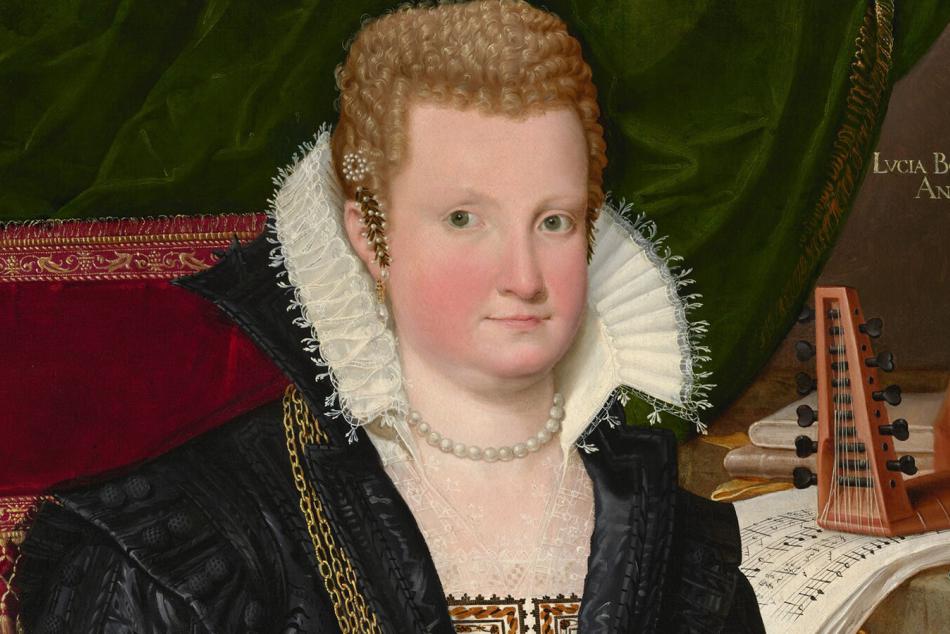
Article: Lavinia Fontana and Lucia Bonasoni Garzoni: Talented 16th-Century Women
Author and art historian Katy Hessel tells the story of these Great Women Artists.
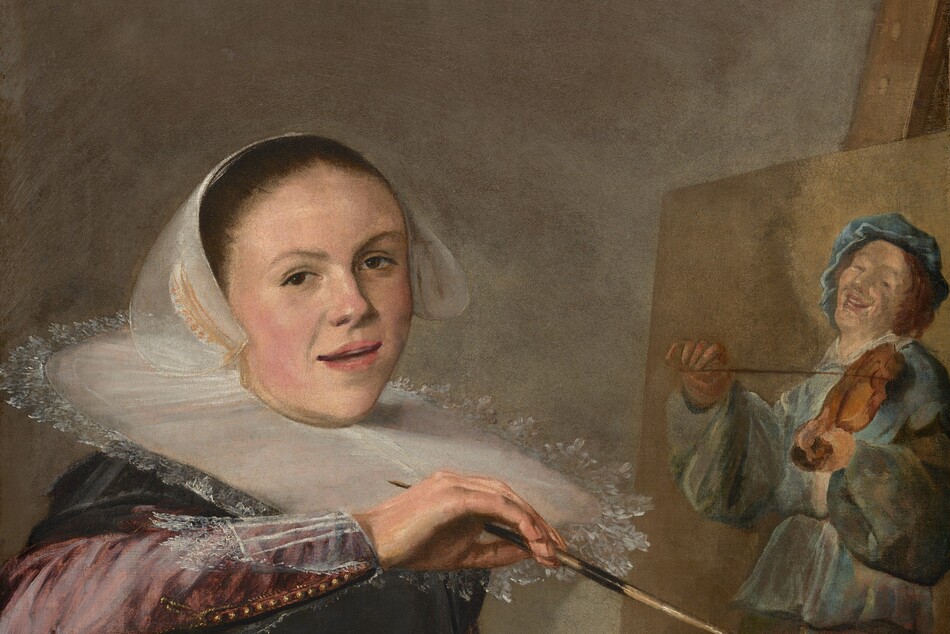
Interactive Article: Art up Close: Judith Leyster, the Leading Star of Her Time
Her paintings were passed off as the works of her male contemporaries. Get to know 17th century painter Judith Leyster through the hidden details of her lively self-portrait.