


Painter George A. Morton Transcends Tradition

When artist George Anthony Morton describes painters of the past—Rembrandt, Velázquez, Sargent—you might think he’s talking about a secret society. To Morton, these greats share a knowledge that can only be tapped through sustained looking and master copying, a traditional method of study in which artists attempt to replicate a “master’s” painting. If artists hone these skills, they can learn the society’s secrets. Such initiation comes with a duty. “Now you're part of the gang, and you can't let them down,” says Morton. “You’ve got to bring something that adds to that discourse, because it's a discourse that pre-existed you, it pre-existed them, and it's going to go on way beyond our lifetimes.”
The Atlanta-based painter takes this responsibility seriously. Morton shares these processes by teaching at the Florence Academy of Art in New Jersey, at his own Atelier South workshop in Atlanta, his More Light nonprofit across the country, and through his recent For Freedoms residency as part of a Corcoran/National Gallery partnership in Washington, DC. And while he acknowledges the privilege of his membership in this secret society, it doesn’t keep him from pushing against tradition. “I think we’ve got to redefine what [tradition] is,” Morton suggests. He wants to expand academic training to include the study of a range of features and subjects. “This is just an aspect of tradition that is untapped.”
Morton’s Beginnings
While Morton has been interested in art since he was a child, he describes a visit to the Nelson-Atkins Museum of Art in Kansas City when he was a teenager as the origin of his professional practice. A math teacher Morton had met while in a juvenile detention facility invited him to visit the museum after he got out. Walking through the museum’s halls in 1999, Morton came face to face with a young man around his age. He stopped in his tracks. The boy in the portrait was painted around 1662, likely in Amsterdam. Despite the centuries and continents between them, something about the figure felt “real and solid and familiar” to Morton. He immediately wondered, “Who did that?” The answer was Rembrandt van Rijn. “I knew right then I wanted to paint like that.”

This portrait by Rembrandt first inspired Morton to pursue a career as an artist.
Rembrandt van Rijn, Young Man in a Black Beret, ca. 1662, oil on canvas, Nelson-Atkins Museum of Art, Purchase: William Rockhill Nelson Trust

Morton paints a copy of Young Man in a Black Beret at the Nelson-Atkins Museum of Art in 2019.
Photo by Don Yaworski.
Morton is now a Rembrandt superfan, calling him “the best artist that ever lived.” He never gave up on his dream of becoming a professional artist since his first encounter with Rembrandt, even during the nearly 10 years he spent in a federal prison for drug charges. He continued to paint and learn while incarcerated. Shortly after his release he dove into studies at the Florence Academy of Art in the United States and Italy. Through a classical curriculum modeled after 19th-century European academies, Morton learned their traditional principles of painting. He refined his technique the same way artists did centuries ago—by drawing from plaster-cast sculptures and by copying paintings. A star of his classes, he became the first African American graduate of the academy. Morton is currently exploring an advisory role with the Florence Academy of Art and hopes to develop pathways for students from historically Black colleges and universities (HBCUs) to access training in Florence, Italy.

George Anthony Morton, Dash, charcoal on paper, courtesy of the artist
The Secrets of the Greats
Morton isn’t searching for Vermeer’s forgotten recipe for a mix of pigments or the particular way Velázquez held a brush. “It's more than just studying their methods. It's also studying how they saw things,” he says. Sustained looking helps him understand the artist’s vision as much as the artist’s hand. “The more often you return, the more you see.” And what does he see when he tries to look through their eyes? Sometimes it’s the other artists who inspired them. But usually they direct his attention to nature. They encourage him to learn the absolutes or principles of design visible in the world. In Master of Light, the 2022 documentary about his life that he cocreated with Rosa Ruth Boesten, Morton described his art as an attempt to “anchor on to the infinity that is nature.” That’s an ambitious task.
“It's more than just studying their methods. It's also studying how they saw things."
George A. Morton
Looking to nature also reveals the constraints of the traditions Morton has inherited. Models for academic training have long been classical sculptures or European paintings. Morton finds that limiting. “There's just so many other groups of people that have different proportions and are worth studying,” he notes.
A 2024 project revolved around Henry Ossawa Tanner’s painting The Thankful Poor. Not only did Morton copy the original while it was on loan to both the Akron Art Museum and the Metropolitan Museum of Art, but he also led the process of painting a mural inspired by the work in the Philadelphia neighborhood where Tanner once lived.

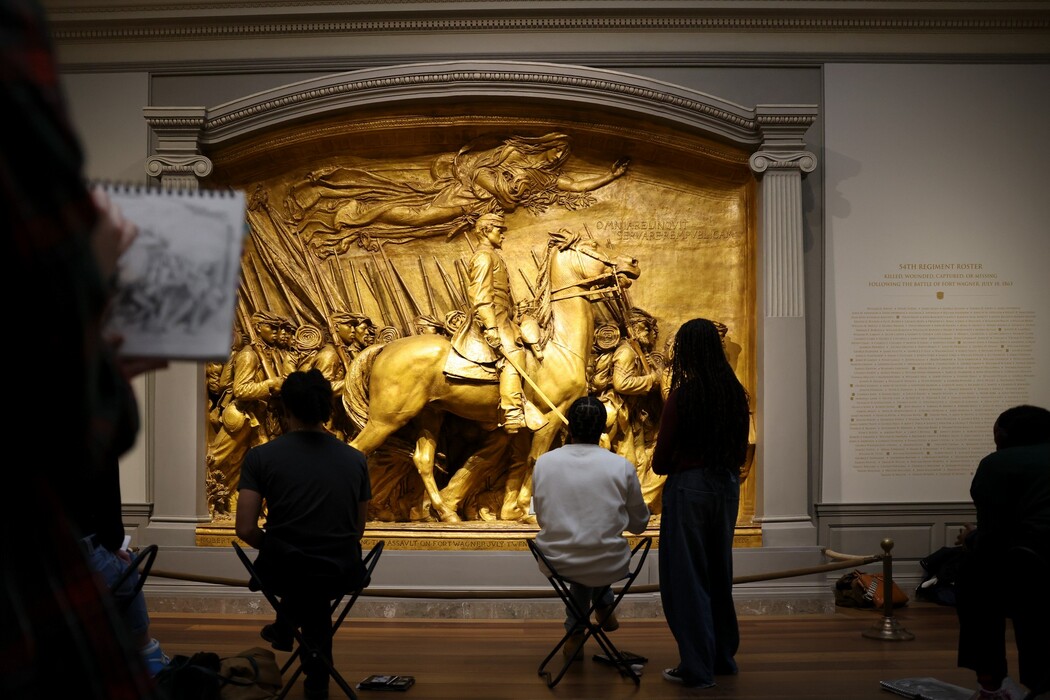
Morton speaks to students in front of Augustus Saint-Gaudens’ The Shaw 54th Regiment Memorial. The workshop was part of his For Freedoms residency through a Corcoran/National Gallery partnership.

The artist sketched a plaster study that Saint-Gaudens used to create the monumental sculpture.
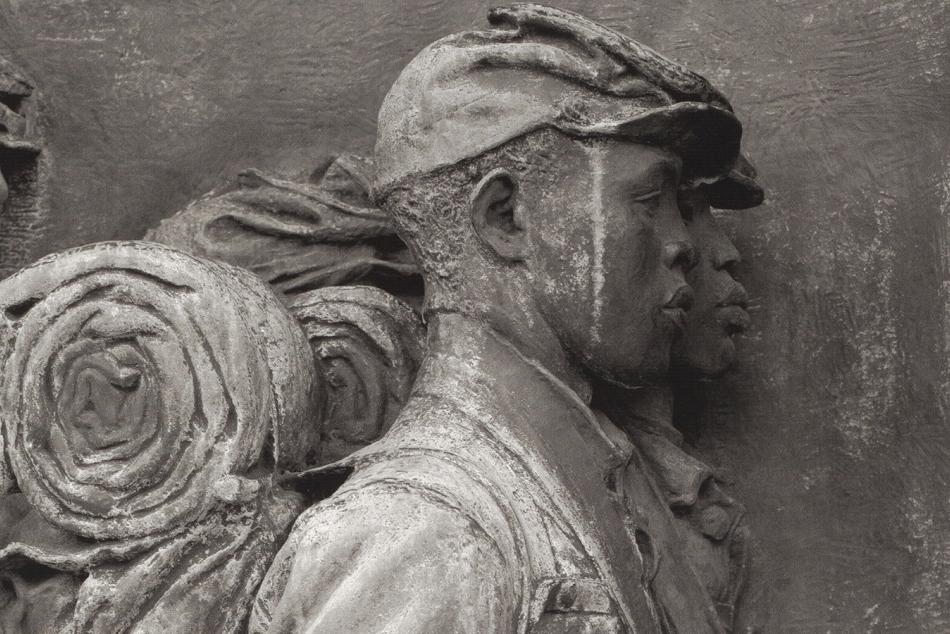
For his For Freedoms residency at the National Gallery and GW Corcoran School of the Arts & Design, Morton focused on The Shaw 54th Regiment Memorial by Augustus Saint-Gaudens. The sculpture of Colonel Robert Gould Shaw and the men of the 54th Massachusetts, one of the first Civil War regiments of African Americans enlisted in the North, features more than a dozen figures. Saint-Gaudens modeled each profile after an actual person. Spending time with the sculpture attuned Morton to how the sculptor captured their unique features. He points to a figure with a clenched jaw, as if he’s gritting his teeth. Another looks like he hasn’t used a razor in months. Saint-Gaudens was “. . .really celebrating their humanity and individuality,” says Morton.
Back in the classroom, Saint-Gaudens’ plaster studies of the soldier’s heads also served as inspiration. In collaboration with the Saint-Gaudens National Historical Park, Morton worked with photographers at the National Gallery and students at the GW Corcoran to print three-dimensional models of the plaster studies, which they then sketched. Nearly a century and a half after the unnamed Black models first posed for Saint-Gaudens, students studied their features anew.
Passing on the Secrets
Morton pursued teaching to continue learning: “I knew I needed more time.” And while his interactions with students make clear how much they benefit from his instruction, Morton sees the experience as mutually beneficial. “I really believe that one person teaches, two people learn.” Looking at and studying artworks alongside others focuses his eyes on details he might not have noticed before. Teaching has also shaped how Morton thinks about who has access to this kind of training. He expanded the work of his atelier with More Light, a nonprofit that provides classical art training to those who historically have been excluded from its methods. Working within correctional settings, HBCUs, and museums, the project fuses traditional teaching methods with trauma-informed instruction to build creative skills and emotional resilience. Morton hopes to show participants “that mastery and healing can exist in the same breath.”
For the artist, creating in the company of the greats and learning to see through their eyes isn’t an escape. It’s a way of reaching into the past and pulling their work into the present—and then imagining what might come next.

You may also like
Article: Remembering Private Alexander Howard Johnson
What do we know about the soldier who inspired the drummer in Augustus Saint-Gaudens’s The Shaw 54th Regiment Memorial?

Article: The Appalachian Artist Making His Own Opportunities
Robby Moore channels Appalachian resourcefulness to create found object assemblages and community art spaces, opening the doors for young artists in his region.