French Sculptures

Filter Results

171 artworks on view.

Results

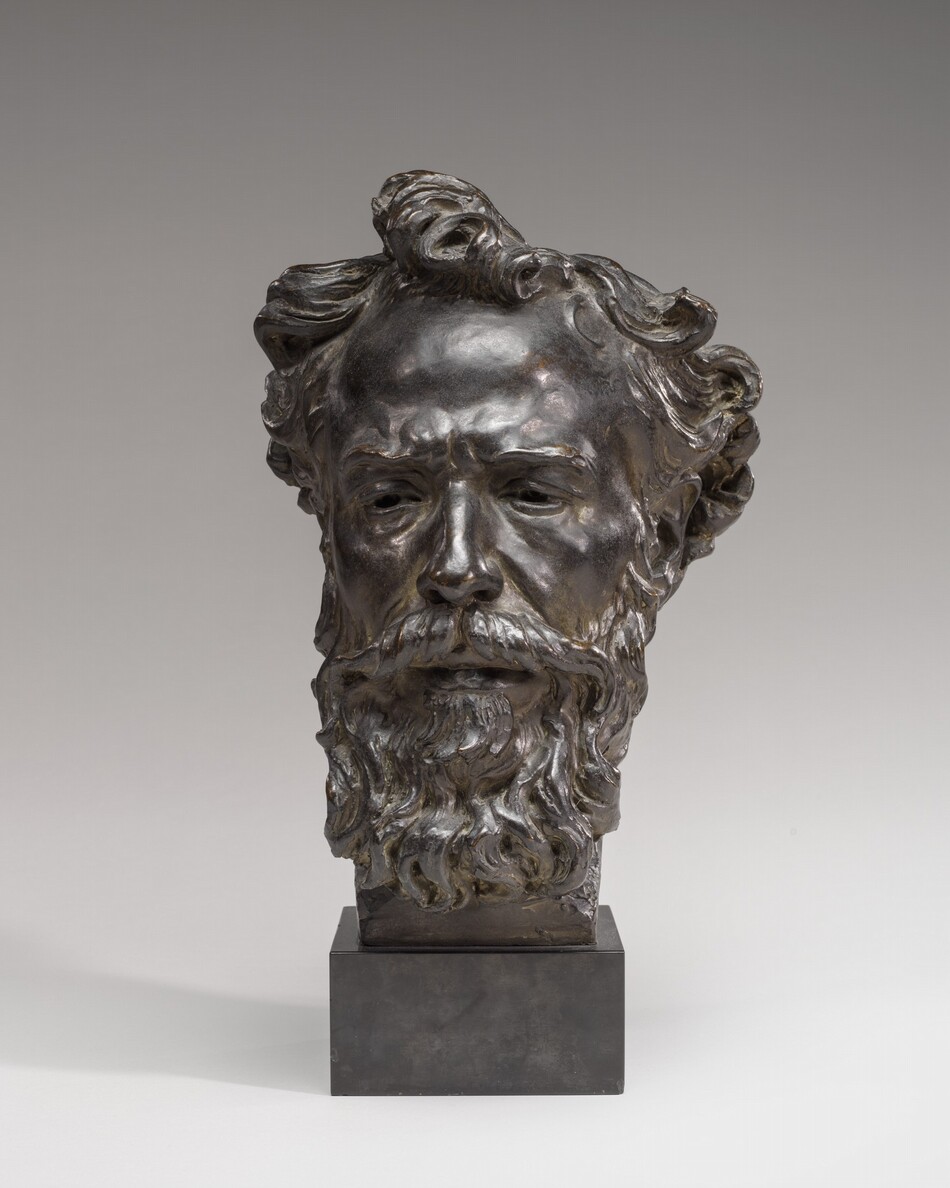
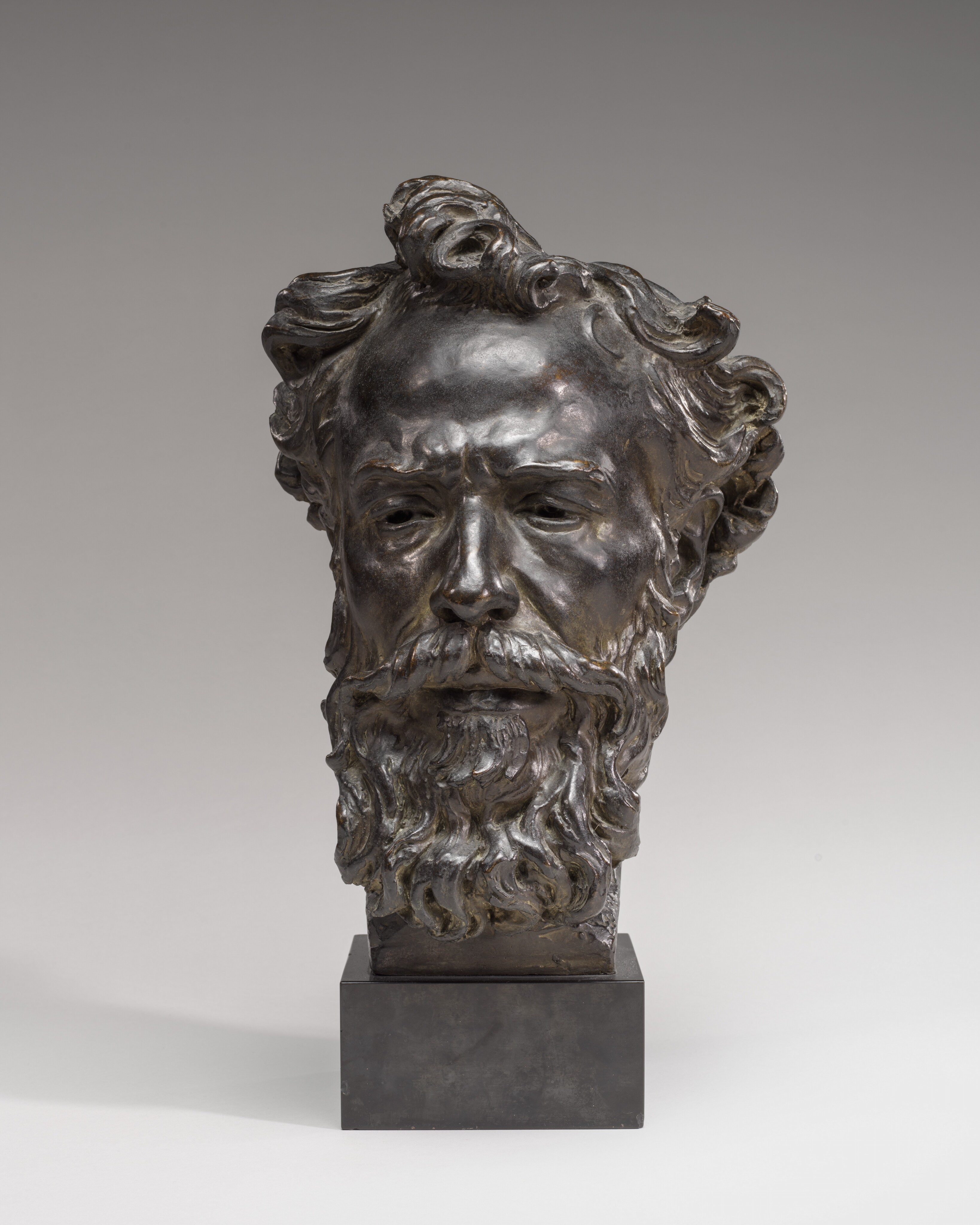
The sculpture shows the head of a man with wavy hair, a full beard, and mustache. It is made of bronze, giving it a dark metallic color with a slight sheen. The details highlight the texture of the hair and beard intricately. The man's expression includes slightly furrowed brows and closed lips. The bust is on a rectangular base.

Alphonse Legros

Aimé-Jules Dalou

model c. 1876, cast possibly 1879/1920

Bronze  Accession ID  1956.14.2

On View: West Building Ground Floor, Gallery G2
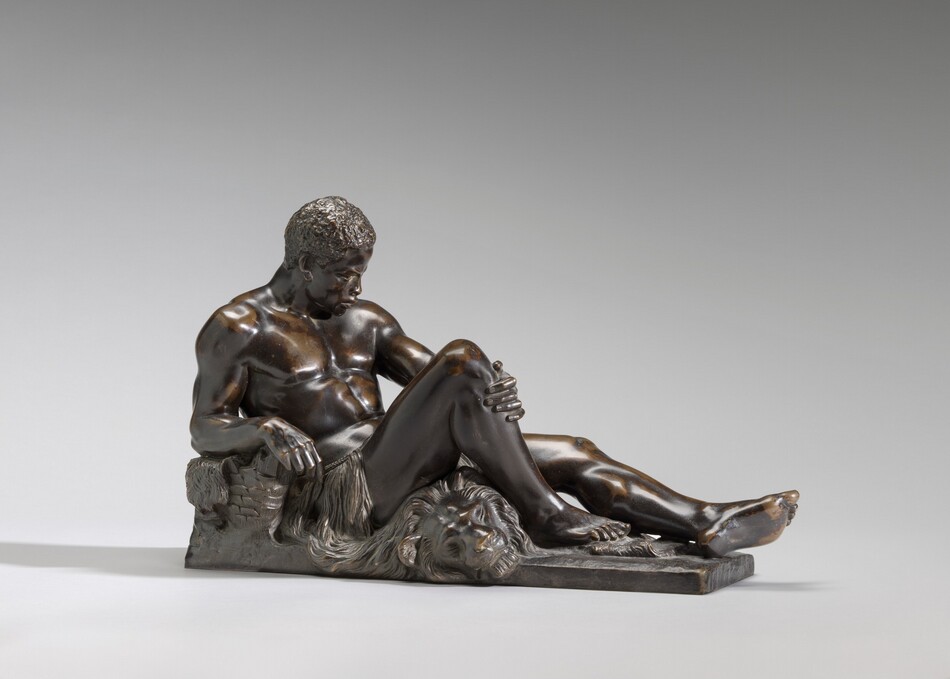
A muscular, nearly nude Black man reclines on a lion’s skin in this freestanding bronze sculpture. In this photograph, his head is to our left and his feet extend to our right. His face tips down, and he has short, curly hair, a furrowed brow, and a small, rounded nose. His full lips are closed, and he has hollows in his cheeks. He leans onto his right elbow, closer to us, which rests on an object, perhaps a basket. His right knee is raised so that foot is flat on the ground. He clutches the bent leg just below the knee with his other hand, and his left leg stretches long. The lion’s head, with eyes closed, rests beneath the bent knee. Long fur, hair, or another material hangs from a rope around the man’s waist. He and the pelt rest on a narrow rectangular base. The dark patina of the bronze has been burnished or rubbed gold in some areas, especially along the ridges of the man’s muscles and on the extended foot.

Allegory of Africa

Frédéric-Auguste Bartholdi

model 1863/1865, cast date unknown

Bronze  Accession ID  1991.84.1

On View: West Building Ground Floor, Gallery G3
A hand cupping two nude people, which are significantly smaller in scale than the hand, rises from a rectangular base in this oatmeal-colored, free-standing plaster sculpture. The roughly textured base is angled away from us to our right, so we look into the hand holding the intertwined people with the well-defined thumb to our right. The woman’s body is curled in a U shape, with the back of her shoulders facing us. The man rests his head against her breast as they kiss, and he wraps both arms up around her head. His legs extend to our right, his knees bent and pressed together. His right hip nestles in the curve of the thumb. The area around the people is roughly textured while the hand and most of their bodies are polished smooth. The artist inscribed his name in the lower right corner of the base, “A Rodin.”

Hand of God

Auguste Rodin

model before 1898, cast by 1903

Plaster  Accession ID  2011.100.1

On View: West Building Ground Floor, Gallery G3
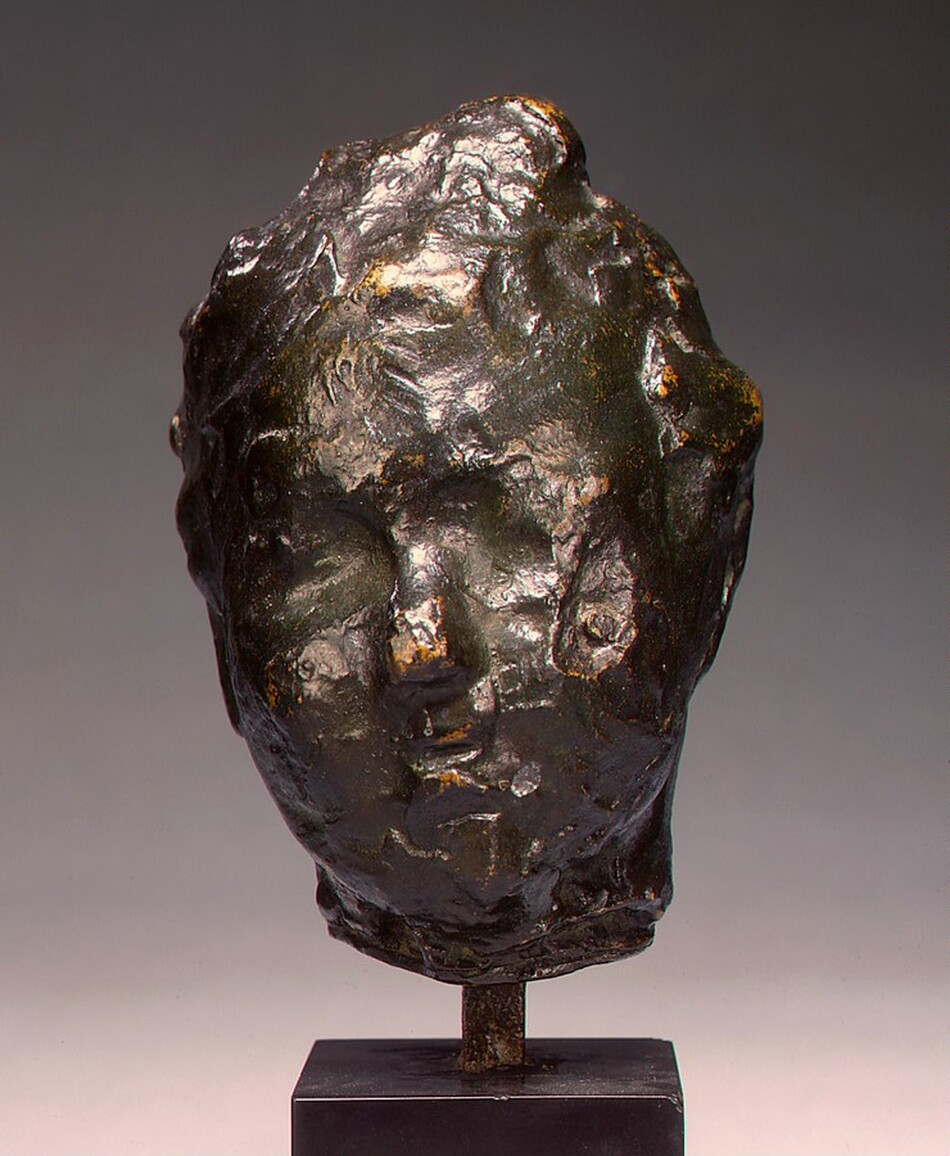
The sculpture depicts a rough, textured head with indistinct facial features. Its surface is dark with a glossy shine, appearing to be made of bronze or a similar metal. Viewed head-on, the sculpture presents a stylized and abstract form, with a sense of ruggedness in its execution. The features are not sharply defined, offering an impression of facial contours rather than detailed anatomy. The head sits upon a simple rectangular base that elevates it slightly, drawing attention to its form and texture against a neutral background.

Head, Study for a Portrait of Mme Salle

Edgar Degas

original clay c. 1892, cast 1920/1926

Copper alloy  Accession ID  1995.47.16

On View: West Building Ground Floor, Gallery G3
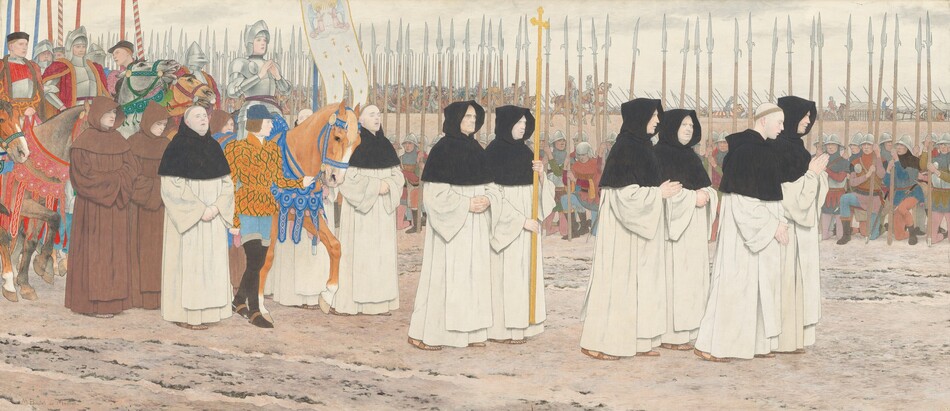
Two by two, monks wearing black and white, hooded robes lead a procession headed by an armored woman on horseback, Joan of Arc, on a rutted, sand-brown road in this horizontal painting. Most of the monks fold their hands at their waist, and the others tuck their hands into voluminous sleeves. One monk holds a tall gold cross and one a horizontal forked banner decorated with two angels. Another pair of monks in pecan-brown, hooded robes walk beside Joan’s butterscotch-brown horse. Joan wears a pale, silvery helmet and full armor, and she holds her fingertips together in prayer as she looks up. The horse has a brilliant blue saddle and collar. A young man wearing marigold orange, light blue, and black leads the horse by the bridle. More armored men on horseback behind Joan hold red, blue, or striped lances vertically by their sides. Dozens of men line the far side of the road, kneeling and holding up tall, blade-tipped halberds. Countless men on horseback line the horizon in the distance, which comes two-thirds of the way up the composition. The artist signed the painting in gray in the lower left, “M. Boutet de Monvel.” 

The Maid in Armor on Horseback (Joan of Arc series: III)

Louis Maurice Boutet de Monvel

c. 1908-late 1909

Oil and gold leaf on canvas  Accession ID  2015.19.36

On View: West Building Ground Floor, Gallery G4
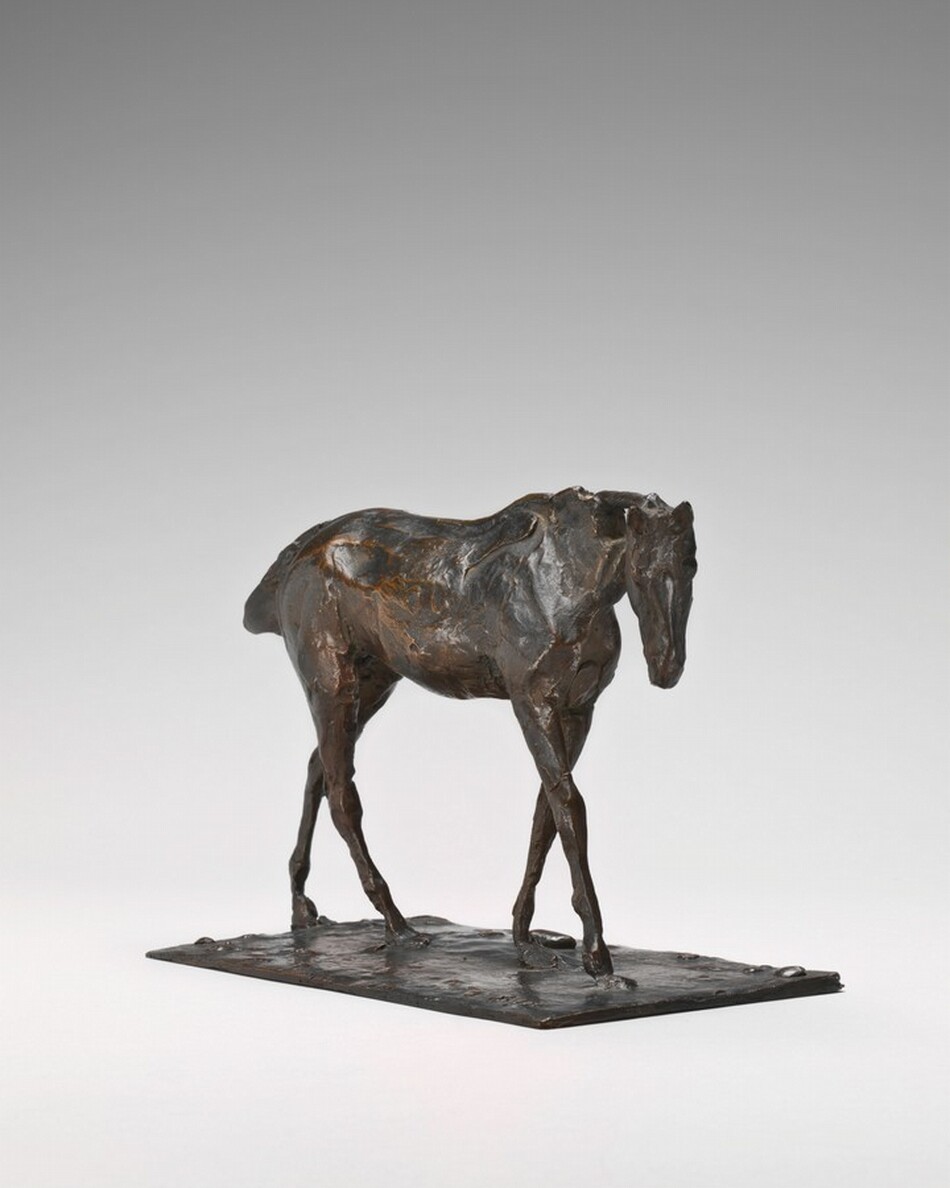
The sculpture depicts a horse in a walking stance. The figure is rendered in bronze. The surface is smooth with textured details. The proportions are life-like, with defined muscle tone and contours. The sculpture is mounted on a flat rectangular base.

Thoroughbred Horse Walking, Part of the Neck Missing

Edgar Degas

original wax early 1870s, cast c. 1920/1960s

Copper alloy  Accession ID  1999.79.39

On View: West Building Ground Floor, Gallery G4
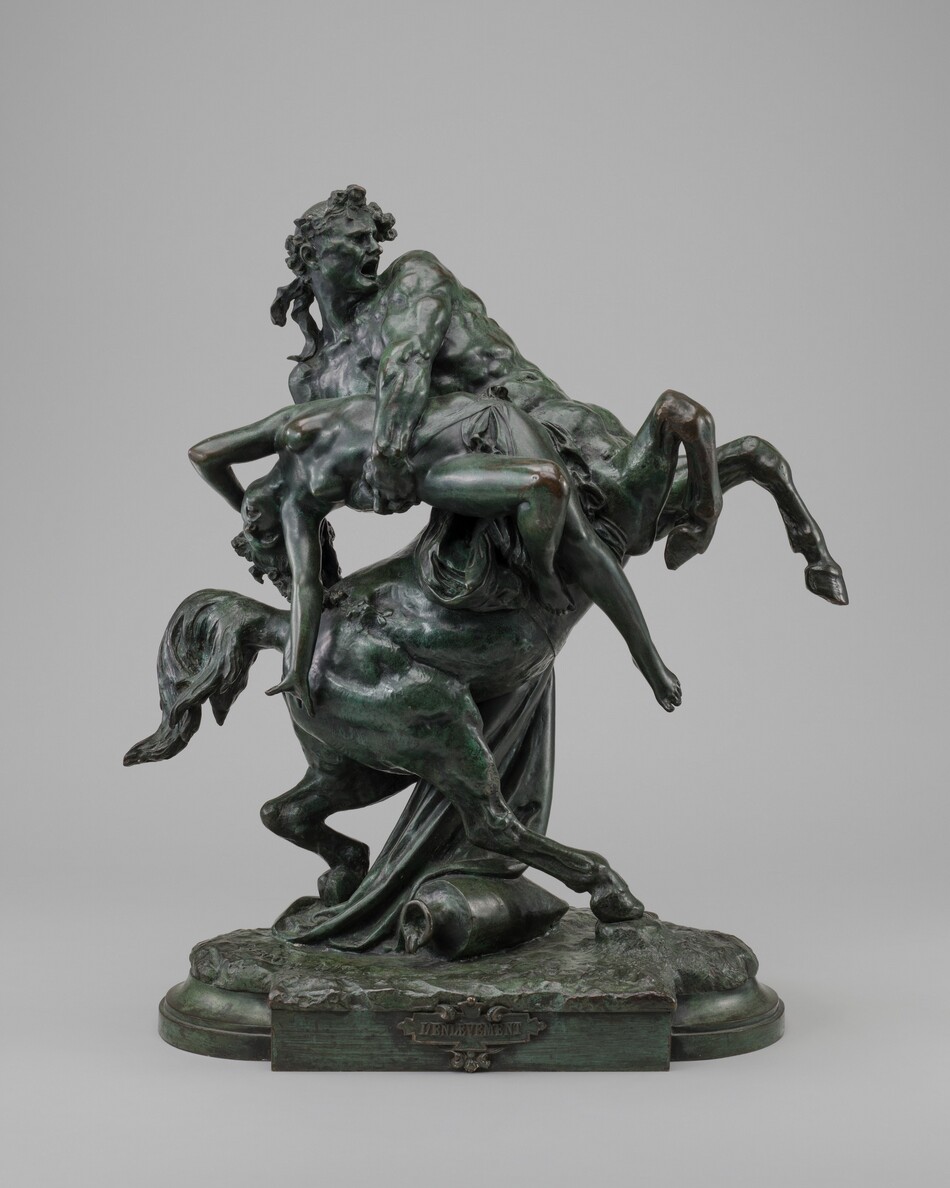
A centaur, a creature with a man’s torso and horse’s body, wraps both arms around a nearly nude woman who falls backward in this bronze, freestanding sculpture. In this photograph, the centaur faces our right with its front feet rearing up. His muscular torso leans to our left, and his mouth is wide open and brows deeply furrowed. A wreath of flowers is tied with a bow around his head, and he looks to the right. In his arms, the woman’s legs and arms fall back as she arcs away from him. One knee and one elbow are bent, and drapery covers only her groin. Her hair cascades onto the centaur’s rump, and her eyes and mouth are wide open. The centaur’s tail is lifted, and one back foot is planted forward, under the bulk of his body. The other leg is bent so the top of that hoof rests on a swath of fabric that falls down the far side of the pair. Water pours from an overturned urn onto a textured ground between the centaur’s feet. The cast base has molding and a plaque on the front reading, “L’ENLEVEMENT.” The bronze is shiny brown in some areas with a pine-green patina in other areas.

The Abduction of Hippodamia (L'Enlèvement d'Hippodamie)

Albert-Ernest Carrier-Belleuse, Auguste Rodin

model 1877/1879, cast after 1877

Bronze  Accession ID  1977.58.1

On View: West Building Ground Floor, Gallery G3
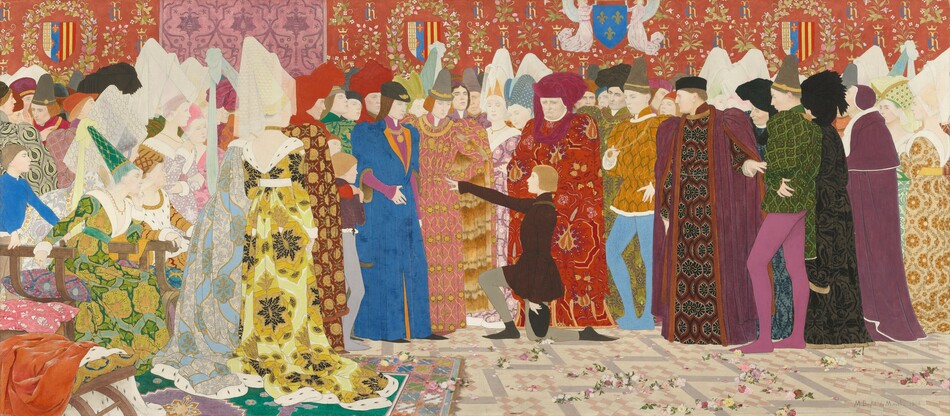
Dozens of people, all with pale peach skin, cluster tightly beyond a person kneeling at the center of this horizontal painting. The composition is filled from edge to edge with colorful patterns in the clothing, a wall-covering in the background, an area rug, and the tile floor, creating a collage-like effect. The men wear floor-length robes or tunics and stockings, and most wear hats or turbans. The women wear long, high-waisted dresses and tall, cone-shaped hats with veils or fabric draped from the peaks. Their garments are patterned in tones of burgundy, rust, and crimson red, forest and spring green, marigold orange, lemon and golden yellow, rose pink, and azure blue. The person kneeling at the center has chin-length blond hair, and wears a black, long-sleeved tunic, pointed black shoes, and gray stockings. That person faces our left in profile and raises a straight right arm to shoulder height, palm down and fingers extended, toward a standing man wearing a royal-blue robe to our left. Pale yellow, mauve-pink, and white flowers are strewn on the tiled floor in front of the crowd.

Her Appeal to the Dauphin (Joan of Arc series: II)

Louis Maurice Boutet de Monvel

1906

Oil and gold leaf on canvas  Accession ID  2015.19.35

On View: West Building Ground Floor, Gallery G4
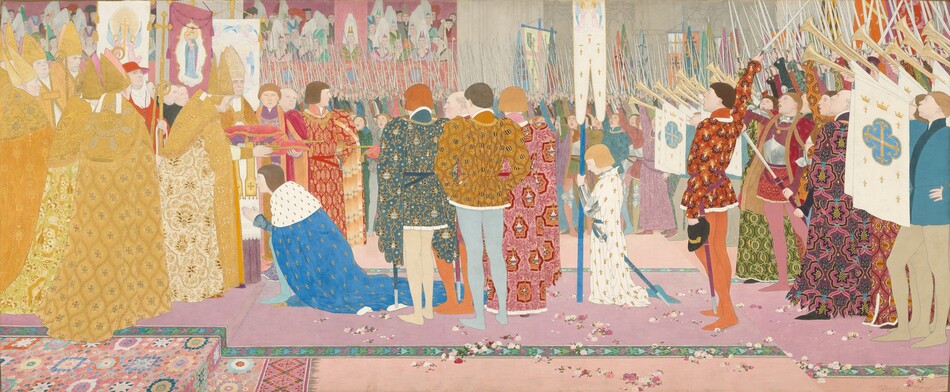
A wide hall or church space is filled with throngs of people focused on a young man kneeling in front of a clutch of clergymen in this horizontal painting. The people all have smooth, pale skin. Their clothing is intricately patterned with areas of vivid color, creating a collage-like effect. The ten clergymen stand on a low platform to our left. Most wear yellow and gold-colored vestments and conical, split mitre hats though one wears a scarlet-red robe and brimmed hat. The kneeling young man they face, the Dauphin, is draped in an azure-blue cloak adorned with gold fleur-de-lis and a shawl-length cape of black-speckled white ermine fur. He leans forward over one stockinged foot with his hands pressed together as the front bishop bends to gesture over him. Four men stand closer to us to our right of the Dauphin, their backs to us. A young person with chin-length blond hair kneels behind this group. A sword hangs at one hip and the head tips down, eyes closed. The arm we see is covered in shiny silver armor, and it holds up a blue standard. The fabric of the standard and of the person’s robe is white with gold fleur-de-lis. Another group of men stand to our right, also facing inward toward the Dauphin. Six of them lift their faces, their mouths open as if in song, as they pull swords out of sheaths or hold them overhead. White banners, also with gold fleur-de-lis and a gold cross against a sky-blue clover shape, hang from almost a dozen long, pale-gold horns being played, lifted high in the air, at the back of the group. The two groups of men wear tunics, robes, and stockings in cherry red, rose pink, fawn brown, burnt orange, harvest yellow, violet, or plum purple. Countless swords are also held aloft across the background against peach, celestial blue, pale yellow, and white standards. Ladies in mauve, seafoam green, petal pink, and taupe fill pink balconies in the upper left corner overlooking the scene. White veils flow from their tall, pointed hats. A heather-purple, narrow carpet scattered with flowers creates a runner leading up to the Dauphin and platform over a richly patterned floor beneath. The artist signed and dated the lower right, “M.Boutet de Monvel 1907.”

The Crowning at Rheims of the Dauphin (Joan of Arc series: V)

Louis Maurice Boutet de Monvel

1907

Oil and gold leaf on canvas  Accession ID  2015.19.38

On View: West Building Ground Floor, Gallery G4
A young blond person stands in the center of a dimly lit room facing dozens of men in this horizontal painting. The people all have pale skin, though many are in shadow. The central person, Joan of Arc, stands in profile facing our left. She clutches one hand at her chest and the other extends in front of her, fingers arcing up. She has chin-length hair and bangs. Her brow is furrowed and her lips parted. She wears a lapis-blue, high-necked tunic over smoke-gray stockings and pointed black shoes. A metal band encircles her waist and a chain and manacle hang from one of two rings there. The chamber is lined with two rows of seats that extend along the short side to our left and the long wall across from us. A man wearing a white robe and a burnished gold mitre hat and cloak sits in the corner, both arms resting on a high throne. The other men wear clergy’s brown or black and white robes or long garments in slate blue, olive green, tawny brown, charcoal gray, and silvery white. Most wear hats. Four more men sit around a table covered in a grass-green cloth behind Joan, to our right. One man looks down at and writes on a sheet of paper. About half a dozen soldiers wearing silvery helmets and holding spear-topped halberds cluster in the back right corner, beyond the table. A wood stepstool sits closer to us, in front of the table, in the lower right corner. The walls of the chamber are paneled in a rectangular grid of light brown planks over darker wood, and the floor is tiled with small pink rectangles. The artist has signed in the lower right, “M. Boutet de Monvel.”

The Trial of Joan of Arc (Joan of Arc series: VI)

Louis Maurice Boutet de Monvel

c. late 1909-early 1910

Oil and gold leaf on canvas  Accession ID  2015.19.39

On View: West Building Ground Floor, Gallery G4
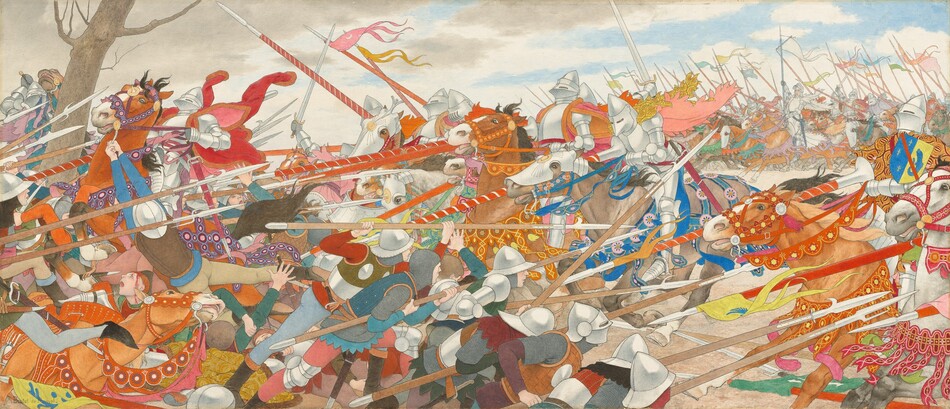
This horizontal painting is tightly packed with colorfully dressed groups of soldiers and knights on horseback surging toward each other. The scene is created with small areas of vivid, mostly flat color, almost like a collage. Long lances and spears create a forest of diagonals among the battling men. The hands and the few faces we can see are painted with pale, peachy skin. The soldiers on the left side wear tunics and leggings in tones of pumpkin orange, sage green, rose pink, ruby red, or azure blue. Most wear pointed, silver helmets with wide brims, and many hold lances as they charge the knights to our right. Near an ash-gray tree in the upper left, a rust-brown horse rears up among the throng, as his rider leans back and pulls on the reins. One person has been lifted off the ground while trying to hold the horse’s bridle. More knights on horseback sweep in from the right wearing silver armor, and riding gray, saffron orange, or brown horses. Several aim carrot-orange lances wrapped with white stripes at the enemy. The horses lunge forward with gaping mouths and wide eyes, their front legs outstretched. A band of knights in the distance in the upper right hold butter-yellow, celery-green, powder-blue, and white pennants that snap in the wind. The blue sky above the battle is scattered with white clouds on the right that transition to darker, tan clouds on the left. The artist signed the lower left corner, “M. Boutet de Monvel.”

The Turmoil of Conflict (Joan of Arc series: IV)

Louis Maurice Boutet de Monvel

c. late 1909-early 1913

Oil and gold leaf on canvas  Accession ID  2015.19.37

On View: West Building Ground Floor, Gallery G4
The sculpture portrays two female figures in a dynamic and intertwined position. One figure appears seated with a flowing drape over her lower body, while the other figure is more upright, reaching towards the seated one. Both figures are depicted with elongated and graceful forms. They seem to be engaged in an interaction or gesture, conveying a sense of connection between them. The material of the sculpture appears to be light tan stone or plaster, with a textured surface. The figures are rendered in a style that emphasizes smooth, curvilinear lines and contours. The background features a pattern of small, spherical objects and linear details that frame the figures.

Two Nudes

Elie Nadelman

c. 1911

Plaster  Accession ID  1975.79.1

On View: West Building Ground Floor, Gallery G5

Loading Results