Italian Medieval and Renaissance Paintings and Sculptures

Filter Results

367 artworks on view.

Results

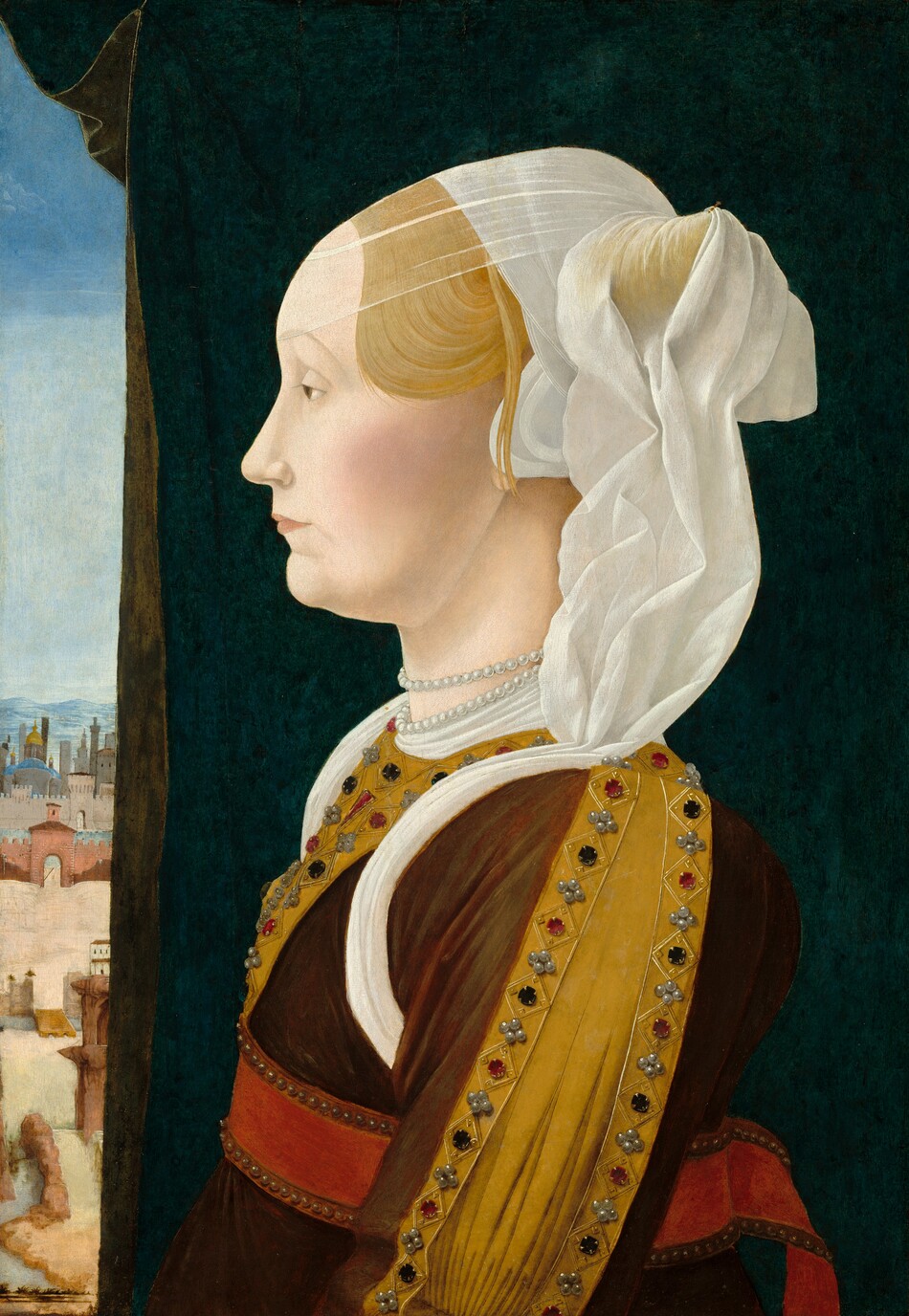
Shown from the waist up, a pale-skinned woman wearing a jeweled dress faces our left in profile in this vertical portrait painting. She looks into the distance with the light brown eye we can see, under a faint, arched brow. She has a petite nose, smooth, lightly flushed cheeks, and her peach-colored lips are closed. Her rust-brown gown is trimmed with wide, mustard-yellow panels studded with pearls, rubies, and sapphires along the front of the bodice and down the sleeve we can see. The elbow of that sleeve, near the bottom edge of the painting, is gathered in intricate, narrow pleats. White fabric billows out from the seam where the sleeve meets her shoulder, and a wide scarlet-red belt bordered with pearls wraps around her waist. Her blond hair is pulled back and coiled into a horn over her ear. Her head is covered with a translucent white veil that falls in deep folds to her shoulder. Another sheer veil layered over the first sweeps down over the high hairline of her forehead. A double strand of white pearls encircles her neck above the white collar of her gown. A marine-blue cloth with an olive-green lining nearly fills the background beyond her, but a sliver of a landscape view can be seen along the left edge of the composition. The window opens onto a town with coral-red city walls in front of blue and gray buildings. Hazy blue mountains line the horizon in the deep distance, and the sky above deepens from pale, ice blue over the mountains to topaz blue across the top.

Ginevra Bentivoglio

Ercole de' Roberti

c. 1474/1477

Tempera on poplar panel  Accession ID  1939.1.220

On View: West Building Main Floor, Gallery M13
The head and chest of a clean-shaven, pale-skinned man is shown in profile facing our right, in front of a curtain opening onto a sliver of a distant landscape in this vertical portrait painting. The man’s eye we can see is hazel under a thin brow, and he has a straight nose over a closed, peach-colored mouth. A crease running from the side of his nose to the corner of his mouth is lightly shaded, and his cheek flushes light pink. His straight, auburn-brown hair is cut to angle from his brow down to his neck. He wears a tall scarlet-red cap and a brown and gold tunic pleated in vertical folds down the front. The tunic is patterned with stylized leaves and vines in gold against the brown background. The neckline is lined with smoke gray, and the high neck of a garment beneath is patterned with gray leaves against brick red. The marine-blue, nearly black, cloth behind him covers most of the background. A narrow view along the right edge of the composition opens onto a landscape with the ruins of a terracotta-colored gate and city wall closer to us, though still deep in the distance. Even farther back is a walled town with gray and pale peach towers and crenellated walls. Spires are silhouetted against azure-blue mountains, hazy along the horizon in the distance, under a pale, ice-blue sky.

Giovanni II Bentivoglio

Ercole de' Roberti

c. 1474/1477

Tempera on poplar panel  Accession ID  1939.1.219

On View: West Building Main Floor, Gallery M13
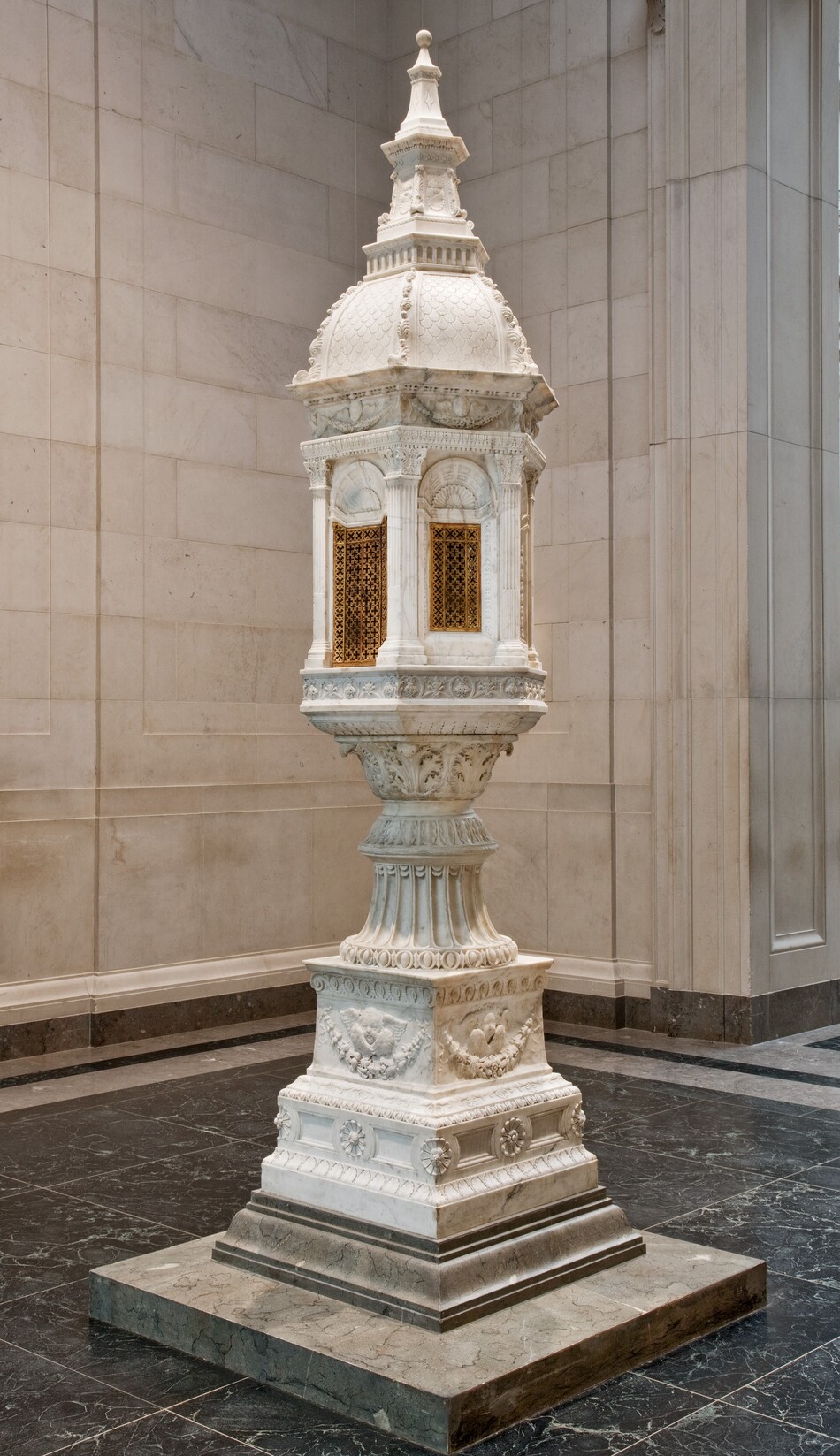
This sculpture is an architectural structure resembling a small tower or pavilion with intricate carvings. It has a domed top with detailed classical motifs, including flowers, columns, scale-like shapes, and swirling designs. The sculpture is white, standing on a square base with decorative carvings like garlands and rosettes. The cylindrical body has a multi-faceted section with small golden panels framed by columns and arches. It is placed indoors on a gray square base.

Ciborium for the Sacrament

Florentine 15th Century, Desiderio da Settignano, Florentine 19th Century

1460s-c.1470 (stem with integral base); probably 1860s-c. 1870 (dome, enclosure, base beneath enclosure); 1870s (finial, bottom plinth)

Marble  Accession ID  1952.5.100

On View: West Building Main Floor, Gallery M5
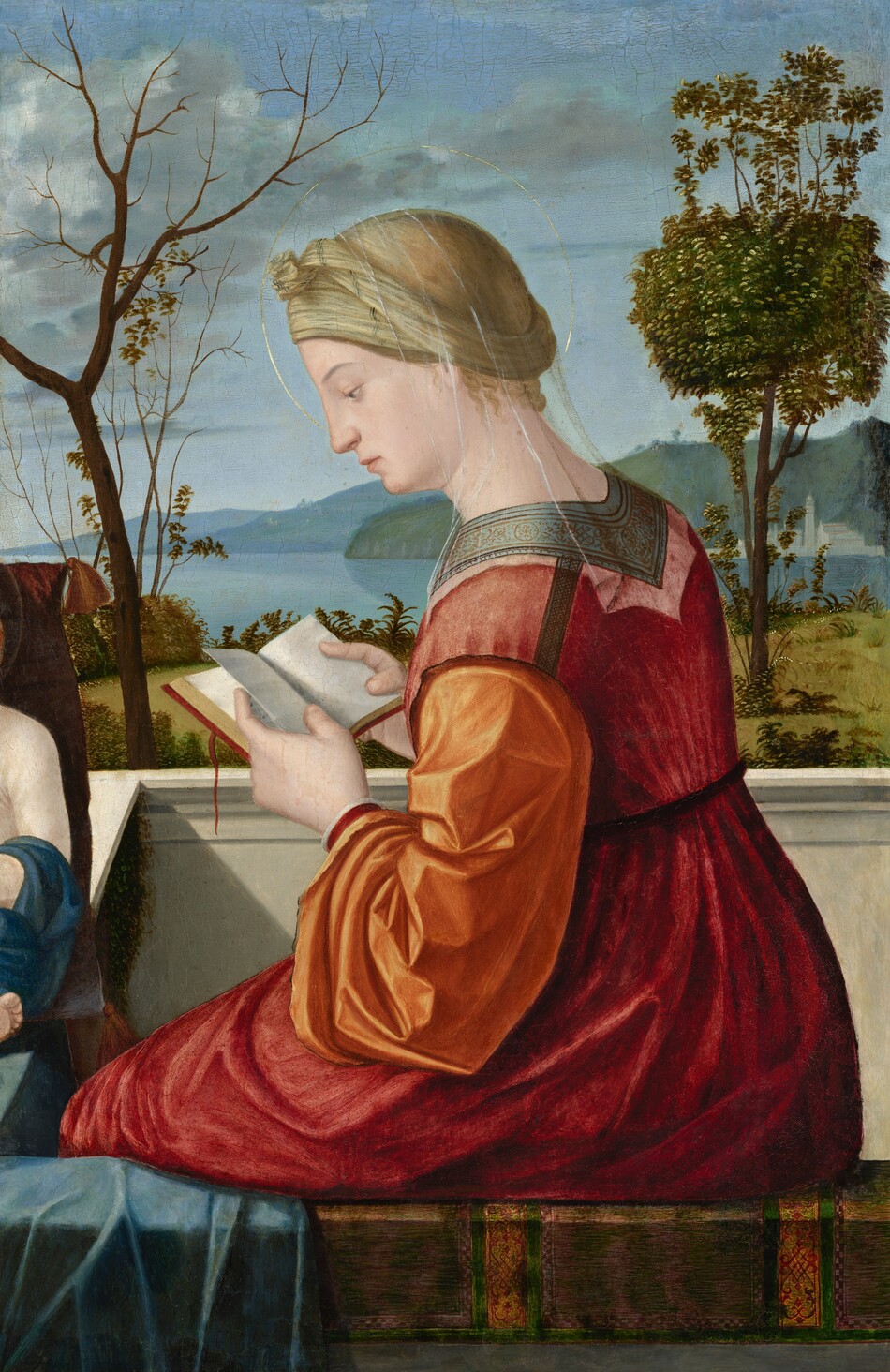
Shown from the hips up against a landscape, a woman with pale skin, wearing a burgundy-red dress with marigold-orange sleeves and a sheer veil, sits facing our left in profile as she reads a small book in this vertical painting. She has a straight nose and peach-colored lips. Her blond hair is covered by a bone-white headdress tied over her forehead. The veil drapes over the headdress, and her head is encircled with a faint gold ring, creating a halo. Her dress has full sleeves and is cinched into pleats at the high waist. The neckline is edged with a band of nickel gray decorated with a pattern of circles and leafy forms. The book has a red cover with a red ribbon, and she holds one index finger between the pages. A low chalk-white stone wall beyond the woman suggests she sits on a porch or balcony. A swath of powder-blue fabric drapes over the ledge on which she sits near one knee. To our left, a sliver of a shoulder, elbow, and toes of one foot suggest a person with pale skin draped in midnight blue, leaning back against a maroon-red pillow with tassels at the corners, in front of the woman and to our left. Behind that second person, in the landscape beyond the balcony, barren branches of a tree twist against the sky while a second tree, to our right, has a leafy, green canopy. A mustard-yellow meadow lined with bushes leads to the water’s edge, where ice-blue water leads back to rolling hills along the horizon. A few white buildings and a tower are clustered on the opposite shore. White and gray clouds float against the pale blue sky.

The Virgin Reading

Vittore Carpaccio

c. 1505

Oil on panel transferred to canvas  Accession ID  1939.1.354

On View: West Building Main Floor, Gallery M10
Standing at the entrance of an open tent, a woman holds the severed head of a bearded man over a sack held open by another person in this vertical painting. All the people have pale, ivory-white skin. To our right, Judith, who holds the head, stands with her body angled to our left. She looks back over her shoulder, off to our right, with light brown eyes. She has a long nose, smooth cheeks, and her small, peach-tinged lips are closed. Tightly curled, amber-brown ringlets frame her oval face and fall to her shoulders. Her loose, pearl-white dress, which is almost the color of her skin, falls off one shoulder and is belted just below her bust. A long, ultramarine-blue cloth drapes over one shoulder and arm, and around her body. Open-toed, moss-green sandals peek out from beneath her hem. Her right hand, to our left, grasps a long, straight, iron blade by her hip. The blade has a ridge up along its center, and the tip is cut straight across. She holds up the severed head in her other hand, so that arm crosses her body. The severed head faces away from us so only a sliver of the nose, cheek, and one closed eye are visible. The head has chestnut-brown hair and beard, and the mouth is open wide. To our left, the attendant holding the sack looks down at the head, her face framed by a white cloth that wraps around her head, under her chin, and across her shoulders. She wears a canary-yellow tunic over silvery-gray pants. A red cape drapes over one shoulder and around her body. She is barefoot. The tent is supported by a wooden pole, just beyond and between the pair. The gold-edged, rose-pink flaps of the tent have been pulled back and tied to each side. The interior beyond them is dark but the end of a gold bed draped with white cloth and one bare foot, the sole coming toward us, emerges from the shadows, to our right of Judith. The ground beneath the tent is made of tan, roughly square stones, scattered with pebbles. The peak of the tent rises off the top center of the composition, and the area to each side is midnight blue.

Judith with the Head of Holofernes

Andrea Mantegna, Giulio Campagnola

c. 1495/1500

Tempera on poplar panel  Accession ID  1942.9.42

On View: West Building Main Floor, Gallery M13
On the right side of this horizontal painting, two light-skinned men stand close to us on a spit of land separated from the rest of the scene by stretch of water that leads back to a town on the far shore. People gather on and around two boats floating in the water between the spit of land to our right and a copse of trees to our left. Beginning with the pair of men to our right: one man looking toward us has a broad forehead and grizzled blond beard. He wears a brick-red and canary-yellow turban, a yellow and crimson-red striped doublet with puffy sleeves, and a red codpiece. His scarlet-red hose have decorative slashes down the thigh to show yellow fabric underneath. He holds one long sword in his left hand, to our right, so the blade rests on that shoulder, and another sword hangs in a scabbard on his waist. Facing him, to our right, is the second man. He has a dark beard and a broad red hat trimmed with white feathers. He wears a doublet with wide red and white horizontal stripes and a white codpiece. His close-fitting white hose have thin, dark lines running from his waist to his feet, like pinstripes. He rests the back of his left hand, closer to us, on his hip. The tip of a long sword rests between his feet, and his far hand holds the hilt, which is as tall as his shoulder. Both men wear slipper-like shoes. Beyond this pair, near the center of the composition, a dozen men work on the wooden ships in the waterway. The trees to our left have feathery canopies of dense green foliage highlighted with butter yellow. A red pennant flutters in the wind near the left edge of the painting. About two dozen men, women, and children sit and stand closely under the trees. They wear capes, robes, turbans, and headdresses in aquamarine blue, marigold orange, burgundy red, cream white, and laurel green. Several of them are turned toward a woman dressed in blue holding an infant. Along the far shoreline, to our right, a city with tan-colored, stone towers glows under a soft topaz-blue sky, mirrored in the luminous blue water, as a ship with a billowing white sail passes by. On the distant horizon, high mountain peaks are faintly visible through a steel-blue haze.

The Trojans Repairing Their Ships in Sicily

Dosso Dossi

c. 1520

Oil on canvas  Accession ID  1939.1.250

On View: West Building Main Floor, Gallery M17
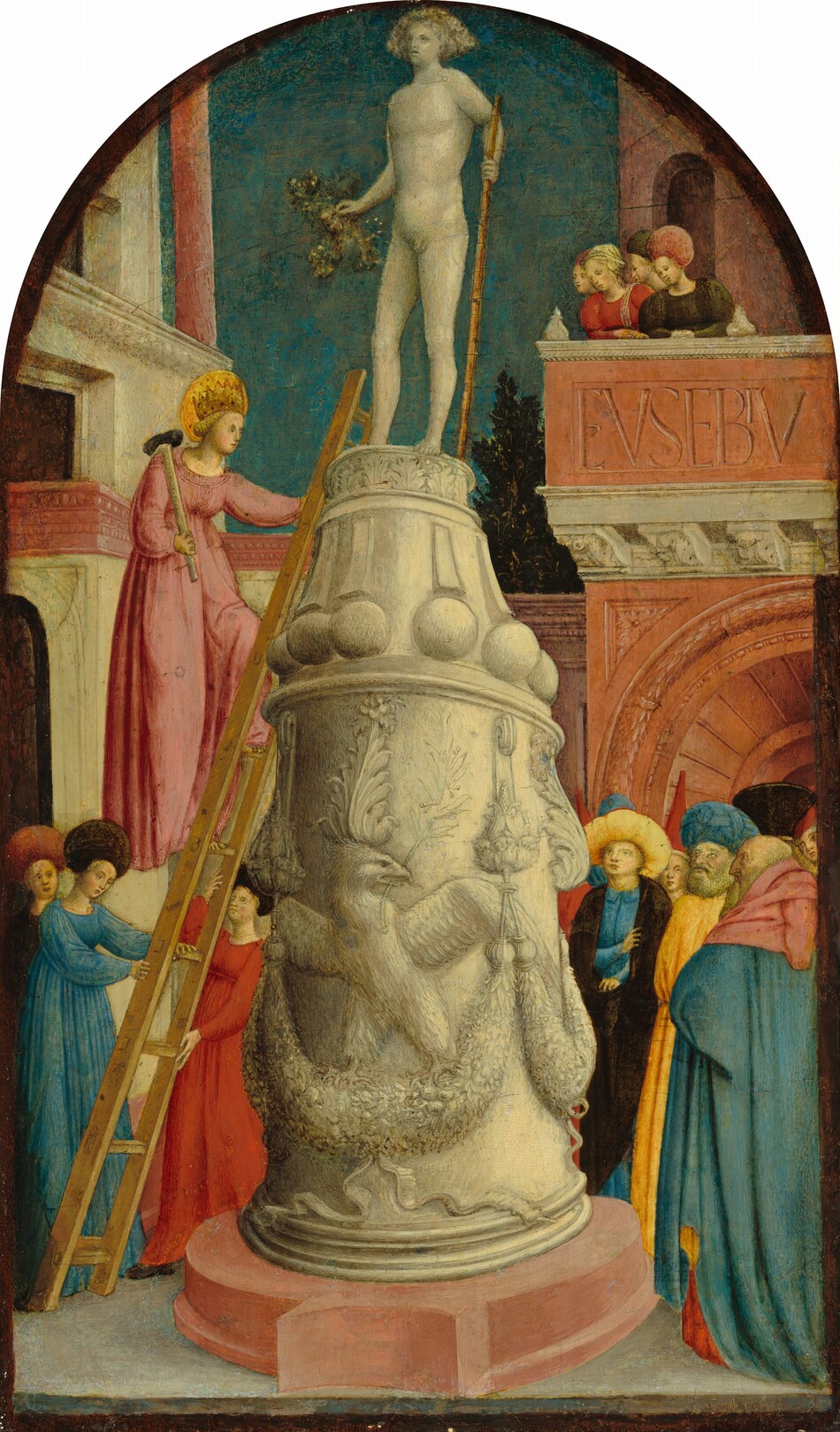
A woman climbs a ladder propped against a tall base of a white stone sculpture with a sledgehammer over one shoulder in this vertical, arched painting. The statue stands in a narrow town square hemmed in with buildings on each side. About a dozen people look on from the ground and from a balcony to our right. All the people have pale skin and wear dresses, robes, or cloaks in topaz blue, red, harvest yellow, or black. The base of the statue is twice as tall as any of the onlookers, and the statue atop is life sized. The base has eagles standing astride garlands, with flame-like leaves flaring above their heads. The statue is of a nude male with chin-length hair. He holds a gold staff in one hand and what appears to be a branch in the other. The woman climbing the ladder wears a carnation-pink dress, a gold crown, and has a gold, disk-like halo. Two more women brace the foot of the ladder, and another stands nearby. The three-story building behind them has a white façade with a carved, pink entablature across the top of the first level. More women and men gather to our right in front of a terracotta-orange building with a wide, arch opening on the ground level. Four women look down from a balcony on the second level. The face of that building is carved over the door to read, “EVSEBIV.” A tree grows beyond an enclosing wall at the far side of the square, between the buildings, beneath an azure-blue sky.

Saint Apollonia Destroys a Pagan Idol

Giovanni d'Alemagna

c. 1442/1445

Tempera on poplar panel  Accession ID  1939.1.7

On View: West Building Main Floor, Gallery M13
A  light-skinned man with short, auburn-brown hair and a long beard is shown from the hips up, his chest and sloping shoulders covered by a muted cobalt-blue cape in this vertical portrait painting. His body is angled to our left and he looks at us from the corners of his brown eyes under curving, low brows. His head, torso, aquiline nose, and hands are slightly elongated. He holds a black hat in his right hand, on our left, close to his body. His left hand emerges from a white sleeve painted with swirling brushstrokes, as he presses a small book to his chest, holding it open with one page caught between thumb and index finger. The lower edge of his cape drapes over that arm, revealing rose-pink lining. He stands with his back to a grayish-green wall that does not span the width of the composition. Slivers of other spaces, possibly rooms, are suggested by tall, narrow views of windows and arched openings along the sides of the painting.

Monsignor della Casa

Pontormo

probably 1541/1544

Oil on panel  Accession ID  1961.9.83

On View: West Building Main Floor, Gallery M21
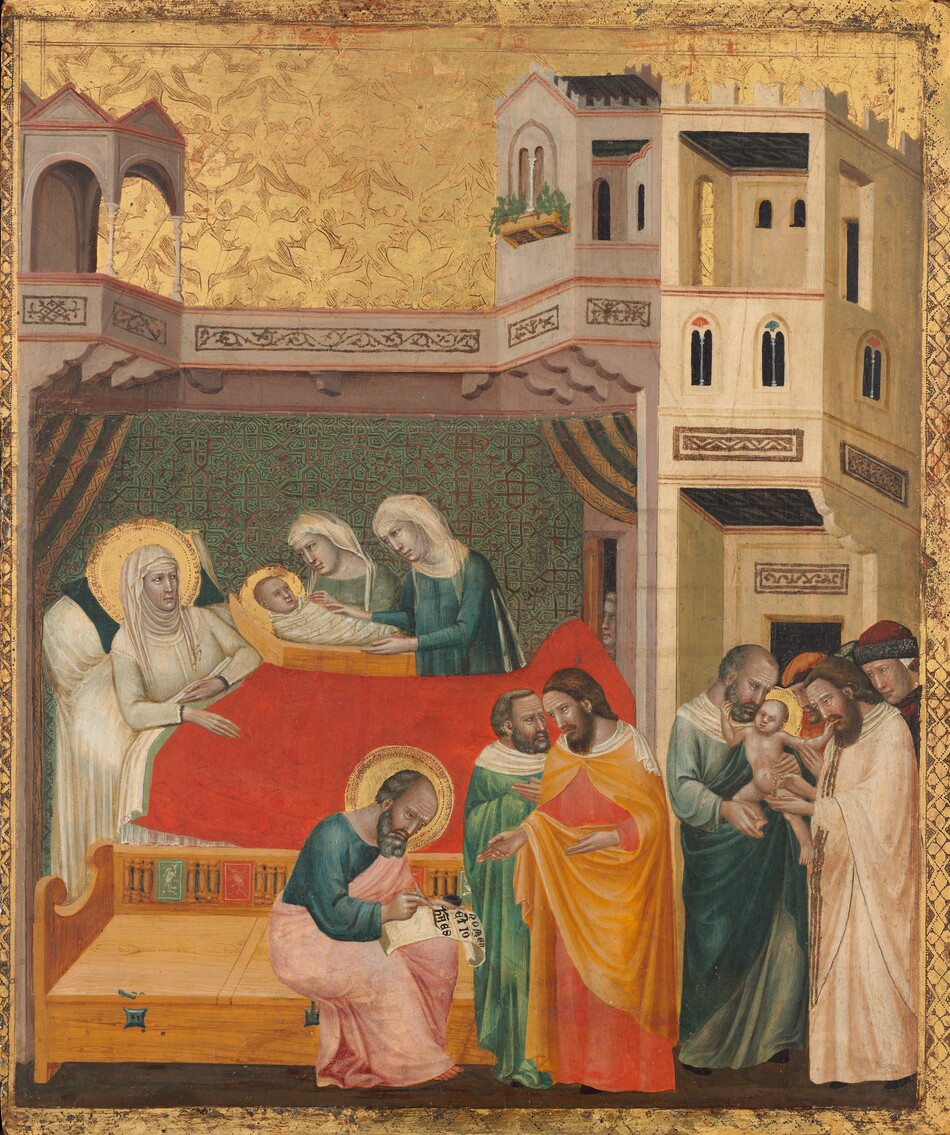
About a dozen women, babies, and men gather in small groups across interior spaces with a bedroom to one side and a covered space to the other in this vertical panel painting. The women have nearly white-colored skin, and the men and children have pale skin, sometimes tinged with gray. The bed spans the left two-thirds of the composition. A woman lies under a vibrant red coverlet and white sheets pulled up to her chest. A white veil covers her head, forehead, and neck, and she wears a white, long-sleeved gown. Her shoulders rest up on pillows, and her head is surrounded by a shiny gold halo. A pale face by the woman’s feet looks through an opening at the base of the bed. Two women on the far side of the bed wear green or blue dresses and white head coverings. They both attend to a swaddled blond baby, who also has a gold halo. The wall behind the bed is patterned with an intricate geometric design in grass green and brown. The space above the bed is shiny gold punched with a leafy pattern. The wall is capped with an entablature held up with corbels. A balcony space rises to the left, and a structure with arched openings is to our right. A deep bench runs parallel to the bed along the bottom edge of the painting, closer to us. A balding man with a gray beard sits there and writes, brows deeply furrowed, on a scroll braced on one knee. If complete, writing on the scroll would read “NOMEN EST IOHANNES.” He wears a blue robe under a pale pink cloak, and he has a halo. A man standing just to our right of the seated man gestures toward the first with both hands. This second man has a brown beard and long hair and wears a marigold orange cloak over red robes. A bearded man with gray hair standing behind him wears leaf green and looks to our right. Four men and a haloed baby crowd in the covered space to our right. The man wearing green is shown again, now holding the nude baby. The man with brown hair now wears white vestments and cuts foreskin of the baby’s penis. Two other two men look on, and a sliver of an orange cap indicates that a fifth person is at the back of the crowd. The covered space is ivory-white and has a balcony above the taller, lower level. The whole panel is edged by gold patterned with a clover-like design.

The Birth, Naming, and Circumcision of Saint John the Baptist

Giovanni Baronzio

c. 1335

Tempera on panel  Accession ID  1952.5.68

On View: West Building Main Floor, Gallery M1
At least eleven people gather around a man hanging from a wooden cross, all against a gold background in this nearly square painting. The people have pale skin tinged heavily with gray, and pink on the cheeks. At the center of the composition, the man, Jesus, hangs from nails driven into the cross through his palms and feet. His thin body is covered only by a sheer loincloth across his hips. His knees angle to our left, and his head tips in that direction. He has a beard and auburn-brown, shoulder-length hair. His eyes are closed under furrowed brows. A gold halo surrounds his head and has red lines radiating to the red outline of the disk. The letters “INRI” appear on a panel on top of the cross. Three small, winged angels, like miniature people, catch vibrant red blood spurting or trickling from Jesus’s two palms and a gash over his right ribs in gold bowls. A fourth angel clasps hands in prayer. The angels have brown or blond hair, gold halos, and cobalt-blue robes and wings. A woman with long, curly, copper-colored hair kneels at the base of the cross, holding Jesus’s bleeding feet. To our left, a woman wearing lapis-blue swoons into the arms of two women who wear hoods and robes in marigold orange or nickel gray. All four women have gold halos, as do two of the four men standing together to our right. One of those men has short, copper-blond hair and wears a blue robe. His cloak is rose pink on one side and green on the other. He holds his small hands together in prayer and looks up at Jesus in profile. The other three men wear helmets and armored breastplates. One of them, at the front of that trio, has a halo and he points up at Jesus. The hand and torso of another person is visible along the right edge of this group, but the upper body has been lost. The cross sits on a low, rocky rise over a small cavern holding a skull. The ground around the cross and groups is carnation pink. A crenelated, turquoise-colored wall, about elbow height, runs across the back of the scene. The glimmering gold background is worn in some areas, revealing the red ground beneath the gold leaf.

The Crucifixion

Paolo Veneziano

c. 1340/1345

Tempera on panel  Accession ID  1939.1.143

On View: West Building Main Floor, Gallery M1
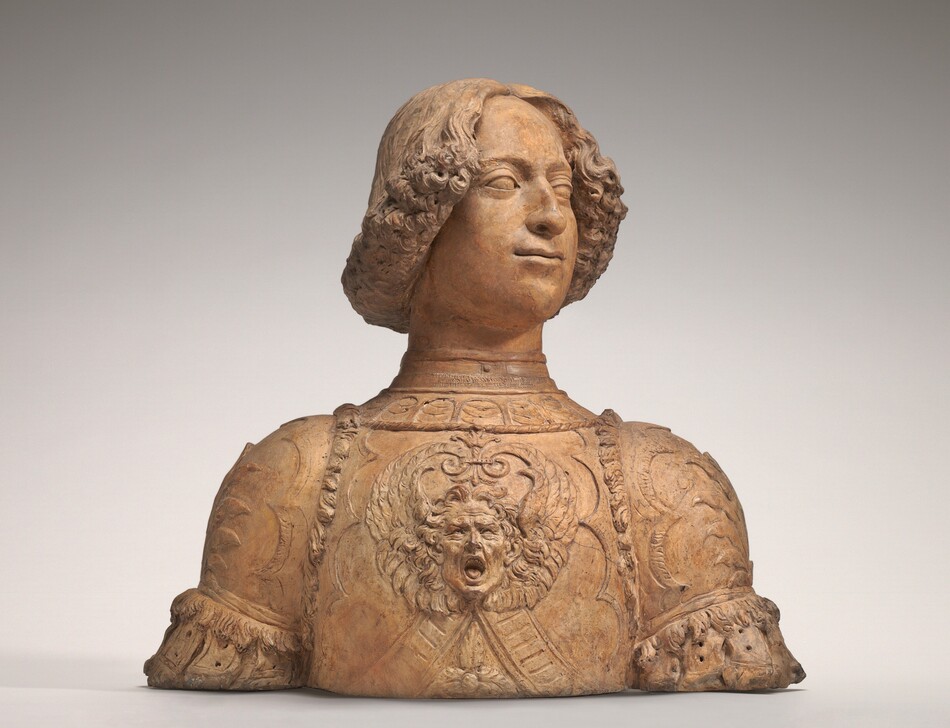
This freestanding, beige, terracotta bust shows the head and shoulders of a cleanshaven man, Giuliano de' Medici, wearing a suit of armor. The bust is straight across the bottom so it rests directly on the white surface on which it is photographed. In this view, the man’s shoulders are square to us, and he looks off to our right, chin lifted. His eyes are blank, and he has a bumped, aquiline nose and rounded cheeks. His lips are closed, the corners slightly pulled back. His thick, curly hair is cut to create an angle down from his eyebrows, on either side of his forehead, to the back of his neck. His breastplate has a high collar, and, at the front center, a man’s head is sculpted in relief with his mouth wide open, head flanked by upswept wings. The yelling man’s teeth and tongue are visible, and he has wavy hair and prominent ears. The pauldrons, the armor covering Giuliano's shoulders, and the rest of the breastplate are decorated geometric shapes and curved lines that end in sharp points.

Giuliano de' Medici

Andrea del Verrocchio

c. 1475/1478

Terracotta  Accession ID  1937.1.127

On View: West Building Main Floor, Gallery M7

Loading Results