Italian Medieval and Renaissance Paintings and Sculptures

Filter Results

367 artworks on view.

Results

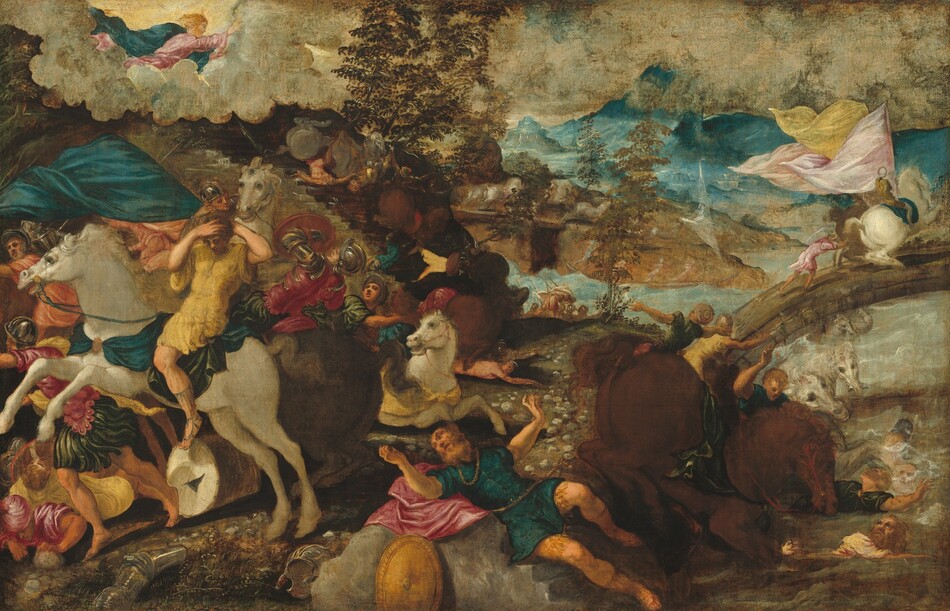
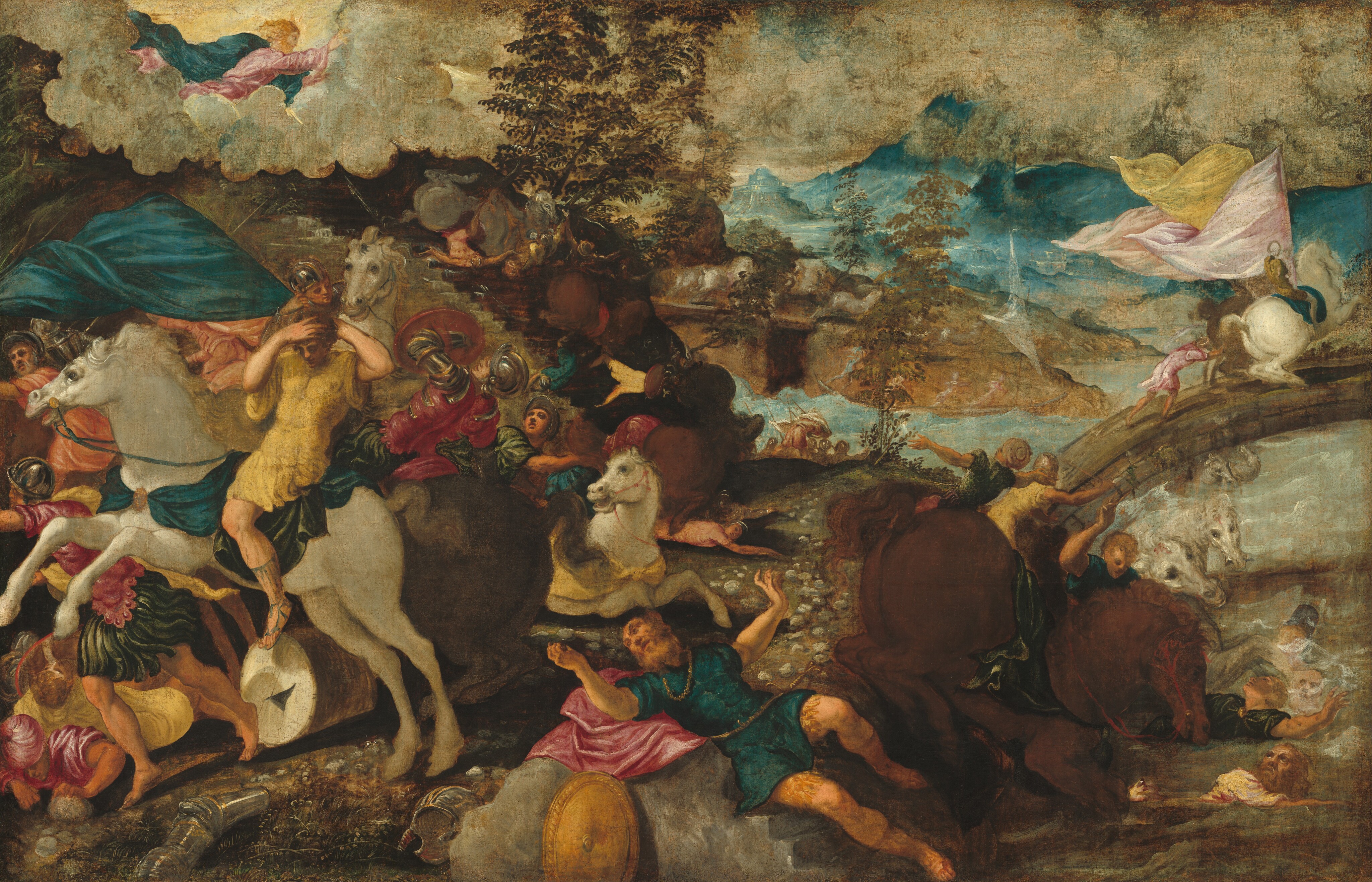
About two dozen, light-skinned men and more than a dozen horses tumble across a rocky shore along a body of water, all against a deep landscape in this horizontal painting. At the bottom center of the canvas, a bearded man, Saint Paul, wears a teal-blue tunic and coral-pink cape, and he lies sprawled across a short set of gray, stone steps, perhaps a fragment from a building. With his head to our left, his body is tipped toward us and his arms are raised, palms facing out, as he looks back and up. He wears a thick gold chain around his neck, and the gold hilt of a sword hangs from his gold belt. A round gold shield is propped on the steps, and other pieces of armor, including a silver helmet and sleeve, are strewn in the grass nearby. To our left, a man wearing a mustard-yellow tunic and teal-blue cape rides a rearing white horse. The rider clutches his own head with both hands. Behind this horse and rider, men wearing emerald green, butter yellow, peach, or blue and metal helmets struggle around brown or white horses. To the right of Saint Paul, a chestnut-brown horse crouches near the edge of a river, and several men and more horses flail in the water. A pebbled path running behind Saint Paul leads to a low, arched bridge that spans the river and extends off the right edge of the composition. Carrying billowing, triangular flags in pale peach, pink, and yellow, men ride and push at a pair of rearing horses on the bridge. To our right, the river winds through a deep, mountainous landscape. To our left, yet more men and horses spill down a flight of stone stairs leading up to a bank of parchment-white clouds that span the sky in the top third of the painting. A bearded, blond man at the upper left corner, wearing rose pink and royal blue, stretches out across the clouds to gesture with an open palm to the landscape below.

The Conversion of Saint Paul

Jacopo Tintoretto

c. 1544

Oil on canvas  Accession ID  1961.9.43

On View: West Building Main Floor, Gallery M24
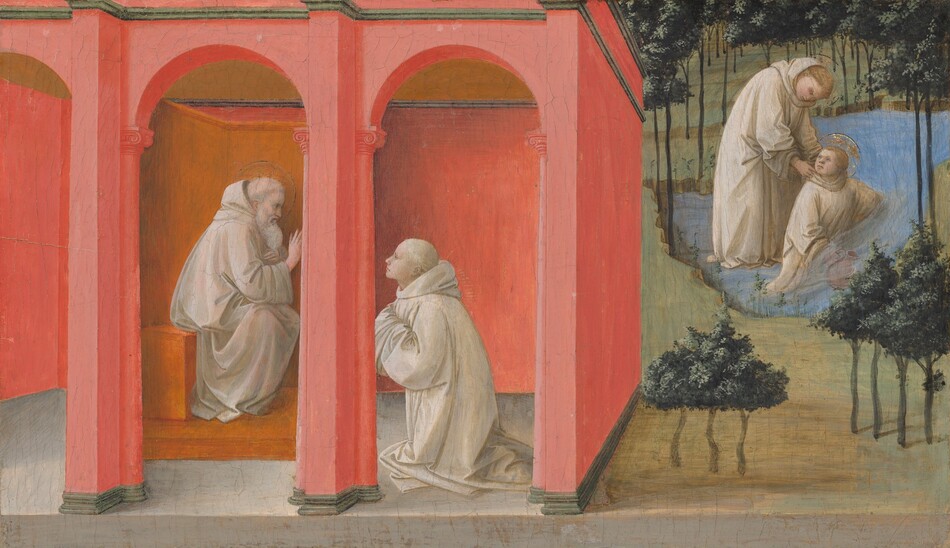
Two men are situated inside a coral-red building that fills the left two-thirds of this composition, and two men are shown in a body of water in a landscape to our right in this horizontal painting. The building recedes sharply into the space of the landscape without seeming to be part of it, and the men in the water seem a little too large in relation to the pool, trees, and the building to our left. The men all have pale skin and wear ivory-white robes. The red, arched building spans the entire height of the painting. Inside, a bearded man with a halo sits on a bench facing our right in profile as he holds up his right hand toward the cleanshaven man kneeling in front of him. Short, gold rays emanate from the younger man’s shoulders as he looks up at the older man with his hands tucked into his voluminous sleeves. In the landscape to our right, the two people both have blond hair and halos. One, either a man or a younger boy, seems to kneel in the pool, filling a pitcher with water. He turns to look toward the man standing behind him, who leans over and touches his shoulders. Trees with triangular canopies of dark green leaves have thin, spindly trunks placed regularly across the background with a few on the grassy ground closer to us.

Saint Benedict Orders Saint Maurus to the Rescue of Saint Placidus

Fra Filippo Lippi

c. 1445/1450

Tempera on panel  Accession ID  1952.5.10

On View: West Building Main Floor, Gallery M4
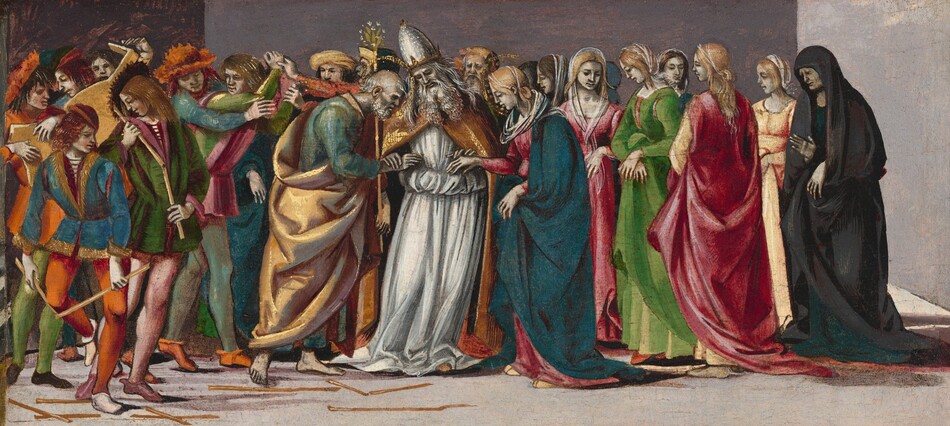
About twenty colorfully dressed people fill a long room behind an old man and young woman standing before a bishop in this horizontal painting. All the people have pale or ash-white skin, and their clothing is in shades of golden yellow, raspberry pink, pumpkin orange, teal, sea blue, or pea green. The men wear tunics and leggings or robes, and some have turbans or feathered hats. The women wear gowns and white or sheer head scarves. The man at the center of the composition, the bishop, wears a pearl-white robe and conical mitre hat. His white hair falls past his shoulders, and he has a long, curly beard. A balding, bearded man and young woman with honey-blond hair stand in front of him. Each has traces of gold halos around their heads. They face each other, and each reaches out one hand, which the bishop in turn holds. The groups of men to our left and women to our right look in all directions, though few look at the couple at the center. An older woman at the rightmost edge of the group stands out. Her gray-toned face is lined, and she wears a black robe. Her eyes are screwed shut, her mouth downturned, and she holds up one hand, palm out. One man in the group to our left plays a lute and others break sticks. More broken sticks are strewn on the ground around the men. The walls of the room are pale lavender or plum purple.

The Marriage of the Virgin

Luca Signorelli

c. 1490/1491

Tempera on panel  Accession ID  1961.9.39

On View: West Building Main Floor, Gallery M7
Dozens of people form a line starting from an opening in a city wall or building in the background to a rustic shed-like structure close to us, to kneel before a seated woman holding a baby on her lap in this vertical painting. All of the people have pale skin tinged faintly with green. The top edge of the panel is shaped so it has two rounded sections like shoulders leading to a stepped, crown-like form with an inward curving triangle at the top. A nickel-gray, crenelated stone wall of a distant city is nestled into the top, stepped section, with a glimmering gold sky above filling the uppermost triangle. Tile-roofed and domed buildings and a few towers appear densely packed beyond the wall. People on foot and horseback create a line from an arched opening in the wall toward us and to our right. Three of the people on horseback in the distance wear long robes and have gold halos. The line of people winds behind a tall, narrow hill to our right and it continues close to us. Two horses, two camels, and several people wait to the right but our attention is drawn to the trio in the foreground, Mary, Jesus, and Joseph, and the three men near the infant, the Magi. Mary wears a lapis-blue mantle covering her head and shoulders over a petal-pink dress, and she sits on a wooden or stone chest in the center of the painting. Her body faces us but she turns her face to look with pale blue eyes off to our right. In one hand she holds a hexagonal gold vessel that tapers to a flame-like finial. With the other hand, on our left, she supports the blond infant sitting in her lap. He is covered only with a white cloth around his waist, and he looks toward the vessel as he holds up the index and middle fingers of his right hand. To our left and slightly behind Mary, a balding man with white hair and beard and wearing a blue garment under a red robe sits with his head propped in his hand, looking down. His other hand rests on what might be the handle of a crutch or staff. The man, woman, and child have gold halos with what appears to be writing. The three Magi also have gold halos and they all wear scarlet-red shoes. The oldest kneels before Mary and kisses Jesus's feet. He has a long, light gray beard and is balding. He wears a brocade-like gold robe over pale brick-red sleeves. A cleanshaven man with dark brown hair and wrinkles around his mouth kneels to our left as he raises a jewel-encrusted gold crown from his head. He wears a gold and red floral-patterned garment and holds a rounded vessel, also with a flame-like finial. A younger, cleanshaven man with smooth features and shoulder-length, curling blond hair to our right also wears a gold crown. A dagger hangs from the waist of his sky-blue tunic, and his leggings are pale plum purple. Both arms are bent to his hands are held up, and in his right hand, he holds another tabernacle-like gold vessel. The structure to our left houses a donkey and bull munching hay. A gold sunburst floats above the roof, which seems to be built up against the stone wall of a building. The hills and trees beyond the people is painted with pine and moss greens and brown.

The Adoration of the Magi

Benvenuto di Giovanni

c. 1470/1475

Tempera on poplar panel  Accession ID  1937.1.10

On View: West Building Main Floor, Gallery M8
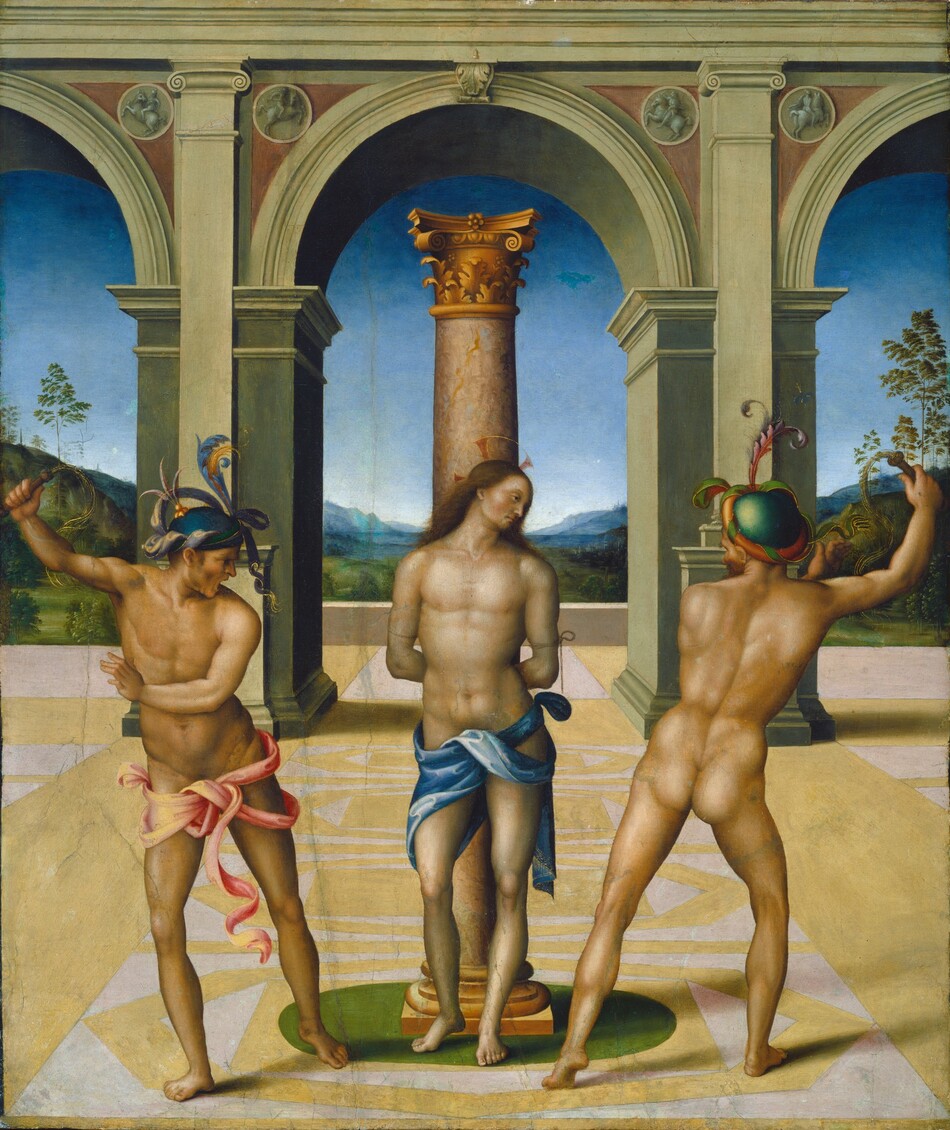
Two muscular men lean away, whips raised, from a third man tied to a freestanding column, in a courtyard-like space in front of a deep landscape in this vertical painting. At the center of the composition, the pale-skinned man bound to the column, Jesus, stands with his body facing us. He turns his head to our right, perhaps looking at the man to that side. Jesus is cleanshaven, and his long brown hair falls back behind his shoulders. A delicate gold ring creates a halo, with red spokes to the top and sides. Ropes wrap around his upper arms, and he is nude except for a blue cloth around his hips. The column is mottled with tan and pale pink, and is topped with a gold, leafy capital. To each side, the men with the whips have more tan skin than Jesus. They stand in the same pose as each other, with their weight mostly in their right legs, and right hands raised with the whips. But the man to our left stands with his body facing us, and the one to our right stands with his back to us, so they each lean away from Jesus. The man to our left wears a pink cloth tied around his waist but is otherwise nude. His mouth is wide open, and his free hand reaches across his chest. His royal-blue cap is decorated with lavender-purple and gold ribbons and plumes. The man to our right is nude except for a parrot-green cap wrapped with a band of orange, like a turban. The area in which they stand has a floor patterned with butter yellow and white. On the far side of the courtyard, a central arch is flanked by one to each side, which are cut off by the left and right edges of the composition. The entablature running across the top of the arches is parallel to the top edge of the painting. The landscape beyond has grassy, rolling hills dotted with trees, reaching back to hazy blue mountains along the horizon. The sky above deepens from pale blue over the mountains to azure blue across the top, seen through the arches. Several vertical cracks are visible on the surface of the panel.

The Flagellation of Christ

Bachiacca

c. 1512/1515

Oil on panel  Accession ID  1952.5.81

On View: West Building Main Floor, Gallery M20
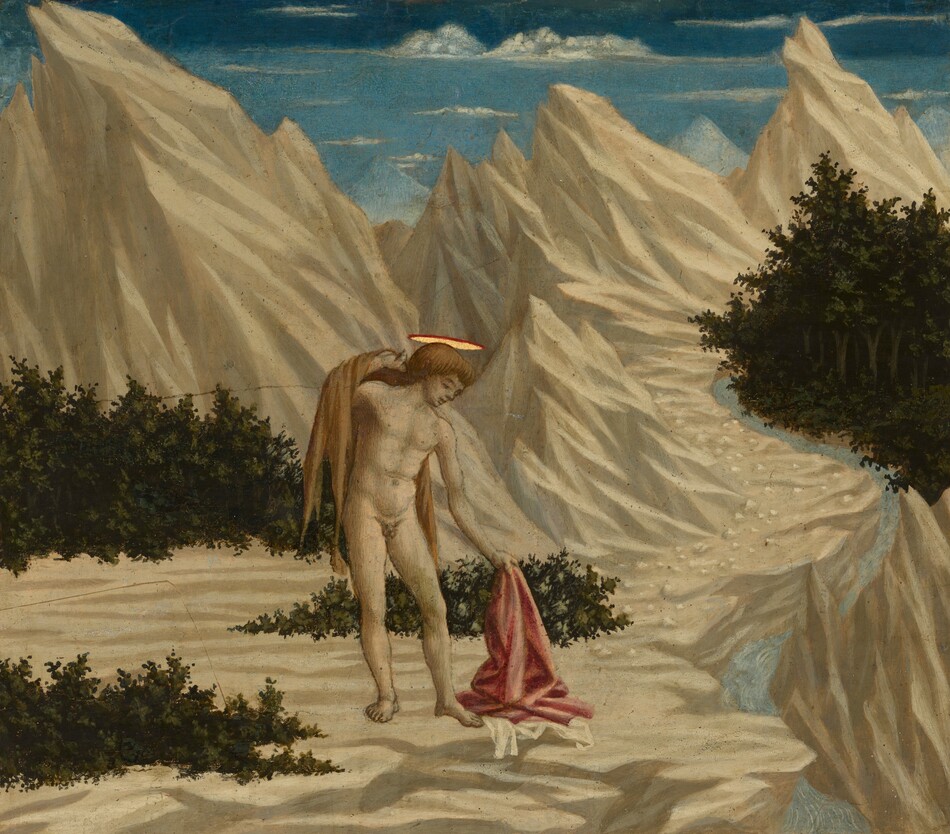
A young, nude, light-skinned man stands in the center of a rocky, mountainous landscape in this square painting. The man’s muscular body faces us but he turns his head in profile to our right as he looks down at the coral-red cloth he drops onto the ground. He is cleanshaven with prominent eyebrows, a straight nose, and his lips are slightly parted. He has thick, reddish-brown hair with bangs across his forehead, and there is a red-edged, glimmering, gold, plate-like halo across the crown of his head. He leans slightly to the side as he drops the red cloth onto a white one, already on the ground. With his other hand, he holds a fawn-brown animal skin or cloth over that shoulder. The man is surrounded by tan and parchment-brown, deeply ridged, mostly barren mountains. The pointed peaks nearly reach the top of the painting. The rocky mountains are interspersed with a few dark green bushes. A light blue stream curves in a shallow S shape along the right side of the painting. Peaks in the far distance are icy blue against a sky that deepens from topaz blue along the horizon to navy blue at the top edge. Some puffy and some thin white clouds float across the sky.

Saint John in the Desert

Domenico Veneziano

c. 1445/1450

Tempera on panel  Accession ID  1943.4.48

On View: West Building Main Floor, Gallery M4
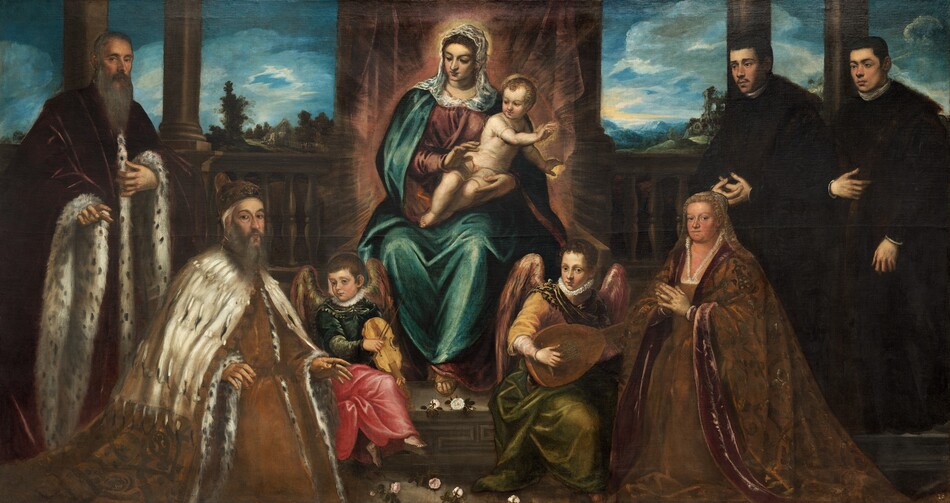
Seven men, women, and children with pale, peachy skin flank a woman surrounded by a halo of light, sitting on a throne and holding a nearly nude baby boy in her lap in this long, horizontal painting. The wide throne sits on a low platform and reaches off the top edge of the canvas. The body of the woman sitting there, Mary, faces us and she turns her head to look down to our left with her lips closed. She wears a loose, dusky rose-pink dress under an aquamarine-blue cloak. A translucent white veil covers her chestnut-brown hair and shoulders, and is tucked into the neckline of her dress. Her right hand, to our left, is raised with the palm down, and she supports the hip and thigh of the baby, Jesus, with her other hand. With his hips facing us, Jesus leans to our right as he twists to hold both hands, palm out, in that direction. He has curly blond hair, and he turns his head back over his shoulder to look down at the people to our left. He has brown eyes under delicately arched brows, flushed cheeks, and his pink lips curve up in a slight smile. Though he appears to be nude at first glance, closer inspection shows he wears a sheer white, short-sleeved, knee-length tunic. Golden rays radiate from Mary and Jesus's bodies and mostly obscure the throne behind them. Two men are shown to our left of the throne and two men and a woman are shown to our right. Mary and Jesus look to our left at an older man with a long, gray beard. He kneels with his body angled to our right with both hands lifted palms down at waist height. He looks at us from the corners of his dark eyes under arched brows. He wears a voluminous, honey-brown robe lined with black spotted, white fur and covered over the shoulders and arms with a white fur cape. His matching brown cap has a pattern around the edge, perhaps beading. Standing behind the kneeling man to our left is a bareheaded man with a long, pointed gray beard and short-cropped, gray hair. He also looks out at us with brown eyes, which are lined at the corners with wrinkles. His robe is burgundy red and also lined with black and white fur down the front and around long, drooping sleeves. To our right of the throne, a woman with blond hair in tight curls kneels with her hands together in prayer at her chest. She looks at us with gray eyes set in a round face. Her full robe is patterned with sage-green vines and leaves against an amber-brown background, and is lined along the sleeves and down the front with maroon red. Behind her and to our right stand two young men with short brown hair, wearing dark brown robes with high, white collars. The man to our left has a thin mustache and the other is cleanshaven, and they both look off to our left. Two winged angels sit on the platform to either side of Mary’s feet, which is strewn with roses. The wings of both angels are painted with golden yellow and rust red. To our left, the child-like angel has short, brown hair and wears a teal-blue jacket with a white ruffle at the neck. Coral-red drapery covers the legs over bare feet, and the angel plays a violin. The angel to our right of Mary’s feet is a little taller, and has curly brown hair. Wearing butter yellow and moss green, that angel strums a lute and looks out at us with dark eyes. To either side of the throne, the room is lined with a balustrade and columns, framing a landscape with rolling green hills and ice-blue mountains. White clouds are streaked across the vivid blue sky.

Doge Alvise Mocenigo and Family before the Madonna and Child

Jacopo Tintoretto

c. 1575

Oil on canvas  Accession ID  1961.9.44

On View: West Building Main Floor, Gallery M24
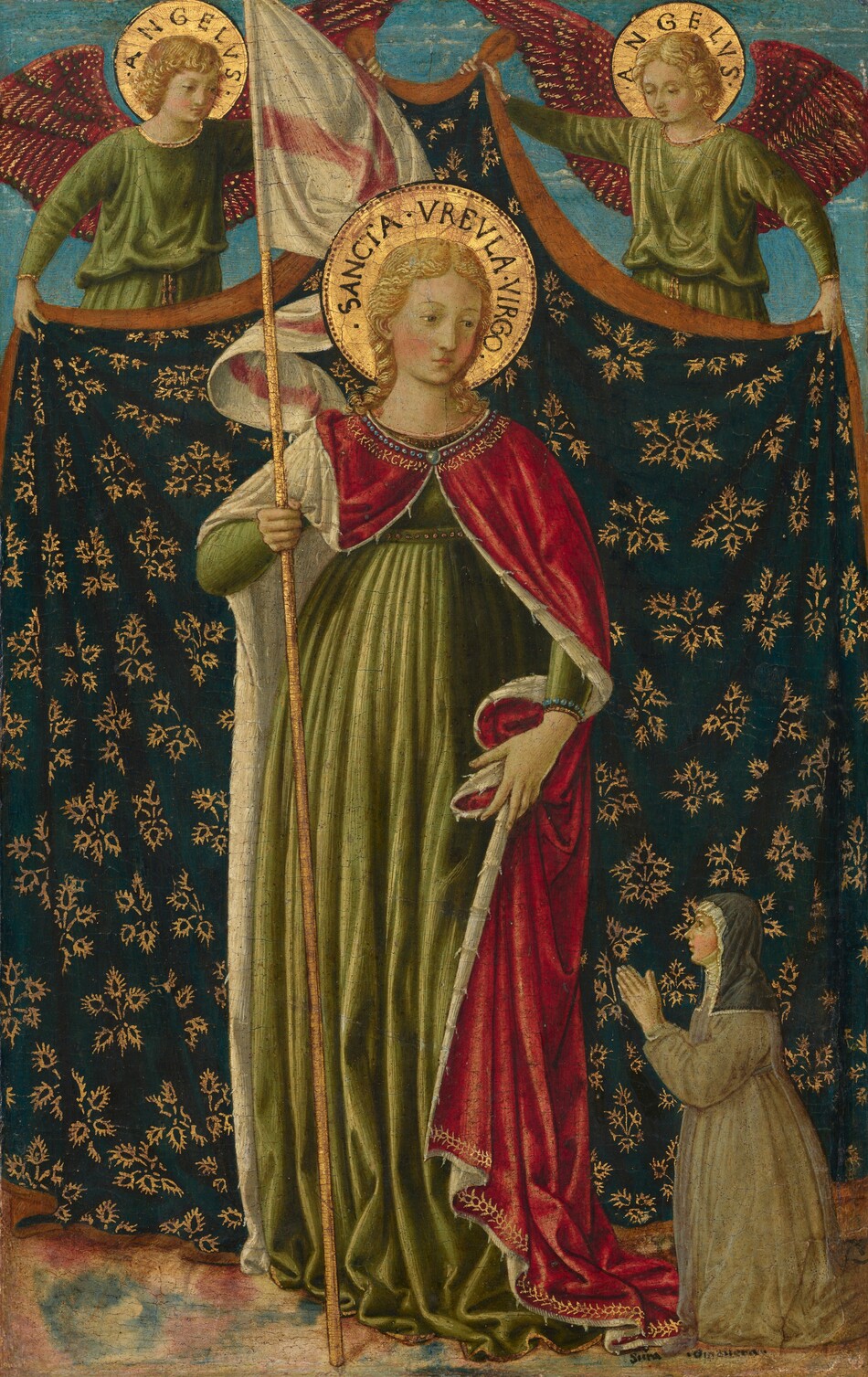
A person holding a flag, Saint Ursula, stands in front of a cloth held up by two winged angels as a fourth person, much smaller in scale, kneels in the lower right corner in this vertical painting. All the people have pale skin. Saint Ursula and the angels have blond hair, rosy cheeks, delicate features, flat gold halos, and they wear leaf-green garments. Saint Ursula stands with her body facing us but she turns to look off to our right and slightly down. A raspberry-red cloak lined with white, perhaps fur, is draped across her shoulders. She holds a bunch of that fabric with her left hand, to our right, and holds the staff with a white standard marked with a red cross with her other. Text around her halo reads, “SANCTA VREVLA VIRGO.” The angels above have red wings and the word “ANGELVS” appears in each halo. The fabric they hold up is forest-green decorated with gold, foliate designs, and the space behind them is lined with thin white clouds against a vivid blue sky. Near the lower right corner of the composition, a person about a half the size of Saint Ursula kneels and wears a dark gray head covering, white cloth covering her chin and neck, and a grayish-brown robe. She faces our left in profile and presses her hands together in prayer. The floor below is loosely swirled with light brown, pink, and blue. Text painted in tiny black letters near the kneeling woman reads, “Suora Ginevera.”

Saint Ursula with Two Angels and Donor

Benozzo Gozzoli

c. 1455/1460

Tempera on panel  Accession ID  1939.1.265

On View: West Building Main Floor, Gallery M4
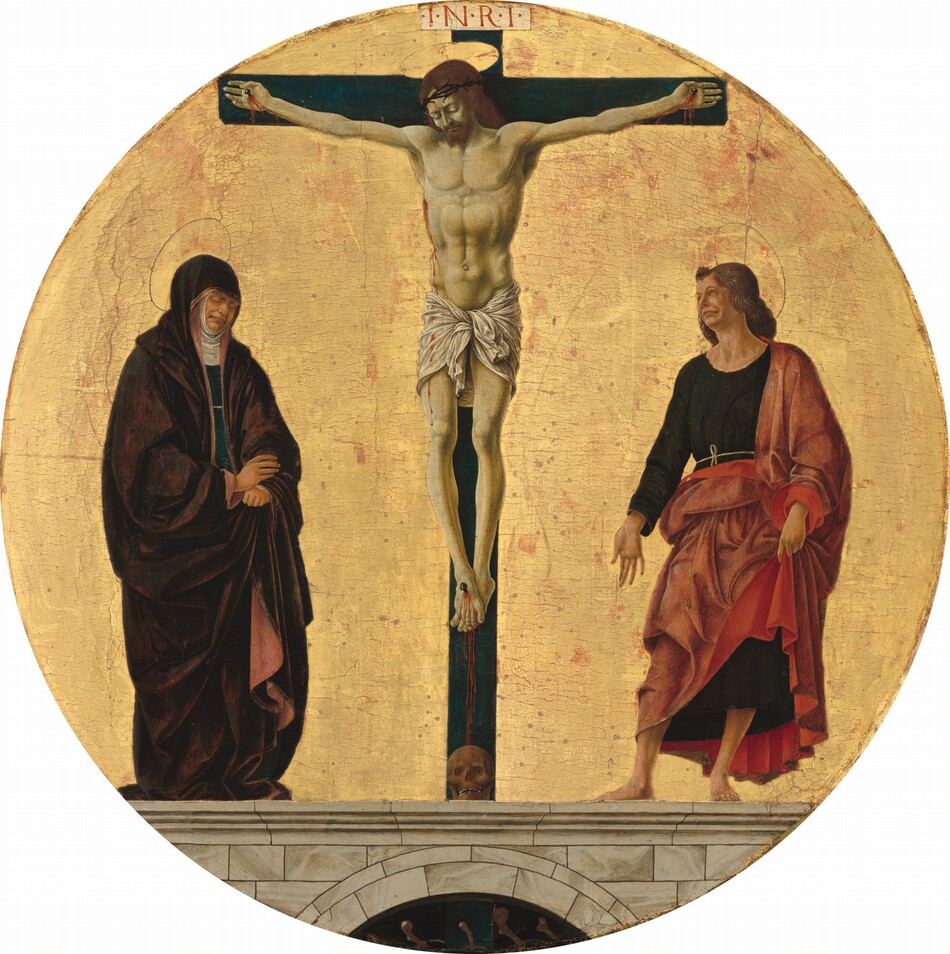
A mostly nude, thin man, Jesus, hangs by his outstretched hands from a wooden cross and is flanked by two people, one on each side of the cross in this round painting. Against a shiny gold background, the cross and two people stand on a gray stone platform that forms a base at the bottom. The two people below have peachy skin, and Jesus’s skin has a gray cast. All of their heads are encircled with flat, gold, disk-like halos. Eyes closed, Jesus’s face tips down to our left, and his body faces us. He has a copper-brown, forked beard, a prominent nose, and his lips are parted. Blood trickles from a ring of thorns around his head, over long hair. Blood drips from the nails holding his hands and feet, which overlap on the cross, and from a gash over his right ribs. A plaque at the top of the cross, over Jesus’s head, has the letters “INRI” painted in red. Standing at the foot of the cross to our left, an older woman wears an off-white wimple around her face and covering her neck, and an ocean-blue dress under an eggplant-purple cloak. Her head tips forward, her eyes closed and lips pressed into a frown. Her crossed hands grip her cloak at her waist. To our right, a man stands at the foot of the cross, his body angled to our left. His head tips slightly up to look at Jesus with narrowed eyes, his mouth turned down. He has long, sable-brown hair and a clean-shaven face. He wears a black tunic tied with a rope and a garnet-red cloak bunched at his waist and over his left shoulder. His left hand holds up his cloak. The surface of the painting is covered with a network of fine cracks and some of the brick-red layer under the gold shows through. Blood pours from Jesus’s feet onto a skull at the base of the skull. The platform on which they stand has an arched opening at the bottom center with some bones protruding from the dark, cavernous space.

The Crucifixion

Francesco del Cossa

c. 1473/1474

Tempera on poplar panel  Accession ID  1952.5.5

On View: West Building Main Floor, Gallery M13
This painting shows a man leaning against a tall white column with his arms tied behind his back. He has light skin and shoulder-length brown hair, and his face is tilted upward with his eyes raised. He is pierced with arrows in several places on his body, including his arm, torso, knee, and foot. He is bare-chested and wears a draped, light purple cloth tied around his waist. The background is solid black, and the top of the column the man leans against is broken off. At the bottom of the column, there is a detailed white stone relief with figures in varying poses, along with some fragmented pieces of stone on the white stone ground.

Saint Sebastian

Amico Aspertini

c. 1505

Oil on panel  Accession ID  1961.9.1

On View: West Building Main Floor, Gallery M19
Shown from the knees up, a seated woman and two winged, nude children gather at the center of this vertical painting. They all have pale, peachy skin. At the center of the composition, the woman, Venus, sits with her body angled slightly to our right as she turns her head back to our left, gazing into the distance with brown eyes under thick brows. She wears a jeweled headpiece over her upswept, honey-blond hair, and delicate ringlets frame her brow. Her cheeks are tinged with dusty rose-pink, and she has a long nose and a ruby-red, bow mouth. She wears an amber-yellow gown trimmed with white lace at the neckline. The short sleeve we can see is slashed to reveal cream-white fabric puffing out of the openings. A wide, gold chain inset with gleaming pale aquamarine-blue jewels the size of thumbprints drapes over her far shoulder and across her chest like a sash. She wears a pearl necklace and teardrop-shaped earrings, and more pearls and gems adorn the gold bracelets on her wrists. One child, in the lower right corner of the painting, stands in front of her with his back to us. He holds an arrow in his left hand, which he rests on the chocolate-brown cloth draped across Venus’s lap. He turns head to the right, and his face is partially obscured by one of his small, charcoal-gray and cream-white wings. Venus holds two ends of an off-white cloth tied around his head as a blindfold. Just beyond him is another person, visible from the hip up, who fills the height of the composition but is mostly cropped by the right edge. We see the left arm, shoulder, and edge of the hip as they stand with their back to us. The arm we can see is raised to hold what appears to be a metal bowl. On Venus’s opposite side, to our left, the second winged child stands on the ledge on which Venus sits. He leans one hand and his chin on Venus’s shoulder and gazes off to our right. He has chestnut-brown hair and eyes, and a round nose in a pudgy face. Loosely painted cranberry-red drapery hangs from the upper left corner and falls in cascading folds behind him. An azure-blue sky with tan clouds is visible beyond the drapes.

Venus Blindfolding Cupid

Italian 16th Century, Anonymous Artist

c. 1566/1570 or c. 1576/1580

Oil on canvas  Accession ID  1952.2.12

On View: West Building Main Floor, Gallery M23
Three men, one woman, and three camels gather around the stone ledge of a well in this horizontal landscape painting. Along the left edge of the composition and on the far side of the well, a man with brown skin and short, black hair faces away from us as he reaches for the reins of two camels, one of which looks at or toward us. This man wears an emerald-green shirt under a canary-yellow tunic, which is tied in place with a strap over one shoulder. With her back to that man, a woman with pale, white skin stands angled toward the two light-skinned men who stand to our right, in the center of the painting. Light falls across this trio, and the woman’s face is especially bright against the muted blues of the sky behind her. Her blond hair is braided and coiled at the back of her head. Her white shirt has puffy, short sleeves, and is covered with sheer, gold fabric, like a vest. Salmon-pink fabric wraps across her shoulders and under her bust, and the light glints off the folds of her full, pink skirt. She touches her left wrist, to our right, with her other hand, and wears bracelets on both arms. A copper-colored pot sits on the ledge next to her, to our left. She looks toward a man who kneels as he holds up a handful of gold coins or jewelry. His body is angled away from us, and we see him in profile facing our left, the bottom of his face hidden by his raised arm. He wears a tunic striped with fawn brown and white, and short, teal-green pants come to mid-thigh. His knees are bare, and he wears peach-colored, shin-high boots. A buttercup-yellow robe is tied over one shoulder and around his waist, and he wears a close-fitting green cap, the same color as his pants. Just beyond him, a balding man with a trimmed, gray beard leans toward and looks at the woman. He wears an apricot-orange tunic under an ocean-blue cape. He gestures with one hand to the gold and props his other hand on a tall walking stick. A camel behind him faces our right in profile with coral-pink fabric draped over its hump. The camel’s head is near a tree with a bush growing at its base. A chest with a rounded top sits near the tree. Another camel peeks its face into the scene from the upper right corner, and a fifth drinks from another copper-colored vessel in the lower right. Gray rocks are scattered on the earth along the bottom edge of the painting, and a stick leans against the side of the well close to us. Beyond the tree and the camels to our right, a town with oyster-white buildings lines the horizon in the distance. The sky above is streaked with navy blue, steel gray, tan, and mauve pink. The weave of the canvas is visible in some areas, especially the sky.

Rebecca at the Well

Veronese, Italian 16th Century

c. 1582/1588

Oil on canvas  Accession ID  1952.5.82

On View: West Building Main Floor, Gallery M24

Loading Results