Medieval and Renaissance Sculptures and Decorative Arts

Filter Results

455 artworks on view.

Results

A free-standing, gold, enameled, rectangular box has a triangular top like the roof of a house, and the box rests on a short, square foot in each corner. In this photograph, we look onto one long side and the short side to our right is angled toward us, so we see the panel there, too. Along the long side, five people are shown from the waist up in the upper, roof-like panel and six more line up on the panel below. The skin of every person is gold, and all wear robes and garments in lapis or sky blue, spring green, yellow, and white. The area around the people is also gold, and each panel is encased by a royal-blue band dotted with stylized stars at regular intervals. Each panel is then lined with small, button-like rounded bosses around its edges. In the upper panel, all of the men except the second from the right have beards, and all have halos with wavy bands of blue, green, yellow, and white. The man to our left holds a book and his neighbor a skeleton key the length of his arm. The man at the center holds up a book with his left hand, on our right, and raises the index and middle fingers of his other hand, held up at shoulder height. The two men to our right also hold books. In the panel below, three horses’ heads peek in from the left edge, creating a vertical band, and three crowned men line up, holding gold vessels and looking toward a woman seated in a throne with a child on her lap. The woman has a halo made with a wavy pattern of blue, yellow, green, black, and white. Her throne is flanked by columns, and the area around it is edged with bands of white, light, and dark blue. The baby wears gold, has a halo, holds a book in his lap with his left hand, and raises the first two fingers of his other hand toward the three men. The final person in this panel wears a hat, holds a scepter topped with a fleur-de-lis, and gestures at the woman and baby. The head and shoulders of a haloed person is visible along the short side of the box, which is angled sharply away from us. The gold between all the people and bordering each panel is intricately carved with tiny flowing organic lines and swirls.

Reliquary Châsse

French 12th Century

c. 1175/1180

Champlevé enamel on gilded copper with oak core  Accession ID  1942.9.278

On View: West Building Ground Floor, Gallery G18
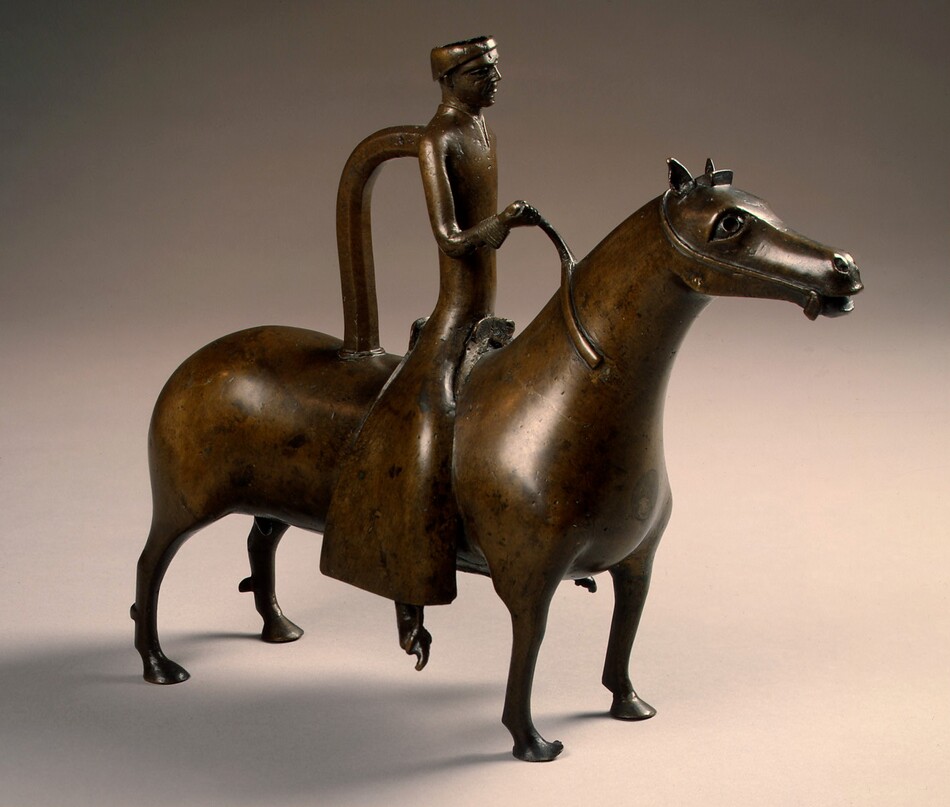
This free-standing bronze sculpture shows the rounded, stylized forms of a person with long limbs riding astride a horse with noticeably short legs. The horse and rider are angled to our right in this photograph. The dark brown bronze gleams white where the light catches the smooth surfaces, and some areas are a burnished gold color. The horse looks ahead with large eyes. It has short ears, and its mouth is parted. The person riding the horse holds the reins with the right hand, closer to us. The reins wrap halfway around the horse’s neck and are then broken off. The cleanshaven rider has a heavy brow ridge and a long, straight nose. He wears a flat-topped cap and a robe that reaches to his ankles. The pointed toes of his shoe pokes through the small stirrup we can see. A rounded handle connects the rider’s upper back to the back of the horse. The background is taupe-gray behind the sculpture and darkens at the upper corners.

Aquamanile in the Form of a Horseman

English 13th Century, Scandinavian 13th Century

13th century

Bronze  Accession ID  1942.9.280

On View: West Building Ground Floor, Gallery G18
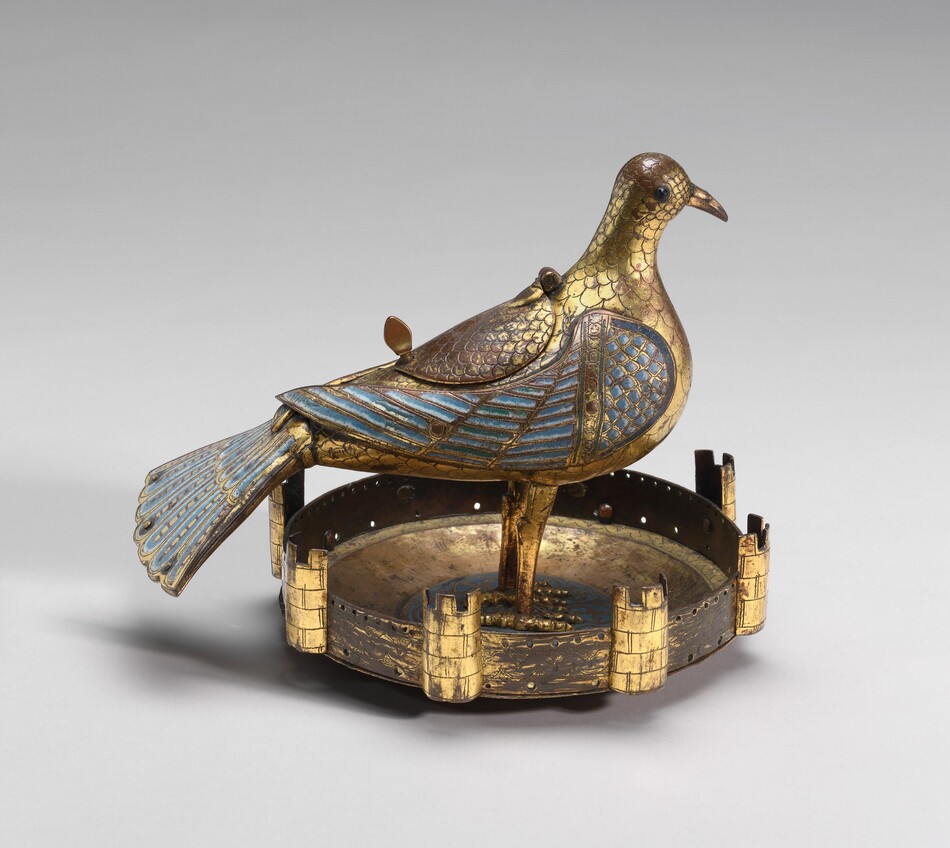
The sculpture depicts a bird crafted from golden metal and decorated with colored enamel. The bird faces the right with its wings tucked in to its body, perched atop a circular base with gold embellishments. The metal bird has detailed blue and green enamel work on its wings and tail.

Pyx in the Form of a Dove

French 13th Century

c. 1220/1230

Gilded copper with enamel  Accession ID  1942.9.284

On View: West Building Ground Floor, Gallery G18
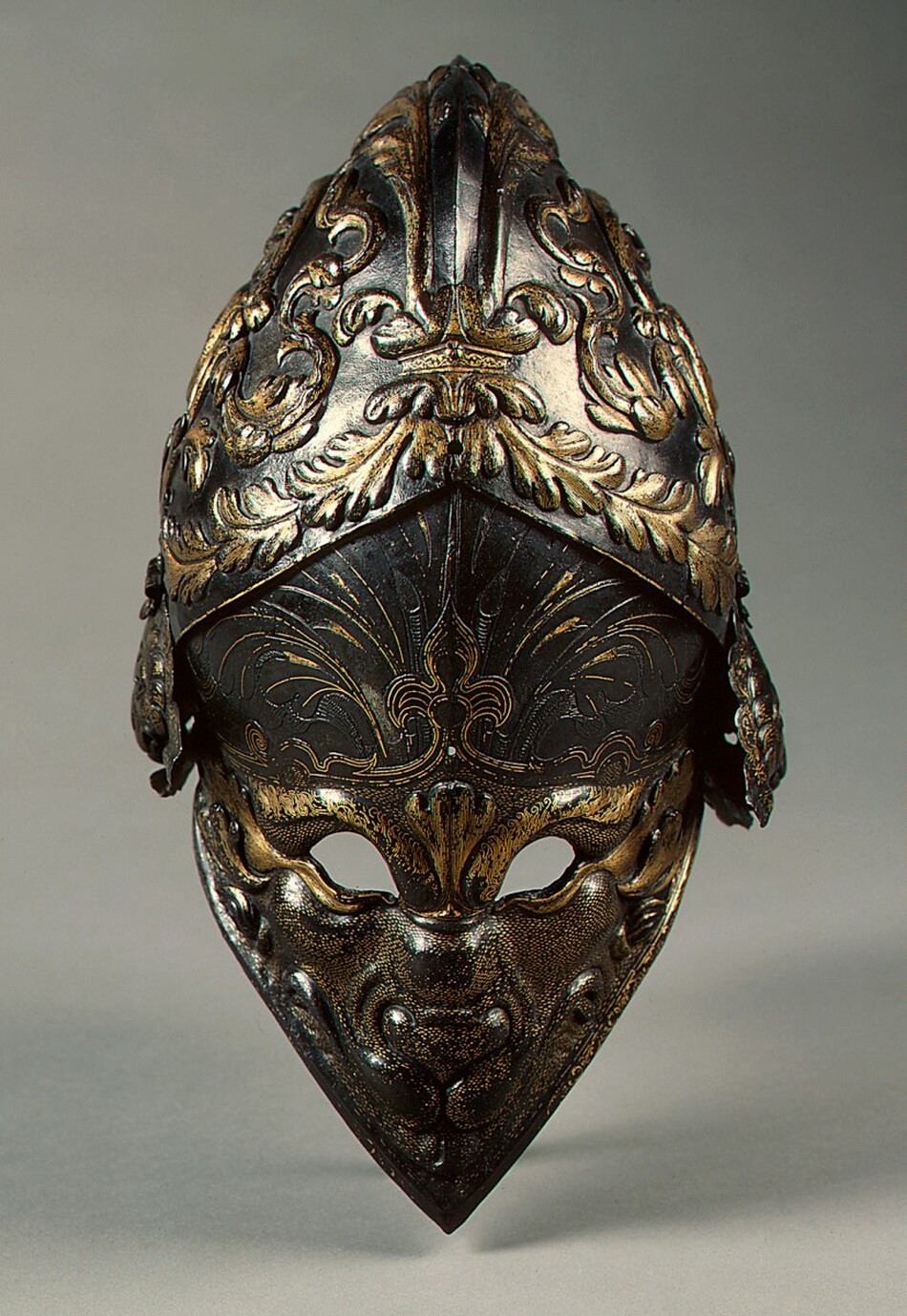
This is an ornate helmet made of dark metal with gold-colored details. It features intricate designs and patterns throughout, including symmetrical swirling and floral designs, as well as designs on the faceguard that look similar to an animal’s face, including a snarling mouth and eye holes. The lighting emphasizes the embossed and engraved elements of the helmet.

"The Morosini Helmet" (visored burgonet)

Milanese 16th Century

probably 1550/1560

Repoussé and embossed iron or steel, with gilding and silvering  Accession ID  1942.9.356

On View: West Building Ground Floor, Gallery G19
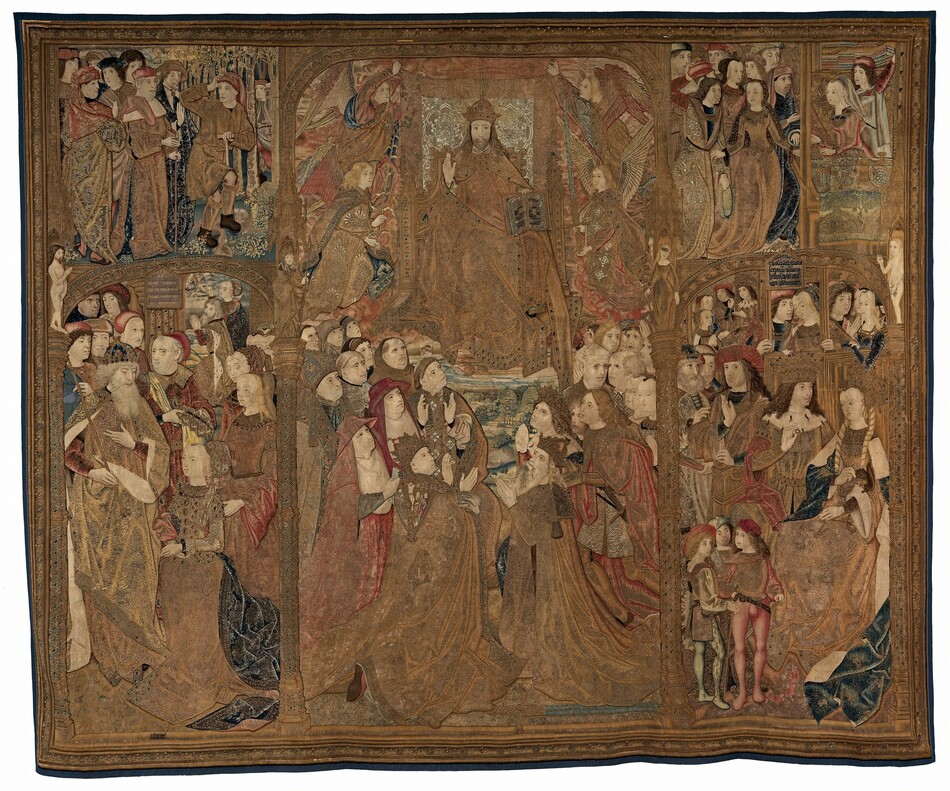
This horizontal tapestry is divided into three vertical sections by architectural columns and arches. The center column is a little wider than those to either side, but all three sections are packed with people, all with ivory-white skin. In the center column, a crowned Jesus is seated on a throne at the top center. His elaborately patterned robe falls in folds down past his feet. He hovers above a landscape view, which is flanked in the foreground by groups of men and women. About a dozen people are clustered on each side, many of them looking up at Jesus, and most of them wearing religious garments that range from monks and nuns to cardinals and bishops. Two crowned men kneel to our right in the center panel, their hands pressed together in prayer. Each column on either side of the central panel is divided so there is a smaller vignette above taller vignettes below. Large groups of people gather in each scene. Much of the tapestry’s surface is now brown, but it is punctuated throughout with patches of rust red, sky blue, and pale yellow.

The Triumph of Christ ("The Mazarin Tapestry")

Netherlandish 16th Century

c. 1500

Tapestry: undyed wool warp; dyed wool, silk, and silver-gilt- and silver-wrapped silk weft  Accession ID  1942.9.446

On View: West Building Ground Floor, Gallery G19

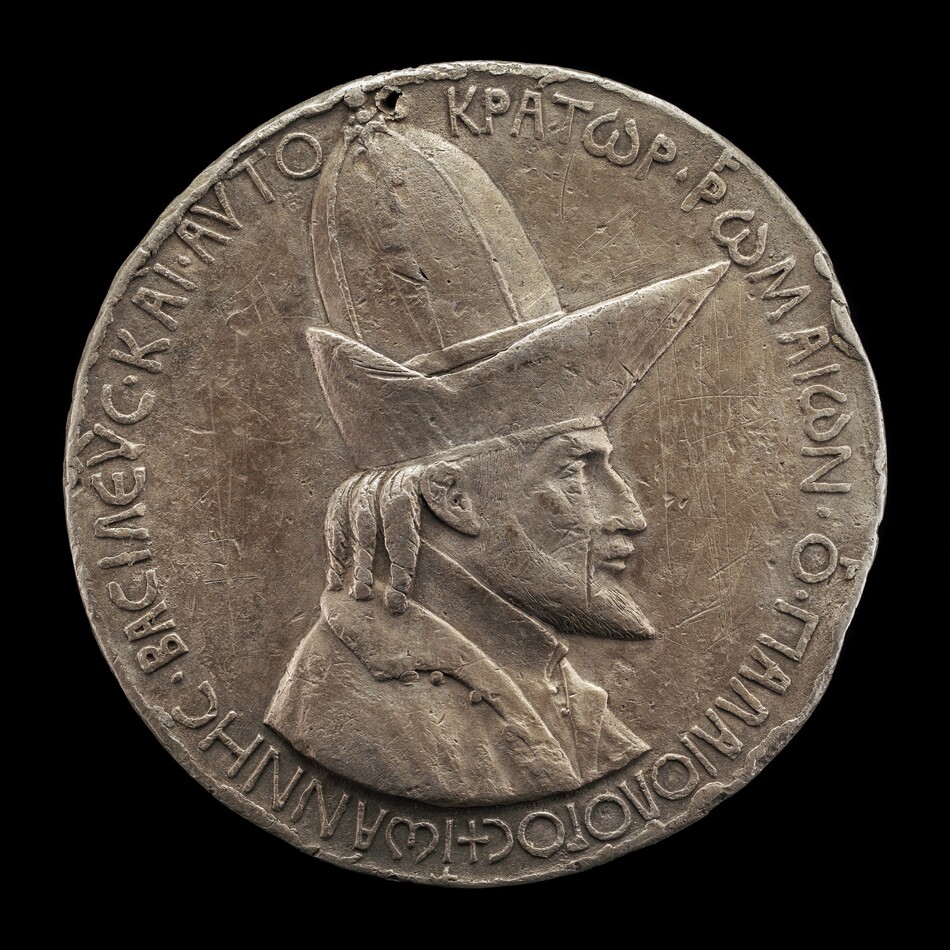
John VIII Palaeologus, 1392-1448, Emperor of Constantinople 1425 [obverse]

Pisanello

1438/1439

Lead//trial cast, possibly  Accession ID  1957.14.593.a

On View: West Building Ground Floor, Gallery G16
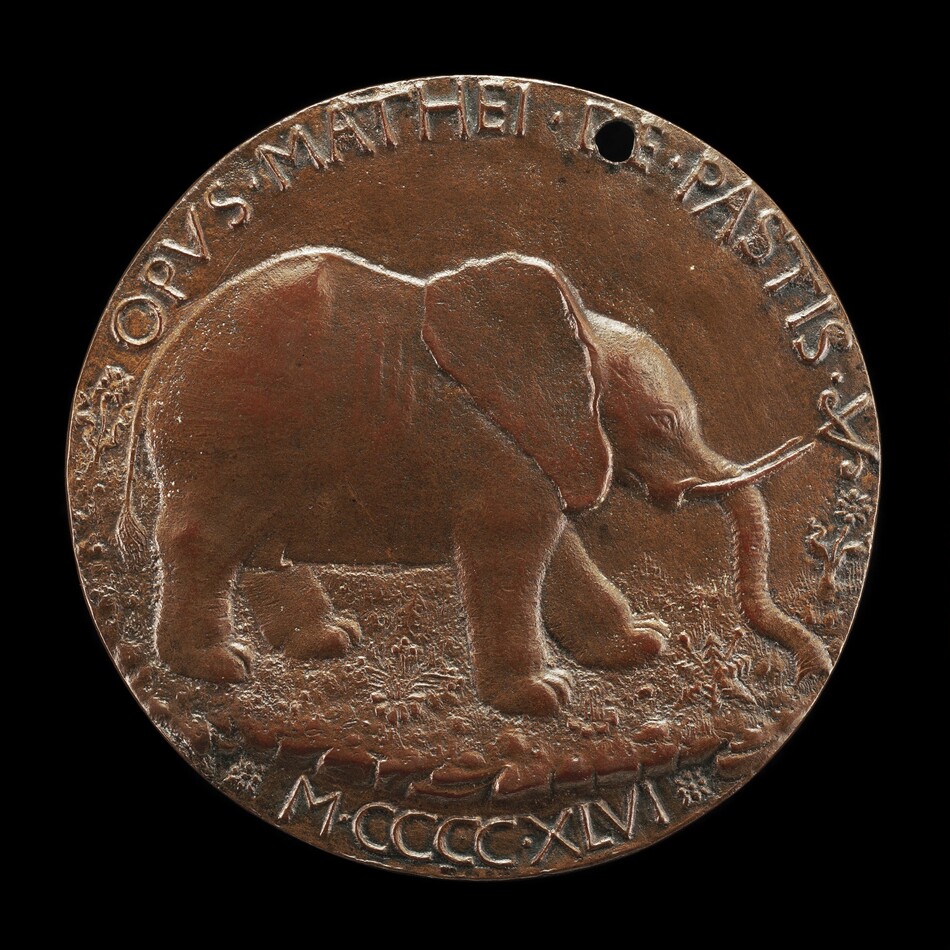
The sculpture is a round medallion featuring a raised depiction of an elephant as its centerpiece. The elephant is portrayed with its trunk pointed upwards, large ears, and sturdy legs. The piece is crafted from bronze, giving it a reddish-brown color. The flat medallion has engravings of the elephant and surrounding surface, including text around the perimeter. A small hole is present near the edge of the medallion. The sculpture showcases detailed texture and posture of the elephant, offering a sense of dimensionality to the flat medium.

The Malatesta Elephant in a Meadow [reverse]

Matteo de' Pasti

c. 1450

Bronze  Accession ID  1957.14.651.b

On View: West Building Ground Floor, Gallery G16
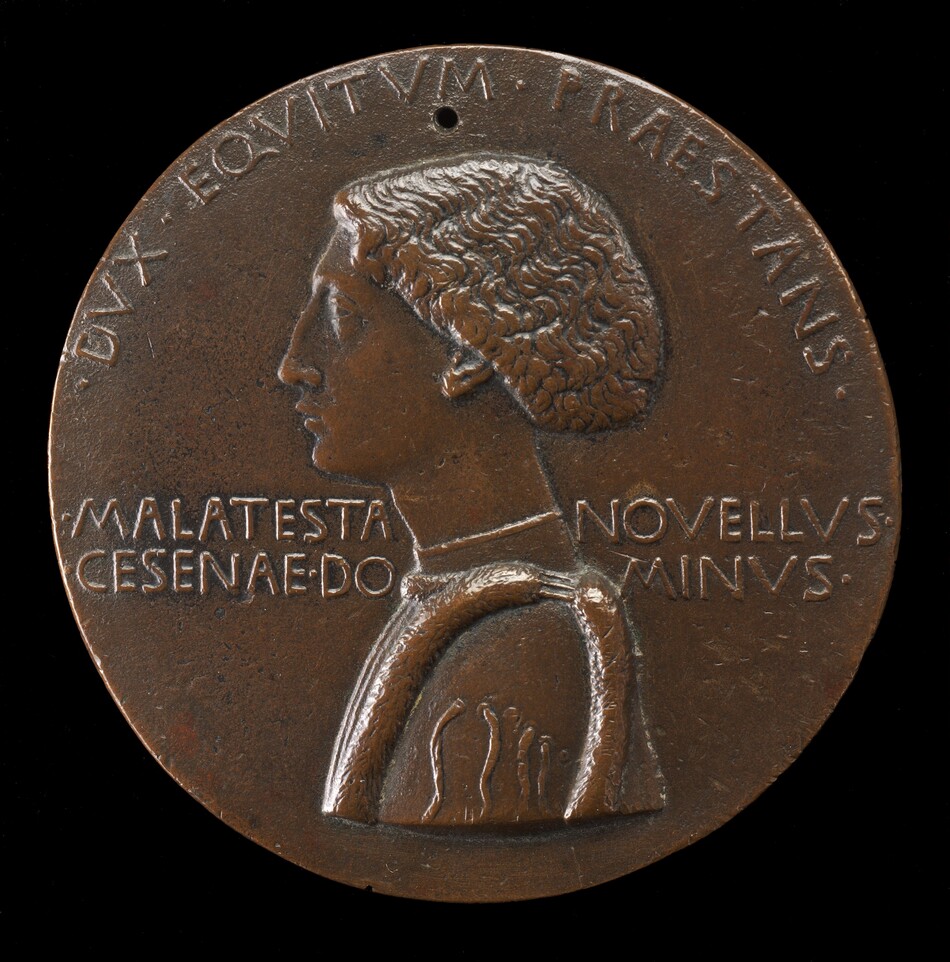
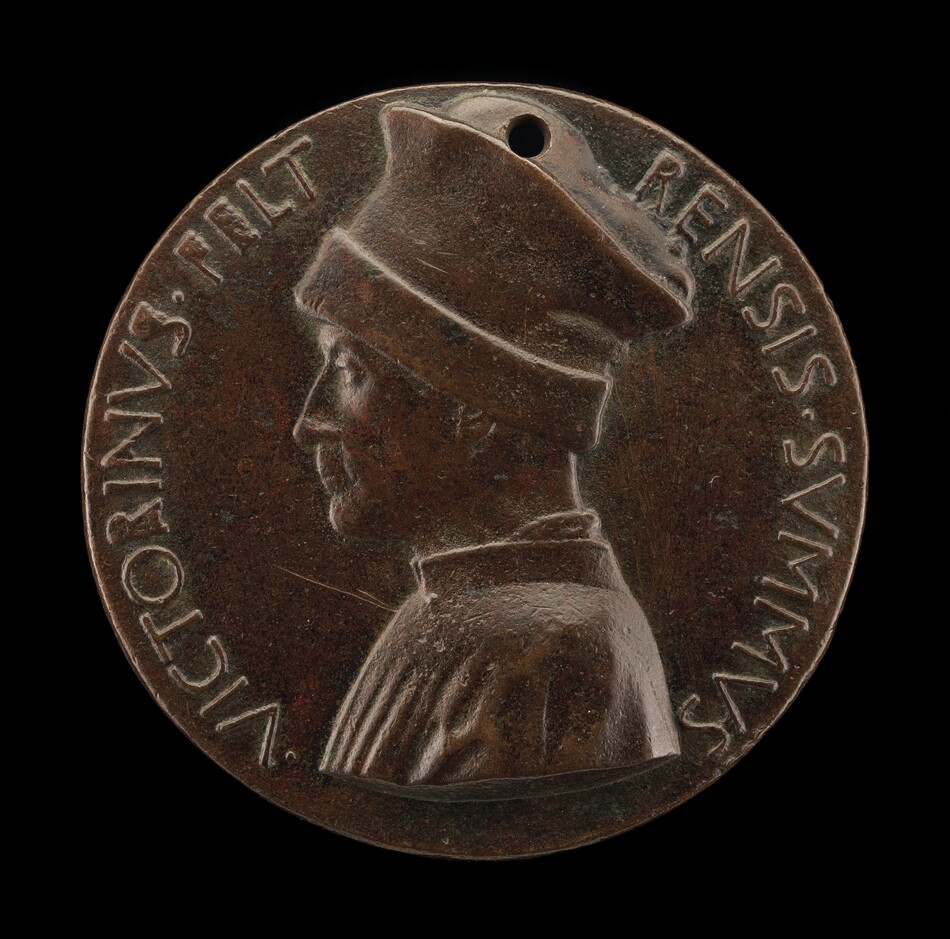
The sculpture is a round medallion featuring the profile of a man facing to the left. The subject is depicted wearing a voluminous hat that wraps around the head and extends upward, as well as a garment with a high collar. The medallion is dark brown in color. The surface is slightly reflective. The edges of the medallion are inscribed with text. There is a small hole at the top of the medallion. The medallion appears to be a flat, circular form with a relief of the figure and inscriptions carved into it.

Vittorino de' Rambaldoni da Feltre, 1379-1446, Humanist [obverse]

Pisanello

c. 1446

Bronze  Accession ID  1957.14.610.a

On View: West Building Ground Floor, Gallery G16

Loading Results