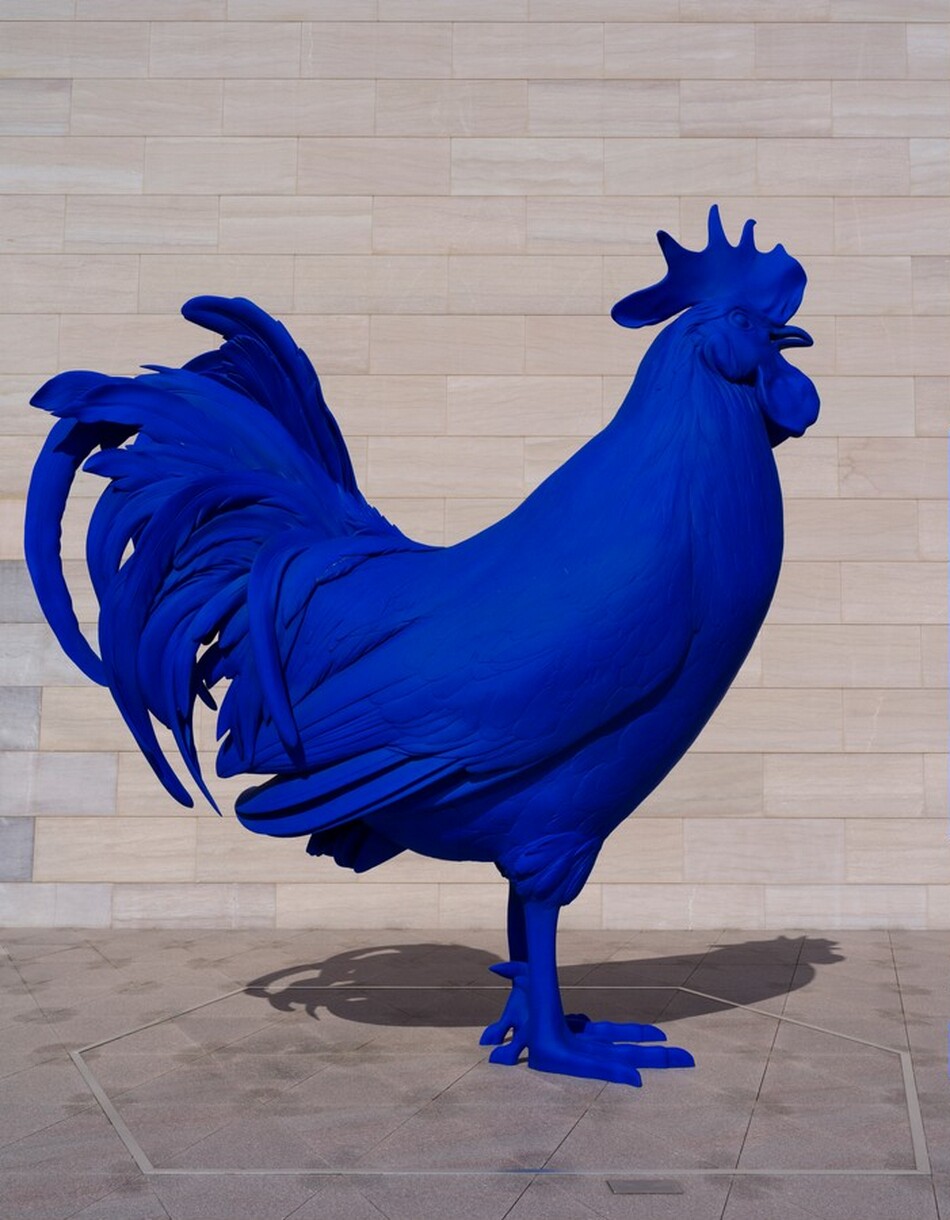
This is a sculpture of a rooster that is entirely colored in flat, vibrant blue. The material of the sculpture is smooth and solid. The blue rooster is in profile, facing the right, with the comb on its head sticking up and its tail feathers fanned out. In the background is a wall made of rectangular beige stone tiles. Below the rooster’s feet is a flat stone surface with geometric patterning.
Katharina Fritsch, Hahn / Cock, 2013, painted glass fiber-reinforced polyester resin on stainless steel armature, Gift of the Glenstone Foundation in honor of the resilience of the American people during the Covid-19 pandemic, 2020.23.1

Blue

Artists turn to the color blue to conjure depth, mood, and atmosphere. It recalls both the sky and the sea. But blue pigment was sometimes costly. Ultramarine blue was made from lapis lazuli, a semiprecious stone mined in what is now Afghanistan. For centuries of Western art, it was reserved solely for painting the Virgin Mary’s cloak. 
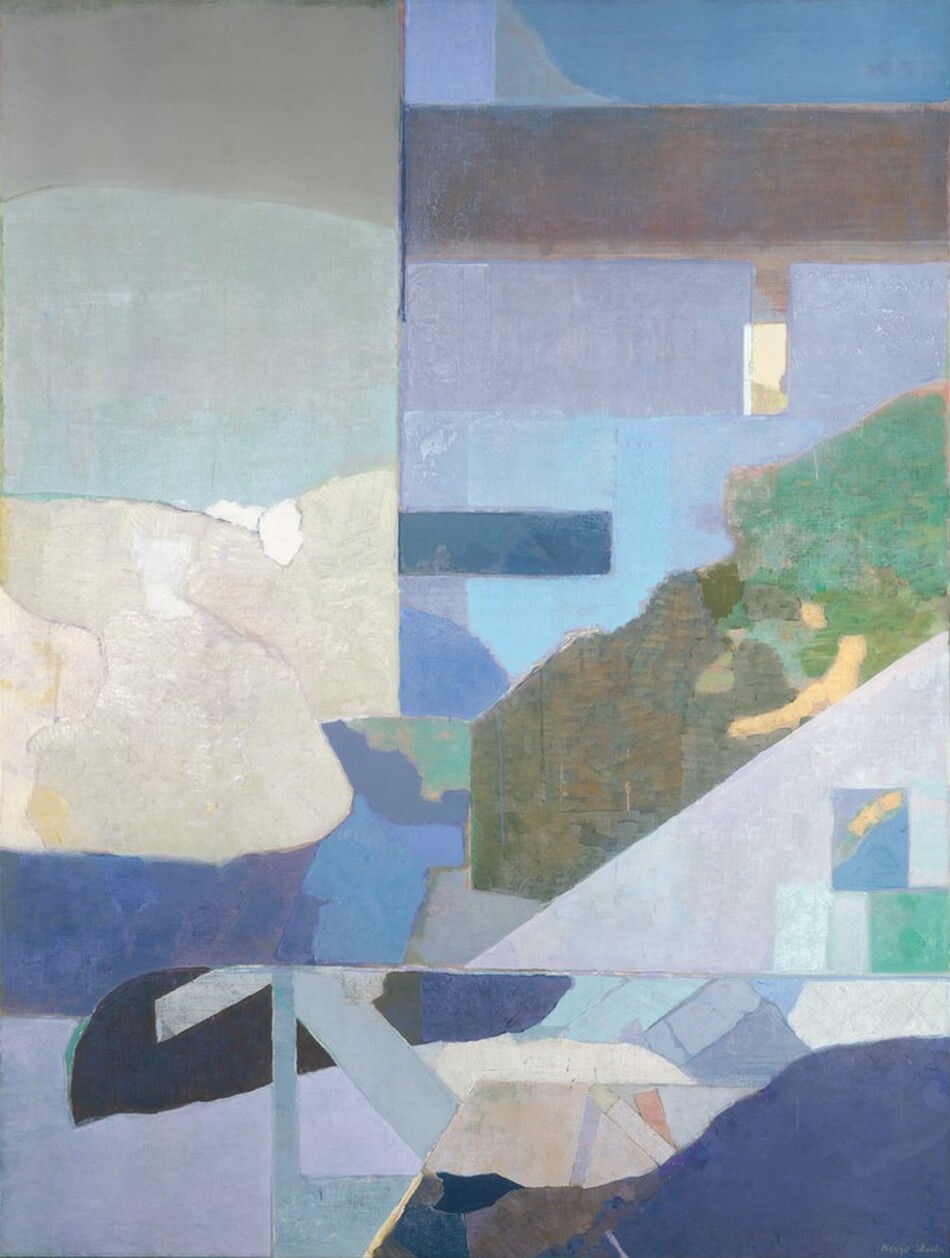
  • This painting showcases a composition of overlapping geometric shapes including rectangles, triangles, and irregular polygons. The shapes are mostly in shades of soft blues, greens, and grays, with a few patches of tan and brown. The shapes have soft edges, some blending together. The collection vaguely resembles a landscape seen from above, similar to an aerial view of fields or a coastline.
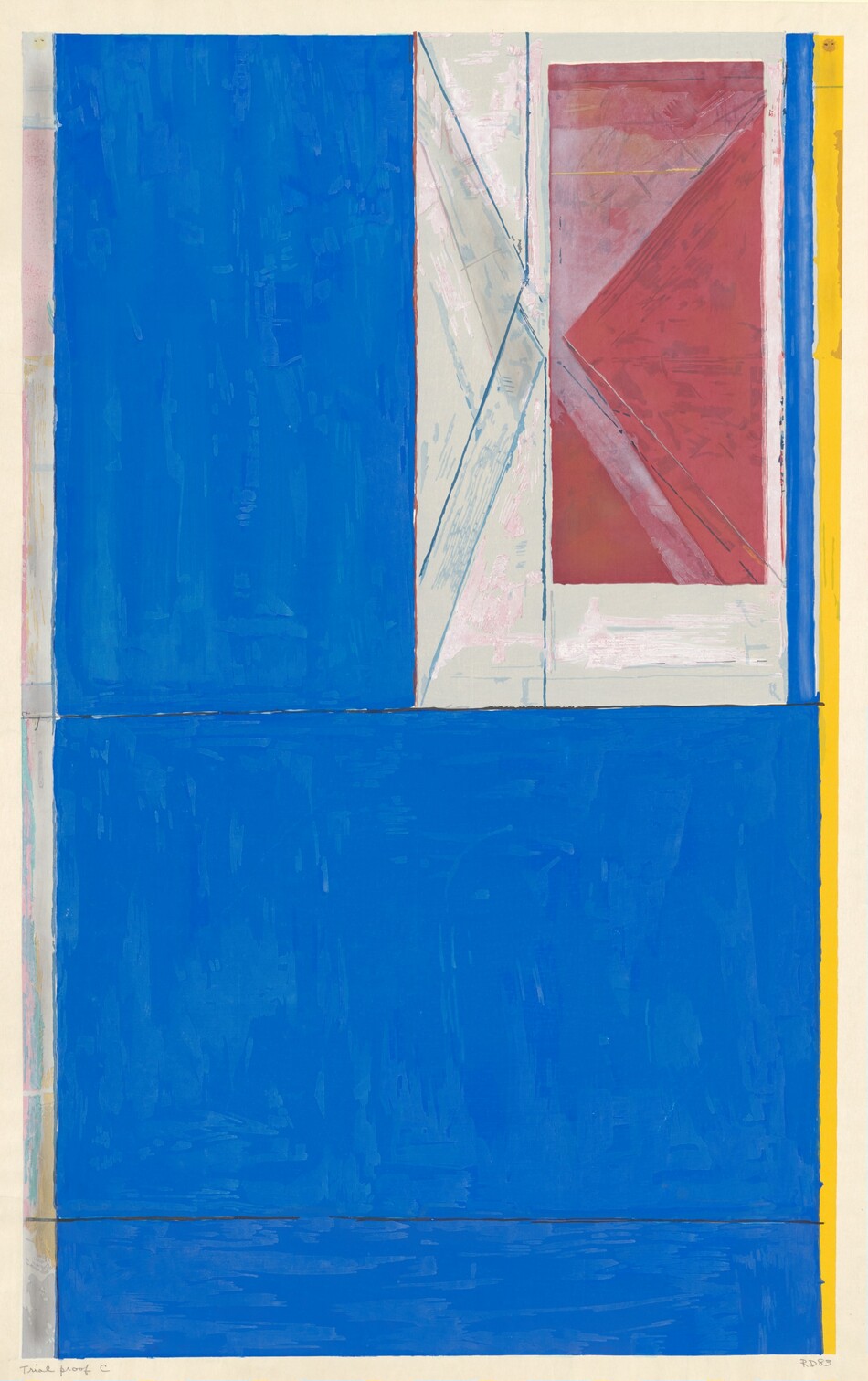
  • A vertical print that’s largely made up of the color blue. Made with color woodcut technique. A wood pattern is seen across all the colors. In the top-right portion of the composition, occupying almost a fourth of the paper, is an off-white vertical rectangle, with a smaller red vertical rectangle positioned within it to the right. A sheer white is layered over the red, creating a triangle on the top of the red, with the hypotenuse running from the top right corner of the red rectangle to the middle of the rectangle on the left. Another sheer stroke extends from this midpoint to the bottom of the red rectangle, creating half an “X” ; this “X” shape is reinforced by thin dark blue lines on the white rectangle. There is a thin, dark blue line running vertically through the white rectangle, connecting to the other dark blue lines. Two dark blue lines run horizontally under the white rectangle, and one an equal distance away from the first dark blue line as the first one was to the top, leaving a smaller, but still sizable piece at the bottom. These dark lines extend onto the left of the rectangle where a thin strip of a mix of light colors is, but not onto the right of the blue rectangle where a thin yellow strip is. On the paper itself under the blue rectangle, and these thin strips there is black text on the left and right, both are illegible.
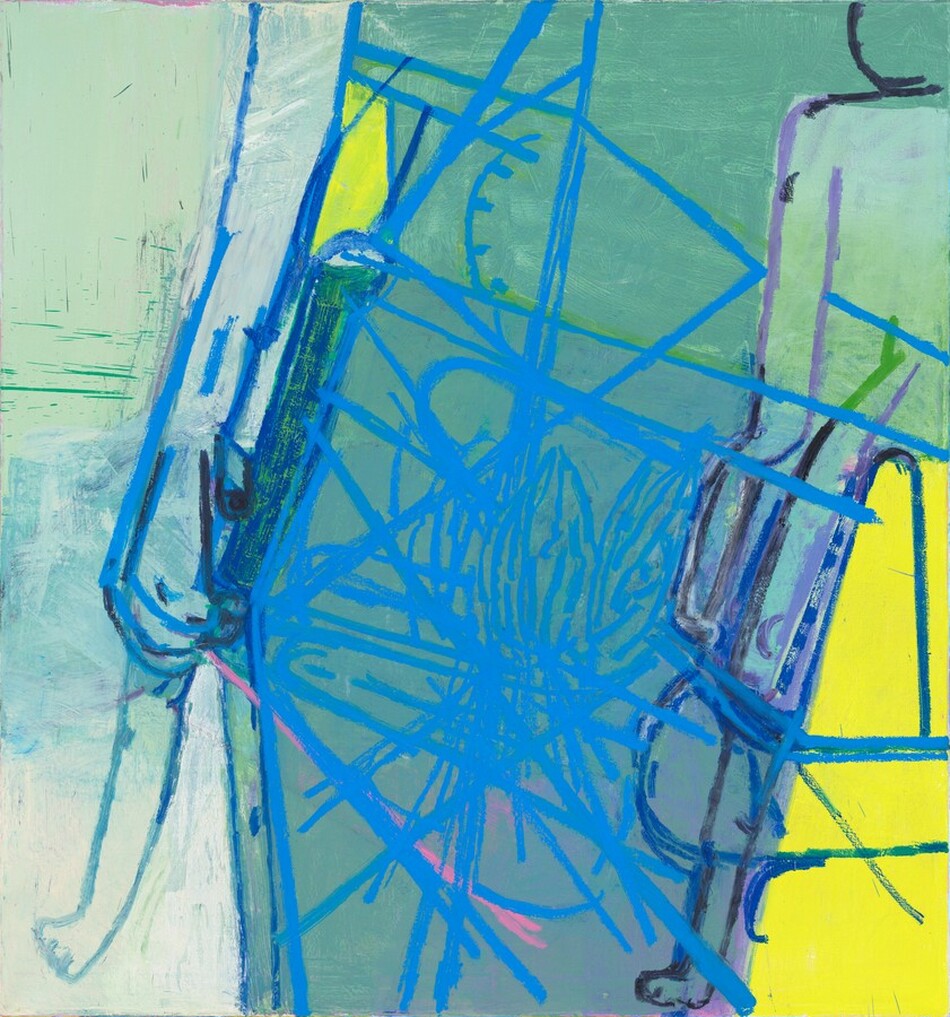
  • This painting shows intersecting blue lines on a green, blue, and yellow background. The lines create a network of abstract shapes resembling human figures, with partial arm and leg outlines on the left and right. The shapes and colors overlap, with the bright yellow sections standing out. The brushstrokes in the painting are thick and visible.
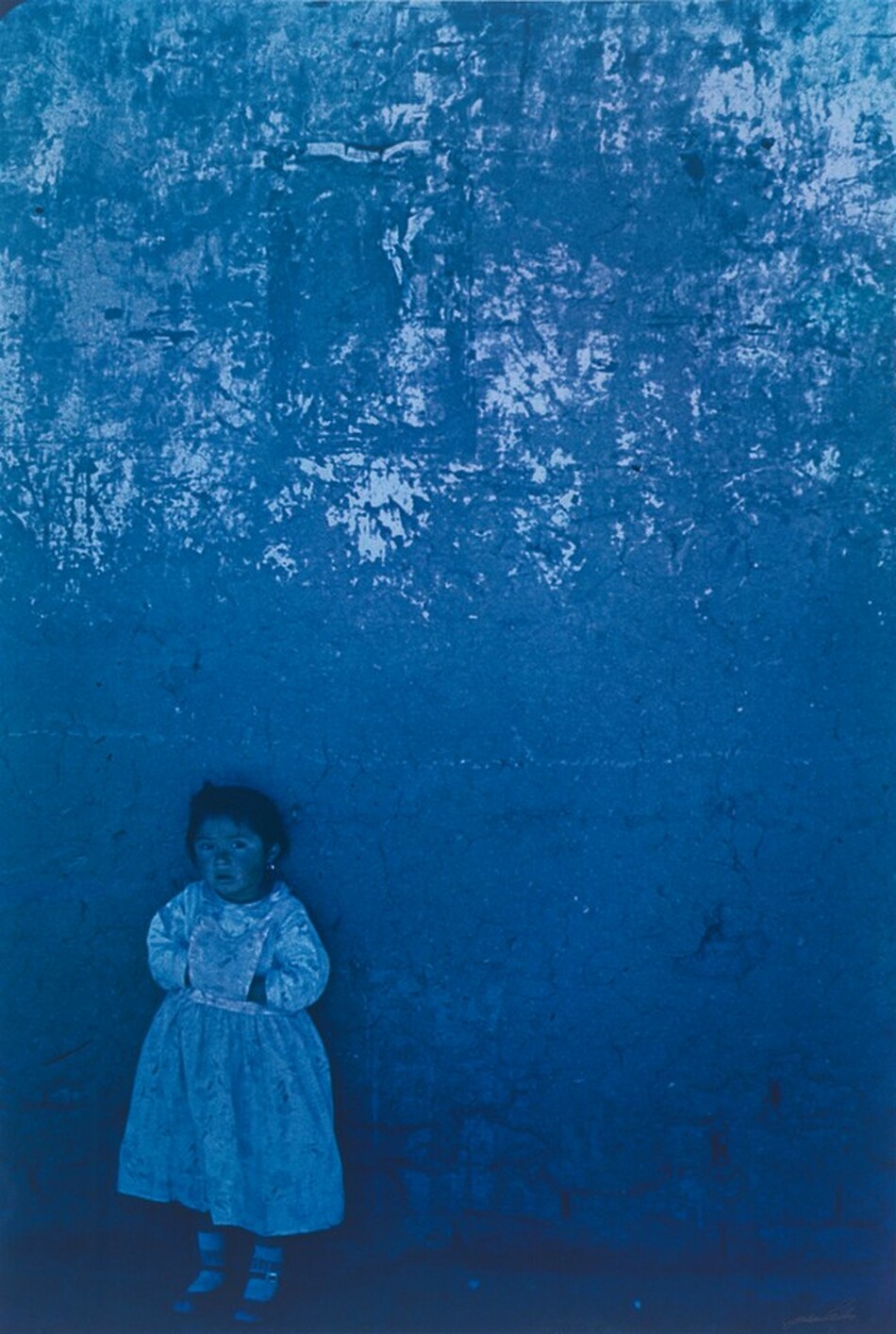
  • The image depicts a young child standing against a textured wall. The child has a round face with short, dark hair and is wearing a long, light-colored dress, white socks, and dark shoes with a strap across the top. The background is a roughly textured wall with a patchy, distressed surface in a blue tone.
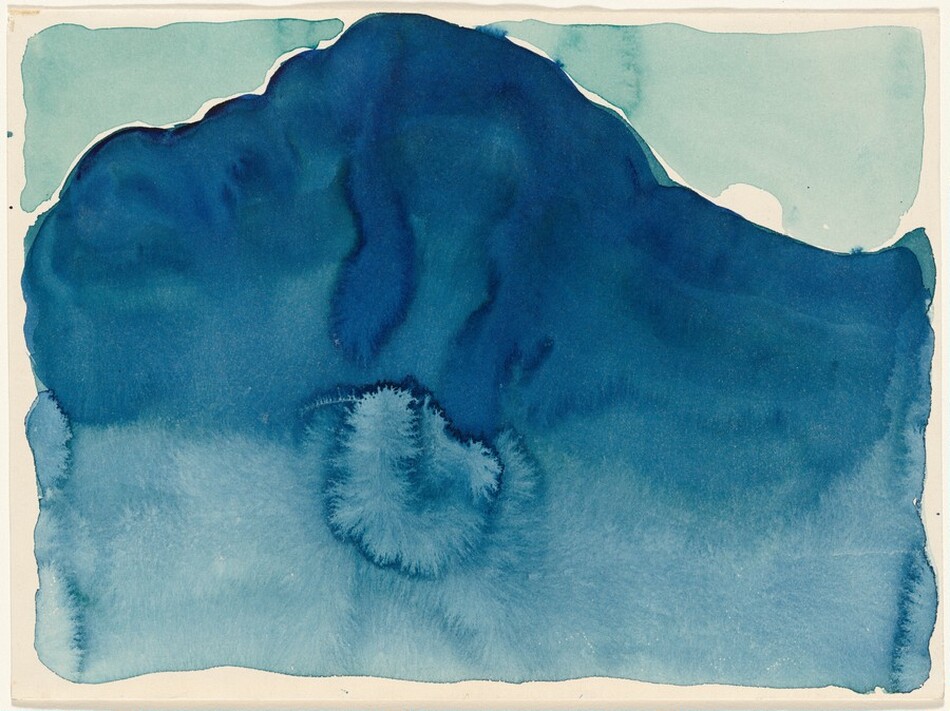
  • Pools of sapphire, aquamarine, and cobalt-blue watercolor puddle and bleed together in this abstract painting on paper. Most of the horizonal sheet is taken up with a dark blue form reminiscent of a hill. The upper corners of the sheet are painted powder blue, suggesting sky. The sheet is edged with the white of the paper, and the darker and lighter blue areas are also mostly separated by a thin white line.
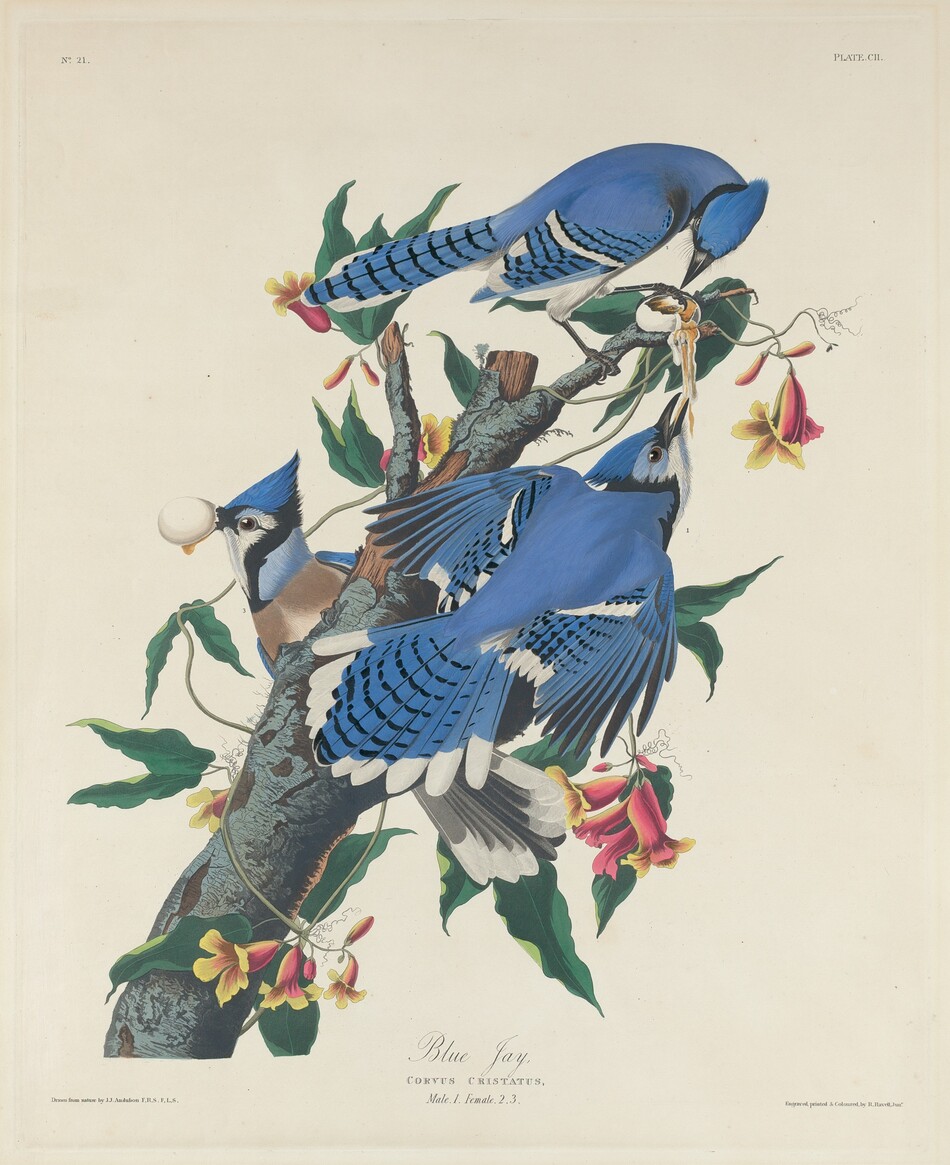
  • This is a print of three blue jays perched on a branch. The birds have bright blue plumage with small areas of white and black, and they are depicted on a gray branch adorned with green leaves and yellow and pink flowers. The topmost bird is using its beak and foot to break open a small white egg, yolk dripping down towards a second bird below that has its wings partially extended and its beak open. The third bird on the left holds a second egg in its mouth. The background behind the birds and branch is off-white paper.
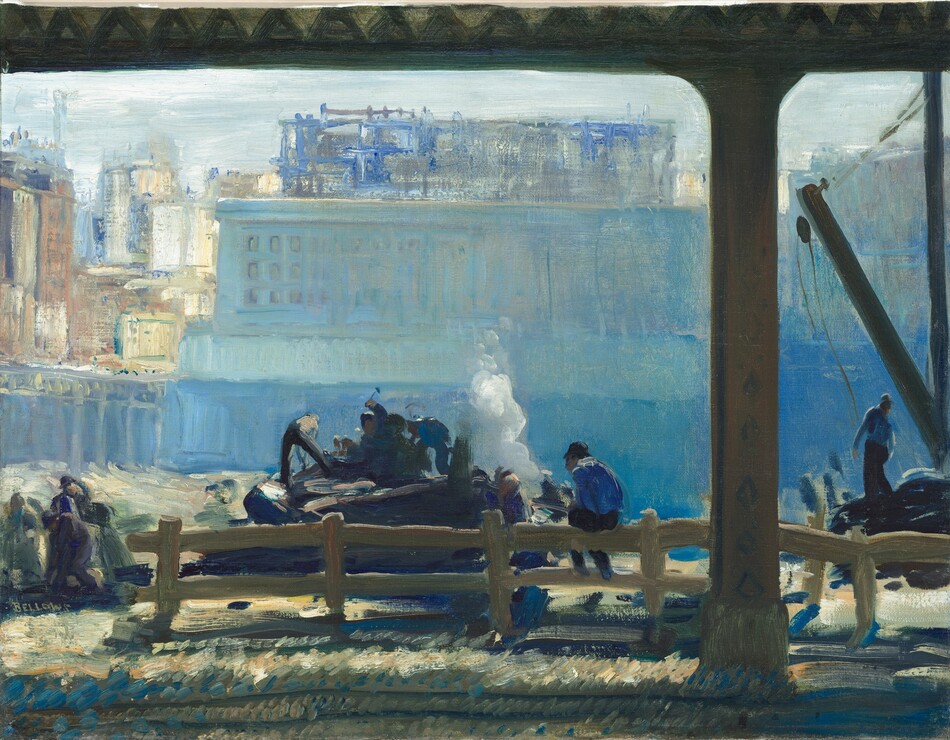
  • From under an elevated train track, we look at a cluster of people hammering and working on the far side of a wooden fence, all against a silvery-blue building that fills most of the background in this horizontal painting. The scene is loosely painted mostly in tones of hazy and saturated blues, so many of the details are indistinct. About a quarter of the way in from the right edge of the composition, a thin iron column holds up the train platform. The column nearly spans the height of the painting, and the track it supports runs across the top edge of the canvas. At the foot of the column, along the bottom edge, are two parallel tracks embedded in an area otherwise painted with short, diagonal strokes in topaz blue, olive green, and straw yellow. Just beyond the tracks, the split-rail wooden fence runs across most of the painting, though there is an opening at the left edge of the canvas. A man sits with his back to us on the railing to our right of center. He wears a dark cap, a lapis-blue shirt, and navy-blue pants. Several men work on or near a mound-shaped form, perhaps a piece of machinery, just beyond the fence, near the center of the painting. One man holds a hammer high overhead while another reaches down or strikes the mound with his feet planted wide. More people work together to our left, and a man to our right stands near a crane. The people and these areas are painted with broad strokes and touches of cobalt blue, charcoal gray, khaki brown, and a few swipes of shell pink and bright white. A puff of white smoke billows up behind the central group, before the land drops precipitously away. The chasm is painted with shimmering tones of aquamarine and cerulean blue. A sky-blue, rectangular building perches at the far edge. A few windows are outlined in royal blue to our left but the rest of the building is loosely painted with long, vertical strokes so no architectural details can be made out. Behind this structure are more city buildings, suggested with strokes of muted rust red, parchment and bright white, and cobalt blue. The ice-blue sky fills the band between the top of the buildings and the train track running overhead. The artist signed his name near the lower left corner, “BELLOWS.”
  • This is a sculpture of a rooster that is entirely colored in flat, vibrant blue. The material of the sculpture is smooth and solid. The blue rooster is in profile, facing the right, with the comb on its head sticking up and its tail feathers fanned out. In the background is a wall made of rectangular beige stone tiles. Below the rooster’s feet is a flat stone surface with geometric patterning.
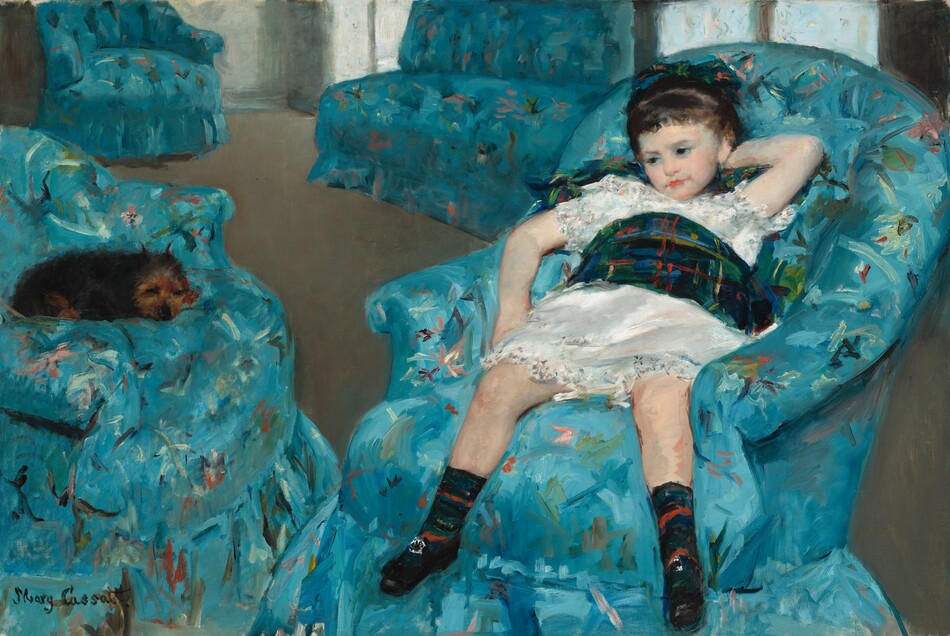
  • A small brown dog and a pale-skinned little girl wearing a white dress sit in matching celestial-blue armchairs in this horizontal painting. To our right, the girl sits with her legs angled to our left. She slumps back with her legs spread, and her left elbow, on our right, is bent so that hand rests behind her head. Her other elbow is draped over the armrest. Her dark brown hair appears to be pulled back, and tawny brown eyes under faint brows gaze down and to our left. She has a small nose set in a round face and a coral-pink mouth closed in a straight line. Her white dress has touches of gray, soft pink, and powder blue with a wide plaid sash around her waist. The pine-green, black, and sapphire-blue sash is accented with overlapping vertical and horizontal lines of burnt orange, light blue, and mustard yellow. Her socks match her sash and come up to mid-calf, over black shoes with silver buckles. The small dog has scruffy black fur and a russet-brown face. It lies curled in the chair opposite the girl, to our left, with its eyes closed and ears pricked up. The rounded backs of the upholstered chairs curve down to become the low arms. The vivid and light blue fabric of the chairs is scattered with loosely painted strokes of avocado and forest green, peach pink, cherry red, plum purple, and white. Beyond the chairs closest to us is another armchair and an armless loveseat, both covered with the same fabric. They sit at the back of the room, in a corner flooded with silvery light coming through four windows on the right side. The furniture is arranged on a peanut-brown floor. The artist signed in the lower left, “Mary Cassatt.”
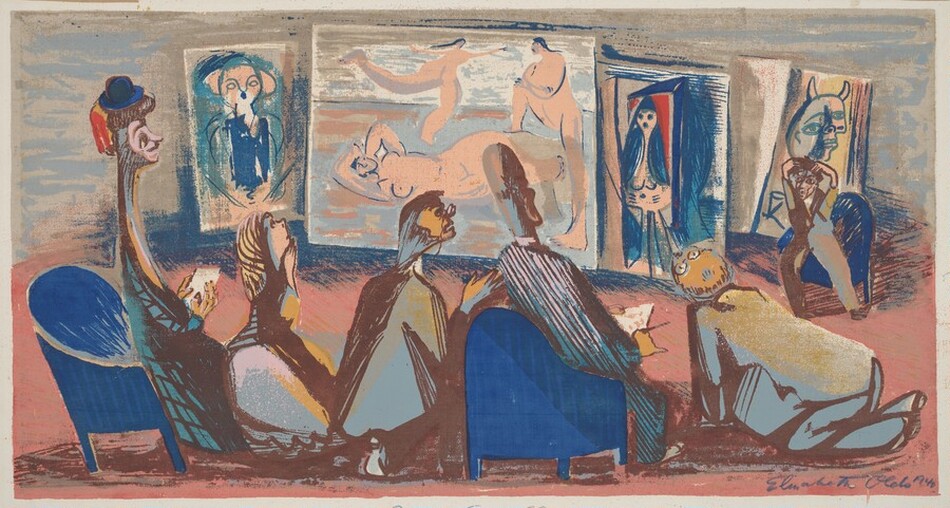
  • The image shows an abstract gathering of figures sitting or kneeling before a wall of artwork. The scene features shapes resembling people in blue chairs with exaggerated facial features and body postures. The artwork on the walls depicts abstract human forms. Contrasting colors highlight the interaction between the characters and the artwork.
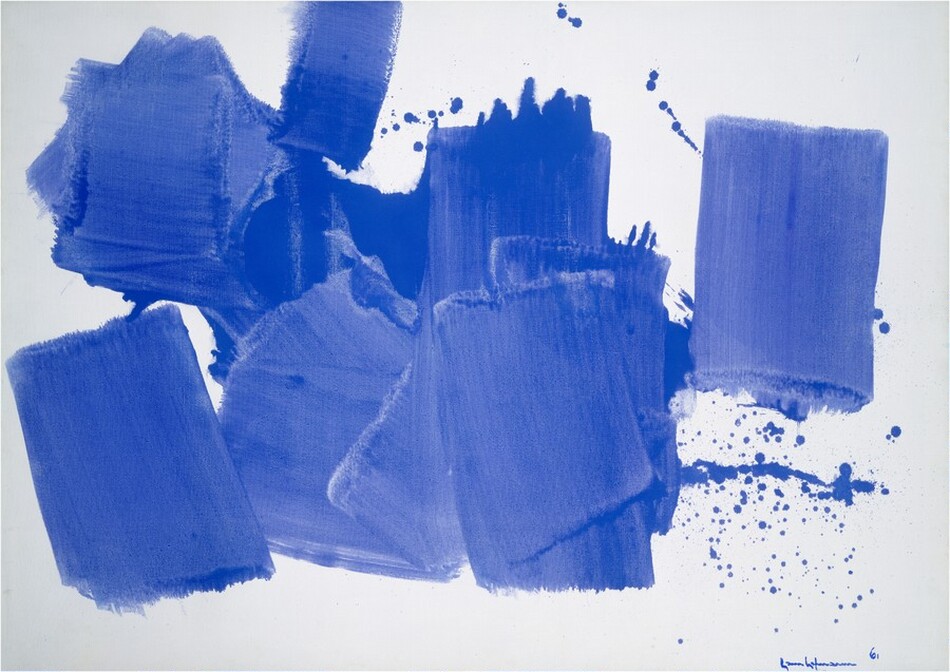
  • This painting contains overlapping blue rectangles against a white background. Each rectangle appears to be one thick brushstroke. Splattered blue paint dots are scattered around the edges of the rectangles, especially towards the bottom right corner.
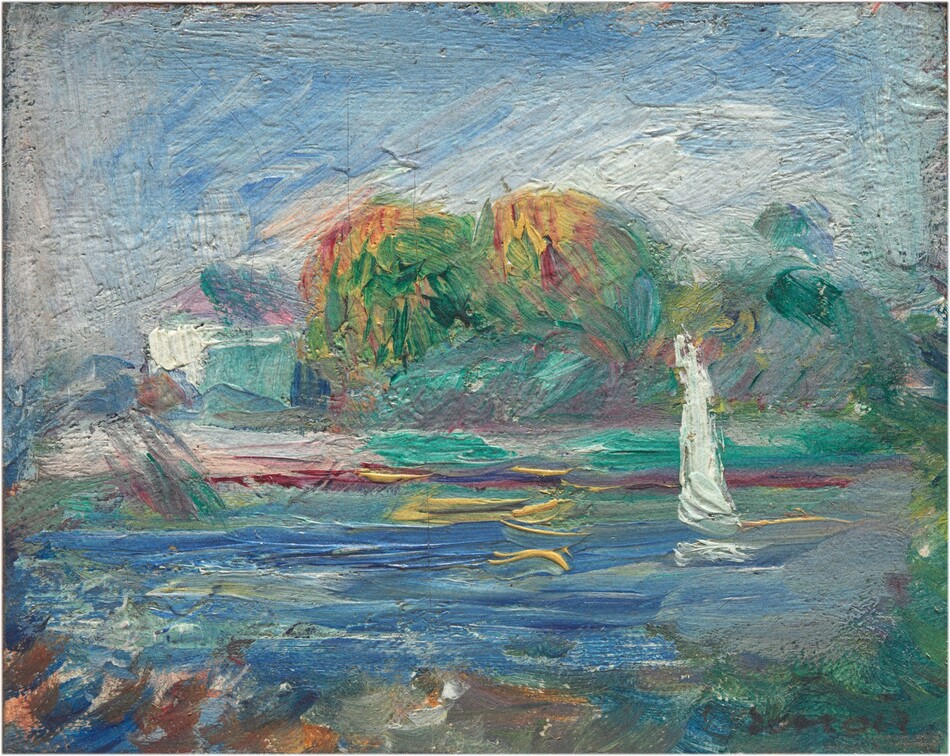
  • Jewel-toned blue, red, yellow, green, and pearl white brushstrokes swirl and stretch in this loosely painted horizontal landscape painting. The thick texture of the paint throughout evokes the sense of touch, even in this digital reproduction. Cobalt-blue streaks nearly fill the lower half of the composition. Terracotta-orange dabs in the lower left corner suggest rocks and blocky strokes of green in the lower right vegetation. An elongated white triangle to our right in the blue area suggests a sailboat. The far riverbank is painted with thin bands of ruby red, grapefruit pink, and teal green. Trees painted as puffy forms above are layered with wine red, forest green, and canary yellow. Yellow streaks in the water below suggest reflections. The sky is a patchwork of white, azure blue, and touches of lavender purple. The artist signed the lower right corner, “renoir.”
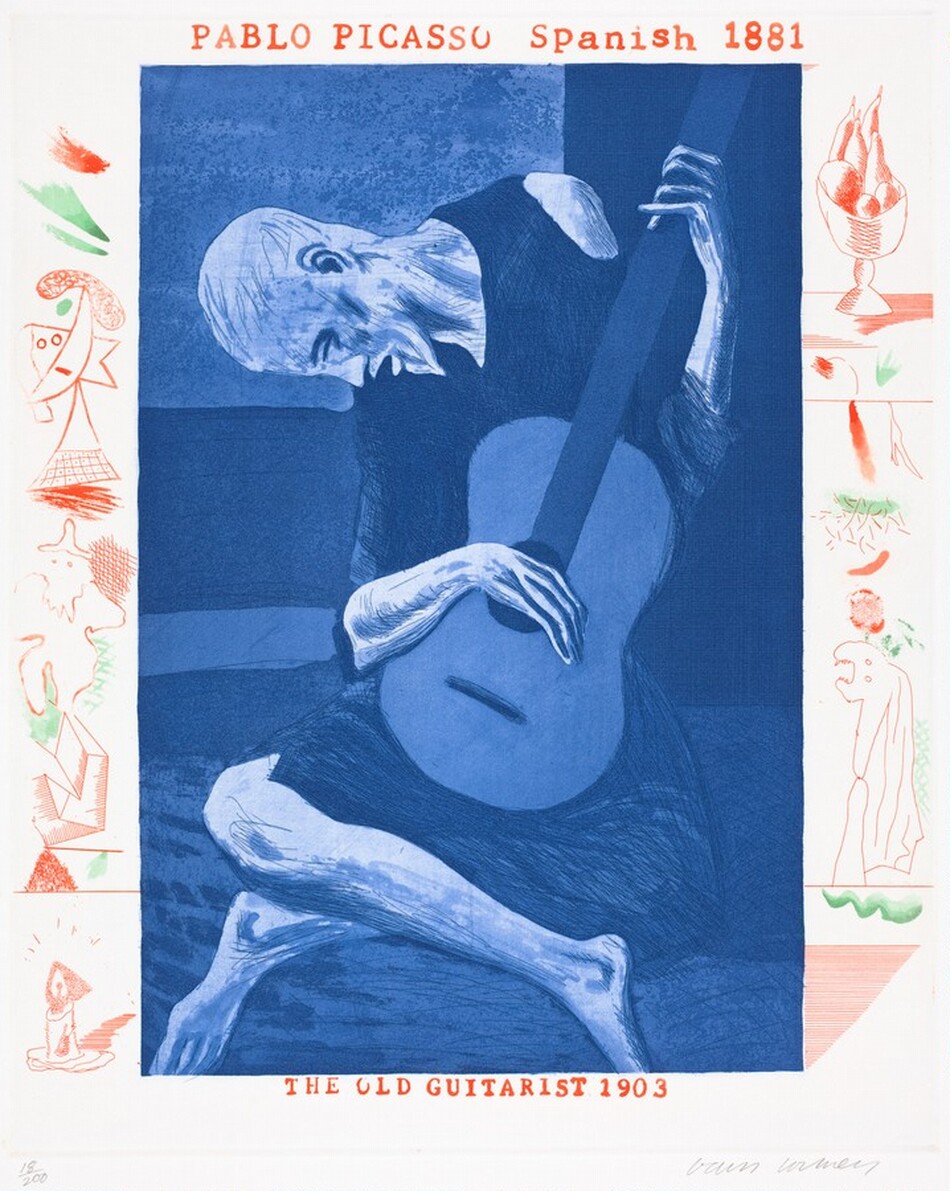
  • This print shows an elderly person playing guitar. The person is seated and wearing loose-fitting clothing. They appear to have a gaunt face and a bald head. The individual is barefoot and has one leg crossed over the other, with their head bent down and one shoulder raised up. Their skin is pale blue, and the background and the guitar are in darker shades of blue. Surrounding this central print is a background with decorative elements in orange and green. Text on the top and bottom reads, "PABLO PICASSO Spanish 1881" and "THE OLD GUITARIST 1903."
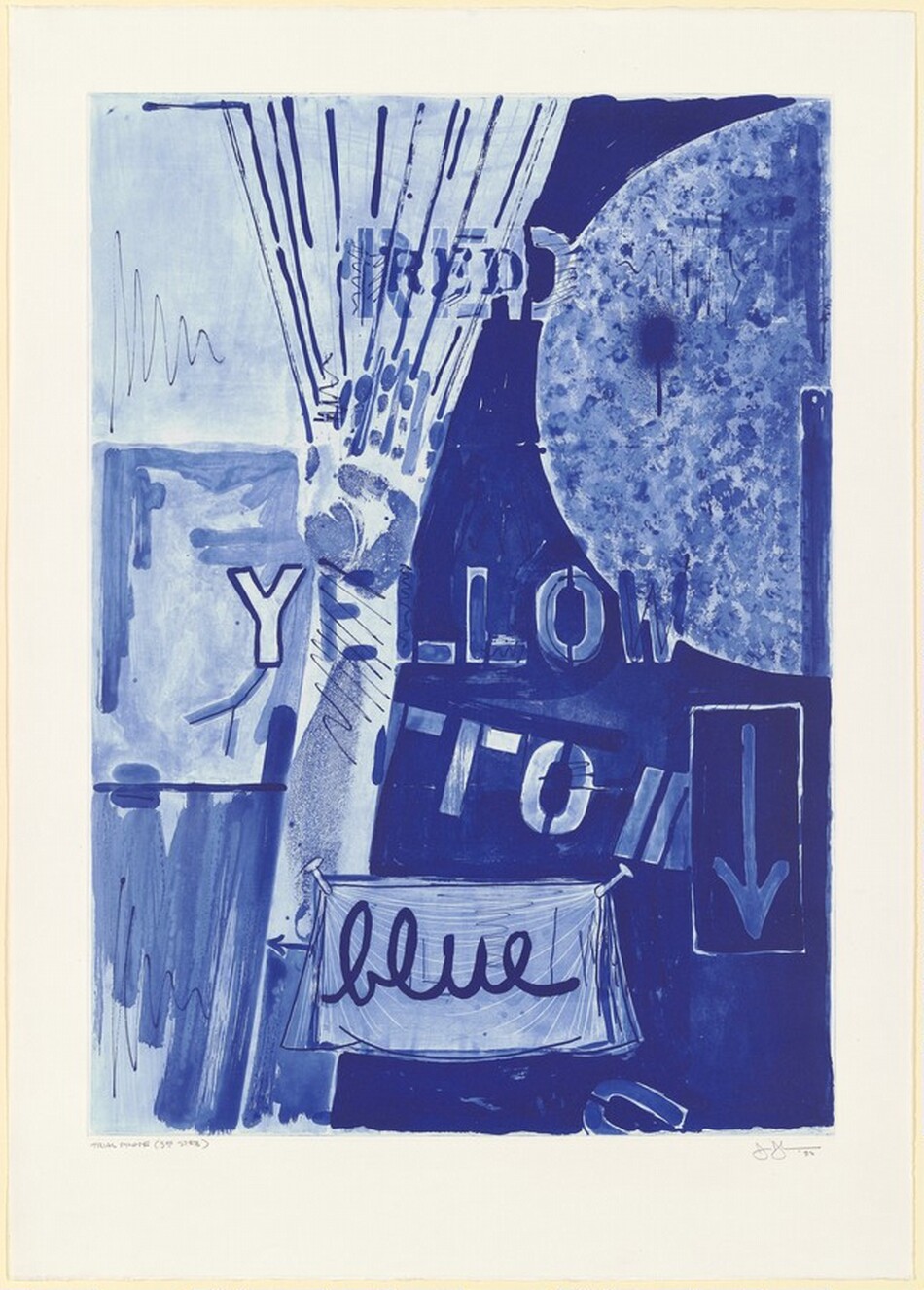
  • This abstract image features bold, angular shapes and dynamic lines creating an energetic composition. The artwork includes a large circular form on the right, straight lines, and a mix of partially legible words including "YELLOW" and "RED". An arrow points downward in the bottom section, with the word "blue" displayed on a banner-like shape. Lines fan out from the top, suggesting beams of light or motion.

Explore more

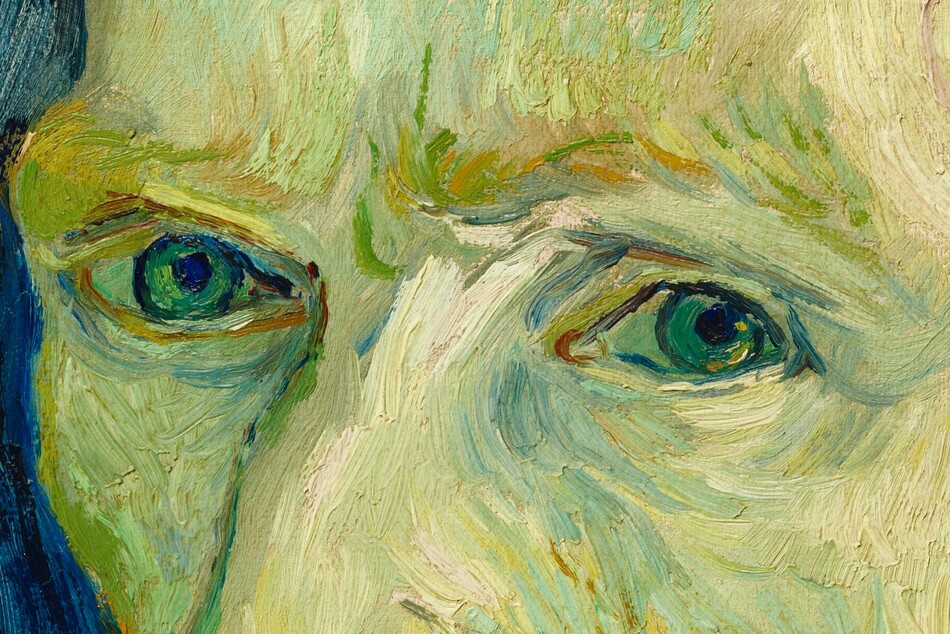
Shown from the chest up, a man with short, orange hair and green-tinted, pale skin looks at us, wearing a vivid blue painter's smock in this vertical portrait painting. His smock and the background are painted with long, mostly parallel strokes of cobalt, azure, and lapis blue. His shoulders are angled to our left, and he looks at us from the corners of his blue eyes. He has a long, slightly bumped nose, and his lips are closed within a full, rust-orange beard. He holds a palette and paintbrushes in his left hand, in the lower left corner of the canvas. The background is painted with long brushstrokes that follow the contours of his head and torso to create an aura-like effect.

Interactive Article:  Understanding Van Gogh Through One of His Final Self-Portraits

The artist painted the turbulent work as he recovered from a mental health crisis. 
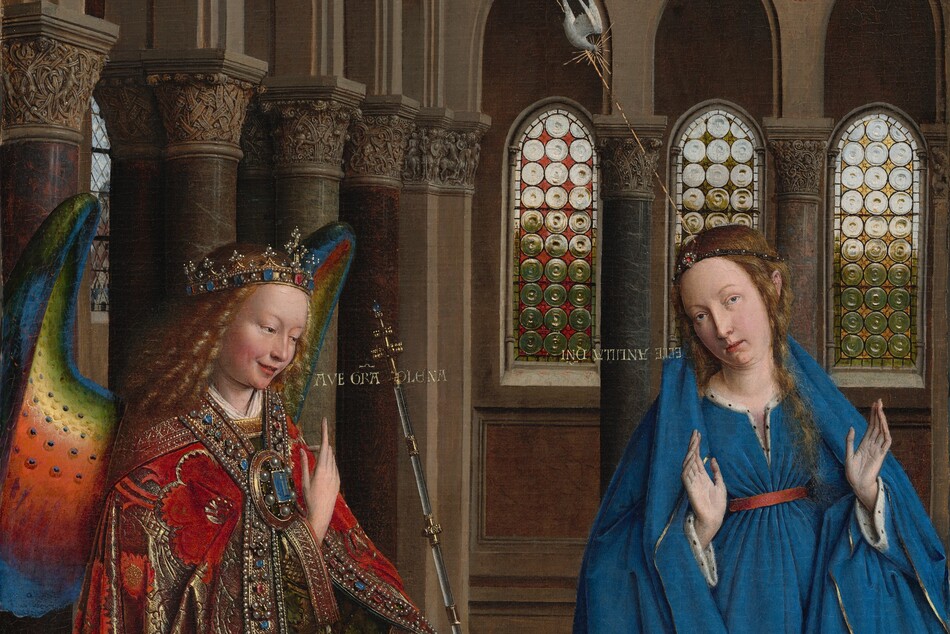
A woman and winged angel, both with pale, peach skin, are situated in a church interior in this tall, narrow painting. To our left, the angel has long, blond, curly hair, smooth skin, and is smiling. The wings are outlined in royal blue, and they blend from blue to green to yellow to crimson. The angel holds one hand, closer to us, up at chest height with the index finger subtly pointing upward. Holding a long scepter in the other hand, the angel angles their body toward the woman to our right. The angel wears a gold jewel and pearl-encrusted crown and a jeweled long, voluminous robe in scarlet-red and shimmering gold brocade. The neck and along the opening down the front are lined with pearls and jewels. The angel looks toward the woman, who wears a royal-blue dress tied with a red belt at the high waist. Her long brown hair is tied back but one tendril falls over her left shoulder, to our right. She kneels facing us with her raised hands facing outward. Her head is tipped a bit to our left, and she looks up and into the distance to our right with lips slightly parted. She kneels behind a book lying open on a low table. A vase of white lilies and a red cushion lies on the floor in front of the table, close to us. The floor is decorated with people and scenes outlined in black and set into square panels, as if inlaid with wood. The church behind and above the people has a row of tall, narrow arches with bull’s-eye glass windows. A walkway lined with columns runs above the arches, and sunlight comes in through arched windows under the flat wood ceiling. A white dove flies toward the woman on gold lines from a window at the upper left of the painting. Latin words painted in gold capital letters are exchanged between the people. The angel says, “AVE GRA PLENA.” The letters of the woman’s response are painted upside down and backward: “ECCE ANCILLA DNI.”

Interactive Article:  Stories and Symbols in Jan van Eyck’s "The Annunciation"

The work is a triumph of early Northern Renaissance painting—and storytelling.
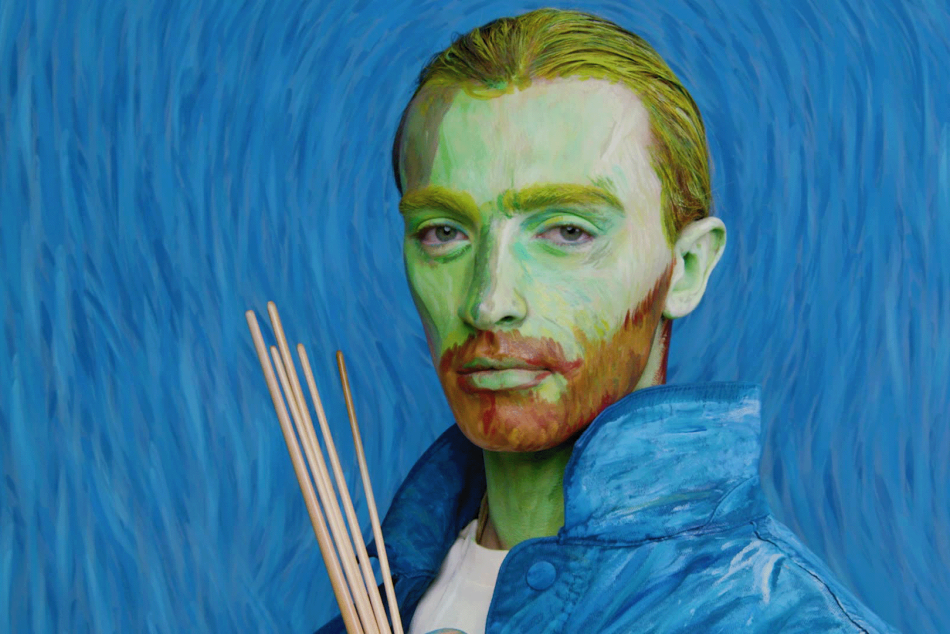
Video:  Oddly Satisfying: Makeup Inspired by Vincent van Gogh

Watch a mesmerizing makeup transformation inspired by Vincent van Gogh's 1889 Self Portrait
 

Article:  10 Contemporary Women Artists to Know

See their paintings, sculptures, installations, and more—all new additions to our collection.
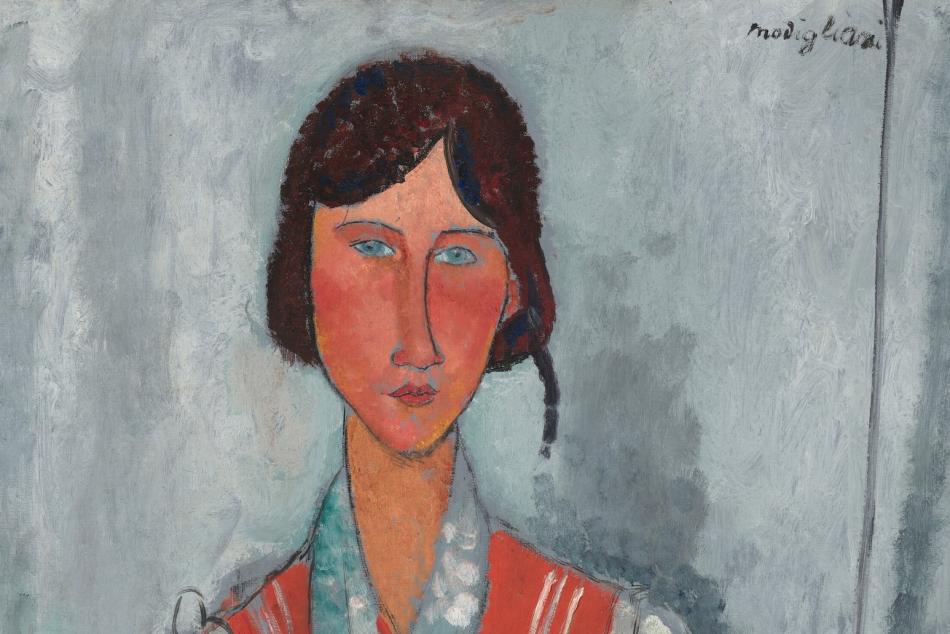
Article:  Poet Heid E. Erdrich Responds to a Portrait by Amedeo Modigliani

The educator, curator, interdisciplinary artist, and guest curator at the Mead Art Museum of Amherst College responds to Modigliani's "Roma Woman with Baby"
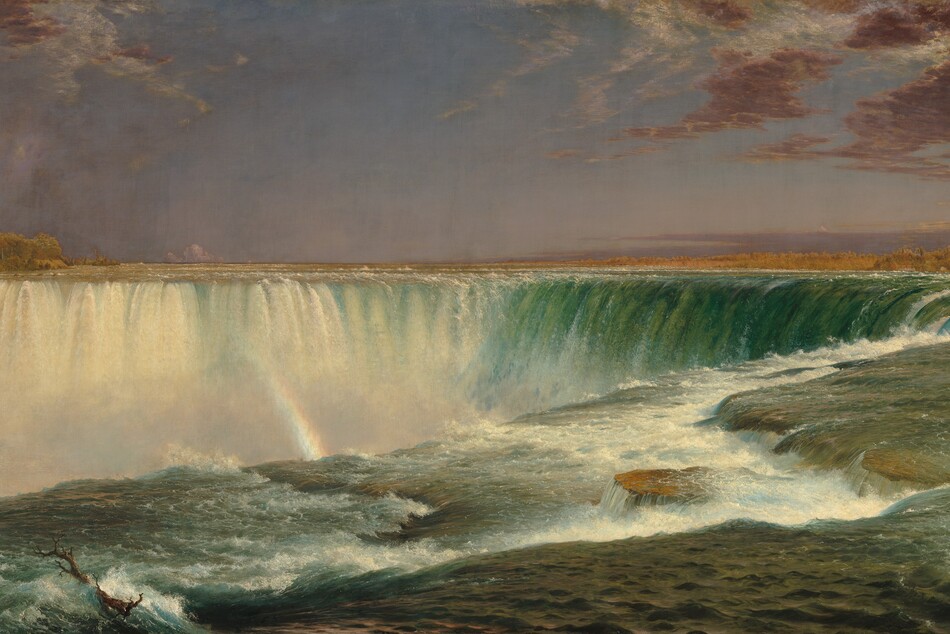
We hover over the bottle-green surface of a river as it rushes toward a horseshoe-shaped waterfall that curves away from us in this horizontal landscape painting. The water is white and frothy right in front of us, where the shelf of the riverbed changes levels near the edge of the falls. Across from us, the water is also white where it falls over the edge. A thin, broken rainbow glints in the mist near the upper left corner of the painting and continues its arc farther down, between the falls. The horizon line is just over halfway up the composition. Plum-purple clouds sweep into the composition at the upper corners against a lavender-colored sky. Tiny trees and a few buildings line the shoreline to the left and right in the deep distance.

Article:  The 19th-Century Blockbuster: Frederic Edwin Church’s “Niagara”

The American artist, skilled at both painting and publicity, created a sensation similar to the social media–famous exhibitions of today.
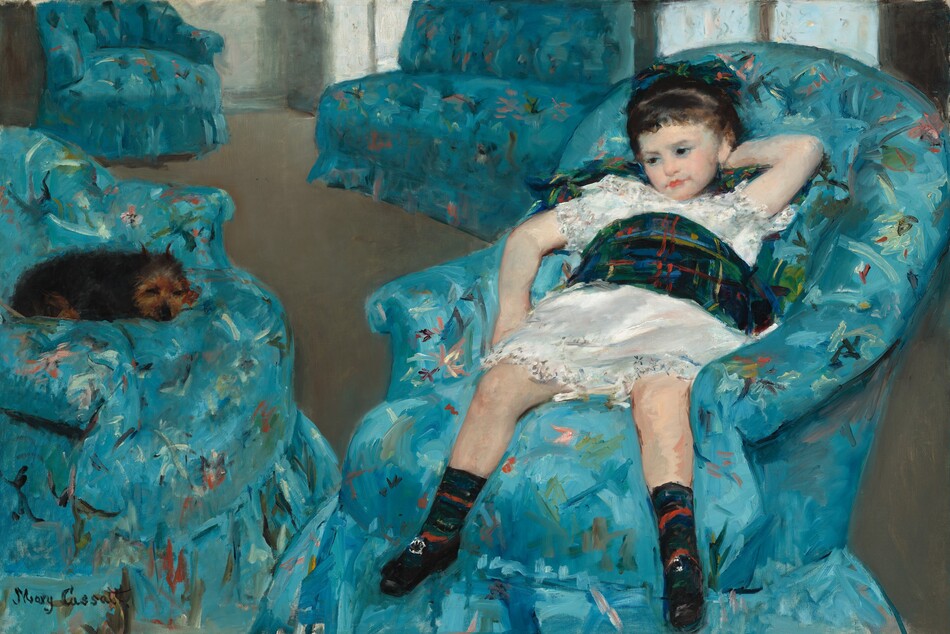
A small brown dog and a pale-skinned little girl wearing a white dress sit in matching celestial-blue armchairs in this horizontal painting. To our right, the girl sits with her legs angled to our left. She slumps back with her legs spread, and her left elbow, on our right, is bent so that hand rests behind her head. Her other elbow is draped over the armrest. Her dark brown hair appears to be pulled back, and tawny brown eyes under faint brows gaze down and to our left. She has a small nose set in a round face and a coral-pink mouth closed in a straight line. Her white dress has touches of gray, soft pink, and powder blue with a wide plaid sash around her waist. The pine-green, black, and sapphire-blue sash is accented with overlapping vertical and horizontal lines of burnt orange, light blue, and mustard yellow. Her socks match her sash and come up to mid-calf, over black shoes with silver buckles. The small dog has scruffy black fur and a russet-brown face. It lies curled in the chair opposite the girl, to our left, with its eyes closed and ears pricked up. The rounded backs of the upholstered chairs curve down to become the low arms. The vivid and light blue fabric of the chairs is scattered with loosely painted strokes of avocado and forest green, peach pink, cherry red, plum purple, and white. Beyond the chairs closest to us is another armchair and an armless loveseat, both covered with the same fabric. They sit at the back of the room, in a corner flooded with silvery light coming through four windows on the right side. The furniture is arranged on a peanut-brown floor. The artist signed in the lower left, “Mary Cassatt.”

Article:  Mary Cassatt Brings Girls and Women into the Museum

Author and art historian Katy Hessel on the impressionist's iconic painting.

You may also like
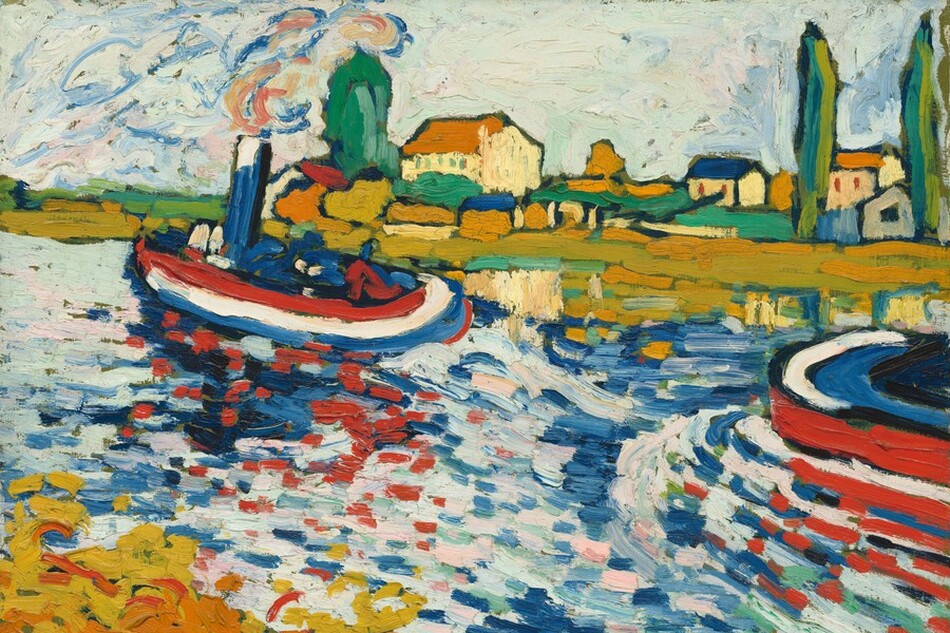
We look across a wide river with buildings lining the opposite bank as two tugboats painted with stripes and strokes of cherry red, white, and cobalt blue steam along from right to left in this stylized, horizontal landscape painting. The paint is loosely and thickly applied throughout. The water is painted with layers of short, horizontal strokes and daubs of ice and royal blue, shell pink, bottle green, and the red, white, and blue of the boats to suggest reflections. One tugboat is just left of center and passes the small village on the opposite bank. Smoke rising from that boat’s stack create eddies of cobalt blue, marigold orange, and petal pink. The bow of a second tug enters from the middle right. The riverbank directly in front of us, in the lower left corner of the composition, is painted with dashes of mustard yellow layered with horizontal strokes of burnt orange. The village on the far side fills the top third of the painting and parallels the river. Its buildings are butter yellow with blue or pumpkin-orange roofs. A few tall, narrow, emerald and avocado-green strokes suggest cypress trees growing amid the village. Horizontal strokes near the river’s edge could be another line of buildings. The building’s reflections are suggested by short, parallel strokes of golden yellow, orange, and green extending into the river. The trees, buildings, and boats are outlined in black. The sky above the village is mint green layered with thick strokes of white, and swirls of azure blue and light pink. The artist signed the painting with black letters in the lower left corner, “Vlaminck.”

Fauvism

Saturated, unnatural colors and powerful brushstrokes made fauvist paintings radical—and widely criticized. Henri Matisse, André Derain, and Maurice de Vlaminck were among the artists dubbed “fauves” (wild beasts). While short-lived (about 1904 to 1908), fauvism was the first avant-garde wave of the 20th century.  
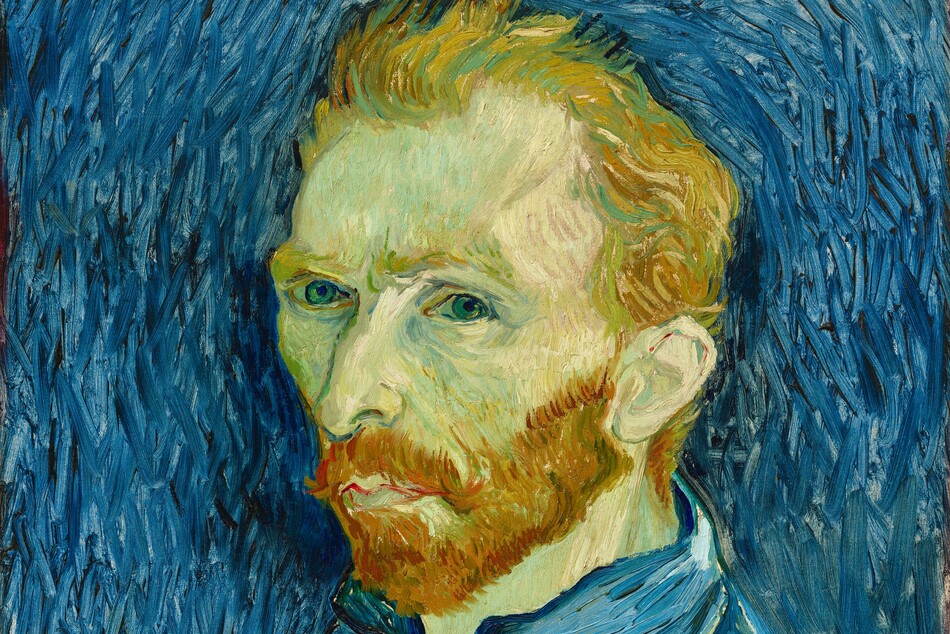
Shown from the chest up, a man with short, orange hair and green-tinted, pale skin looks at us, wearing a vivid blue painter's smock in this vertical portrait painting. His smock and the background are painted with long, mostly parallel strokes of cobalt, azure, and lapis blue. His shoulders are angled to our left, and he looks at us from the corners of his blue eyes. He has a long, slightly bumped nose, and his lips are closed within a full, rust-orange beard. He holds a palette and paintbrushes in his left hand, in the lower left corner of the canvas. The background is painted with long brushstrokes that follow the contours of his head and torso to create an aura-like effect.

Post-Impressionism

Post-impressionists took the impressionists’ recording of light and color in nature to more emotional and spiritual places. And each artist pursued unique subject matter and a distinctive style. Paul Cezanne was preoccupied with natural forms and spatial depth. Paul Gauguin and Vincent van Gogh expressed themselves through bold color and brushwork.