Interactive Article

Stories and Symbols in Jan van Eyck’s "The Annunciation"

The work is a triumph of early Northern Renaissance painting—and storytelling.

6 min read
A woman and winged angel, both with pale, peach skin, are situated in a church interior in this tall, narrow painting. To our left, the angel has long, blond, curly hair, smooth skin, and is smiling. The wings are outlined in royal blue, and they blend from blue to green to yellow to crimson. The angel holds one hand, closer to us, up at chest height with the index finger subtly pointing upward. Holding a long scepter in the other hand, the angel angles their body toward the woman to our right. The angel wears a gold jewel and pearl-encrusted crown and a jeweled long, voluminous robe in scarlet-red and shimmering gold brocade. The neck and along the opening down the front are lined with pearls and jewels. The angel looks toward the woman, who wears a royal-blue dress tied with a red belt at the high waist. Her long brown hair is tied back but one tendril falls over her left shoulder, to our right. She kneels facing us with her raised hands facing outward. Her head is tipped a bit to our left, and she looks up and into the distance to our right with lips slightly parted. She kneels behind a book lying open on a low table. A vase of white lilies and a red cushion lies on the floor in front of the table, close to us. The floor is decorated with people and scenes outlined in black and set into square panels, as if inlaid with wood. The church behind and above the people has a row of tall, narrow arches with bull’s-eye glass windows. A walkway lined with columns runs above the arches, and sunlight comes in through arched windows under the flat wood ceiling. A white dove flies toward the woman on gold lines from a window at the upper left of the painting. Latin words painted in gold capital letters are exchanged between the people. The angel says, “AVE GRA PLENA.” The letters of the woman’s response are painted upside down and backward: “ECCE ANCILLA DNI.”
Jan van Eyck, The Annunciation, c. 1434/1436, oil on canvas transferred from panel, Andrew W. Mellon Collection, 1937.1.39

How do you tell a story with only one image? Flemish artist Jan van Eyck did just that when he made this small jewel of a painting in the early 15th century. Van Eyck translated a short biblical text into an incredibly detailed work of art.

This painting depicts the Annunciation, a scene from the Christian New Testament. The archangel Gabriel, God’s messenger, is telling the Virgin Mary that she will conceive the son of God.

Van Eyck transformed this scene from the distant biblical past into a highly contemporary, sumptuous, and symbolic image. This scene tells the biblical story but also speaks to Mary’s broader significance in Christianity. Let’s take a close look and see what we can discover.
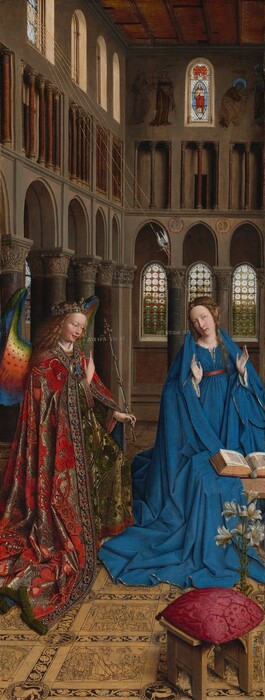
A woman and winged angel, both with pale, peach skin, are situated in a church interior in this tall, narrow painting. To our left, the angel has long, blond, curly hair, smooth skin, and is smiling. The wings are outlined in royal blue, and they blend from blue to green to yellow to crimson. The angel holds one hand, closer to us, up at chest height with the index finger subtly pointing upward. Holding a long scepter in the other hand, the angel angles their body toward the woman to our right. The angel wears a gold jewel and pearl-encrusted crown and a jeweled long, voluminous robe in scarlet-red and shimmering gold brocade. The neck and along the opening down the front are lined with pearls and jewels. The angel looks toward the woman, who wears a royal-blue dress tied with a red belt at the high waist. Her long brown hair is tied back but one tendril falls over her left shoulder, to our right. She kneels facing us with her raised hands facing outward. Her head is tipped a bit to our left, and she looks up and into the distance to our right with lips slightly parted. She kneels behind a book lying open on a low table. A vase of white lilies and a red cushion lies on the floor in front of the table, close to us. The floor is decorated with people and scenes outlined in black and set into square panels, as if inlaid with wood. The church behind and above the people has a row of tall, narrow arches with bull’s-eye glass windows. A walkway lined with columns runs above the arches, and sunlight comes in through arched windows under the flat wood ceiling. A white dove flies toward the woman on gold lines from a window at the upper left of the painting. Latin words painted in gold capital letters are exchanged between the people. The angel says, “AVE GRA PLENA.” The letters of the woman’s response are painted upside down and backward: “ECCE ANCILLA DNI.”
Jan van Eyck, The Annunciation, c. 1434/1436, oil on canvas transferred from panel, Andrew W. Mellon Collection, 1937.1.39

A Fateful Moment

The archangel Gabriel appears to Mary and tells her that she will bear a son. Conceived through the Holy Spirit, he is to be a manifestation of the Lord’s power. Mary responds, agreeing to have this child. This child will be Jesus Christ, the son of God and the central figure of Christianity. 

To further emphasize how sacred the scene is, Van Eyck placed it in a church of the same style contemporary viewers would have attended. The medieval church setting made the biblical scene feel more immediate. Renaissance painters, particularly in northwestern Europe, would soon adopt this innovation.

A Church Full of Metaphors

The Annunciation was considered the moment that bridged the Old Testament, which is a foundational text for both Judaism and Christianity, and the New Testament, which focuses on the life of Jesus. And Mary herself was an allegory of the Christian Church. As she gave birth to Jesus, she gave birth to Christianity. Van Eyck uses details in the church to create visual metaphors for this transition. 

Peacock Feathers and Precious Materials

The symbolism in this painting goes beyond architectural details. The expensive materials Van Eyck represented, as well as the ones he himself used as an artist, were also imbued with Christian meaning.

The Mysteries of Van Eyck’s Painting

The Annunciation was probably once part of a triptych—a three-panel painting. A triptych would normally have been displayed on the altar of a chapel. While the painting’s original context remains uncertain, it was likely commissioned by Philip the Good, Duke of Burgundy. Philip appointed van Eyck as his court painter and valet de chambre (personal attendant) in 1425.

Works like The Annunciation were quite valuable, and after Van Eyck’s time, it may have been dismantled, each panel sold individually.

Is what we see today a narrative presented out of context? What might Van Eyck have painted on those two other panels? Given the artist’s extensive imagination, those works would have undoubtedly told an incredible story. 
 

You may also like
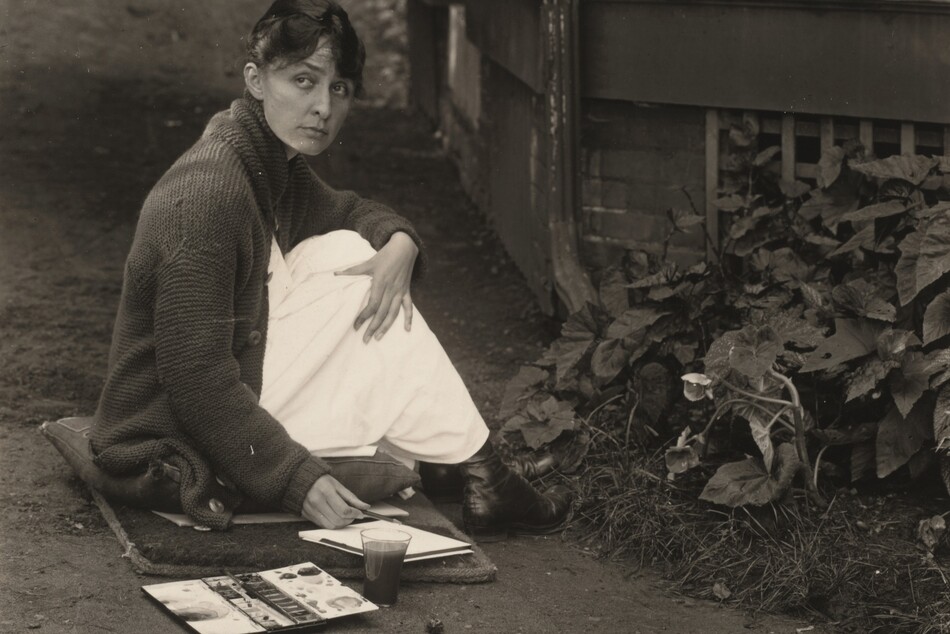
The image depicts a woman sitting on the ground. She is turned slightly towards the camera, with her right arm resting on her bent knee. She has short, wavy dark hair, a soft facial expression, and is wearing a chunky sweater over a white skirt. Artist supplies such as a palette, an open book or sketchpad, and a glass of liquid are nearby. The background shows a pathway beside a brick structure partially covered by greenery, with plants growing next to where she is seated.

Interactive Article:  Everyday Awe

Learn how the American painter Georgia O'Keeffe marveled at commonplace natural forms—and how to find the same sense of awe on your own.

Article:  Painter George A. Morton Transcends Tradition

Through sustained looking and detailed re-creations, this Atlanta-based artist studies Rembrandt and Sargent while finding new subjects that carry forward the painters’ traditions.