


Color in "Andries Stilte as a Standard Bearer" (1640) by Johannes Cornelisz Verspronck

Coloring page reproduction of Johannes Cornelisz Verspronck, Andries Stilte as a Standard Bearer, 1640. This is an auto-generated image.
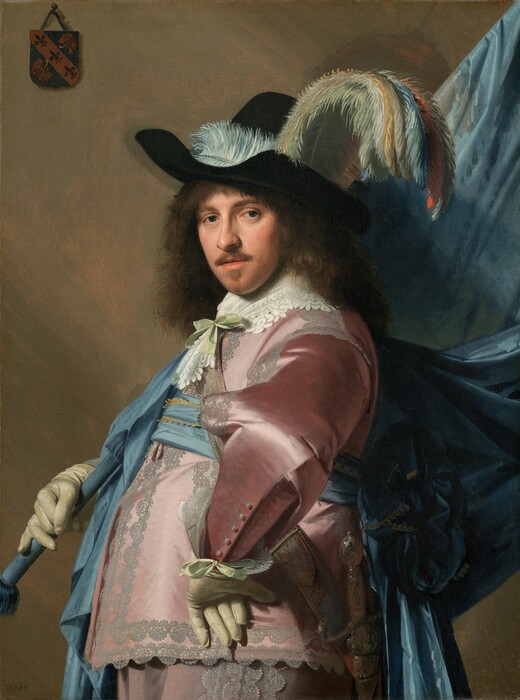
With great bravura, this fashionably clad member of the Haarlem civic guard stands with one arm akimbo, staring out at the viewer. His proud bearing, accented by the panache of his shimmering pink satin costume and plumed hat, attests to the great sense of confidence felt by the Dutch at the height of their "golden age."
Andries Stilte, whose family coat of arms decorates the upper corner of this painting, is presented as a standard bearer, or ensign, of the Kloveniers, one of Haarlem’s militia companies. During the Dutch revolt against Spanish rule in the late sixteenth and early seventeenth centuries, militia companies served as a civic guard. By 1640, when Verspronck made this portrait, civic guard companies had lost most of their military function. Officers were chosen from Haarlem’s wealthy burghers, who vied for these prestigious appointments. The blue standard and sash serve to identify Stilte’s company and rank, but the rest of his outfit displays his personal taste, his family’s wealth, and his status as a bachelor (Haarlem’s militia regulations stipulated that only unmarried men could serve as ensigns). Stilte commissioned Verspronck to paint him wearing his sumptuous pink costume right before he resigned his rank to marry. As a married militia officer, Stilte would have worn an elegant black outfit.
Johannes Cornelisz Verspronck was one of the foremost portraitists in Haarlem during the mid-seventeenth century. Little is known about his artistic background, although he probably studied first with his artist-father, Cornelis Engelsz (c. 1575–1650). Verspronck may also have trained with Frans Hals (c. 1582/1583–1666). While many seventeenth-century Dutch artists, including Hals, portrayed Dutch militia companies, a life-size portrait of an individual ensign—such as Verspronck's striking likeness of Stilte—is exceedingly rare.


