


Color in "Portrait of a Member of the Haarlem Civic Guard" (c. 1636/1638) by Frans Hals

Coloring page reproduction of Frans Hals, Portrait of a Member of the Haarlem Civic Guard, c. 1636/1638. This is an auto-generated image.
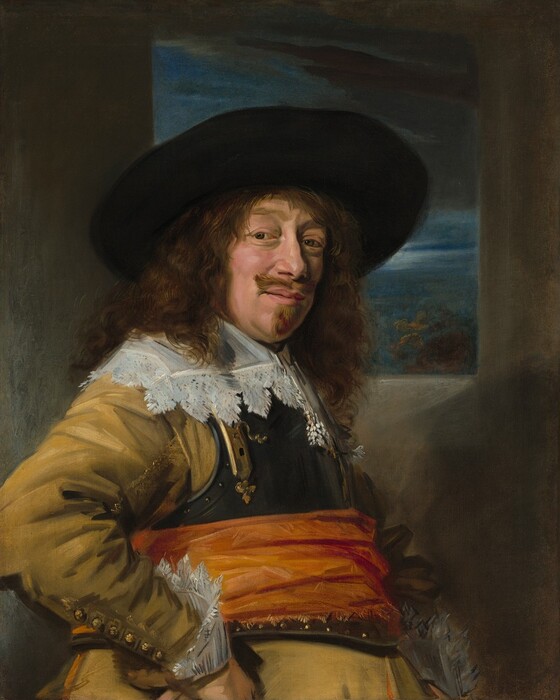
Starting in 1568, seven provinces of the Netherlands broke away in revolt against Spanish rule, initiating a war for independence that lasted until 1648. In the early years of the conflict the militias (civic guard companies) of Haarlem in particular put up a heroic fight. By Hals’ time the military front was sufficiently far to the south that the function of these militias had become more social than martial, which explains the presence in this portrait of the elegant lace collar over the iron breastplate and the lace cuffs. Each battalion was divided into three companies based on the colors of the rebel flag—orange, white, and blue; the civic guardsman here clearly was a member of one of the orange companies. Hals, member of the Saint George civic guard since 1612, made a number of large group portraits of the militia companies.
This portrait is one of only two known portraits by Hals of an individual guardsman. It has been dated at various periods of the artist’s career, but recent scholars have placed it at the end of the 1630s on the basis of comparisons with Hals’ civic guard painting Officers and Sergeants of the Saint George Civic Guard Company in the Frans Halsmuseum, which the artist executed about 1639. Hals portrayed himself in the left background among his fellow guardsmen, and is staring at the viewer. Hals’ facial features are remarkably similar to those of the man in this Portrait of a Member of the Haarlem Civic Guard, so much so that one wonders if this image is, in fact, a self-portrait.


