National Gallery of Art National Gallery of Art

Directions

  • Open 10:00 a.m.–5:00 p.m.
  • Directions
  • Visit

    • Plan Your Visit
    • Accessibility
    • Visiting with Kids
    • Food and Drink
    • Tours and Guides
    • Explore the Campus

    Admission is always free

    6th and Constitution Ave NW 
    Washington, DC 20565

    East building

    Must-Sees at the National Gallery

    Make the most of your visit

    Learn more
  • Exhibitions & Events

    • Exhibitions
    • Calendar
    • Kid-Friendly Events

    America’s 250th

    Celebrating American art and artists
  • Art & Artists

    • Artworks
    • Artists
    • Stories
    • Fun and Games
    • Educational Resources
    • Research

    West to East

    Discover how artists across America have been inspired by the places they call home.

    Start the series

Utility

  • Support
  • Shop
  • Become a Member

Open 10:00 a.m.–5:00 p.m.

National Gallery of Art
  • Visit

    • Plan Your Visit
    • Accessibility
    • Visiting with Kids
    • Food and Drink
    • Tours and Guides
    • Explore the Campus

    Admission is always free

    6th and Constitution Ave NW 
    Washington, DC 20565

    East building

    Must-Sees at the National Gallery

    Make the most of your visit

    Learn more
  • Exhibitions & Events

    • Exhibitions
    • Calendar
    • Kid-Friendly Events

    America’s 250th

    Celebrating American art and artists
  • Art & Artists

    • Artworks
    • Artists
    • Stories
    • Fun and Games
    • Educational Resources
    • Research

    West to East

    Discover how artists across America have been inspired by the places they call home.

    Start the series

Utility

  • Support
  • Shop
  • Become a Member

Directions

  • Open 10:00 a.m.–5:00 p.m.
  • Directions

Global Search

Autocomplete Suggestions
    No Results
    Keep typing to get suggestions
    Loading Results

    Top Searches:

    • Free images
    • Van Gogh
    • Landscape
    • National Gallery Nights
    • Matisse
    Advanced Artwork Search

    Results

    The Age of Correggio and the Carracci
    Closed February 16, 1987
    In the left half of this horizontal painting, a bare-chested, seated woman, Venus, is tended by three nude women and several child-like, nude, winged putti. All the women and putti have pale, peachy skin. To our right, a statue of a man stands on an ornately carved pedestal on a veranda in front of a distant landscape. Venus sits facing our right and she looks into a rectangular, black-framed mirror she holds up with her left hand. Her blond hair is braided and she has delicate features. A sky-blue cloth wraps around her waist and lap, and covers her legs. One foot rests on the lap of a seated putto, who ties on a sandal. Another putto helps hold up the mirror. A third putto near us, in front of Venus, pulls strings of pearls from a gold box and the fourth, in the lower left corner, lifts a comb and long needle out of a gilded, rectangular box. Two of the women behind Venus tend to her hair and the third holds up and gazes at a teardrop-shaped pearl. A dusky rose-pink curtain falls behind the women and putti. The view opens onto a terrace on the right half of the painting. A gray stone sculpture of a nude man holding up a bunch of grapes with one hand and bracing a tall stick with the other stands facing our left on an ornately carved base. The base is made up of a wide, shallow bowl above a single pedestal foot. In the distance, two people sit against a tall balustrade. The person on the left wears gold-colored armor, a helmet, and holds a long spear. The bearded man to the right appears to be nude as he leans to the side toward his companion, resting his hand and chin along a staff propped on the bench's seat. Trees and mountains in the landscape beyond are painted with brown, deep gray, and forest and sage green. A sliver of white sky along the horizon brightens an otherwise steel-gray sky.
    Master Drawings from Titian to Picasso
    Closed October 6, 1985
    There are castle-like structures depicted in sketches across a sheet of paper. The viewer has a slightly elevated perspective looking down on the buildings within a hilly landscape. There is no horizon visible. The focus is on the detailed architecture mixing with the natural hills. The artist uses precise brushstrokes to show the buildings and landscape. The color palette is minimal, with natural tones and dark ink. In the distance, the buildings stand out against the hills. Close by, smaller structures and pathways suggest a more intimate setting.
    Robert Nanteuil
    Closed April 28, 1985
    The image features a person in a portrait from the waist up within an oval frame. The person is turned slightly to the right, facing forward with a solemn expression. They have a long, narrow face, a pointed nose, and slightly downturned lips. The person's long, curly hair falls past their shoulders. They are wearing period clothing with a high collar and lace detailing, and have a piece of armor over their shoulder. The individual is holding an embroidered fabric. The portrait is surrounded by a decorative border with engraved text and an emblem with crowned insignia below. The background has finely etched lines for depth and texture.
    German Expressionist Prints from the Collection of Ruth and Jacob Kainen
    Closed February 9, 1986
    This painting features abstract figures against a blue background. Three figures in bold pink lines are depicted near a blue area. The contrast between the figures and the blue background creates a dynamic composition. The use of color and brushstrokes conveys motion and spontaneity. The forms are simplified, emphasizing abstraction.
    Master Prints from Washington Private Collections
    Closed March 3, 1985
    This painting features abstract figures against a blue background. Three figures in bold pink lines are depicted near a blue area. The contrast between the figures and the blue background creates a dynamic composition. The use of color and brushstrokes conveys motion and spontaneity. The forms are simplified, emphasizing abstraction.
    The Folding Image
    Closed September 3, 1984
    A screen made up of five tall, rectangular panels, set side by side and each surrounded by a gold frame, is painted as a single scene showing a tree-lined sidewalk curving around a park in a city. The scene is loosely painted with short, rounded brushstrokes. The top two-thirds to three-quarters of most of the panels are filled with the lime and olive-green leaves of the trees that line the sidewalk and park. In the leftmost panel, the sidewalk and road lead back to a row of caramel-brown building façades. The sidewalk is pale taupe, and the street is painted with dashes of the same taupe against terracotta brown, suggesting cobblestones. Spindly trees are spaced in a row along the sidewalk in round holes covered with smoke-gray metal grates. A black fence, painted with thin, sometimes broken black lines encloses the park beyond, which has a path around plantings and the vivid green lawn. Touches of pink on a sage-green tree to our left in the park suggest flowers. A gray statue on a high plinth is partially lost in the break between the two rightmost panels. Men, women, and children, painted with a few strokes of black, gray, or marine or periwinkle blue, walk along the sidewalk and the garden path, or sit at the base of the fence or on benches spaced along the sidewalk. The women seem to wear long dresses and the men dark clothing and hats. Two carriages are pulled up on the street near a lamp post alongside the sidewalk near the lower left. In the leftmost panel, horse-drawn carriages move along the road leading back to the buildings, and more people seem to be gathered on the sidewalk near the left edge of the panel in the distance. The artist signed the work with brown paint in the lower right corner: “E. Vuillard.” The panels of the screen have been set up so the panels rest on a platform or on the floor in a shallow zig-zag pattern, in a room with an off white wall and bisque-brown molding along the floor.
    The Orientalists: Delacroix to Matisse
    Closed October 28, 1984
    A woman wearing a sheer white blouse, short red and gold vest, and full-legged, patterned pants cinched below the knee lies back and looks at us with hooded eyes in this horizontal painting. Her shoulders lean back against an oversized white pillow, up along the right edge of the composition. Her body tips toward us, and her knees are bent so her feet are together in the lower left corner. Her right arm rests along the side of her body, and she props herself up with her other arm. That hand has a gold band on the ring finger. Her light skin is tinged with green on her face. Her head rolls slightly away from us so she looks down her cheeks at us with slitted, dark eyes through heavily lined lids. She has dark brows, and her rose-red lips are parted. The angle of her head creates a slight double chin. Gold hoops with dangling fringe or chains hang from her ears, and she wears three strands of dark beads around her neck. Her black hair is plaited in a thick braid that comes down over her left shoulder, closer to us. A cap made of gold-colored disks and red fringe sits on the far side of her head. The woman’s clothing is more loosely painted. We may see her breasts and pink nipples through her sheer, silver-gray tunic, which has long, voluminous sleeves. The short, bolero-style vest is strawberry red and gold, with narrow cap sleeves. A sea-blue sash around her waist is striped with overlapping burnt-orange and black lines. Her pants have flaring legs gathered with a button just below her knees. The pattern is of sage-green circles with swipes of rust-red in the center, suggesting flowers and vines against a black background. Her knees are spread open so her feet can barely be contained within the composition. Her teal-green slip-on shoes have the suggestion of flowers painted with dabs of yellow, black, and red, and a pompom atop each toe box. A red and gold cushion sits just beyond her feet. On it is a tray of oranges and an emerald-green jug. The pillow the woman leans on is propped against a short section of wall or piece of furniture painted with a border of roses. The room opens up beyond this, and has a turquoise and brown rug leading back to a cranberry-red sofa, on which a gray piece of fabric has been draped. The wall above is patterned with yellow and green diamonds and pink flowers against a laurel-green background. The artist signed the lower left, “A. Renoir. 70.”
    American Naïve Watercolors and Prints
    Closed January 13, 1985
    This painting depicts a landscape view from an elevated point, showing a village of white buildings with red and white roofs atop rolling green hills. The buildings are spread throughout the painting, with one white tower with a cross to the right of center. Thin brown paths and white fences crisscross the green land between the houses. The sky is overcast with light gray and hints of blue.
    Index of American Design
    Closed February 2, 1985
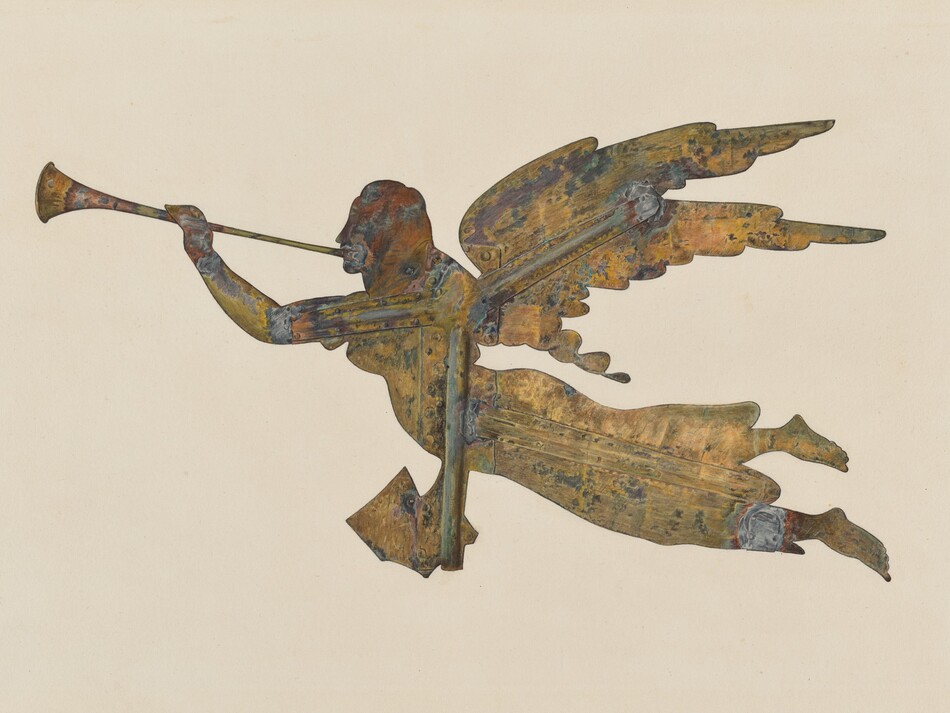
    This painting depicts an angel in flight, facing the left and playing a trumpet. The angel's wings are spread out behind them, and their feet are extended out horizontally to the right. A small rod or post extends downward from the torso of the angel. The angel is entirely painted in shades of yellow, reddish-brown, and gray, reminiscent of weathered metal with patches of rust. Small rivets are visible at joints and edges of the angel, which appears to be comprised of small panels. The background of the painting is plain beige paper.
    Degas
    Closed March 10, 1985
    Four light-skinned ballerinas with russet-orange hair tied back in buns adjust the straps of their bodices as they gather close together, their bodies and wide, knee-length tutus taking up the left half of this horizontal painting. The background or backdrop beyond them shows a grove of deep green trees to our left and a sunset view of meadows leading back to trees to our right. Three of the dancers stand in a row that extends from the lower left corner to our right and away from us. All three wear rust-orange bodices over tutus that are painted loosely with flecks of pale celery green and buttercup yellow against a muted royal-blue background. Their bodices and upper bodies are outlined with black. The woman closest to us stands with her body angled to our right. Her face turns away as she looks to her left and adjusts that shoulder strap. The two dancers farther from us stand with their backs to us, their bodies angled away from us to our left. The middle dancer looks back over her right shoulder as she lifts the other elbow to adjust that strap. The third dancer in the row holds both hands to her right strap as she looks off into the distance, to our left. The fourth ballerina, to our far left beyond this trio, stands with the arm we can see, her left, lifted with her hand held high as she looks off to our right. Her bodice is a brighter carrot orange, and is more loosely painted. The green foliage behind the dancers extends off the top edge of the painting. The pale sage-green field to the right stretches before puffy, rounded trees daubed with mauve-pink highlights. The coral-pink and golden yellow sky is streaked with lavender-gray clouds. The artist signed his name in red paint with tiny, almost illegible letters in the lower right corner, “Degas.”

    Pagination

    • Previous page
    • First page 1
    • …
    • Page 182
    • Page 183
    • Page 184
    • Current page 185
    • Page 186
    • Page 187
    • Page 188
    • …
    • Last page 276
    • Next page
    Subscribe to

    Site Footer

    Home National Gallery of Art

    Hours

    Admission is always free.
    Open 10:00 a.m.–5:00 p.m.

    Locations

    • West Building

      6th St and Constitution Ave NW
      Washington, DC 20565

    • East Building

      4th St and Constitution Ave NW
      Washington, DC 20565

    • Sculpture Garden

      7th St and Constitution Ave NW
      Washington, DC 20565

    Newsletter Sign Up Form

    Art news every week

    Subscribe

    * indicates required

    Follow us

    Social Media

    • Facebook
    • Instagram
    • Pinterest
    • Twitter
    • YouTube

    Footer Primary Menu

    • About
      • About Us
      • Press
      • Contact Us
    • Visit
      • Plan Your Visit
      • Calendar
      • Today's Tours
      • Accessibility
      • Exhibitions
    • Get Involved
      • Donate
      • Opportunities
    • Research
      • Free Images for Download
      • Artwork Search
      • The Center
      • Conservation
      • Library
      • Archives
      • Past Exhibitions
      • Publications
    © 2026 National Gallery of Art

    Legal Links

    • Notices
    • Privacy Policy