


Childe Hassam and the Flag in American Art
Explore the American impressionist's paintings of the US flag.

Few symbols elicit reactions as varied—or as strong—as the US flag. Artists throughout our country’s history have used it to represent everything from power and economic prosperity to tyranny and inequality.
When Childe Hassam created Allies Day, May 1917, his pride in this national symbol was clear. The United States had just entered World War I in April, joining the United Kingdom and France in their fight against the Central Powers: Austria-Hungary, Bulgaria, Germany, and the Ottoman Empire.
Hassam commemorated the decision to join the war with a series of 30 paintings of flags. This one depicts a parade on Fifth Avenue in New York City celebrating the country’s new alliance with Britain and France. In the painting, US, British, and French flags flutter in the breeze of a bright, hopeful spring day.

Wurts Bros., World War Commissions. British and French. Fifth Avenue, Looking North from 55th Street. Court of Honor, 1917, photograph, The New York Public Library, Digital Collections
An American Impressionist
Allies Day celebrates solidarity between European and American military forces with a melding of French and American artistic visions. Hassam was an American painter, but his style echoes the visual language of French impressionism.
In 1886, Hassam and his wife, Kathleen Maude Hassam, moved to Paris. While living there, the artist was exposed to the work of impressionists such as Claude Monet and Camille Pissarro. He adopted elements of their practices, some of which are clearly present in Allies Day.
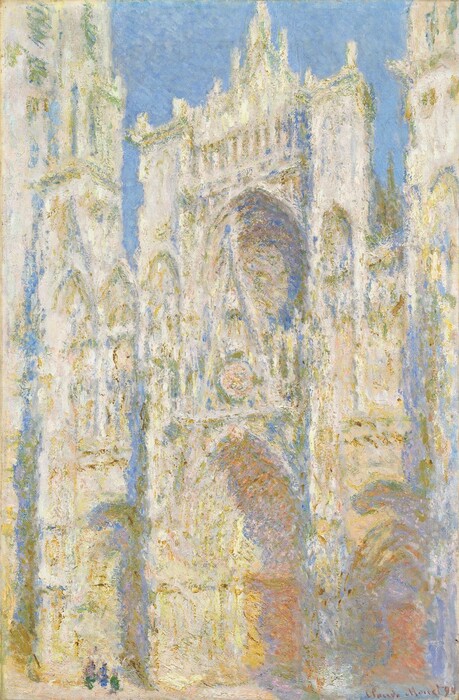
The brushstrokes and color choices echo Monet’s images of Rouen Cathedral in northern France. The French artist also used touches of bright colors to convey the effect of sunlight on the building’s gray stone.

Hassam may have drawn inspiration from other impressionist scenes as well, such as Monet’s The Rue Montorgueil in Paris and Édouard Manet’s The Rue Mosnier with Flags. Both works depict Paris streets on June 30, 1878, when the country declared a national celebration of the peace following the end of the Franco-Prussian War, the establishment of the Third Republic, and the resolution of more recent political conflicts.

Claude Monet, La Rue Montorgueil in Paris, 1878, oil on canvas, Musée d’Orsay, RF 1982 71. © Musée d’Orsay, Dist. RMN-Grand Palais / Patrice Schmidt

Édouard Manet, The Rue Mosnier with Flags, 1878, oil on canvas, Getty Center 89.PA.71
Though Hassam’s paintings commemorate the start of a war rather than a period of peace, his fluttering flags and views of city streets bear a strong resemblance to these earlier French works.
Still Standing
Allies Day borrows from a French artistic style, but its subject matter is uniquely American. The painting celebrates the country’s optimistic mood as it rose to a position of international influence in the early 20th century. The architectural grandeur of Fifth Avenue was the perfect venue for such a celebration. Some of the buildings Hassam captured in the scene still stand today.
A Patriotic Series
Hassam’s flag paintings are full of optimism. US flags wave gently on a serene Fourth of July day or decorate a city street that shimmers in the rain. Many works portray the banners as protective canopies, floating over the people who walk beneath them. Reproductions of Hassam’s paintings were even sold to support the war effort.

Childe Hassam, The Fourth of July, 1916 (The Greatest Display of the American Flag Ever Seen in New York, Climax of the Preparedness Parade in May), 1916, oil on canvas, The New York Historical, Gift of Richard Gilder, 2016.31

Childe Hassam, Avenue of the Allies: Brazil, Belgium, 1918, oil on canvas, Los Angeles County Museum of Art, Mr. and Mrs. William Preston Harrison Collection, 29.18.1
The series shows an artist experimenting with different perspectives, settings, and times of day. It also charts the course of the conflict, from the US declaration of war to Victory Day parades in 1919. Alongside the American flag, Hassam featured banners from Belgium, Brazil, Cuba, Italy, Japan, and other Allied nations.
Hassam was an ardent supporter of the Allied cause. He was also an advocate for American art. Speaking to a reporter in 1932, Hassam declared that art made in the US was "as good as any other in the world today." To prove this, the artist donated over 400 works to the American Academy of Arts and Letters at the time of his death. He left instructions to sell his works and use the proceeds to purchase art by living artists. These works were then donated to museums in the US and Canada. Through both this act of generosity and his own paintings, Hassam's legacy continues to shape the story of American art.

Exhibition: American Icon
Old Glory, reimagined: artists transform our flag over the centuries.
You may also like
Article: Artistic Visions of Our Nation’s Nature
See how artists interpret our nation’s natural beauty—from a fluttering Baltimore oriole to a towering redwood tree.
Interactive Article: Paul Revere, Artist of the American Revolution
You’ve heard about the revolutionary’s midnight ride. But did you know Revere was a master silversmith and engraver?