


George Washington, Pictured

As the United States’ first president and commander of the Continental Army that won the colonies’ independence, George Washington left an undeniable enduring legacy.
His likeness has become synonymous with the nation’s founding. For centuries, artists have depicted the military general—in paint, in print, and in plaster—all aiming to capture his elusive mystique. These portraits continue to give us insight into Washington’s emotional life, military presence, and cultural footprint.
Ever guarded, Washington was a difficult sitter.
Gilbert Stuart was Washington’s most famous portraitist; his 1796 Athenaeum portrait of the president appears, in reverse, on the $1 bill. Stuart worked tirelessly to put the general at ease. “An apathy seemed to seize him,” he said of Washington, “and a vacuity spread over his countenance, most appalling to paint.”
Stuart’s sparkling wit did little to thaw the president (though he did perk up when the conversation turned to horses). Washington once lamented “the irksomeness of sitting and the time I lose by it.” Nevertheless, he sat for portraits, knowing how crucial his likeness would be for the young republic and its survival.
Stuart was spellbound by the general. While Washington only sat for the painter twice, the sittings were the basis for more than 100 paintings. Stuart famously proclaimed, “I expect to make a fortune by Washington alone.” His daughter Jane recounted, “It is impossible for any human being to have a more exalted admiration (and I might say love) than my father had for Washington.”
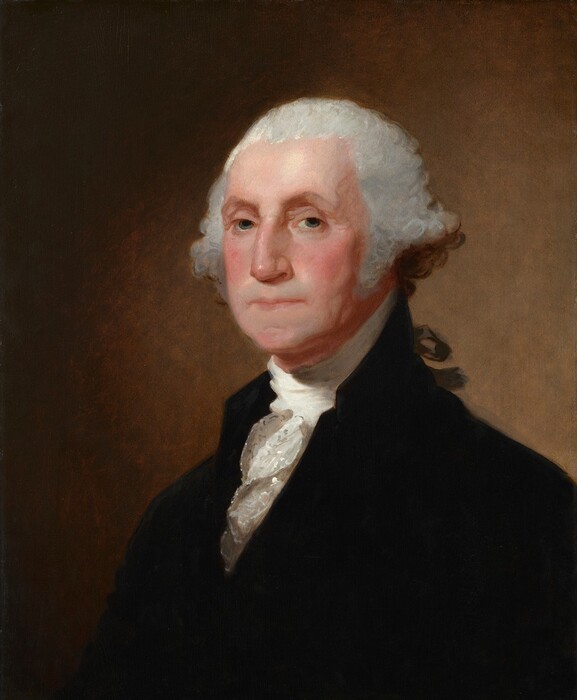
Painting Washington was a family business.
Rembrandt Peale, who was 17 when he first painted the president, was similarly entranced. His father, Charles Willson Peale (1741–1827), was the first to paint Washington’s portrait and eventually made over 79 pictures of him. (When Washington sat for Rembrandt, he requested that the artist’s father sit beside him to keep him “in familiar conversation.”)
Lauded by Thomas Jefferson for his “superlative excellence,” Rembrandt was rumored to be obsessed with Washington. Even after the president passed away, the younger Peale continued to paint him from studies.
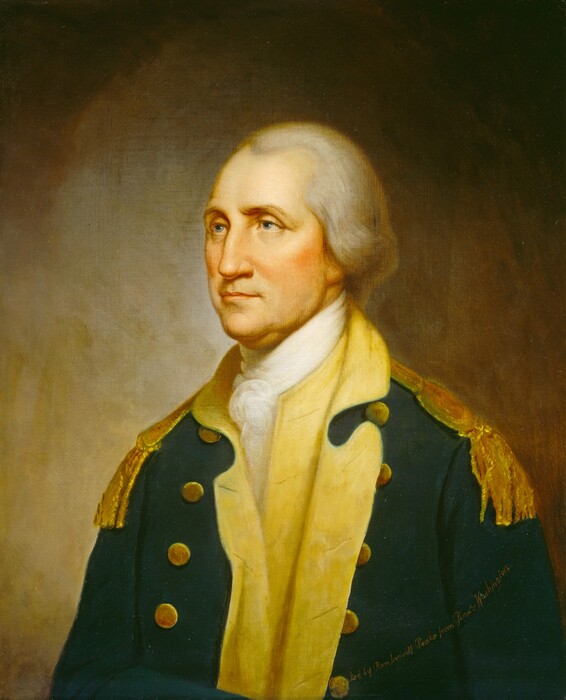
Washington was a symbol of hope in the face of insurmountable fear.
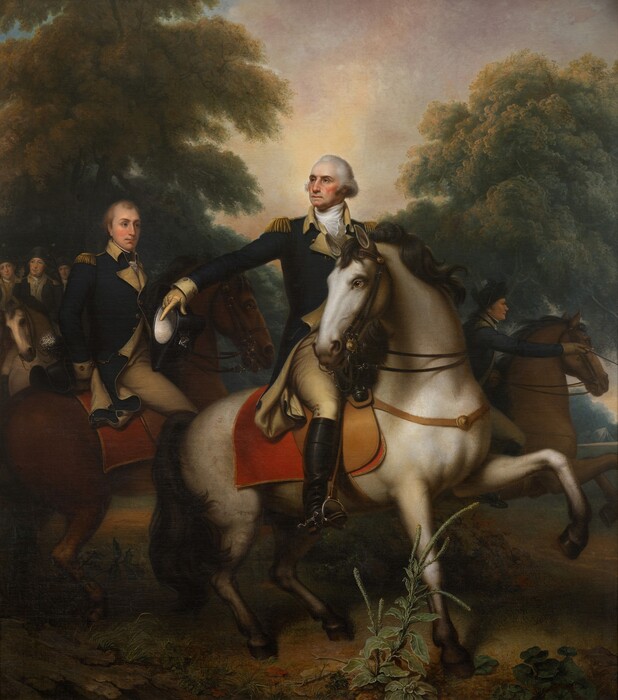
In Washington before Yorktown, Rembrandt Peale silhouettes the revolutionary general before a luminous sky. The painting—one of a few life-size portraits of Washington on horseback—shows him marching into the Siege of Yorktown, the decisive battle that would lead to Britain’s surrender.
According to folklore, the mullein herb in the foreground could cast out evil spirits; here it is a symbol of Washington’s martial might. As the military officer Henry Knox told him: “The people of America look up to you as their father, and into your hands they entrust their all.”
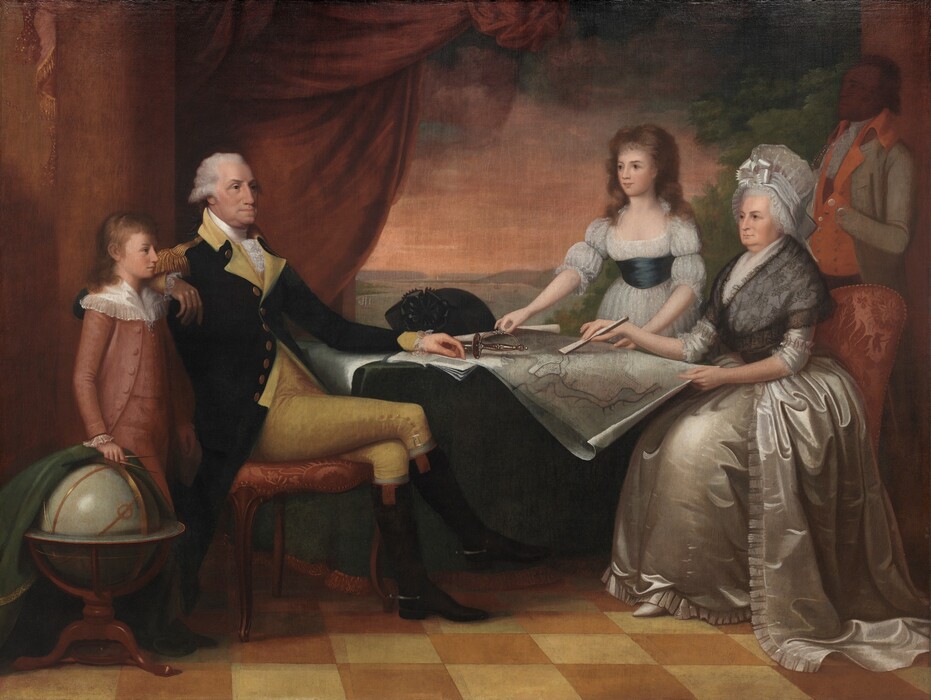
George Washington was a family man.
While Washington had no biological children, he adopted Martha Custis’s son and daughter from her previous marriage. The Custises adored their adopted father. Edward Savage’s The Washington Family is a glowing group portrait, the satin of Martha’s dress catching the light. Set in Mount Vernon—Washington’s home and plantation—the president still occupies a position of military leadership and political authority. He wears a uniform of buttery yellows and deep blues, his posture impeccably upright.
The identity of the Black man pictured in the background is unknown. However scholars speculate that he may be Christopher Sheels, one of the enslaved men at Mount Vernon.
Houdon’s marble sculpture draws parallels to ancient heroes.
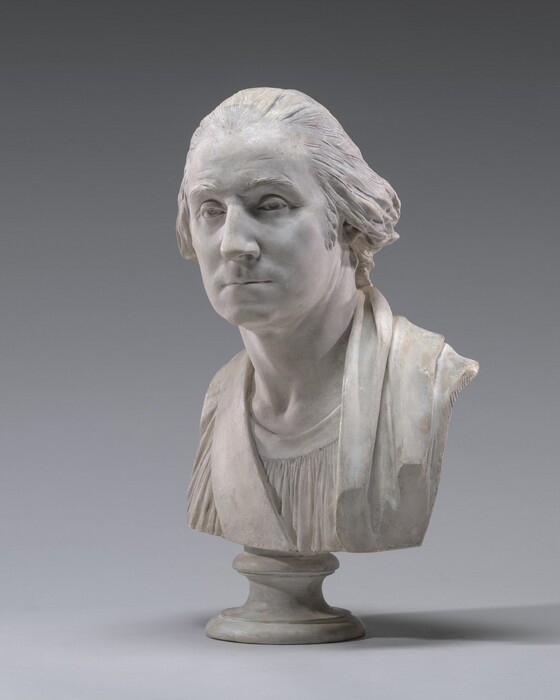
In Jean-Antoine Houdon’s plaster bust of Washington, he is clad in a pleated tunic, a toga draped over one shoulder. Here, the general appears timeless, echoing classical works of ancient Rome. Only statuary, Houdon insisted, could have that effect, as it “preserves forms in all their truth and renders almost imperishable the images of men who have brought their nation glory or happiness.”
After two terms, and despite wildly popular support, Washington left the presidency to return to Mount Vernon. He drew comparisons to Cincinnatus, the Roman general who seized absolute powers during a crisis, but resigned and returned to his farm after securing victory for the republic.
The nation mourned Washington’s death.
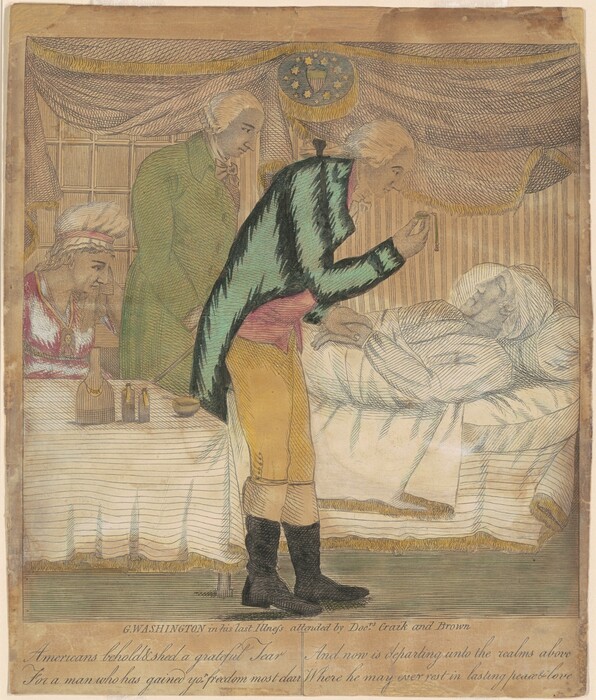
At the age of 67, Washington suddenly passed away in 1799 from a throat infection. Engravers and printers immediately set to work to capture the outpouring of national feeling.
One of the most evocative images from this period is The Death of George Washington, by 18th-century printers and publishers E. Pember and S. Luzerder. The hand-colored engraving depicts the general in his final hours, clad in white, his face in shadow. “Americans behold and shed a grateful tear,” the inscription reads, “for a man who has gained you freedom most dear.”
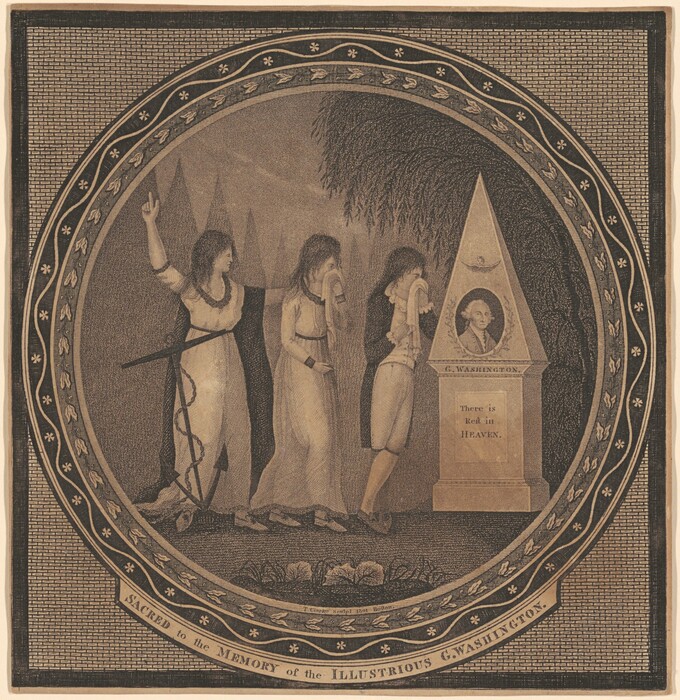
Thomas Clarke’s engraving, Sacred to the Memory of the Illustrious George Washington, has a similar air. Three mourners stand before a monument to the United States’ first president, clutching their handkerchiefs mid-wail. The stone obelisk bears Washington’s portrait, bringing grieving citizens face-to-face with their lost leader.
Centuries on, Washington continues to inspire artists.
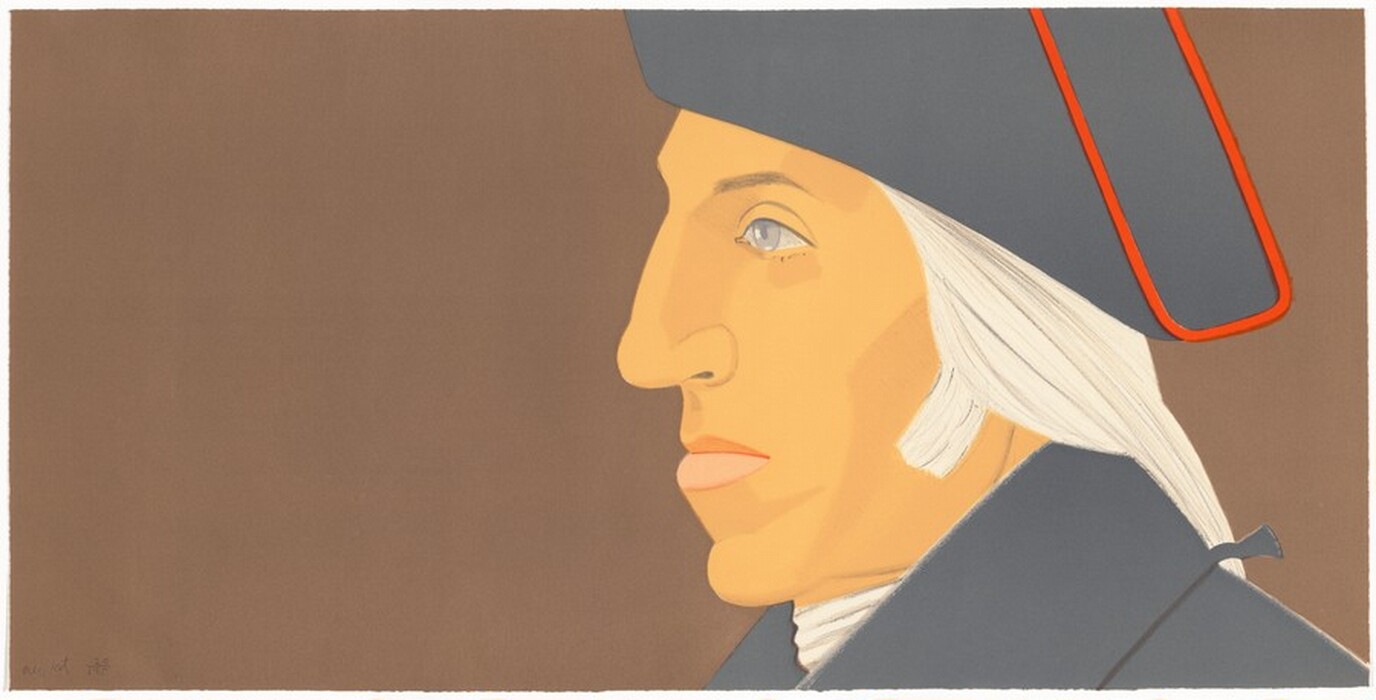
Known for his tightly cropped portraits, Alex Katz presents an altogether modern Washington. Set in profile against a solid, tawny-brown ground, the president here is instantly recognizable. The planes of his face are carved from blocks of color, his eyes a silvery blue, with white hair pulled back cleanly and his cap edged in fiery red. Pared down and richly toned, Katz’s lithograph has the look of a billboard.
What set Washington apart, the historian W. W. Abbot observed, was a detachment that was “dignified, even forbidding…the distance he consciously set and maintained between himself and nearly all the rest of the world.” Across 250 years of portraits, artists immortalized the first president’s stoic and stately bearing, making his image an icon of the nation he founded.
You may also like
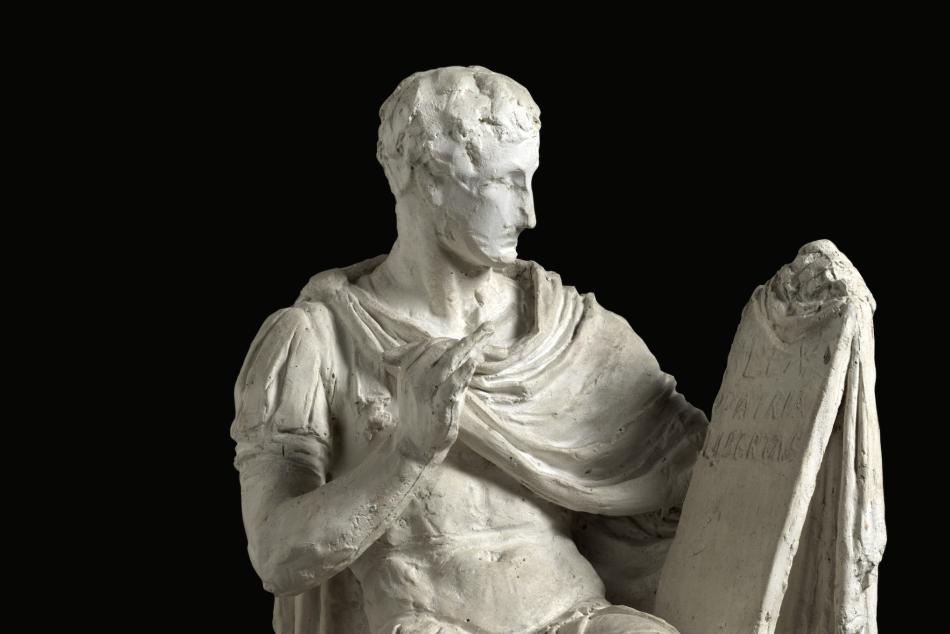
Article: Antonio Canova Sculpts George Washington
How did the Italian sculptor approach a portrait of the first US president?

Article: Painter George A. Morton Transcends Tradition
Through sustained looking and detailed re-creations, this Atlanta-based artist studies Rembrandt and Sargent while finding new subjects that carry forward the painters’ traditions.