

The Last of the Buffalo and Their Revival


Independent Curator and Writer
In the northwest corner of Wyoming, an hour from Yellowstone Park, the city of Cody was founded in 1896 by the visionary entrepreneur William F. Cody, better known as “Buffalo Bill.”
Today, 1 million tourists pass through each year, enjoying summer entertainments such as a nightly rodeo, a gunfight reenactment outside the Irma Hotel, a Wild West Spectacular, and a world-class museum.
But every year, on November 1, the park entrance closes and tourists go back to their homes. Wild animals wander down into the valleys when the mountain snow gets deep, and herds of elk, deer, and big horn sheep gather in the canyon between Cody and Yellowstone. A few bison (buffalo) bulls graze along the highway, pose as boulders while chewing their cud, and take leisurely strolls down the centerline.
Cody is also home to one of Albert Bierstadt’s two monumental, nearly identical canvases, both titled The Last of the Buffalo.

The Last Buffalo by Albert Bierstadt on exhibit at the Whitney Western Art Museum in Cody, Wyoming.
Presenting a dramatic, if not entirely accurate, depiction of the bison’s demise, Bierstadt’s paintings helped inspire efforts to save the animal from extinction. Now, just up the Shoshone River Canyon from where the Cody painting resides, the bison herds of Yellowstone have returned. And the story of one particular buffalo who was removed from, and then restored to, Bierstadt’s painting, symbolizes the near-extinction and re-introduction of America’s national mammal.
Twin Buffalo Paintings
Time unspools from top to bottom in these paintings: from distant past to present, from abundant herds of bison to bleached bones. An immense blue sky and wispy clouds fade into snow-capped peaks partly obscured by haze. Beneath the mountains, brown hills slope gently into a broad valley where a river meanders among cottonwood trees and grasslands. Great bison herds flow through the canyons, spreading dust into the sky and streaming along the snaking river.


Albert Bierstadt. The Last of the Buffalo, c. 1888, oil on canvas. Buffalo Bill Center of the West, Cody, WY. Gertrude Vanderbilt Whitney Trust Fund Purchase, 2.60.
In his late sixties, Bierstadt painted his two versions of The Last of the Buffalo at the same time. One was exhibited in the 1889 Paris Salon; then Mrs. Albert Bierstadt gifted it to the Corcoran Gallery of Art in 1909. (In 2014, it entered the National Gallery of Art’s collection.) The other landed in Cody, Wyoming, at the Whitney Western Art Museum. Both are immense: the Cody painting is 5 by 8 feet, and the Corcoran painting is almost two feet wider.
Dramatic, figurative subjects are unusual for Bierstadt, who is best known for painting sublime, unpeopled landscapes. He did make studies of Native peoples and others he encountered on his travels across the west. But he referred to these figures as “adjuncts” and usually showed them dwarfed by snowcapped peaks, expansive waters, and verdant valleys.

Bierstadt rendered the bear in Mount Corcoran (c. 1876–77) and the buffalo in Buffalo Trail (1869) in miniature to emphasize the scales of the landscapes.
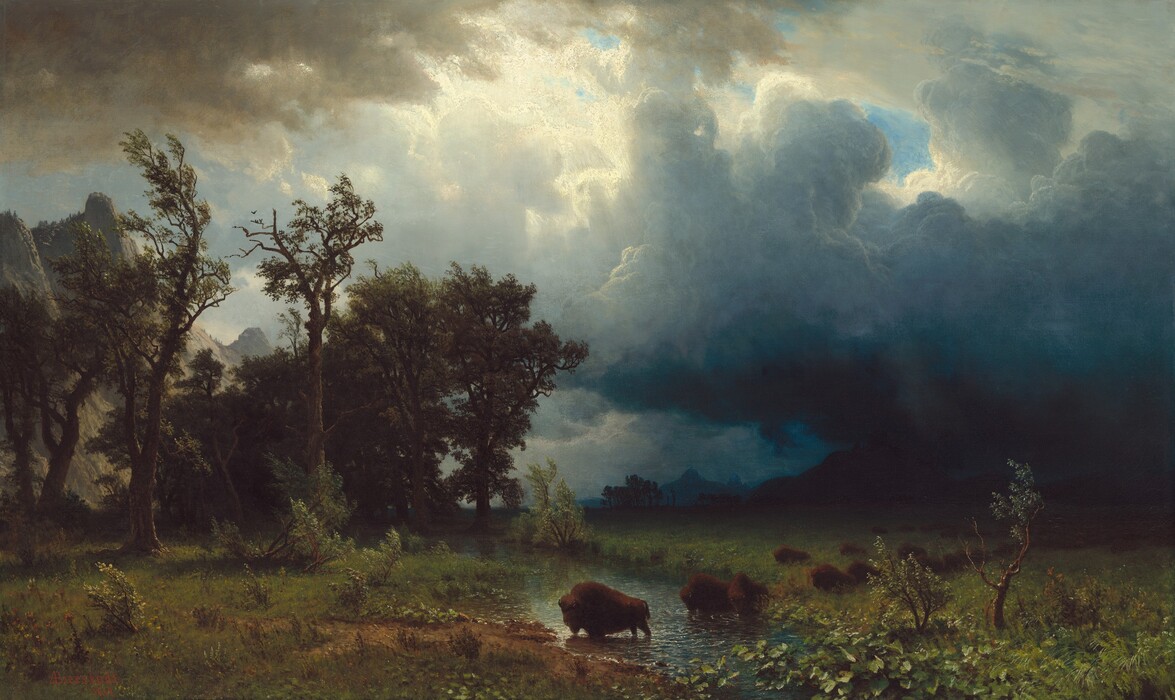
But in The Last of the Buffalo, the focus is on the figures. On the right, a Plains Indian mounted on a rearing white horse thrusts his spear into an enormous bull. The bison gores his horse. The foreground is littered with dead and dying buffalo. Partially hidden amid the carnage, a dead man and horse foreshadow the conclusion of the battle. At left, a lone wounded bison stands beside a trail strewn with skulls, gazing at the spectacle as if contemplating his own fate.
Who Slaughtered the Buffalo?
By contrasting the fallen Plains Indian with the buffalo corpses, Bierstadt links the fates of the Native Americans and the bison. The paintings follow a long tradition of artist-explorers such as George Catlin and Edward S. Curtis conducting “salvage anthropology”: documenting indigenous cultures they believed would soon vanish.
Indeed, during the late 19th century the last free Plains Indians were forced onto reservations. At the same time, the bison herds, estimated at 10–30 million in 1860, were reduced to a few hundred.
“I have endeavored to show the buffalo in all his aspects and depict the cruel slaughter of a noble animal now almost extinct,” Bierstadt wrote, describing the Corcoran painting. “The buffalo is an ugly brute to paint, but I consider my picture one of my very best.”
But Bierstadt inaccurately portrays Native peoples as the perpetrators of the slaughter. In fact, the US military intentionally eradicated bison to end the traditional lifeways of the western tribes, making space for railway construction and privately owned land and livestock.

Photograph of a pile of American bison skulls waiting to be ground for fertilizer, circa 1892, Burton Historical Collection, Detroit Public Library.

Rath & Wright's Buffalo Hide Yard in Dodge City, Kansas, showing 40,000 buffalo hides. National Archives, Washington DC.
A History of Alteration
Both versions of The Last of the Buffalo were conserved in 1984–85, which offers an opportunity to learn about Bierstadt’s methods and uncover the similarities and differences. Infrared reflectography showed that Bierstadt painted over an antelope in both paintings, which led conservators to believe that the smaller Cody painting was not a preparatory study. Instead, it seems Bierstadt made changes to both paintings simultaneously, working out the placement of figures in the landscape.

Conservation photography of the Cody painting from the mid-1980s shows the lone buffalo is missing in the left half of the foreground.
When the Cody painting resurfaced in the 1950s after decades in a British collector’s possession, there was no wounded bison in it. An empty expanse of grass extended over the area where the animal stands in the Corcoran painting.
But conservators found that a patch had been cut from another painting to cover a hole (measuring 10 1/4 by 8 7/8 inches) in that same spot. They noted traces of a reddish hump above the patch and shadows below. When a photograph of the wounded bison from the Corcoran painting was projected onto its counterpart, the details lined up exactly. We can conclude that a wounded bison had once stood in the left middle ground. (If someone in England has the missing bison, Cody would love to have it back!)

The patch, revealed in the Cody painting

A close-up of the restored bison, painted over the patch on the Cody painting.
The Rebirth of the Buffalo
In the late 1880s, Americans moved from accepting, and even actively causing, the buffalo’s demise, to forming coalitions to prevent its extinction. Bierstadt joined the movement. He became a founding member of the hunting and wildlife conservation association Boone and Crocket Club in 1887, while working on The Last of the Buffalo. Bierstadt and other artists as well as conservation groups called attention to the buffalo’s plight. Partly in response, the US government began taking steps to protect the animal.

A bison herd in Yellowstone National Park.

A bison in Yellowstone National Park.


Bison crossing a road at night.
Hunting was officially banned in Yellowstone in 1886, but the rules were not enforced for many years. By 1902, only 22 bison remained there. Gradually, thanks to protection of that small herd, introduction of bison from other herds, vaccination, and culling, the Yellowstone bison returned to sustainable numbers. Recently, their population has ranged from 3,500 to nearly 6,000. Thanks to tribal, governmental, and private efforts, more than 500,000 bison roam across North America today.
About the Author
Susan Barnett is an independent curator and writer. Previously the Curator of Western American Art for the Whitney Western Art Museum at the Buffalo Bill Center of the West, Barnett also served as curator for the Yellowstone Art Museum in Montana and the Erie Art Museum in Pennsylvania.
Barnett has lived in the Rocky Mountain West for more than three decades. Her recent exhibitions and publications explore the mythical, contemporary, and historical West. Other research includes studio craft, photography, and contemporary art.

West to East
Discover how artists across America have been inspired by their communities and the places they call home.
You may also like
Article: Artistic Visions of Our Nation’s Nature
See how artists interpret our nation’s natural beauty—from a fluttering Baltimore oriole to a towering redwood tree.
Article: Mark Klett's Rephotography of the American West
How the photographer’s journey tracking down views from 19th century photographs altered the writer’s understanding of space and time.