Interactive Article

Layers of Power in "The Feast of the Gods"

At first glance, this painting looks like a great party. But it’s more complicated than that.

By
  • Alex Dean
4 min read
Six women, eight men, two satyrs, and one child gather in pairs and trios in a loose row that spans the width of this nearly square painting. They are set within a landscape with craggy rocks, cliffs, and trees. Most of the people face us, and the men, women, and child have pale skin. The two satyrs have men’s torsos and furry goat’s legs, and they have darker, olive complexions. Most of the men wear voluminous, knee-length togas wrapped in short robes in shades of white, topaz blue, grass green, coral orange, or rose pink. Most of the women wear long, dress-like garments in tones of shell pink, apricot orange, or lapis blue over white sleeves. For all but one woman, their garments have fallen off one shoulder to reveal a round, firm breast. Several objects are strewn on the rocky, dirt ground in front of the group, including a wide, wooden bucket with a piece of paper affixed to its front to our right, a glass goblet, a pitchfork, a large blue and white ceramic dish filled with grapes and small yellow fruits, and an overturned cup near the center. Cliff-like, craggy rocks rise steeply behind the group to our left, filling much of the sky opposite a tall grove of leafy, dark green trees to our right. A few puffy white clouds float across the vivid blue sky. The slip of paper on the barrel has been inscribed, “joannes bellinus venetus p MDXIIII.”
Giovanni Bellini, Titian, The Feast of the Gods, 1514/1529, oil on canvas, Widener Collection, 1942.9.1

With music playing and a barrel full of wine, this 16th-century Italian painting seems at first to be about pleasure. But it also tells fascinating stories about power. We see not only the divinely powerful gods but also three painters, each trying to assert their vision on this canvas.

The Feast of the Gods depicts a scene from Ovid’s Fasti. Dating to 8 BCE, these tales of Roman gods inform how we celebrate special occasions today. In the story shown here, Priapus, the lustful god of fertility, tries to lift the gown of a nymph named Lotis while at a party. Lotis is asleep, unaware of his advances. According to the legend, the donkey at left is about to bray, waking Lotis and scaring off Priapus.

As the painting’s suggestive—and disturbing—subject matter might indicate, it was not meant for public viewing.
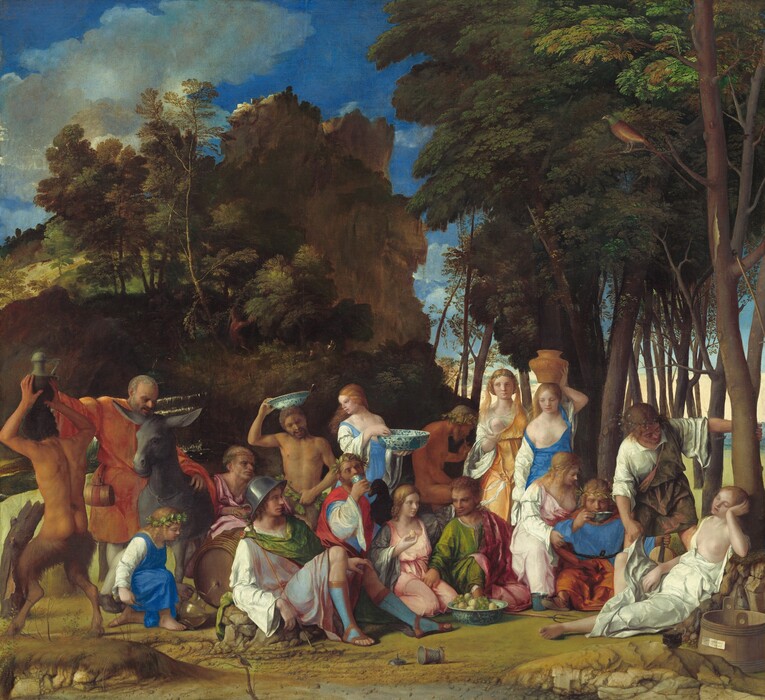
Six women, eight men, two satyrs, and one child gather in pairs and trios in a loose row that spans the width of this nearly square painting. They are set within a landscape with craggy rocks, cliffs, and trees. Most of the people face us, and the men, women, and child have pale skin. The two satyrs have men’s torsos and furry goat’s legs, and they have darker, olive complexions. Most of the men wear voluminous, knee-length togas wrapped in short robes in shades of white, topaz blue, grass green, coral orange, or rose pink. Most of the women wear long, dress-like garments in tones of shell pink, apricot orange, or lapis blue over white sleeves. For all but one woman, their garments have fallen off one shoulder to reveal a round, firm breast. Several objects are strewn on the rocky, dirt ground in front of the group, including a wide, wooden bucket with a piece of paper affixed to its front to our right, a glass goblet, a pitchfork, a large blue and white ceramic dish filled with grapes and small yellow fruits, and an overturned cup near the center. Cliff-like, craggy rocks rise steeply behind the group to our left, filling much of the sky opposite a tall grove of leafy, dark green trees to our right. A few puffy white clouds float across the vivid blue sky. The slip of paper on the barrel has been inscribed, “joannes bellinus venetus p MDXIIII.”
Giovanni Bellini, Titian, The Feast of the Gods, 1514/1529, oil on canvas, Widener Collection, 1942.9.1

The Wealth of Duke Alfonso’s Court

Alfonso d’Este, the Duke of Ferrara, asked Venetian artist Giovanni Bellini to create this painting in the early 1500s. It was to be the first in a series of works for the grand camerino d’alabastro (alabaster study) of the duke’s castle in Ferrara.

Alfonso d’Este was a great patron of the arts. He planned to decorate the walls of his camerino with several large, expensive paintings by renowned artists such as Bellini.

The opulent camerino was the duke’s private office, and only a select few were allowed in. So this hedonistic scene was meant only for him—and perhaps his close friends and advisors.

The work is full of references to the wealth and influence of Duke Alfonso’s court. 

Such coveted items would have traveled to Europe via the Silk Road, a network of trade routes from Asia. Including them in this painting points to Italy—and specifically Ferrara—as an influential presence in global trading networks.

Party of the Gods

While The Feast of the Gods was meant to demonstrate Duke Alfonso’s earthly, material power, it is also brimming with divine power.

The painting is a veritable who’s who of Roman gods and goddesses. Clues throughout the work help us identify them. 

The Work of Three Painters

Giovanni Bellini created this work during the Italian Renaissance, when individual artists were gaining influence and recognition.

While Bellini was the first to work on The Feast of the Gods, two other great Renaissance artists contributed as well: Dosso Dossi and Tiziano Vecellio (also known as Titian).

After Bellini’s death in 1516, Dossi and Titian made significant changes, including adding the large, rocky landscape to the background. Thanks to conservation work done on the painting, we can see what it probably looked like before their alterations.

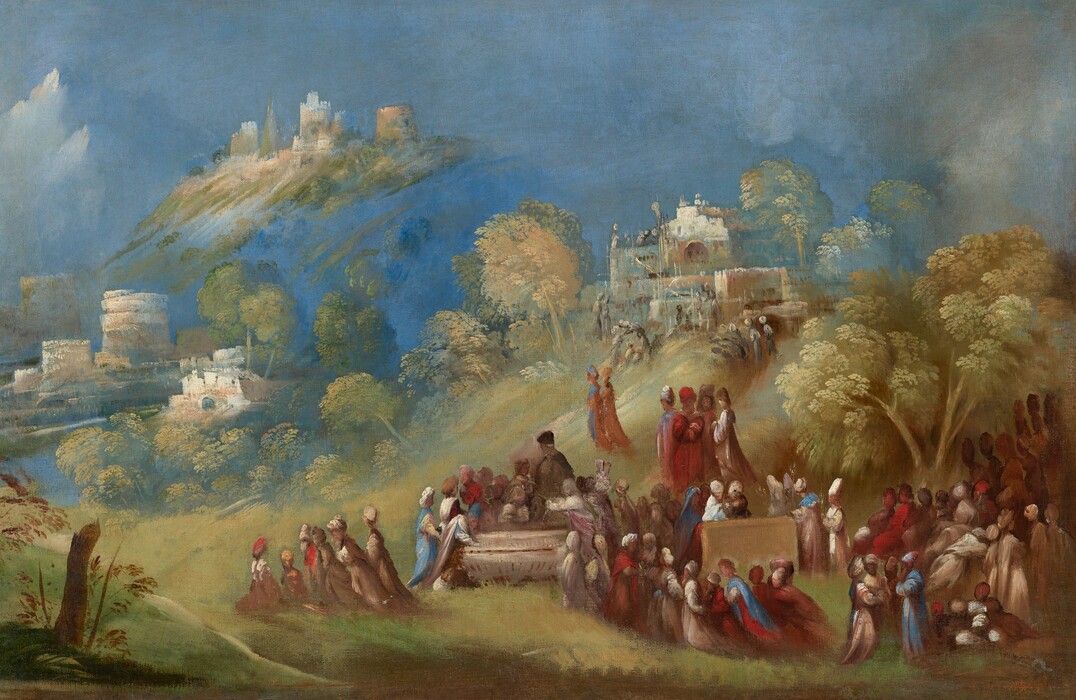
Dossi, known for his delicately feathered trees, may have added the ones in the upper right corner. They look like the beautiful foliage in his other works, such as The Trojans Building the Temple to Venus and Making Offerings at Anchises’s Grave in Sicily (painted around 1520).

He also likely added the pheasant that appears in the trees’ upper branches.
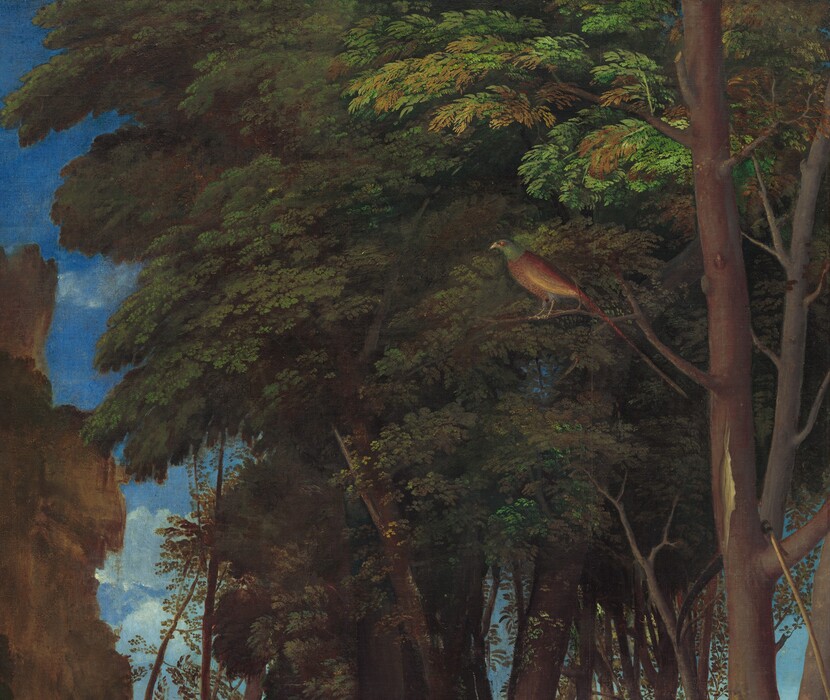
Six women, eight men, two satyrs, and one child gather in pairs and trios in a loose row that spans the width of this nearly square painting. They are set within a landscape with craggy rocks, cliffs, and trees. Most of the people face us, and the men, women, and child have pale skin. The two satyrs have men’s torsos and furry goat’s legs, and they have darker, olive complexions. Most of the men wear voluminous, knee-length togas wrapped in short robes in shades of white, topaz blue, grass green, coral orange, or rose pink. Most of the women wear long, dress-like garments in tones of shell pink, apricot orange, or lapis blue over white sleeves. For all but one woman, their garments have fallen off one shoulder to reveal a round, firm breast. Several objects are strewn on the rocky, dirt ground in front of the group, including a wide, wooden bucket with a piece of paper affixed to its front to our right, a glass goblet, a pitchfork, a large blue and white ceramic dish filled with grapes and small yellow fruits, and an overturned cup near the center. Cliff-like, craggy rocks rise steeply behind the group to our left, filling much of the sky opposite a tall grove of leafy, dark green trees to our right. A few puffy white clouds float across the vivid blue sky. The slip of paper on the barrel has been inscribed, “joannes bellinus venetus p MDXIIII.”
Giovanni Bellini, Titian, The Feast of the Gods, 1514/1529, oil on canvas, Widener Collection, 1942.9.1
This painting shows a landscape with castle-like structures on a green hill, with a group of people gathering in colorful clothing in the bottom left. The people are indistinct, painted in shades of red, brown, and blue, with no visible facial features. Two objects appear in the center of the groups of people: a low cream-colored object and a square brown object. One of the large buildings to the right of center appears to be under construction. Green trees are scattered across the ground and hills. Some of the green, building-lined hills on the left are separated from the rest of the land by strips of blue, as if they are surrounded by mist, or float in the sky.
Dosso Dossi, The Trojans Building the Temple to Venus and Making Offerings at Anchises's Grave in Sicily, c. 1520, oil on canvas, Purchased as the Gift of Anonymous, 2021.6.1

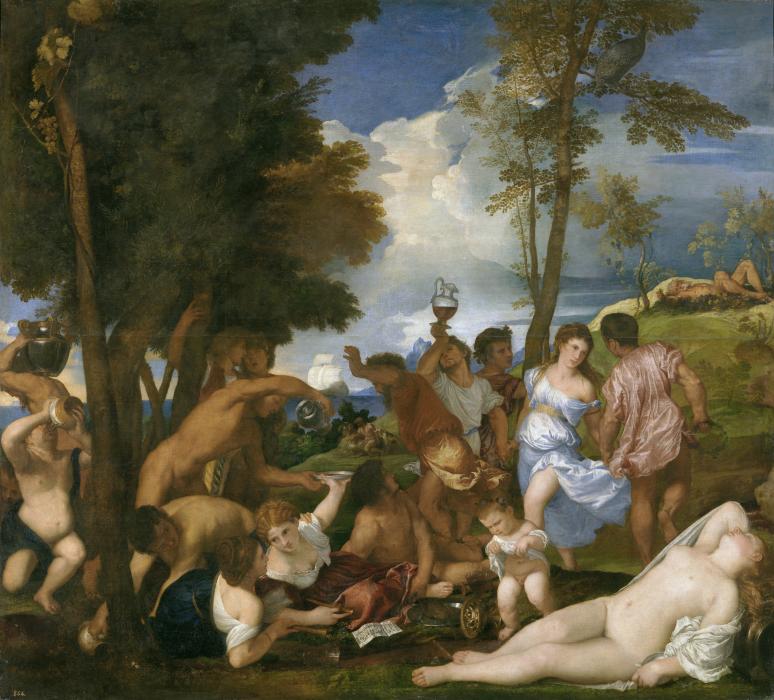
Titian, The Bacchanal of the Andrians, 1523–24, oil on canvas, Museo del Prado
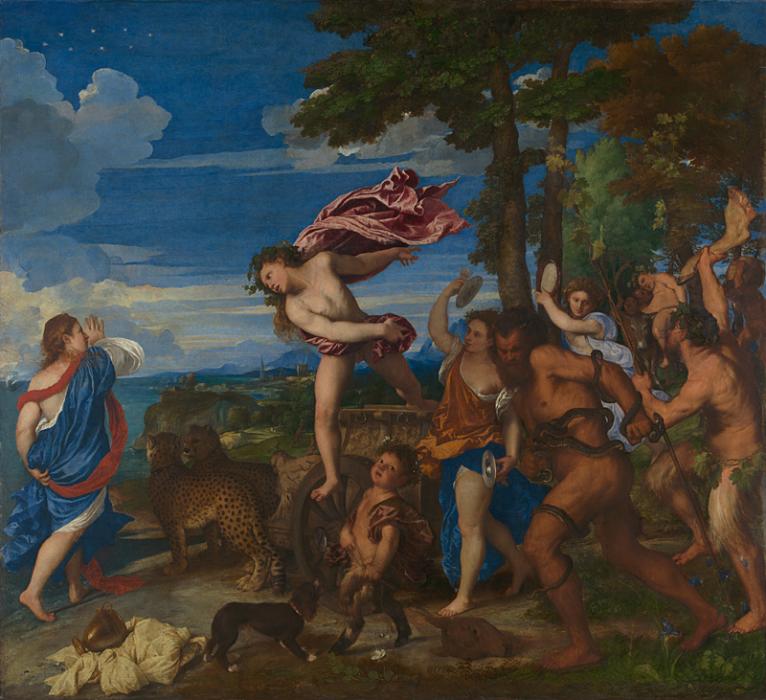
Titian, Bacchus and Ariadne, 1520-3, oil on canvas, National Gallery London

Titian made other paintings for Alfonso’s camerino, including Bacchanal of the Andrians and Bacchus and Ariadne (both painted in the early 1520s). His changes to The Feast of the Gods may have been meant to harmonize it with the rest of the duke’s collection.

In this work, we see the mastery of three great Italian artists. Ultimately, it is their skill—more than Duke Alfonso’s power or the majesty of the gods—that makes this painting so memorable. 

You may also like
The painting features a valley with purple and brown mountains in the distance, surrounding a reflective body of water with a small rowboat floating on it. Closer to us, there are gray rocks, brown tree trunks and branches, and lush green vegetation at the edge of the water. The sky above is painted in warm shades of yellow, peach, and orange, which transition to pale greenish-blue at the top. The water below reflects these colors, as well as those of the distant mountain and surrounding trees.

Article:  Who Is Elizabeth Gilbert Jerome? 5 Things to Know

The Hudson River School painter created landscapes that captured America’s natural splendor.

Interactive Article:  The Exceptional Emotion of Artemisia Gentileschi’s "Mary Magdalene in Ecstasy"

One of the Italian baroque painter’s finest works recently joined our collection.