Interactive Article

Mary Cassatt, the Daring Printmaker

The pioneering American Impressionist's radical techniques pushed the medium in new directions.

8 min read
The image depicts a seated woman wearing a large coat and skirt. She is seated with her body angled to the side, head turned slightly towards the viewer. The woman has delicate facial features, with her hair covered by a fluffy hat. Her hands are resting in her lap as she sits on a wide chair. She is not wearing any visible jewelry or holding any objects. The background features simple vertical lines resembling a plain interior wall, creating a minimalist setting.

Recent research suggests that this print is a self portrait.

Mary Cassatt, Reflection, c. 1890, drypoint on laid paper, Ailsa Mellon Bruce Fund, 2024.57.1

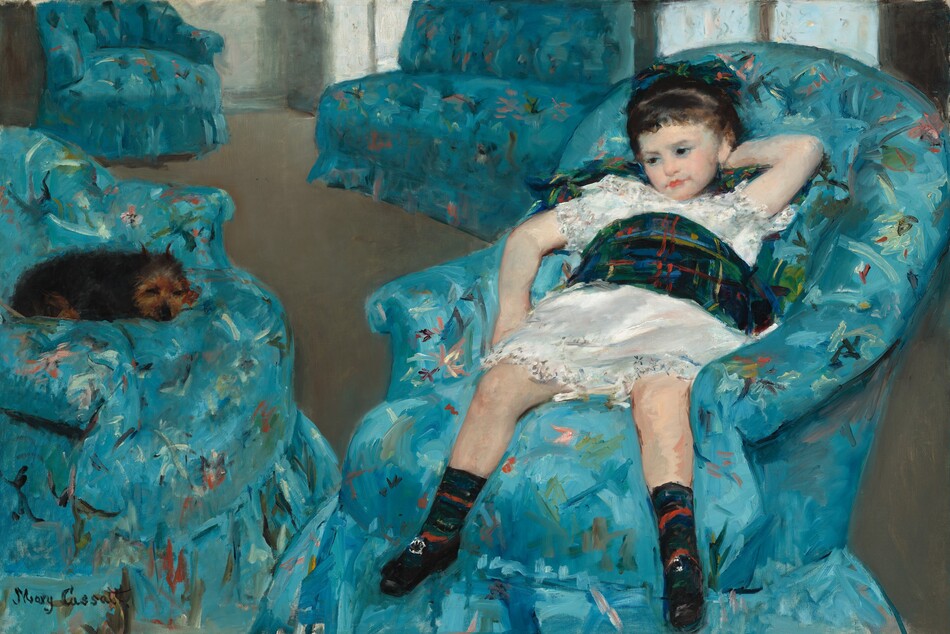
The American artist Mary Cassatt established herself in Paris’s art scene with paintings like Little Girl in a Blue Armchair. She regularly exhibited at the annual Paris Salon beginning in 1868 and was the only American (and one of only four women) in the independent impressionists group. Today, most know Cassatt for her works on canvas.

But Cassatt was also one of the most innovative printmakers of her generation. The messy, time-consuming work of printmaking requires special equipment and skills, which might have seemed daunting to certain 19th-century painters. Not Mary Cassatt. From the creation of her first prints around 1879 in the company of fellow impressionist Edgar Degas, her creativity was sparked. As Cassatt embraced printmaking and mastered its technical challenges, it pushed her in new directions as an artist.

Mastering the medium

Cassatt was a quick learner. About a year after Degas introduced her to the process, she collaborated with him, Camille Pissarro, Félix Bracquemond, and Gustave Caillebotte on a journal of prints, Le Jour et la Nuit (Day and Night). While the project was never completed (due to Degas’s apparent inability to follow through on his ambitious ideas), the experience gave Cassatt a solid foundation in printmaking. Working closely with the other artists, she learned the techniques of softground etching, drypoint, and aquatint.

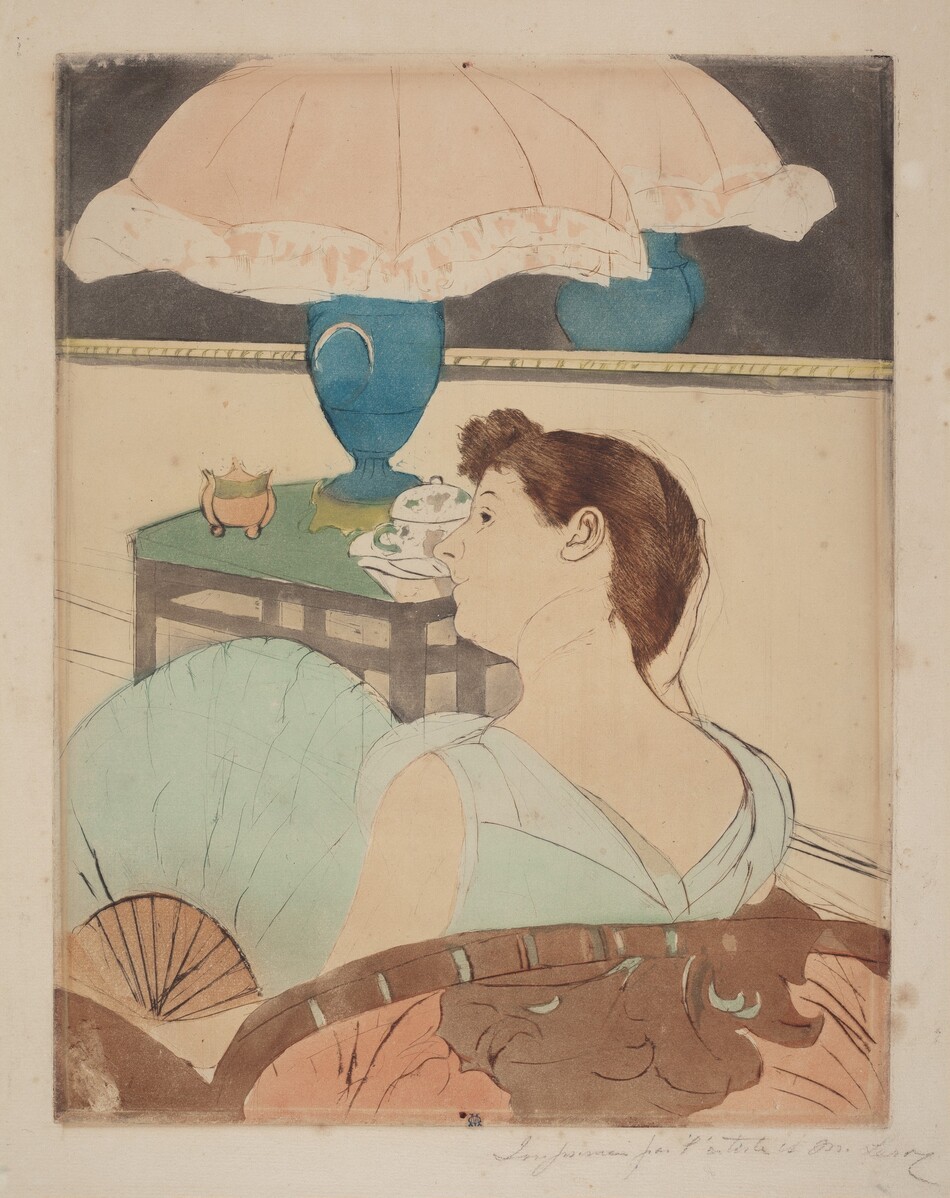
Cassatt threw herself into to the project. For her contribution to the journal she created an image of a woman in an opera box, a theme she had explored in pastels and paintings.

Though Le Jour et la Nuit was never completed, Cassatt did not make her contribution in vain—she, Degas, and Pissarro exhibited prints, including some of the trial-and-error proofs from the unrealized project in the fifth impressionist exhibition in 1880. Cassatt continued to develop her printmaking prowess over the course of the next three decades.

The Set of 10
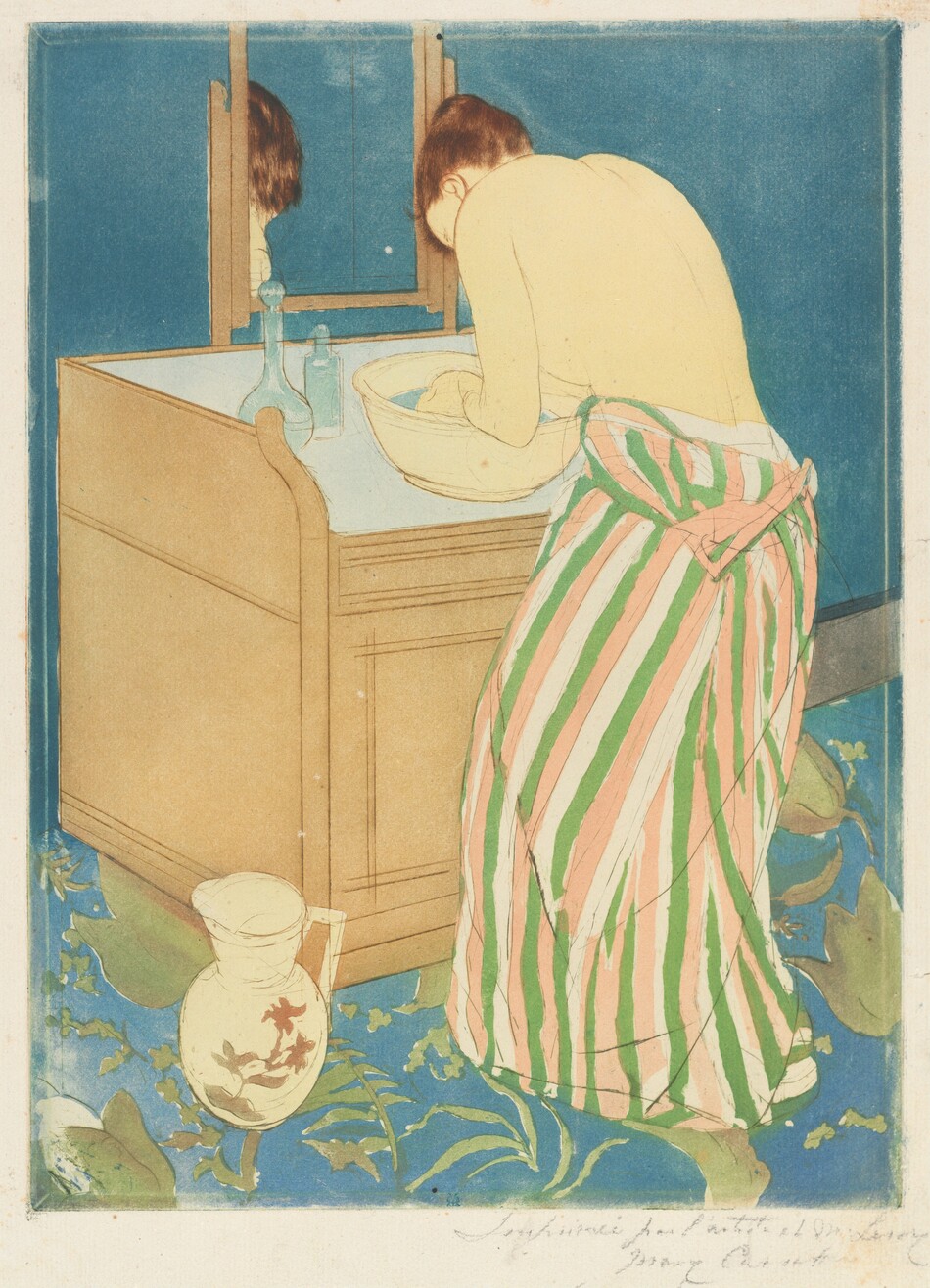
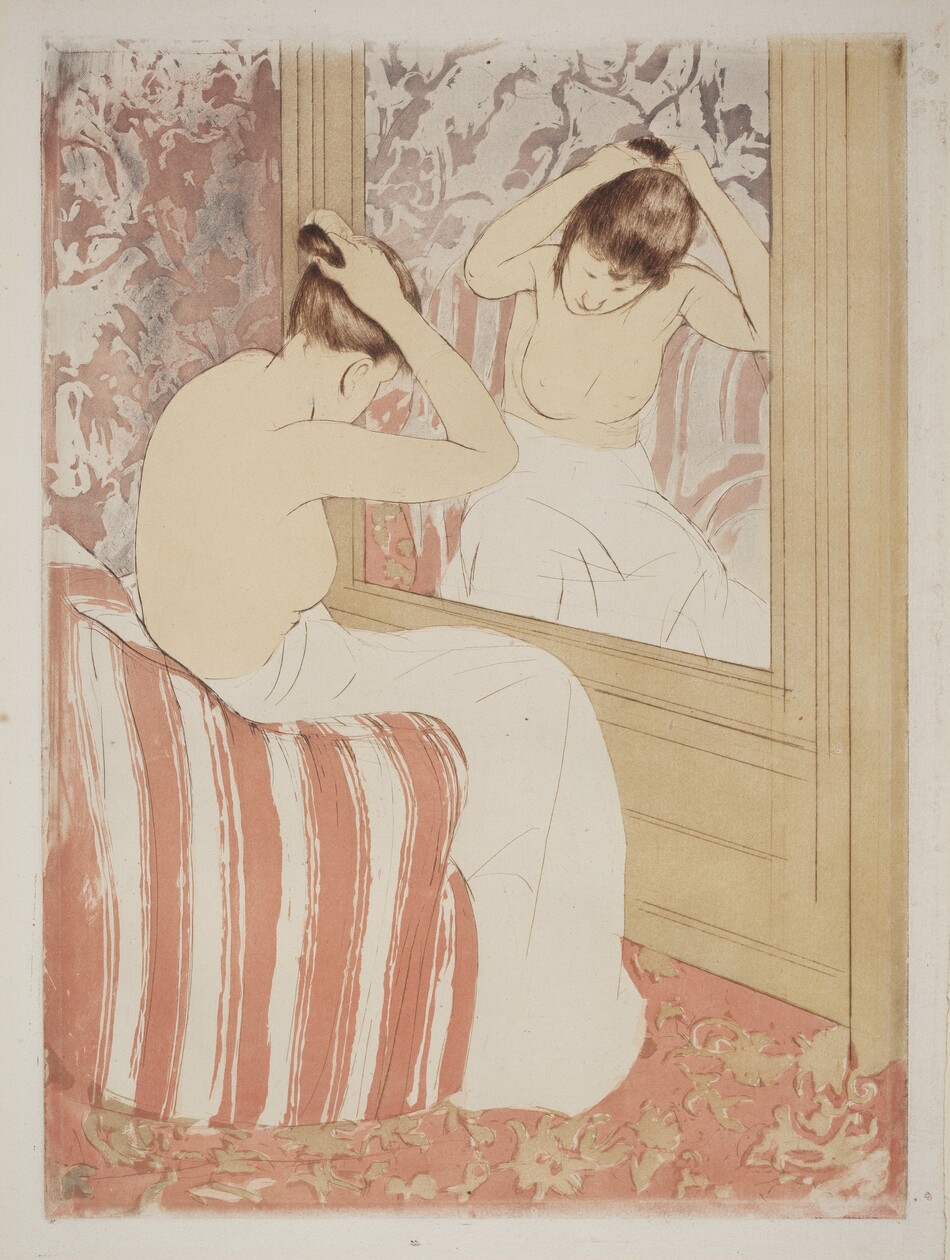
In the spring of 1890, a major exhibition of Japanese woodcuts swept the Parisian art world. Cassatt found it revelatory, writing to fellow artist Berthe Morisot, “I can’t think of anything else but color on copper.” Already a collector of Japanese prints, Cassatt became consumed with adapting their vibrant hues, flat forms, and strong lines into prints of her own work. This spark of inspiration would lead her to create what is now known as her Set of 10.

The ambitious and technically complex group of color prints required Cassatt to stretch her already strong skills. Color printing was a relatively new beast to her. Later, she reflected, “I was entirely ignorant of the method when I began.” She engaged printer Modeste Leroy to realize her vision and help produce the works together in her studio. (Each of the images was printed from two or three plates, inked with different colors, in alignment and sequence.) Her studio became a laboratory as she experimented with combining different techniques, adjusting tones, and revising compositions.

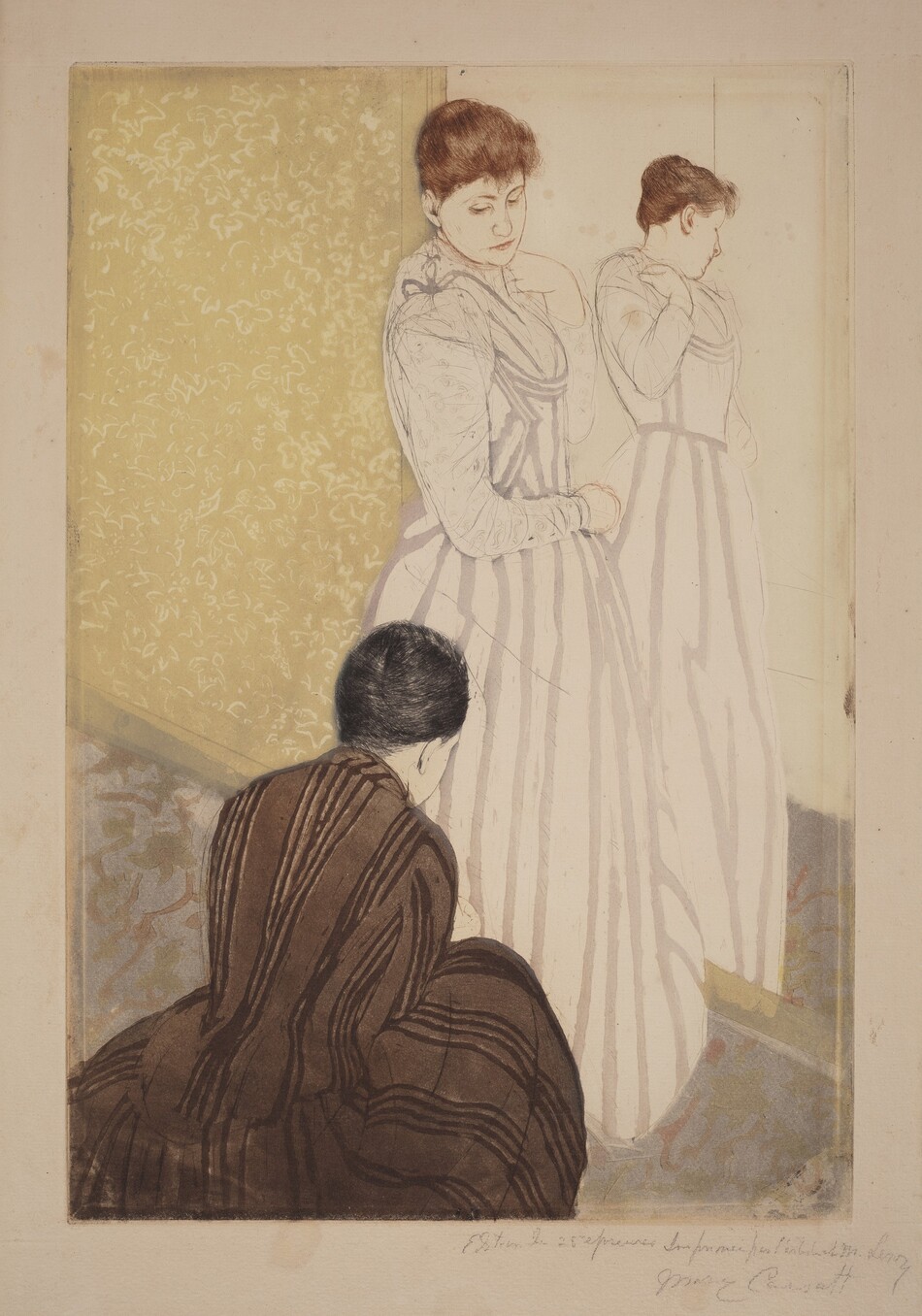
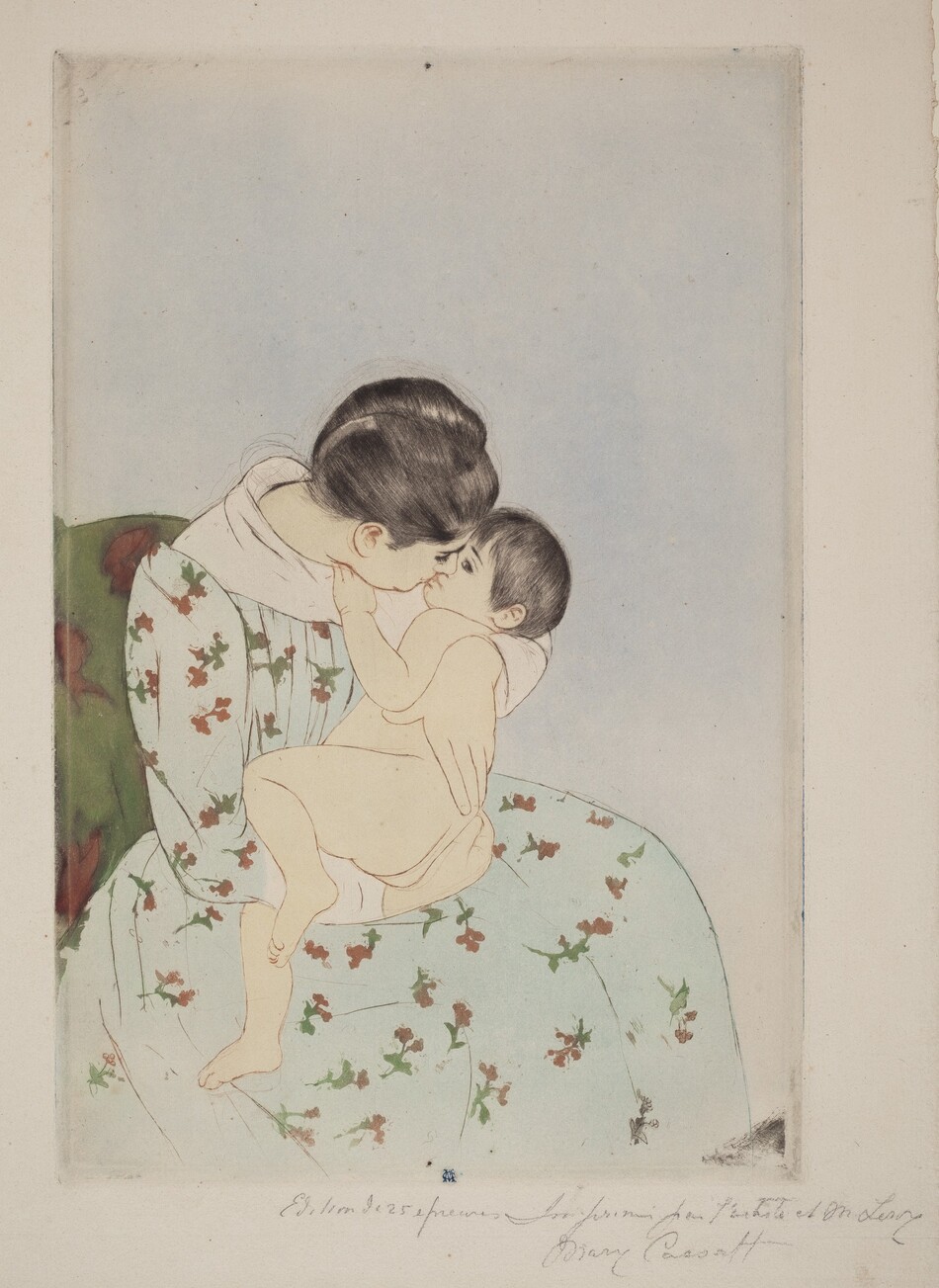
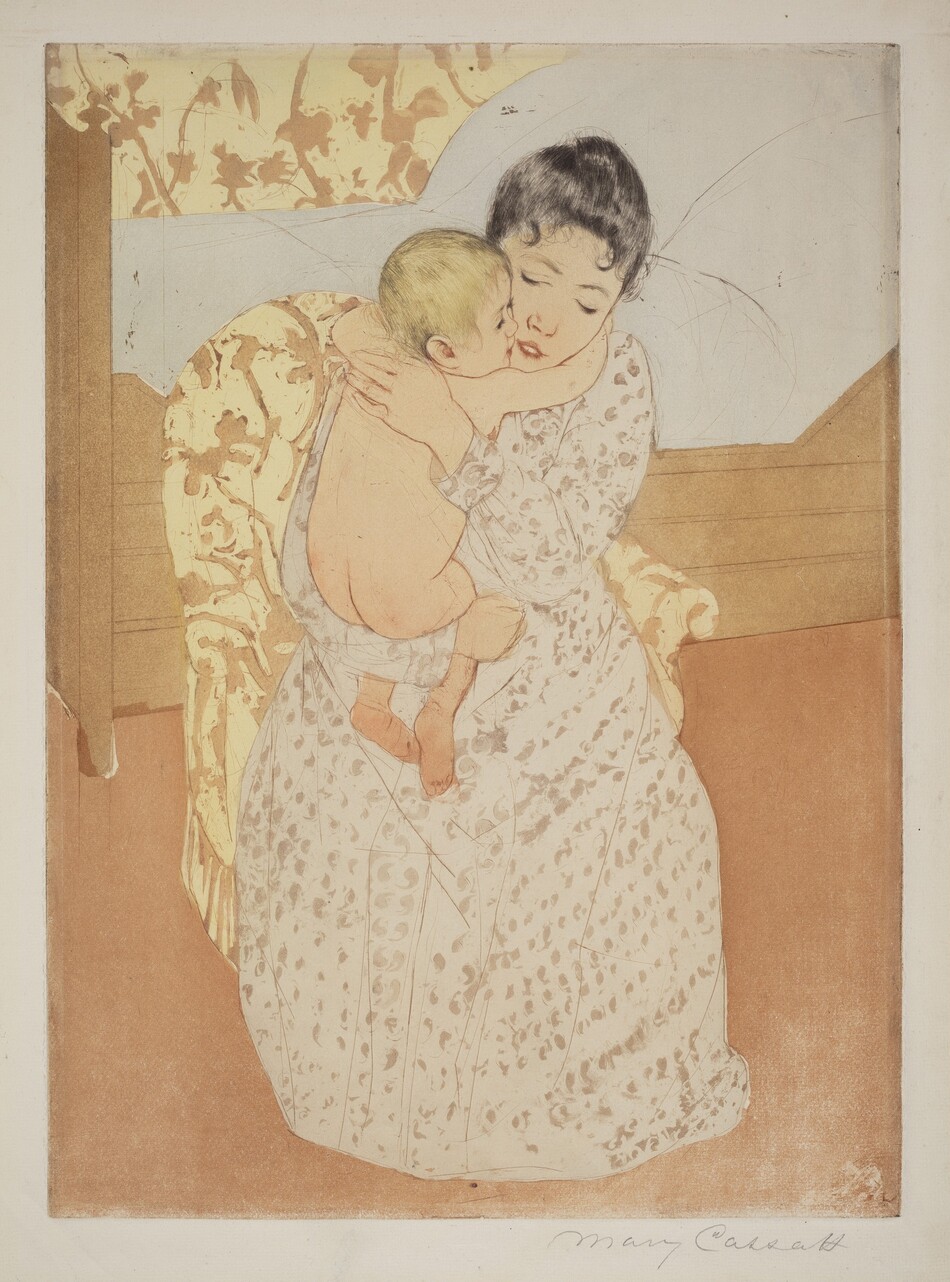
In less than a year, Cassatt created and finalized 10 images, putting in long hours with Leroy to print 25 copies of each one. The group shows women’s private and public lives. Prints like The Coiffure nod to Japanese prints she admired. Others including Mother’s Kiss and Maternal Caress depict the embrace of a mother and child, a theme she was simultaneously exploring in other mediums.
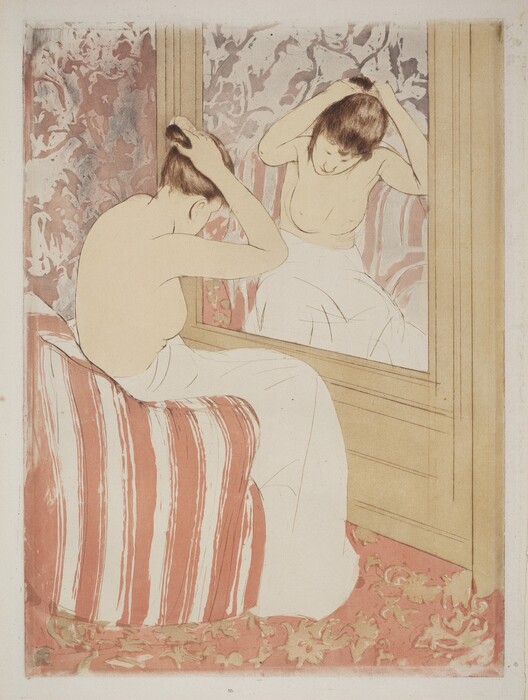
A pale-skinned woman, nude from the waist up, gathers her hair in her raised hands as she sits before a mirror in this vertical, colored print. The large mirror is to our right, and the woman’s body is mostly turned away from us. Her head is bowed but a loose tendril of brown hair hanging beside one cheek is reflected in the mirror. Her lower body is wrapped in a voluminous off-white cloth as she leans forward on a curved terracotta-red and white striped armchair. Her facial features, the contours of her body, and the folds of the towel are all delineated with thin strokes of tawny brown. The mirror is set into a tan wall, and the wall beyond and carpet below her covered with abstract floral patterns. The wall has a dusty-rose motif over an off-white background with washes of light gray while the carpet pattern is tan over a peach background. The wall and chair are reflected in the mirror in paler tones.
Mary Cassatt, The Coiffure, 1890-1891, color drypoint, softground etching, and aquatint on laid paper, Rosenwald Collection, 1943.3.2758

Kitagawa Utamaro I, Takashima Ohisa (Takashima Ohisa), Edo period, about 1795 (Kansei 7), woodblock print (nishiki-e); ink and color on paper, William S. and John T. Spaulding Collection, Museum of Fine Arts, Boston.

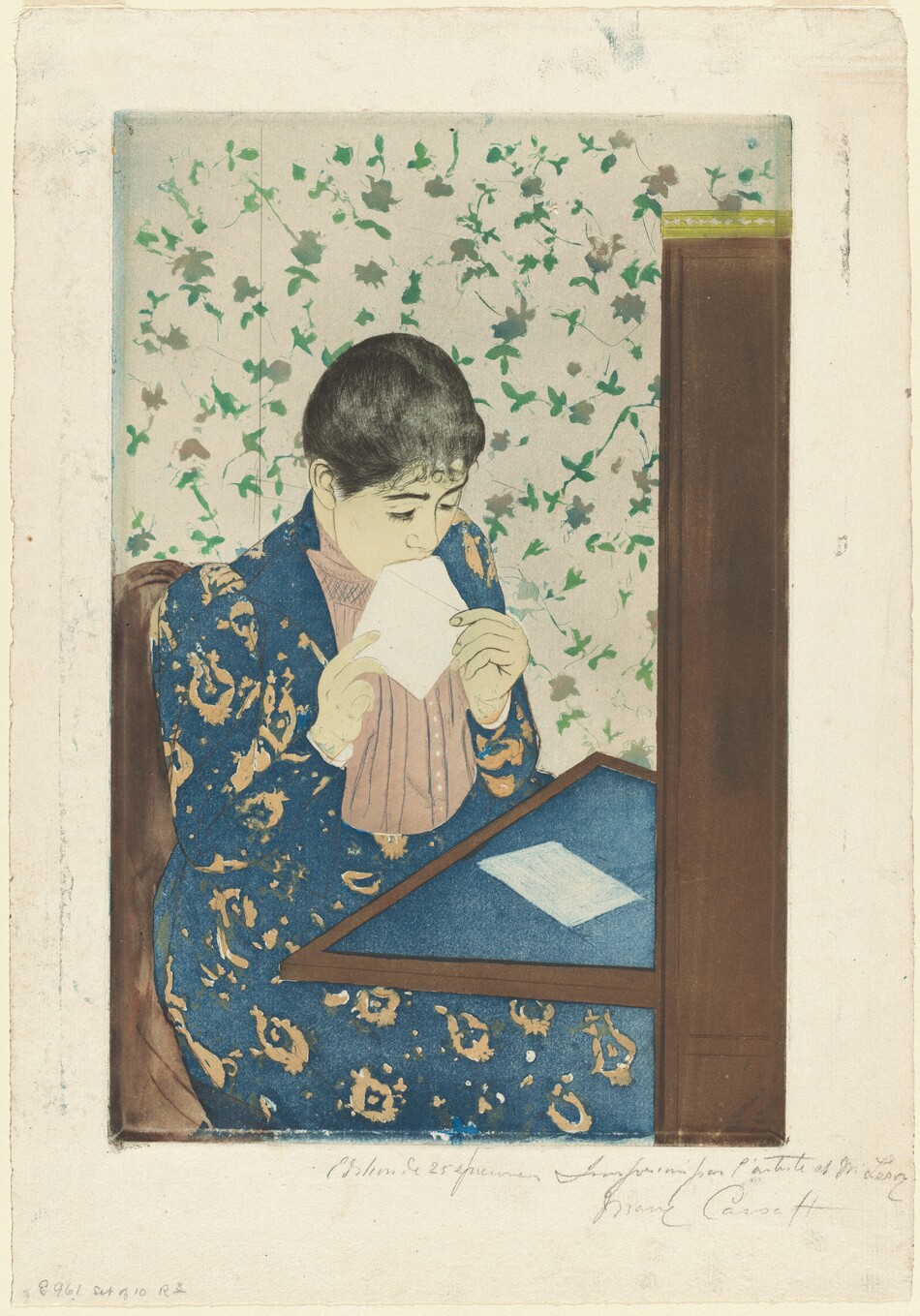
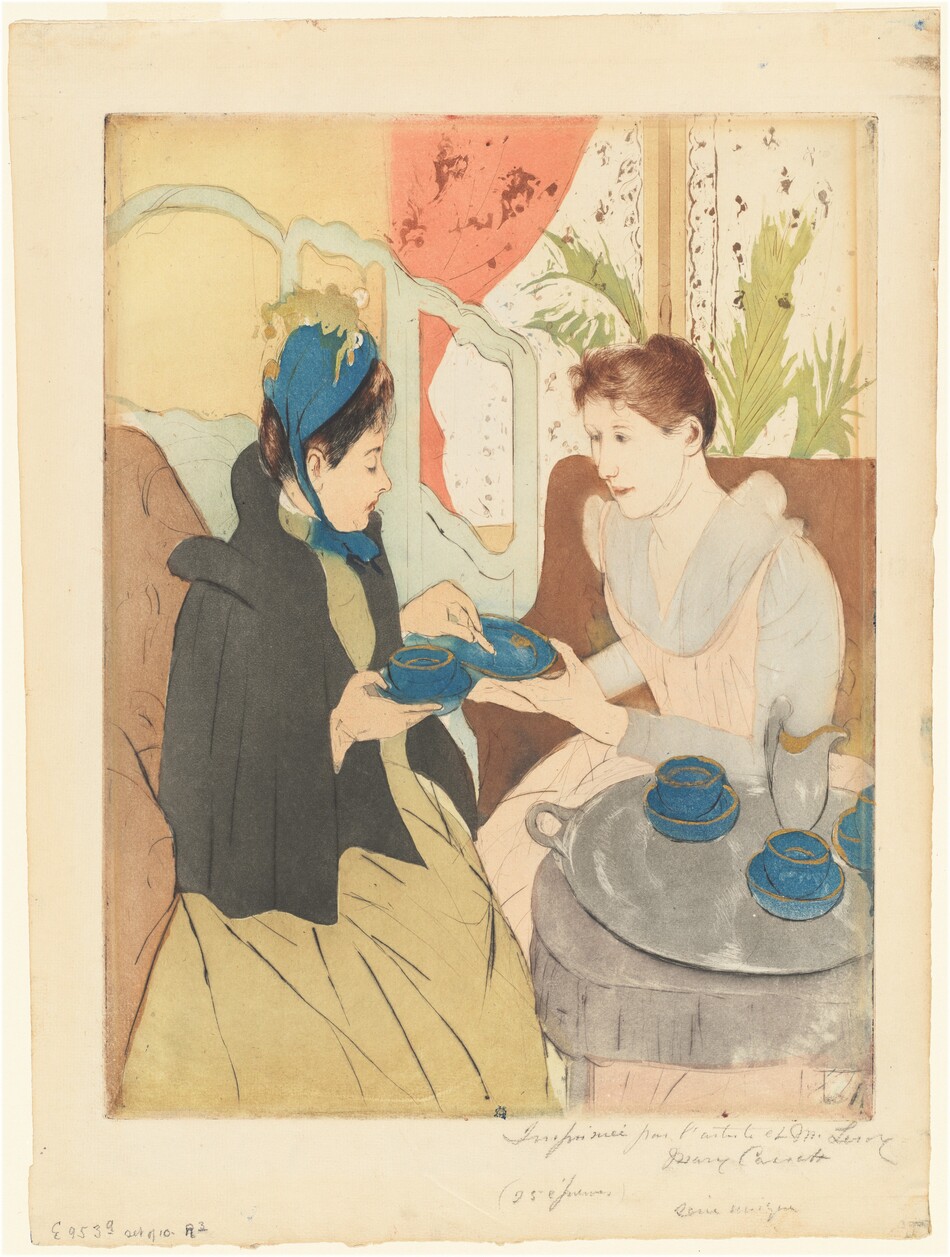
The range of color, tone, and texture in the Set of 10 is astounding. Works like The Letter are rich in overlapping details, printed in a distinctive style that was entirely Cassatt’s own. So how did she make these radical prints?

Cassatt's printmaking process

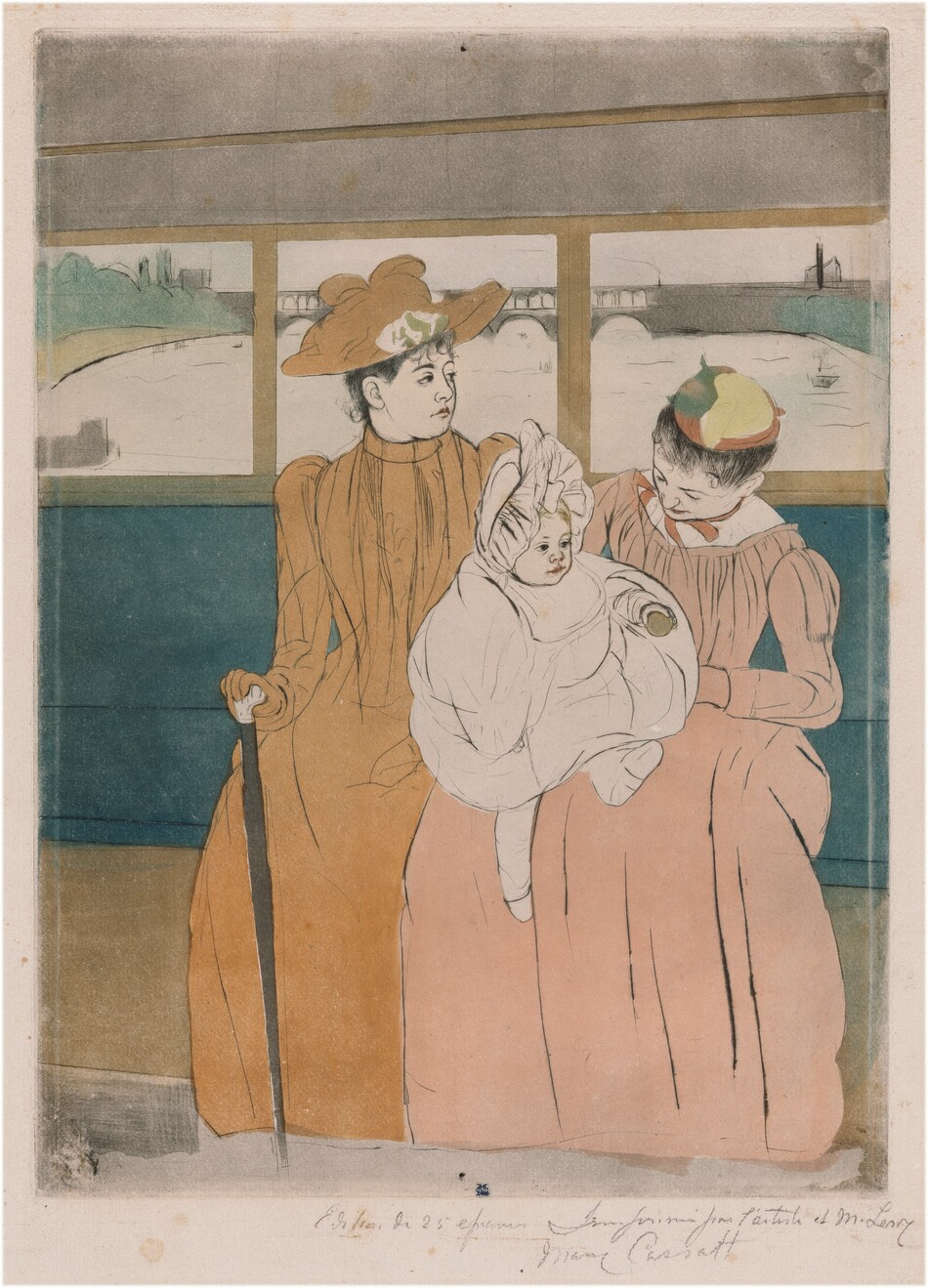
Although Cassatt’s prints often revisited the subjects of her paintings and drawings, In the Omnibus depicts a subject she did not explore in any other medium. Our unique group of six works for In the Omnibus, part of her Set of 10, offers a glimpse of Cassatt’s mind at work. Through them we can track her process from a preparatory drawing to the final color print.

Cassatt started with a chalk-and-graphite drawing, which she wrapped around a copper plate coated with softground. You can see the tabs where the drawing was wrapped along the upper left and lower right edges.
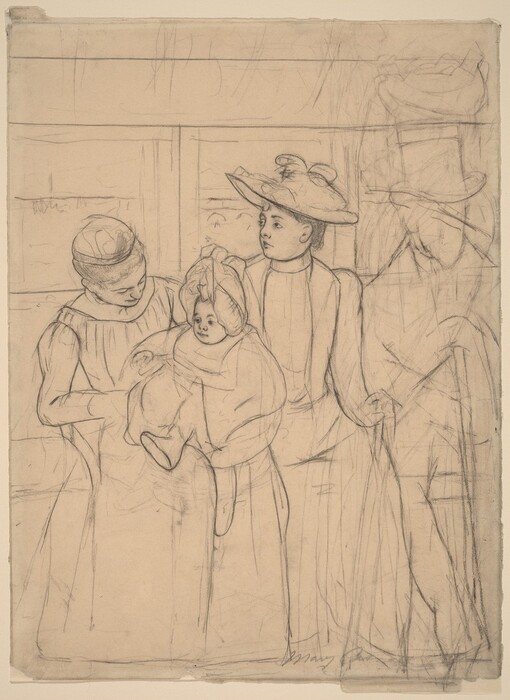
Mary Cassatt, In the Omnibus [recto], 1890-1891, black chalk and graphite on wove paper, Rosenwald Collection, 1948.11.51.a

Then, she traced the outline she wanted to transfer to the plate—the reverse of the drawing (seen below) shows these softground lines. Notice the details she chose to transfer: the two seated women and the baby, along with the horizontal and vertical lines of the omnibus windows. If you look closely at the drawing above, you can see traces of a seated man with a top hat and cane, and a standing woman in profile. Cassatt toyed with the idea of including these passengers, but ultimately decided to simplify the composition and focus on the group of three.

The image features a sketch of three individuals. Two adults and a child are shown in a simple setting. The adult on the left wears a wide-brimmed hat and rests their arm on the backrest. The adult on the right leans towards the child. Both adults wear long dresses. The child is nestled between them. The background is plain with subtle lines indicating a wall and a bench.
Mary Cassatt, In the Omnibus [verso], 1890-1891, transferred softground on wove paper, Rosenwald Collection, 1948.11.51.b

For Cassatt, transferring her preparatory drawing to her first copper plate was only the beginning. The iterative nature of printmaking enabled her to continue revising In the Omnibus, which she ultimately printed from three plates.

The first of the four below proofs show how Cassatt used the drypoint technique. Using a sharp tool, she scratched directly into her plate (and over the guide of the softground etching lines) to define the figures and the omnibus interior. She then used aquatint to add color to the seats, women’s dresses and hats, the ball in the baby’s left hand, and the distant bridge and riverbanks.
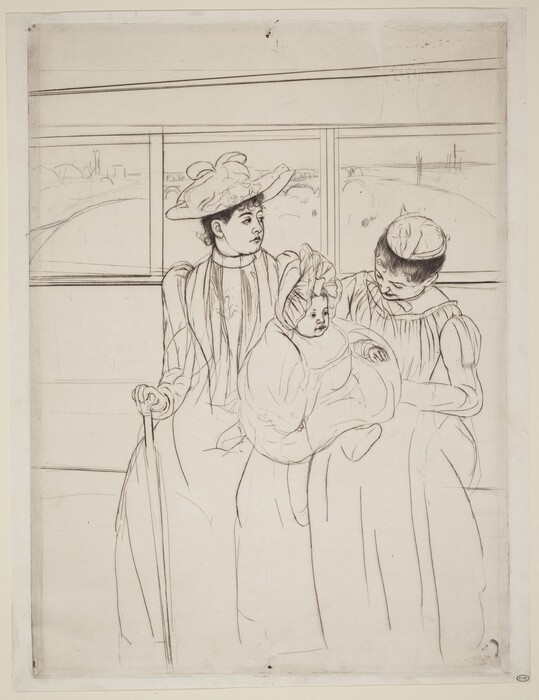
Printed with black lines on cream-white paper, two women, one holding a baby on her lap, sit on the long bench seat of an omnibus in this vertical composition. The women and their full skirts take up almost the width of the composition against the bench, which extends off both sides. The woman to our left wears a high-collared dress, gloves, and hat. She looks off to our right, almost in profile. She has a round face and the hint of a double chin. One gloved hand rests on a cane. The other woman holds the baby and tips her head down toward the child. Both women’s black hair is pulled up under their hats. The baby wears a ruffled bonnet, a blousy garment, stockings, and shoes. A row of windows behind them, parallel to the top of the bench, open onto an arched bridge spanning a river with boats. To our left, the water’s edge is lined with puffy forms reminiscent of trees and bushes.
Mary Cassatt, In the Omnibus, 1890-1891, drypoint with graphite on wove paper, Rosenwald Collection, 1946.21.93
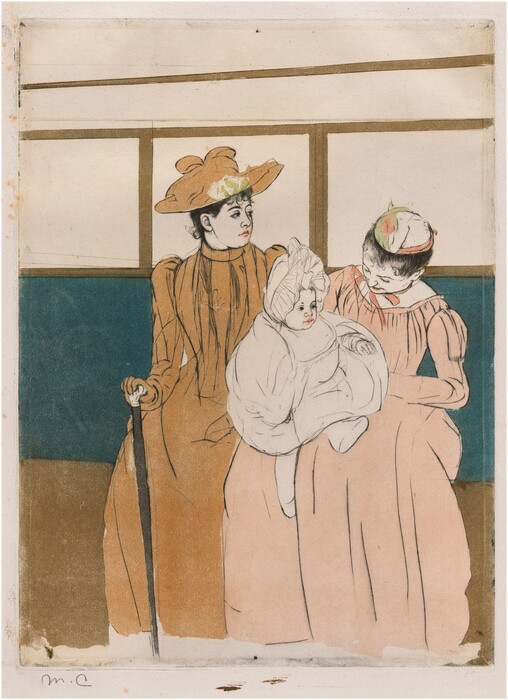
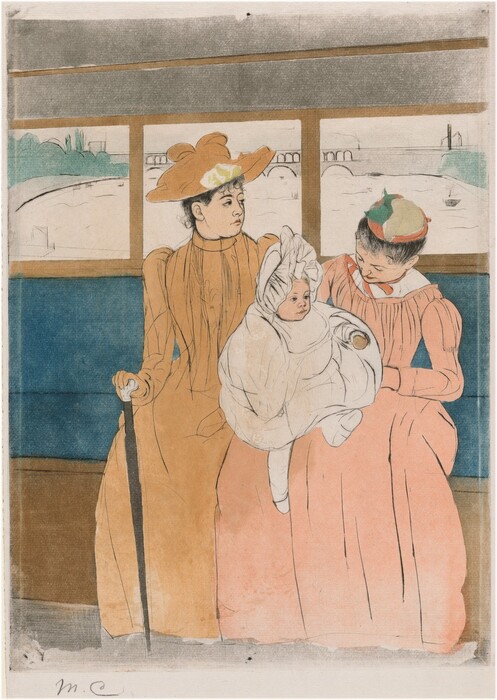
Two women, one holding a baby on her lap, sit on the long bench seat of an omnibus in this vertical, colored print. The women and their full skirts take up almost the width of the composition against the peacock-blue bench, which extends off both sides. The women and baby’s skin are the color of the cream-white paper. The woman to our left wears a tan-colored, high-collared dress, gloves, and hat. She looks off to our right, almost in profile. She has a round face and the hint of a double chin. One gloved hand rests on a cane. The other woman holds the baby and tips her head down toward the child. That second woman wears a tea rose-pink dress and a hat with areas of darker pink, fern green, and white. Both women’s black hair is pulled up under their hats. The baby’s ruffled white bonnet, blousy garment, stockings, and shoes are also the white of the paper, though the lips are picked out with pink. The structure of the women’s bodices, puffy long sleeves, and long skirts as well as the baby’s clothing are outlined in black. A row of windows behind them, parallel to the top of the bench, are blank, also the color of the paper. The panel behind the women’s legs is peanut brown, and the top of the omnibus is white as well. The artist signed the work with her initials in graphite in the bottom left, “MC.”
Mary Cassatt, In the Omnibus, 1890-1891, color drypoint, softground etching, and aquatint on laid paper, Rosenwald Collection, 1943.3.2753

Cassatt explored different colors, testing a palette of peach, coral, and teal.  She tried using flesh tones to print the faces of all three figures, but in the end left the white of the paper with discrete touches of color on their lips instead.
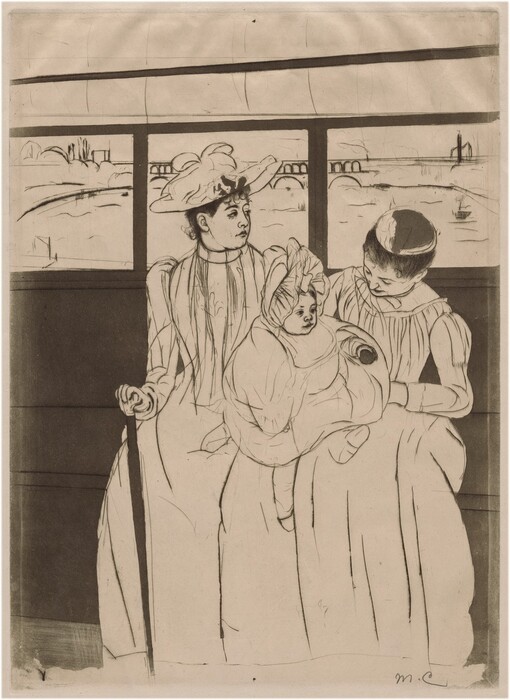
Printed with black lines and areas of dark gray on cream-white paper, two women, one holding a baby on her lap, sit on the long bench seat of an omnibus in this vertical composition. The women and their full skirts take up almost the width of the composition against the gray bench, which extends off both sides. The woman to our left wears a high-collared dress, gloves, and hat. She looks off to our right, almost in profile. She has a round face and the hint of a double chin. One gloved hand rests on a cane. The other woman holds the baby and tips her head down toward the child. Both women’s black hair is pulled up under their hats. The baby wears a white bonnet, a blousy garment, stockings, and shoes, and holds a gray ball in one hand. A row of windows behind them, parallel to the top of the bench, open onto an arched bridge spanning a river with boats. To our left, the water’s edge is lined with puffy forms reminiscent of trees and bushes. The artist signed the work with her initials in graphite in the bottom right, “MC.”
Mary Cassatt, In the Omnibus, 1890-1891, drypoint and aquatint on wove paper, Rosenwald Collection, 1943.3.2752
Two women, one holding a baby on her lap, sit on the long bench seat of an omnibus in this vertical, colored print. The women and their full skirts take up almost the width of the composition against the peacock-blue bench, which extends off both sides. The women and baby’s skin are the color of the cream-white paper. The woman to our left wears a tan-colored, high-collared dress, gloves, and hat. She looks off to our right, almost in profile. She has a round face and the hint of a double chin. One gloved hand rests on a cane. The other woman holds the baby and tips her head down toward the child. That second woman wears a tea rose-pink dress and a hat with areas of darker pink, fern green, and straw yellow. Both women’s black hair is pulled up under their hats. The baby’s ruffled white bonnet, blousy garment, stockings, and shoes are also the white of the paper, though the hair is picked out with yellow, the lips with pink, and the ball held in one hand with brown. The structure of the women’s bodices, puffy long sleeves, and long skirts as well as the baby’s clothing are outlined in black. A row of windows behind them, parallel to the top of the bench, open onto an arched bridge spanning a river with boats. To our left, the water’s edge is lined with spruce green trees. Back inside, the panel behind the women’s legs is peanut brown, and the top of the omnibus is muted mauve purple. The artist signed the work with her initials in graphite in the bottom left, “MC.”
Mary Cassatt, In the Omnibus, 1890-1891, color drypoint, softground etching, and aquatint on laid paper, Rosenwald Collection, 1943.3.2764

Fully satisfied, Cassatt made her final print. She signed the lower right of impressions with both her and Leroy's names to acknowledge his contributions.


Cassatt’s final prints

Cassatt’s grand experiment was a grand success. After an exhibition of the Set of 10 by her dealer Durand-Ruel in Paris in 1891, she received acclaim from both critics and artists. Fellow impressionist and color printmaker Camille Pissarro complimented her ability to tame the unwieldy printmaking process and create prints “as beautiful as Japanese work.”

In subsequent years Cassatt regularly exhibited her prints; an 1893 exhibition, the artist's first retrospective, included 67 prints alone. In the end she made more than 200. Reflecting in 1898 on her remarkable body of work, a critic stated that it would be unwise for any other artists to “dispute the field with her.”
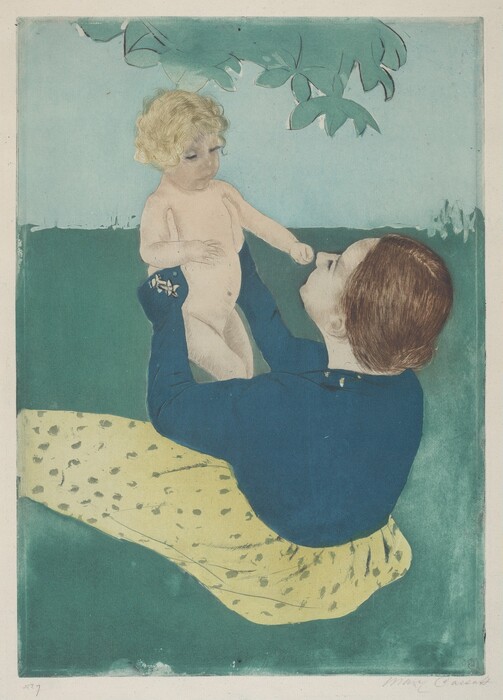
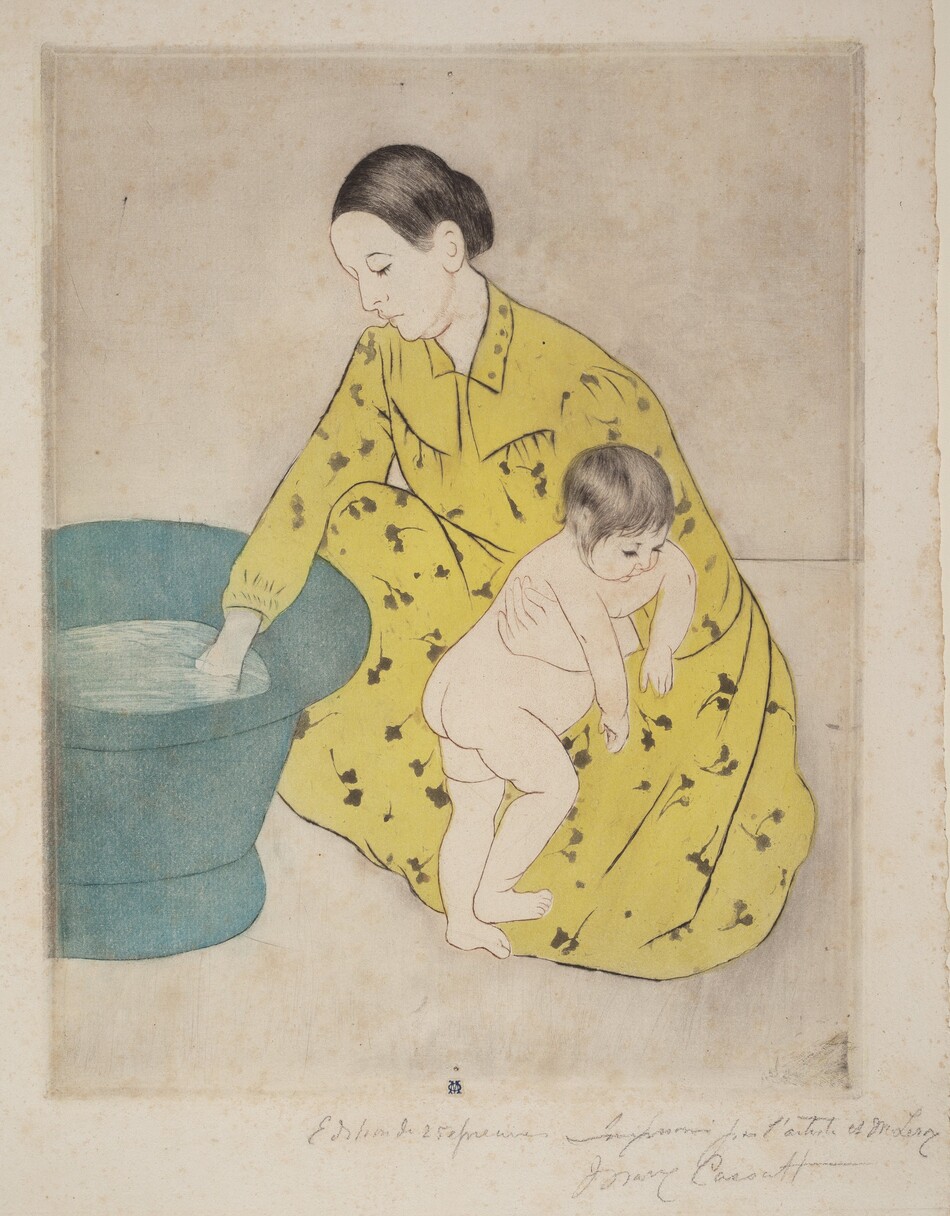
The image shows an adult and a child in an outdoor setting. The adult is seated, while the child is held upright on their lap. They are surrounded by grass and there are leafy branches above them, suggesting they may be under a tree. The adult has long brown hair and is wearing a blue top and a yellow skirt. The child has short, curly, blonde hair and appears nude.
Mary Cassatt, Under the Horse-Chestnut Tree, 1896-1897, color drypoint and aquatint, Gift of Mrs. Jane C. Carey as an addition to the Addie Burr Clark Memorial Collection, 1959.12.4

You may also like

A small brown dog and a pale-skinned little girl wearing a white dress sit in matching celestial-blue armchairs in this horizontal painting. To our right, the girl sits with her legs angled to our left. She slumps back with her legs spread, and her left elbow, on our right, is bent so that hand rests behind her head. Her other elbow is draped over the armrest. Her dark brown hair appears to be pulled back, and tawny brown eyes under faint brows gaze down and to our left. She has a small nose set in a round face and a coral-pink mouth closed in a straight line. Her white dress has touches of gray, soft pink, and powder blue with a wide plaid sash around her waist. The pine-green, black, and sapphire-blue sash is accented with overlapping vertical and horizontal lines of burnt orange, light blue, and mustard yellow. Her socks match her sash and come up to mid-calf, over black shoes with silver buckles. The small dog has scruffy black fur and a russet-brown face. It lies curled in the chair opposite the girl, to our left, with its eyes closed and ears pricked up. The rounded backs of the upholstered chairs curve down to become the low arms. The vivid and light blue fabric of the chairs is scattered with loosely painted strokes of avocado and forest green, peach pink, cherry red, plum purple, and white. Beyond the chairs closest to us is another armchair and an armless loveseat, both covered with the same fabric. They sit at the back of the room, in a corner flooded with silvery light coming through four windows on the right side. The furniture is arranged on a peanut-brown floor. The artist signed in the lower left, “Mary Cassatt.”

Article:  Mary Cassatt Brings Girls and Women into the Museum

Author and art historian Katy Hessel on the impressionist's iconic painting.
Article:  What Is Impressionism? 4 Things to Know

Learn the hallmarks of one of the most recognizable art movements in the world.