

The Most Famous Sculpture of the 19th Century
Hiram Powers’s “The Greek Slave”

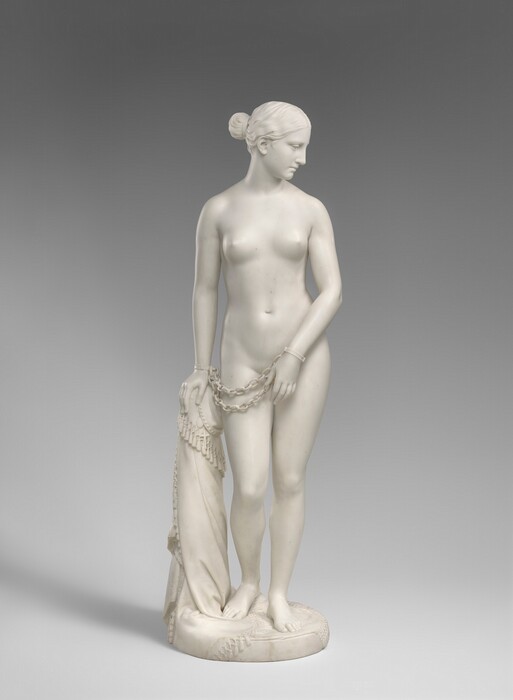
The Greek Slave was the most famous sculpture in the nineteenth-century United States. Created by artist Hiram Powers in the 1840s, it drew huge crowds as it traveled to exhibition venues across Europe and the US. Wherever it went, the work caused a sensation.
Some viewers were scandalized by the figure’s nudity. Shocked audiences in the United States were unaccustomed to seeing a life-sized sculpture of an unclothed woman by an American artist. Certain exhibition venues even required men and women to view it separately.
Others saw it for what it was: a striking, emotionally resonant work of art. In 1847, the New York Daily Tribune reported that audiences visiting the sculpture were “rapt and almost as silent as devotees at a religious ceremony.”
Powers depicts a Greek woman being sold for auction after she was captured by Ottoman soldiers during the Greek War of Independence in the 1820s. But viewers interpreted the work’s meaning in diverse ways. Poets wrote odes to its beauty, and it came to represent both the abolitionist and anti-abolitionist movements.
Ancient Influences
Hiram Powers was a neoclassical sculptor, meaning that he drew on the visual language of ancient Greek and Roman art. While surviving examples of ancient art had long been admired, the recent discovery of sculptures, frescoes, and buildings in archaeological digs in Greece and Italy inspired new enthusiasm and shaped the neoclassical style. Elements of The Greek Slave hint at these ancient inspirations.
Powers took inspiration from the Medici Venus. He probably saw that ancient Greek sculpture for himself at the Uffizi in Florence, Italy. The artist and his family moved to Italy in 1837 and remained there until Powers died in 1873. Powers was living in Florence when he created The Greek Slave.

Medici Venus, late 2nd century BC–early 1st century BC, Parian marble of the lychnite variant (statue); Pentelic marble (base), Le Gallerie degli Uffizi.
Artistic Process
Although Powers was influenced by ancient art, he used a complex technique typical of his day to make The Greek Slave. He probably did not carve the marble himself but instead relied on the skill of Italian stone carvers.

Hiram Powers, Model of the Greek Slave, 1843, plaster and metal pins, Smithsonian American Art Museum
He started by creating a full-scale model in clay. A plaster cast was then produced, using the clay model as a guide. Next, a series of points was added to the dried plaster surface. Carvers used a pointing machine to measure these marks and transfer the model’s dimensions to a block of marble. A long, thin needle attached to rods and joints indicates the measurements.
From 1843 to 1866, Powers and his Italian carvers produced six sculptures of The Greek Slave. The first marble one is at Raby Castle in Staindrop, near York, in England. Art collector William Wilson Corcoran, founder of the Corcoran Gallery of Art in Washington, DC, purchased the second marble in 1851.
The sculpture took the place of an altar when Corcoran’s daughter, Louise, was married in the family’s private art gallery in April 1859. When the Corcoran Gallery of Art closed in 2014, the sculpture entered the National Gallery’s collection. The other four sculptures are in American museums today.
Greek Independence
Powers wrote in a letter that he imagined this female figure as having been captured and taken from her family and home during the Greek War of Independence, which lasted from 1821 to 1829. Greeks revolted against the Ottoman Empire, seeking sovereignty after centuries of Turkish rule.
The artist included details to tell her story.
Viewers in the 19th century recognized these details as signs of her purity, moral character, and Christian virtue during Greece’s struggle for independence. Over the years people appropriated the sculpture as being more than a work of art and connected it to events in the United States.
An Abolitionist Symbol
For many Americans in the 1800s, the sculpture’s subject matter was a reminder of the transatlantic slave trade. When Powers created The Greek Slave in the early 1840s, almost 20 years before the outbreak of the Civil War in April 1861, public outcry against enslavement was already growing.
Those opposed to slavery took up Powers’s work as a symbol of the abolitionist movement. Frederick Douglass, a prominent statesman and reformer, owned a small version made of Parian porcelain that he displayed in his home, Cedar Hill, in Anacostia.
A closer look shows us how it became a symbol of the abolitionist cause.
A later version of the work, carved in 1866, wears manacles rather than chains. This change draws a direct parallel to enslavement in the United States. By the 1850s, Powers had become a dedicated abolitionist. He likely altered this sculpture in his studio in Italy to acknowledge the political climate in his home country.

Hiram S. Powers, The Greek Slave, 1866, marble, Brooklyn Museum, Gift of Charles F. Bound, 55.14. (Photo: Brooklyn Museum)

A detail of the manacles on Hiram S. Powers, The Greek Slave, 1866, marble, Brooklyn Museum, Gift of Charles F. Bound, 55.14. (Photo: Brooklyn Museum)
A Popular Image

Unknown artist, Pitcher, c. 1853, earthenware with Rockingham glaze, Yale University Art Gallery
Illustrations and imitations of the sculpture appeared everywhere, from political cartoons to everyday objects. Soon, the image could be found on tobacco tins, pitchers, and even sheet music. The image was so popular that Powers even issued a patent to prevent unauthorized reproductions.

Artists and poets also made creative works inspired by the sculpture. It was displayed in the American Pavilion at the 1851 Great Exhibition in London, where John Absolon captured it in this lithographic print.
John Absolon, Day & Son, Ltd., Lloyd Brothers & Co., View in the East Nave; The Greek Slave, by Power [sic], from "Recollections of the Great Exhibition, 1851", 1851, hand-colored lithograph with gum, Metropolitan Museum of Art
English poet Elizabeth Barrett Browning thought of The Greek Slave as a prescient political message. She even wrote a sonnet celebrating its power. Her poem highlighted the ability of “Art’s fiery finger” to critique injustice, promote societal change, “and break up ere long / The serfdom of this world.”
Over time, The Greek Slave became more than an emblem of Christian modesty and stoic virtue. For some, it was the model of genteel behavior and the submissive role of women in marriage. For others, it embodied women’s rights and encouraged understanding between genders, races, and religions. Those who opposed the abolitionists considered it a sign of hypocrisy. It could be an object of veneration or a symbol of shame.
The Greek Slave still appeals to universal feelings and invites quiet contemplation. No matter what meaning you derive from it, spending time with this sculpture becomes a way to open your heart and feel compassion for this woman’s plight.
You may also like

Interactive Article: The Feminine Enigma of Cecilia Beaux’s Sita and Sarita
It’s just a picture of a woman and her cat—or is it?

Article: Artistic Visions of Our Nation’s Nature
See how artists interpret our nation’s natural beauty—from a fluttering Baltimore oriole to a towering redwood tree.