


Photographing American Mining and Energy

For nearly two centuries, American photography and the mining of valuable natural resources have been deeply intertwined.
Introduced in 1839, photography premiered less than a decade before successive metal mining booms transformed the landscape and demographics of the American West. Emerging extractive industries hired photographers to promote their operations and attract investors and workers.
Since photography’s inception, artists have used a range of techniques and formats to depict resource extraction like coal mining and oil drilling, which often occurs in remote locations, sometimes underground. Their aims and attitudes range from enthusiastic boosterism to impassioned critique. Together, these photographers’ works unearth and make visible the history of industrial mining and its continued impact on our everyday lives and the American landscape.
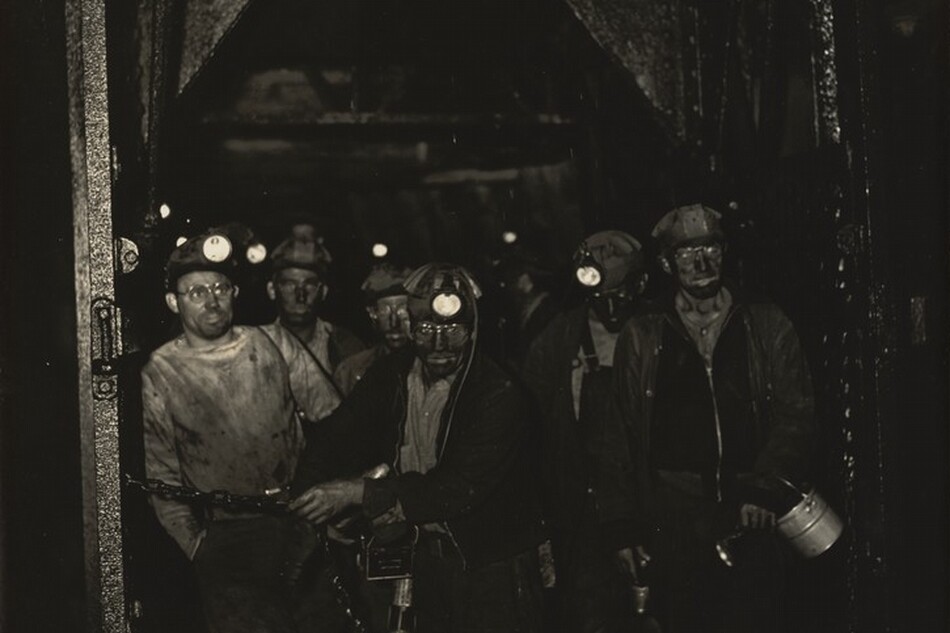
Explore the exhibition : Beneath the Surface: Mining and American Photography
Discover how photography has developed alongside extraction, an activity that has shaped the United States and undergirds modern life.
Daguerreotypes
After the 1848 discovery of gold at Sutter’s Mill in California, hundreds of thousands of aspiring miners flocked to the West Coast. Posed with tools of his trade, this miner was one of many who sat for a daguerreotype to memorialize their quest for precious metals.

Unidentified artist, Portrait of a California gold miner with pick and shovel, c. 1855, daguerreotype with applied color, The Nelson-Atkins Museum of Art, Kansas City, Missouri (Gift of the Hall Family Foundation) 2017.68.279
The mining of silver, copper, and mercury was essential for the creation of daguerreotypes: the process produces a unique image on a highly polished silver-coated copper plate.
Stereographs
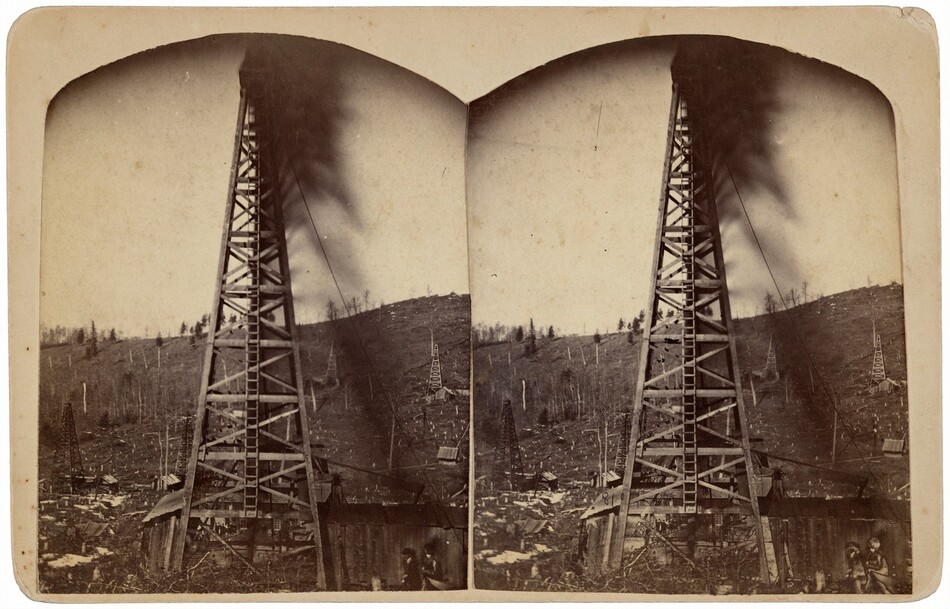
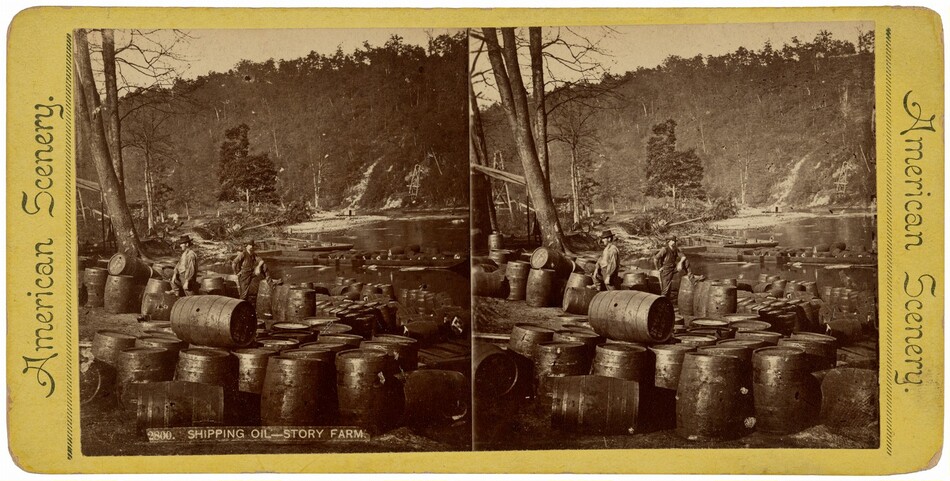
Photographers took advantage of the stereograph to make immersive scenes of resource extraction. A popular photographic format from the mid-1850s to the early 1900s, the stereograph features two pictures of the same subject taken about 2 ½ inches apart, roughly the distance between our eyes. When seen through a stereoscope viewer, the two pictures appear to combine into a three-dimensional image (the equivalent of early 3D glasses).
Photographers were dispatched across the country and American territories to document places of interest. Sites of resource extraction were a particular draw. The discovery and mining of oil, gold, silver, and other materials excited many with the promise of prosperity and beckoned fortune seekers to these burgeoning industries.


Commissions and Surveys
Mining companies, as well as related businesses like railroads, commissioned early photographers to document industrial infrastructure as a way to mark technological advancements and to attract investors.
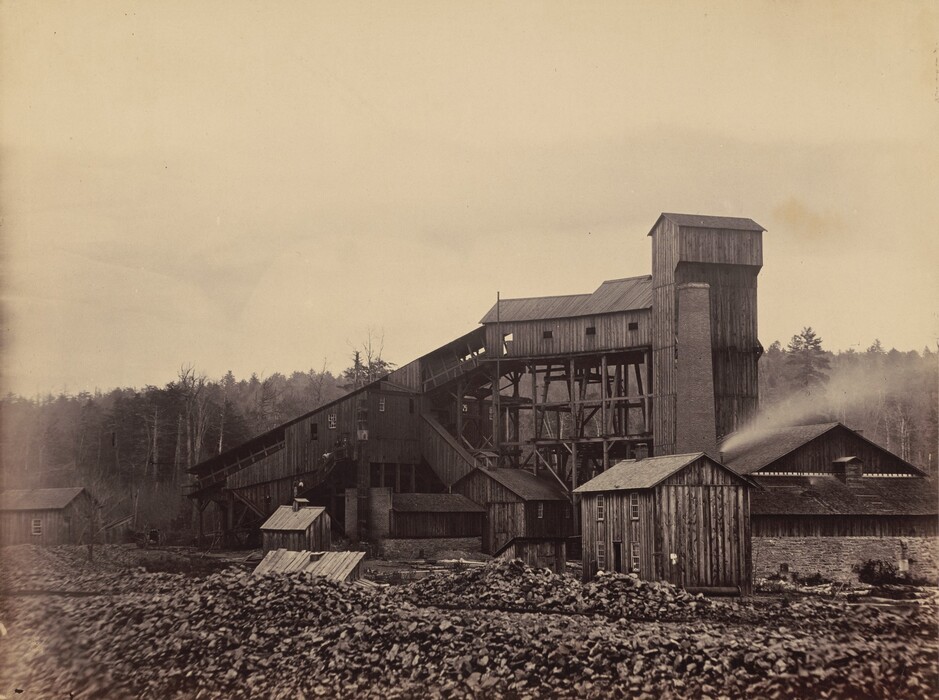
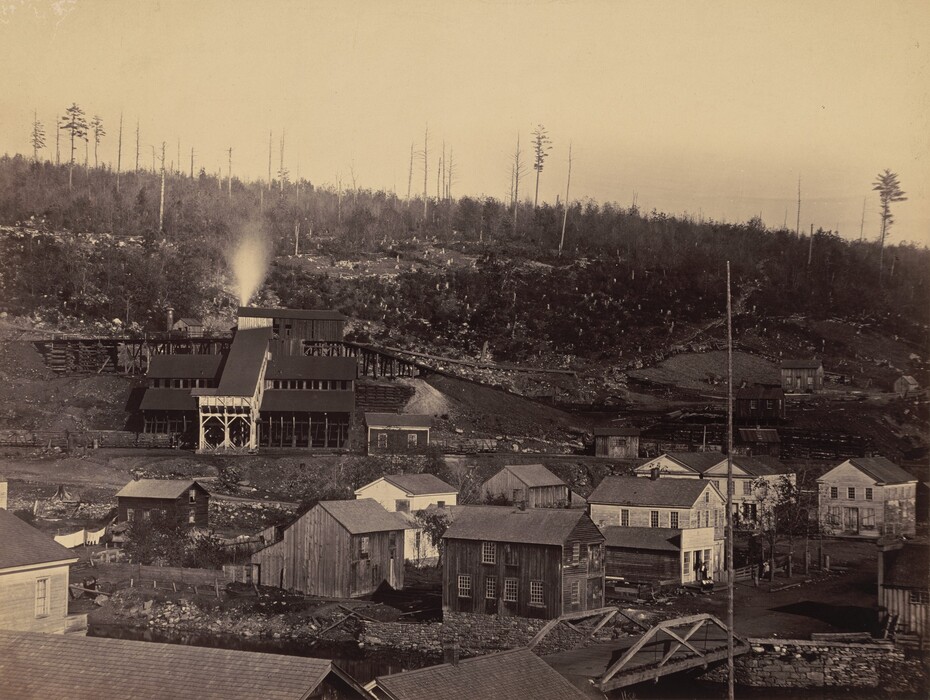
The Delaware and Hudson Railroad and Canal Company hired Thomas H. Johnson to photograph the expansion of their coal mining operations in northeastern Pennsylvania These “breakers” broke coal into fragments and sorted them by size.
Government-sponsored surveys presented other opportunities for nineteenth-century photographers to travel across the country and document mining sites. While on a geological survey in 1868, Timothy O’Sullivan photographed silver mining at the Comstock Lode in Nevada. There, he produced some of the first subterranean photographs.


Panoramas
The enormous scale demanded by resource extraction calls for a grand mode of representation. The panorama, derived from the Greek words for “complete” and “view,” is an ideal format. Its size and breadth can accommodate the vastness of industrial enterprises.

Frank J. Schlueter, Goose Creek, Texas oil field, 1917, gelatin silver print, panorama, Prints & Photographs Division, Library of Congress, Washington D.C.
Frank Schlueter’s 1917 panoramic photograph, taken at Goose Creek, Texas, captures men and horses working alongside huge oil derricks, some so tall they extend beyond the picture frame. In 1901, oil was discovered at Spindletop along the Gulf Coast of Texas, which ushered in the modern petroleum industry and the Texas oil boom. Seeking business as a photographer, Schlueter opened a nearby studio and began accepting commissions for pictures of oil fields.

Lewis deSoto, Carlsbad (Payómkawichum) 07.24.17, 2017, from the series POWER, inkjet print, Amon Carter Museum of American Art, Fort Worth, Texas.
A century later, Indigenous photographer Lewis deSoto (Cahuilla) used the panoramic format to show power generation in California. Here, a picturesque coastline is dotted with palm trees and people enjoying the sunny Southern California day. In the distance rises the Encina Power Station, which permanently closed in 2018. The panorama’s wide vista reveals the looming presence of industry in even the most scenic of places.
The title refers to Carlsbad, the current name of the city where the beach is located, and Payómkawichum, the name Native Americans of the area call themselves. deSoto invokes the Indigenous name to link industrial power generation with the ancestral power imbued in the land.
Modernist Forms
Modernist photographers, with their interest in abstract shapes and daring camera angles, found a fitting subject in the sharp geometric forms of industrial facilities and machinery.

Margaret Bourke-White, Four Thousand Fahrenheit, Otis Steel Co., c. 1927-1928, gelatin silver print, Amon Carter Museum of American Art, Fort Worth, Texas, Purchase with the assistance of the Stieglitz Circle
In the late 1920s, Margaret Bourke-White spent several months photographing inside the Otis Steel Company in Cleveland, Ohio. She called the evenings spent at the factory “a photographic paradise.” Bourke-White’s picture of glowing molten metal celebrates what she deemed the “beauty waiting to be discovered” at the plant.

Gordon Parks, Crude oil, fuel oil, gas oil, range oil and gasoline pipelines leading from the waterfront to the Everett Refinery. Everett, Massachusetts, May 1944, Photography Collection, Miriam and Ira D. Wallach Division of Art, Prints and Photographs, The New York Public Library, Astor, Lenox and Tilden Foundations
In 1944, Gordon Parks joined a group of photographers hired by Standard Oil New Jersey to promote the company’s role in supporting the war effort. In Parks’s dynamic composition, orderly rows of cylindrical pipes converge at the horizon line, carrying oil to the Everett Finery in Massachusetts. Plumes of white steam hover over the refinery, suggesting a constant churn of manpower and machinery.
Aerial Views
Adopting a bird’s-eye view has allowed photographers to record the extent of resource extraction and the way it has marked our landscape. Photographers can also bypass access restrictions to industrial sites by flying overhead with a plane or drone. From the sky, a paradox emerges: although we can see more from a distance, the elevation skews scale and at times heightens the aesthetic appeal of earthbound places.
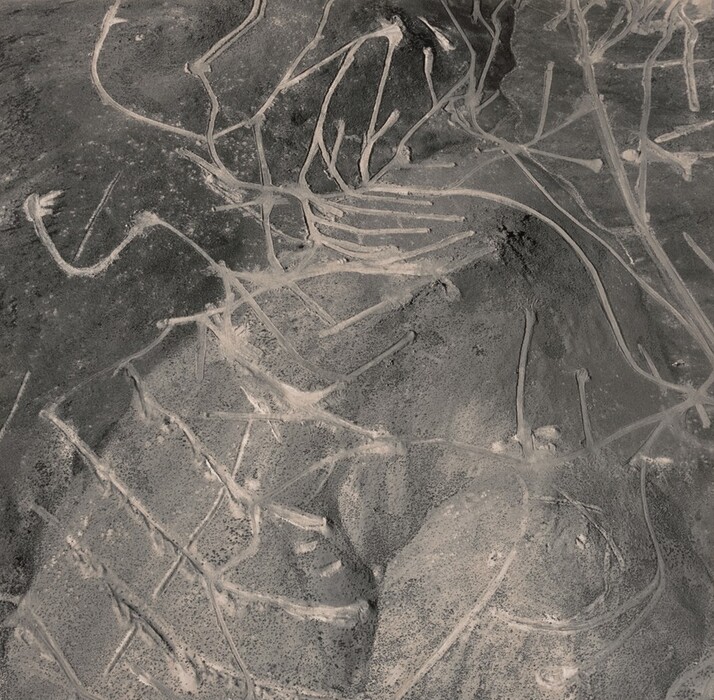
Taken from a helicopter, Emmet Gowin’s picture of a mining exploration near Carson City, Nevada, reveals an elaborate pattern of topographical scars. Gowin acknowledged the distorting effect of viewing industrial sites from the sky, remarking, “From the air it seemed like everything I was seeing was miraculous.”
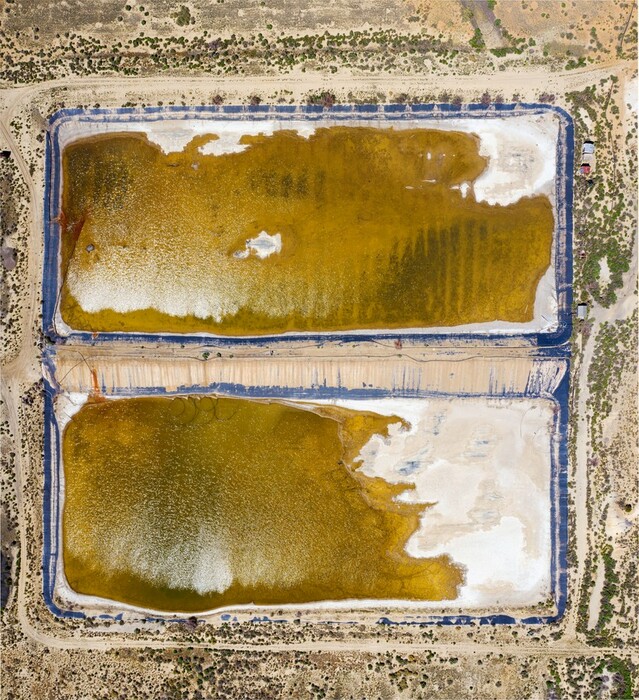
Photographer Will Wilson (Diné) used a drone to capture this aerial view of pearl and copper hued remediation ponds that hold residual waste from uranium mining. Located in northwest New Mexico on the lands of the Navajo Nation, Church Rock Mill is the site of the largest radioactive spill in American history. The radioactive waste poses risks to nearby communities and ecosystems. By surveilling the remediation ponds from above, Wilson calls attention to these hazardous sites.
Portraits
Pictures of laborers in extractive industries spotlight those who power our nation. Sometimes operating in high-risk environments, these workers feed important supply chains. Portrait photographers foreground the humanity of their subjects and individualize the massive workforce supporting our industrial economy.

Richard Avedon, Tom Stroud, oil field worker, Velma, Oklahoma, 6/12/80, gelatin silver print, Courtesy of the Amon Carter Museum of American Art, Fort Worth, Texas, © The Richard Avedon Foundation
From 1979 to 1985, Richard Avedon traveled across 17 American states to photograph working-class Americans for his portrait project In the American West. Coal miners and oil field workers were among his most frequent subjects. Avedon is known for his portraits of celebrities and politicians, but here he elevates each worker to a vaunted status.
Tom Stroud, an oil field worker from Velma, Oklahoma, stands before Avedon’s signature white backdrop and looks directly at the camera. His skin, clothing, and helmet are splotched with mud and oil (Avedon preferred to photograph subjects at the end of their shifts). The portrait’s large size—about five feet tall by four feet wide—gives monumental status to Stroud and his labor.

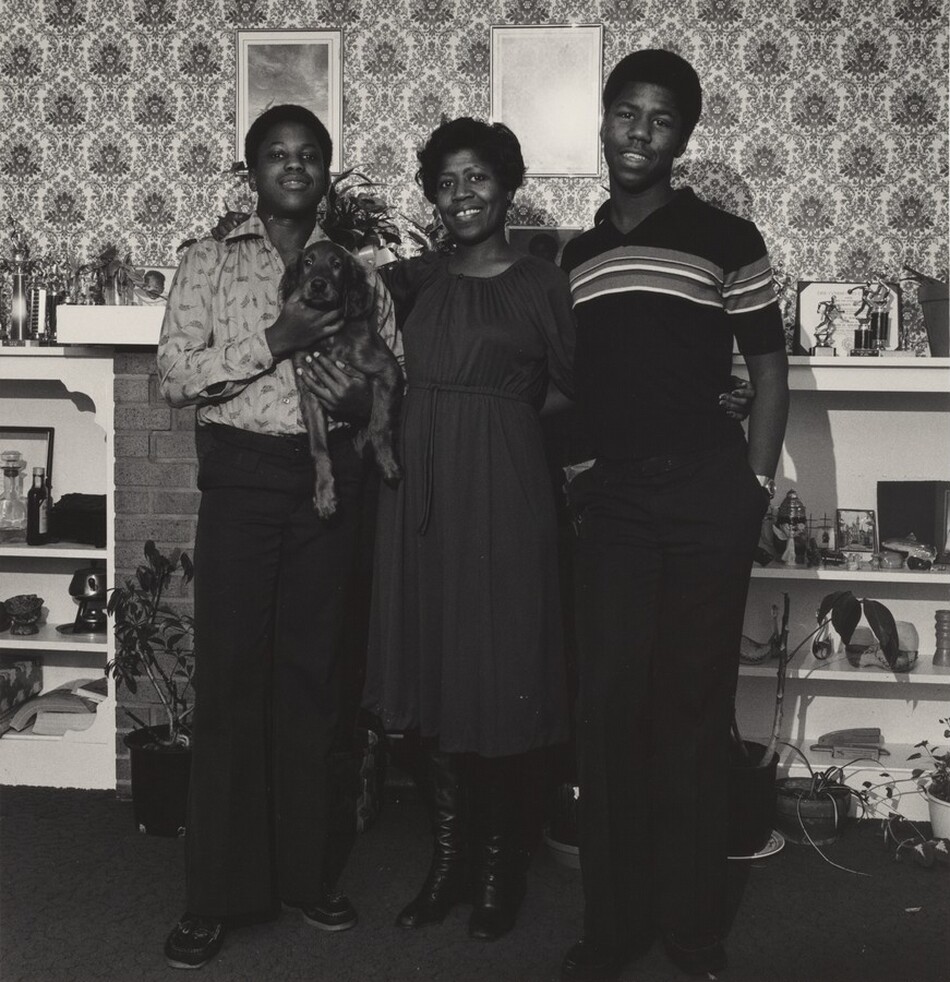
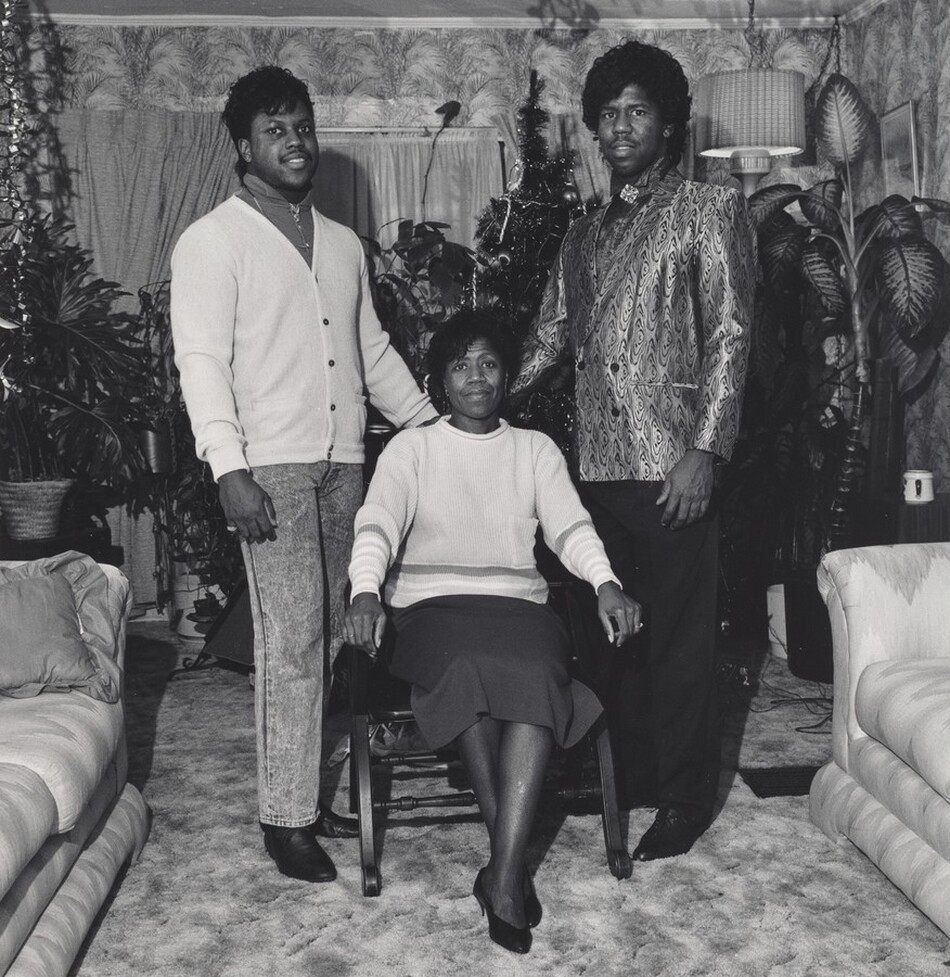
In his series Portraits in Steel, Milton Rogovin chronicled the lives of steel workers near his hometown of Buffalo, New York, as the once-robust industry waned by the 1980s. He photographed them at home and at work over many years to document the broad scope of their lives.
These three portraits of steel worker Doris McKinney, taken between 1978 and 1987, show her working at the Republic Steel mill in Buffalo and relaxing at home with her family. At work, McKinney holds a burning torch and wears the safety gear required at a dangerous workplace. At home, she poses with her sons on either side of her. Rogovin created the family portraits nearly a decade apart; they document how McKinney’s sons have grown and how her life had changed after Republic Steel’s closure in the 1980s, an event that left thousands unemployed.
Large-Scale Color Photographs
At first glance, the tidy yards, pristine garden shed, and welcoming patio furniture form an idyllic suburban scene. But in the distance, massive smokestacks and a cooling tower overtake the hazy gray sky.
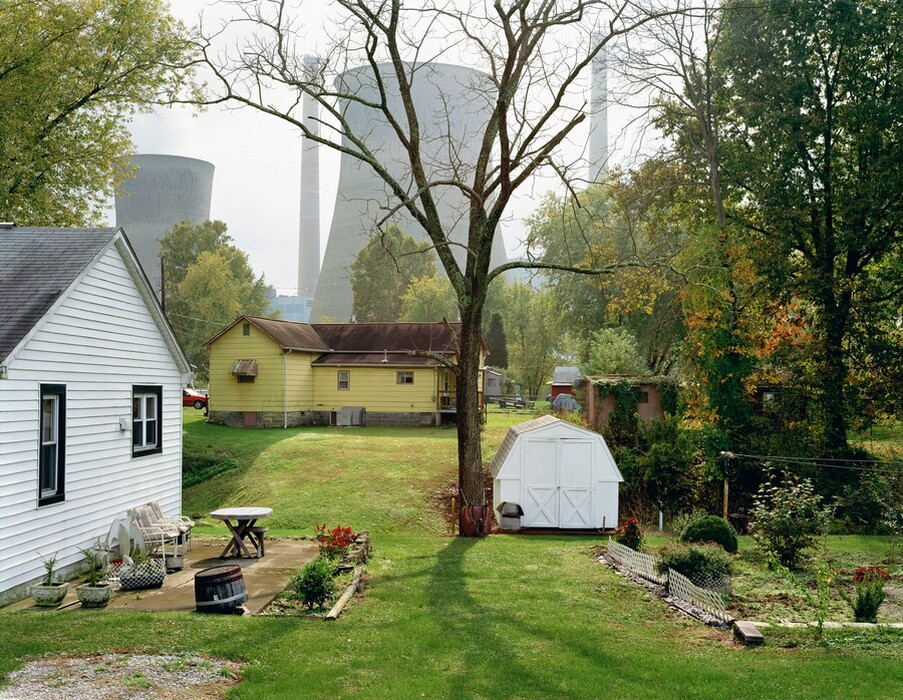
Mitch Epstein’s mammoth picture records the looming presence of the Amos Coal Power Plant in Raymond City, West Virginia. The exceptional size (62 x 80 inches) of Epstein’s composition places us within a serene neighborhood dominated by the coal industry. Its monumental scale confronts us with the immensity of extractive operations and the impact these industries have on the lands and people of the United States.
You may also like

Article: Piliāmoʻo Creates Archives of Erasure and Currents of Return
Photographer duo Mark Hamasaki and Kapulani Landgraf work with communities to tell the stories of what must be protected—and restored—in Oʻahu, Hawaiʻi.

Article: Seven Artists Inspired by Jazz
Learn how some of your favorite artists found inspiration from jazz music and listen to tunes behind their works.